


2 Kings 8:2
Bible text: King James Version (1769 Blayney text) · Public domain
Bible text: King James Version with Strong's numbers · Public domain
Bible text: Berean Standard Bible · Public domain
Bible text: American Standard Version (1901) · Public domain
Bible text: World English Bible, Messianic edition · Public domain
Bible text: Geneva Bible (1599) · Public domain
Bible text: Young's Literal Translation · Public domain
- וַתָּקָםva·Ta·komand she aroseH6965Conj-w ¦ V-Qal-ConsecImperf-3fsVerb Qal Consecutive Imperfect 3rd Singular Feminineוַandתָּקָםshe arose
- הָאִשָּׁהha·'i·Shahthe womanH802Art ¦ N-fsNoun Singular Feminine Absoluteהָtheאִשָּׁהwoman
- וַתַּעַשׂva·Ta·'asand she didH6213Conj-w ¦ V-Qal-ConsecImperf-3fsVerb Qal Consecutive Imperfect 3rd Singular Feminineוַandתַּעַשׂshe did
- כִּדְבַרkid·Varaccording to [the] word ofH1697Prep-k ¦ N-mscNoun Singular Masculine Constructכִּaccording toדְבַר[the] word of
- אִישׁ'ish[the] man ofH376N-mscNoun Singular Masculine Construct
- הָאֱלֹהִיםha·'E·lo·Him<the> GodH430Art ¦ N-mpNoun Plural Masculine Absoluteהָ<the>אֱלֹהִיםGod
- וַתֵּלֶךְva·Te·lekhand she wentH1980Conj-w ¦ V-Qal-ConsecImperf-3fsVerb Qal Consecutive Imperfect 3rd Singular Feminineוַandתֵּלֶךְshe went
- הִיאhi'sheH1931Pro-3fsPronoun Personal 3rd Singular Feminine
- וּבֵיתָהּu·vei·Tahand her householdH1004Conj-w ¦ N-msc ¦ 3fsNoun Singular Masculine Constructוּandבֵיתָhouseholdהּher
- וַתָּגָרva·Ta·gorand she sojournedH1481Conj-w ¦ V-Qal-ConsecImperf-3fsVerb Qal Consecutive Imperfect 3rd Singular Feminineוַandתָּגָרshe sojourned
- בְּאֶרֶץbe·'e·retzin [the] land ofH776Prep-b ¦ N-fscNoun Singular Feminine Constructבְּinאֶרֶץ[the] land of
- פְּלִשְׁתִּיםpe·lish·Tim[the] PhilistinesH6430N-mpNoun Gentilic Plural Masculine Absolute
- שֶׁבַעShe·va'sevenH7651N-csNoun Singular common gender Absolute
- שָׁנִיםsha·NimyearsH8141N-mpNoun Plural Masculine Absolute
English is a literal word-by-word gloss of the Hebrew, not the KJV's wording. Why?
This is the original text the KJV's translators worked from — each Hebrew word with its own literal English meaning in this verse, prepared by scholars at Tyndale House, Cambridge. The KJV translates whole sentences, not word by word, so its wording differs: one Hebrew word can become several English words, and the KJV may choose “the LORD” where the gloss reads “Yahweh”. Both are faithful — they answer different questions. For the KJV's own rendering, switch to the KJV text.
Details
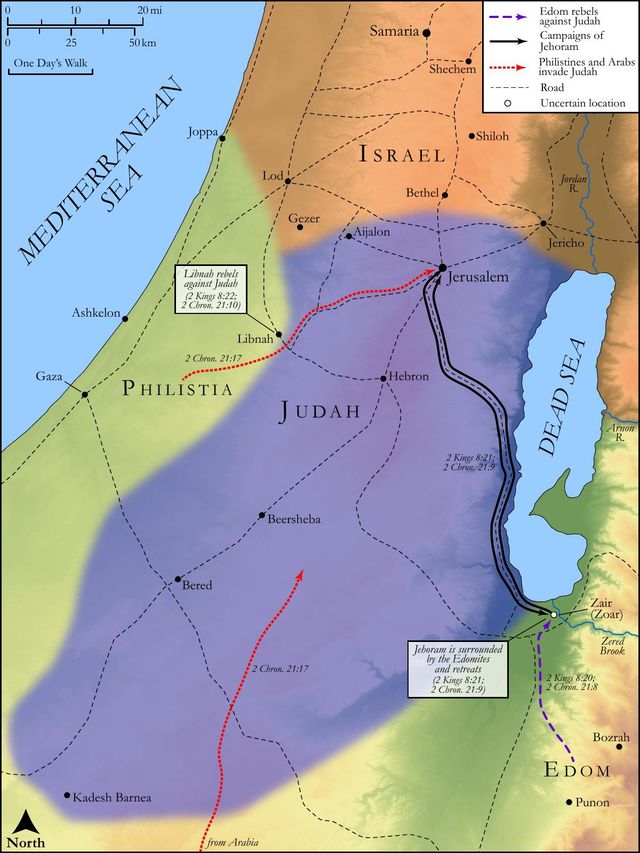
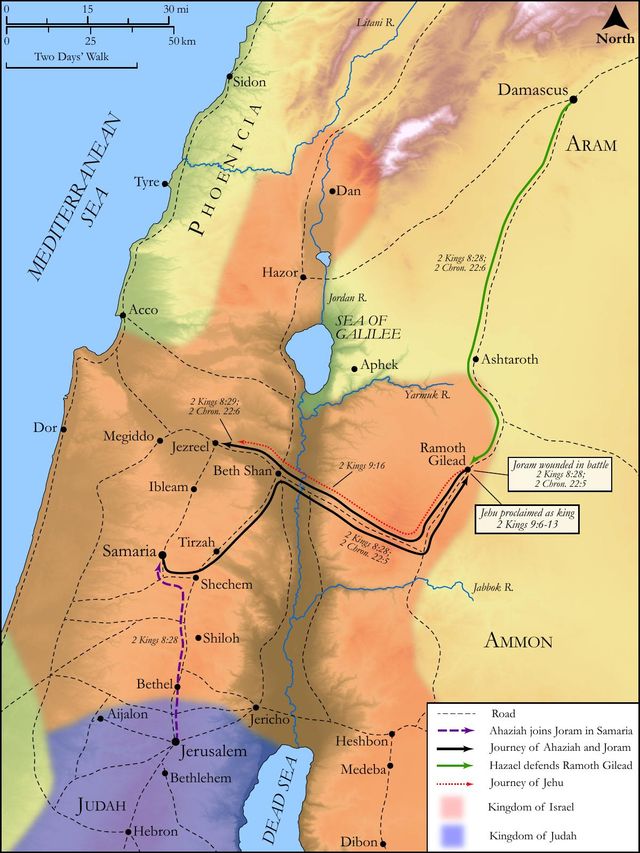
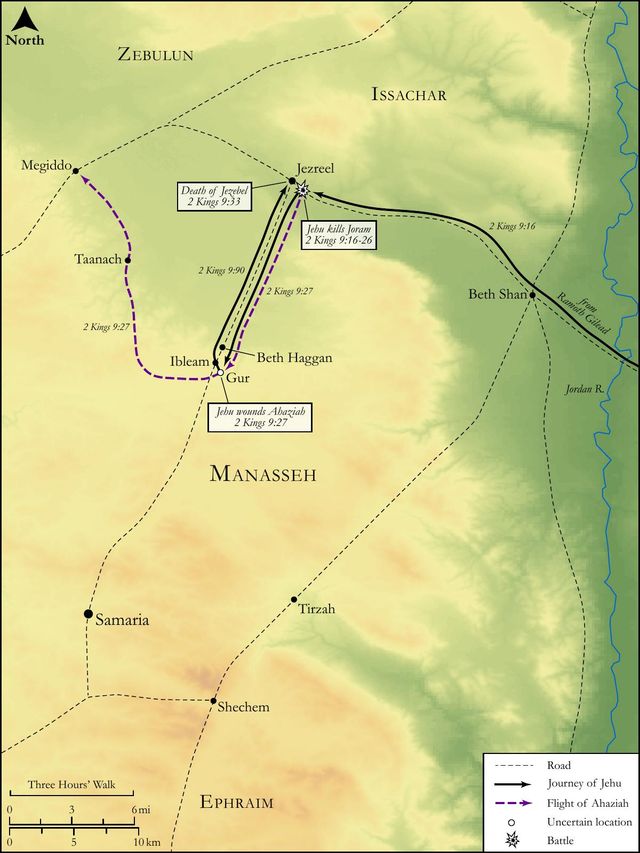
See on the biblical-era maps
Study this verse
Public-domain commentary
Matthew Henry
From his Commentary on the Whole Bible. Henry comments on passages, not single verses — this entry covers 2 Kings 8:1–6. His three-level outline is real structure in the source text, so it is rendered as structure.
Here we have,
I.The wickedness of Israel punished with a long famine, one of God's sore judgments often threatened in the law.
Canaan, that fruitful land, was turned into barrenness, for the iniquity of those that dwelt therein. The famine in Samaria was soon relieved by the raising of that siege, but neither that judgment nor that mercy had a due influence upon them, and therefore the Lord called for another famine; for when he judgeth he will overcome. If less judgments do not prevail to bring men to repentance, he will send greater and longer; they are at his beck, and will come when he calls for them. He does, by his ministers, call for reformation and obedience, and, if those calls be not regarded, we may expect he will call for some plague or other, for he will be heard. This famine continued seven years, as long again as that in Elijah's time; for if men will walk contrary to him, he will heat the furnace yet hotter.
II.The kindness of the good Shunammite to the prophet rewarded by the care that was taken of her in that famine; she was not indeed fed by miracle, as the widow of Sarepta was, but,
1.She had notice given her of this famine before it came, that she might provide accordingly, and was directed to remove to some other country; any where but in Israel she would find plenty. It was a great advantage to Egypt in Joseph's time that they had notice of the famine before it came, so it was to this Shunammite; others would be forced to remove at last, after they had long borne the grievances of the famine, and had wasted their substance, and could not settle elsewhere upon such good terms as she might that went early, before the crowd, and took her stock with her unbroken. It is our happiness to foresee an evil, and our wisdom, when we foresee an evil, and our wisdom, when we foresee it, to hide ourselves.
2.Providence gave her a comfortable settlement in the land of the Philistines, who, though subdued by David, yet were not wholly rooted out. It seems the famine was peculiar to the land of Israel, and other countries that joined close to them had plenty at the same time, which plainly showed the immediate hand of God in it (as in the plagues of Egypt, when they distinguished between the Israelites and the Egyptians) and that the sins of Israel, against whom this judgment was directly levelled, were more provoking to God than the sins of their neighbours, because of their profession of relation to God. You only have I known, therefore will I punish you, Amo 3:2. Other countries had rain when they had none, were free from locusts and caterpillars when they were eaten up with them; for some think this was the famine spoken of, Joe 1:3, Joe 1:4. It is strange that when there was plenty in the neighbouring countries there were not those that made it their business to import corn into the land of Israel, which might have prevented the inhabitants from removing; but, as they were befooled with their idolatries, so they were infatuated even in the matters of their civil interest.
III.Her petition to the king at her return, favoured by the seasonableness of her application to him.
1.When the famine was over she returned out of the land of the Philistines; that was no proper place for an Israelite to dwell any longer than there was a necessity for so doing, for there she could not keep her new moons and her sabbaths as she used to do in her own country, among the schools of the prophets, Kg2 4:23.
2.At her return she found herself kept out of the possession of her own estate, it being either confiscated to the exchequer, seized by the lord, or usurped in her absence by some of the neighbours; or perhaps the person she had entrusted with the management of it proved false, and would neither resign it to her nor come to an account with her for the profits: so hard is it to find a person that one can put a confidence in in a time of trouble, Pro 25:19; Mic 7:5.
3.She made her application to the king himself for redress; for, it seems (be it observed to his praise), he was easy of access, and did himself take cognizance of the complaint of his injured subjects. Time was when she dwelt so securely among her own people that she had no occasion to be spoken for to the king, or to the captain of the host (Kg2 4:13); but now her own familiar friends, in whom she trusted, proved so unjust and unkind that she was glad to appeal to the king against them. Such uncertainty there is in the creature that that may fail us which we most depend upon and that befriend us which we think we shall never need.
4.She found the king talking with Gehazi about Elisha's miracles, Kg2 8:4. It was his shame that he needed now to be informed concerning them, when he might have acquainted himself with them as they were done from Elisha himself, if he had not been wiling to shut his eyes against the convincing evidence of his mission; yet it was his praise that he was now better disposed, and would rather talk with a leper that was capable of giving a good account of them than continue ignorant of them. The law did not forbid all conversation with lepers, but only dwelling with them. There being then no priests in Israel, perhaps the king, or some one appointed by him, had the inspection of lepers, and passed the judgment upon them, which might bring him acquainted with Behazi.
5.This happy coincidence befriended both Behazi's narrative and her petition. Providence is to be acknowledged in ordering the circumstances of events, for sometimes those that are minute in themselves prove of great consequence, as this did, for,
(1.)It made the king ready to believe Gehazi's narrative when it was thus confirmed by the persons most nearly concerned: "This is the woman, and this her son; let them speak for themselves," Kg2 8:5. Thus did God even force him to believe what he might have had some colour to question if he had only had Gehazi's word for it, because he was branded for a liar, witness his leprosy.
(2.)It made him ready to grant her request; for who would not be ready to favour one whom heaven had thus favoured, and to support a life which was given once and again by miracle? In consideration of this the king gave orders that her land should be restored to her and all the profits that were made of it in her absence. If it was to himself that the land and profits had escheated, it was generous and kind to make so full a restitution; he would not (as Pharaoh did in Joseph's time) enrich the crown by the calamities of his subjects. If it was by some other person that her property was invaded, it was an act of justice in the king, and part of the duty of his place, to give her redress, Psa 82:3, Psa 82:4; Pro 31:9. It is not enough for those in authority that they do no wrong themselves, but they must support the right of those that are wronged.
Historical interpretation
Historical reception
1 surviving comment on this verse from the historical church.
“Now Elisha had said to the woman whose son he had restored to life, ‘Get up and go with your household.’ ” This is the Shunammite woman who had received Elisha in her home. And [the prophet] had taken care of her son too, who had died, by reviving him. Elisha predicted to her that a seven-year famine would occur and invited her to find a new home by emigrating. He chose for her Palestine, a close and fertile region, whose inhabitants were rich thanks to their maritime commerce. For the land of the Philistines is entirely situated along the coast, and it had, at that time, some renowned harbors which were full of countless vessels, as is testified by the Scripture in many passages. That is why the patriarchs Abraham and Isaac had looked there for their refuge.From the allegorical point of view, Palestine, which received the righteous who were in exile and symbolically far from the Lord, was a figure of the world. And the people of Palestine detested the people of God and ill-treated the children of Israel who feared God. Later they were defeated by David and gave up their weapons of war, but they took them up again now and then. The world hates the saints and constantly persecutes them. And even after our Lord has defeated it and its prince [the devil] has been thrown out, these two never cease from fighting against his servants, grabbing and destroying the idle and the ignorant.
Continue studying 2 Kings 8:2 across the web’s major study libraries — every link below opens this exact verse, chapter, or book on the destination site.
Read & Compare
 BibleGatewayThis verse in more than 200 translations and 70 languages.
 Bible.comThe YouVersion reader — hundreds of translations, reading plans, and highlights.
 ESV.orgCrossway's official English Standard Version reader.
 NET BibleThe NET translation with 60,000+ translators' notes on every rendering decision.
 STEP BibleTyndale House's free study tool — original text, vocabulary, and scholarly resources.
 BibliaLogos Bible Software's free web reader.
 USCCBThe New American Bible (Revised Edition) with the U.S. bishops' study notes.
Commentaries
 BibleHub CommentariesDozens of classic commentaries on this verse, gathered on one page.
 StudyLightMore than 100 commentary sets — the largest collection on the web.
 BibleRefPlain-English commentary on what this verse means, verse by verse.
 Enduring WordDavid Guzik's free commentary on this chapter, widely used by Bible teachers.
 Bible Study ToolsVerse commentary alongside Greek and Hebrew study aids.
Original Language & Research
- BibleHub InterlinearThe verse word by word — original language, transliteration, and English.
- BibleHub LexiconEvery word's original-language definition and Strong's entry.
 Blue Letter BibleDeep-study tools — Strong's numbers, concordance, and word studies.
 SefariaThe Hebrew text with Rashi and centuries of Jewish commentary.
Sermons, Hymns & Audio


TrulyRandomVerse is not affiliated with these sites and doesn’t control their content. They’re linked because they’re genuinely useful.
Summary
This verse details the Shunammite woman's prompt and unwavering response to the prophetic warning delivered by Elisha, the man of God. Demonstrating profound and tested trust, she immediately gathered her entire household and relocated to the land of the Philistines, sojourning there for the full seven years of the impending famine that Elisha had foretold. Her radical obedience and decisive action secured her family's preservation through divine foresight and faithful adherence to God's word.
Context
ShowHideLiterary Context
This verse directly follows 2 Kings 8:1, where the prophet Elisha, frequently referred to as "the man of God," issues a crucial warning to the Shunammite woman about an impending seven-year famine that would devastate the land of Israel. Her immediate and comprehensive obedience, as described in 2 Kings 8:2, is not an isolated act but is deeply rooted in her extensive prior experiences with Elisha and the miraculous power of God. She is a familiar and significant character, first introduced in 2 Kings 4 for her exceptional hospitality to Elisha, for which God miraculously blessed her with a son (2 Kings 4:8-17). Later, when this beloved son tragically died, Elisha, as God's instrument, miraculously raised him from the dead, profoundly cementing her faith in Elisha as a genuine messenger of the Lord. Her actions in this passage are a powerful testament to a tested and proven trust in God's word delivered through His prophet, setting the narrative stage for her miraculous restoration of property upon her return, as detailed in 2 Kings 8:3-6.
Historical & Cultural Context
Famine was a perennial and devastating threat in Israel and the nations round about, often perceived as either a direct divine judgment or a severe natural disaster that could decimate entire populations. Elisha's specific warning of a "seven-year" famine in Israel underscores its projected severity and prolonged nature, necessitating drastic and immediate measures for survival. The "land of the Philistines" was a territory traditionally hostile to the Israelites, both geographically and culturally. For an Israelite woman and her entire household to "sojourn" there for such an extended period would have been an immense and potentially perilous undertaking, requiring extraordinary faith and a willingness to live as aliens among a people who worshipped different deities. This act highlights the extreme gravity of Elisha's warning and the Shunammite woman's desperate need for refuge, while also reflecting the common ancient practice of temporary migration for survival during times of severe hardship. It further emphasizes God's sovereignty, providing a safe haven for His people even in unexpected and traditionally adversarial lands.
Key Themes
ShowHideThis verse powerfully illustrates several profound theological and narrative themes. Firstly, Obedience to Prophetic Warning is paramount; the Shunammite woman's immediate and unquestioning action demonstrates radical trust in God's word, even when it demands significant personal sacrifice and relocation. This highlights a core biblical principle: heeding divine instruction is crucial for preservation. Secondly, it showcases Divine Provision and Protection, as her obedience directly leads to her household's preservation from the devastating famine, underscoring God's sovereign foresight and meticulous care for those who heed His warnings. God's protective hand extends even to foreign lands. Thirdly, the narrative emphasizes Trust in God's Messenger; her willingness to uproot her life and sojourn in a foreign land for seven years underscores her profound conviction that Elisha was indeed speaking on behalf of the Lord, a trust built on a history of miraculous encounters, including the raising of her son. Finally, the act of "sojourning" itself evokes the broader biblical theme of Sojourning and Exile, where God's people often experience periods of displacement and temporary residence in foreign lands, relying completely on divine sustenance and guidance, often leading to a miraculous return and restoration, as will be seen later in her story in 2 Kings 8:3-6.
Exposition and Analysis
ShowHideKey Word Analysis
ShowHideFrom the root "dabar," meaning "to speak." This word signifies not merely a spoken utterance but carries the weight of a matter, a decree, a word with authority and substance. In this context, it refers to the authoritative prophetic word of Elisha, which the Shunammite woman recognized as originating from God. Her response was not to a mere suggestion but to a divine imperative, highlighting the gravity and truthfulness of the warning.
A primitive root meaning "to do or make" in the broadest sense. Here, it denotes active and complete execution. It signifies more than passive reception; it implies a decisive act of compliance and prompt fulfillment of the instruction. The Shunammite woman's "doing" was a direct, unreserved, and immediate response to the prophetic word, demonstrating her profound trust and obedience.
A primitive root meaning "to turn aside from the road (for a lodging or any other purpose), i.e., sojourn (as a guest)." This verb implies dwelling as a temporary resident, a stranger, or a foreigner in a place that is not one's permanent home. It emphasizes the transient nature of her stay in the land of the Philistines, highlighting her status as an alien dependent on temporary refuge, awaiting a return to her own property and homeland. This term underscores her faith in God's ultimate plan for her return.
Verse Breakdown
ShowHide"And the woman arose,"
This phrase indicates an immediate and decisive action. It suggests a prompt and energetic response to Elisha's warning, without hesitation or delay. Her "arising" is not merely physical movement but signifies a readiness to act upon the divine instruction, a posture of obedience.
"and did after the saying of the man of God"
This clause highlights her complete and faithful obedience. She did not question, negotiate, or procrastinate, but fully complied with Elisha's prophetic word. This obedience is a direct result of her prior experiences with God's power and faithfulness demonstrated through Elisha.
"and she went with her household"
This emphasizes that her action was not solitary but involved her entire family unit. It signifies a collective act of faith and a shared journey of survival, underscoring her responsibility as the head of her household in making this critical decision and leading them in obedience.
"and sojourned in the land of the Philistines"
This specifies her destination and the nature of her stay. She relocated to a foreign, often adversarial territory, indicating the severity of the famine in Israel and her willingness to seek refuge wherever God directed. Her "sojourning" implies a temporary, transient residence, not a permanent relocation.
"seven years"
This precise duration directly corresponds to the length of the famine foretold by Elisha in 2 Kings 8:1. It underscores the accuracy of the prophetic word and God's precise timing in both the judgment (famine) and the provision of refuge, demonstrating His meticulous oversight of events.
Literary Devices
ShowHideThe narrative in 2 Kings 8:2 effectively employs several literary devices to enhance its theological and practical impact. Foreshadowing is prominently evident in Elisha's precise warning of a "seven-year" famine in 2 Kings 8:1, which is then perfectly matched by the "seven years" of the woman's sojourn. This precise correspondence validates the prophetic word and meticulously sets up the later narrative of her return and miraculous restoration. There is also a subtle Irony in the fact that the Shunammite woman, a faithful Israelite, finds refuge and sustenance in the "land of the Philistines," a traditionally hostile and "unclean" territory from an Israelite perspective. This highlights God's sovereignty and His ability to provide and protect His people even in unexpected or seemingly adverse circumstances, transcending conventional boundaries and demonstrating His universal power. Furthermore, the concept of Sojourning itself serves as a significant Type or Motif that resonates throughout the broader biblical narrative, recalling the experiences of Abraham, the Israelites in Egypt, and their wilderness wanderings. This recurring theme emphasizes dependence on God, temporary displacement, and the promise of eventual return to an inheritance, thus connecting the Shunammite woman's personal story to the grander narrative of God's dealings with His people and their pilgrim journey.
Theological and Thematic Connections
ShowHideThis verse profoundly illustrates the theological principle that God's warnings, delivered through His chosen messengers, are not intended to merely instill fear but to prompt obedient action for preservation and blessing. The Shunammite woman's immediate and radical obedience to Elisha's word demonstrates a deep-seated trust in God's sovereign plan and His ability to provide, even when the path forward seems difficult or counter-intuitive. Her willingness to leave her familiar home and sojourn in a foreign land for an extended period underscores the active faith required to navigate seasons of uncertainty. This narrative serves as a powerful testament to the truth that those who hear God's word and act upon it will experience His faithful protection and provision, often in ways that defy human logic or expectation, ultimately leading to restoration and demonstrating His unwavering covenant faithfulness.
Reflection and Application
ShowHideThe Shunammite woman's story in 2 Kings 8:2 offers timeless lessons for believers today. Her prompt and unwavering obedience to a difficult command—to uproot her life and sojourn in a foreign land for seven years—challenges us to deeply examine the depth of our own trust in God's guidance. In a world often characterized by uncertainty, economic instability, or personal crises, we too may be called to "sojourn" in uncomfortable or unfamiliar circumstances, to leave behind what is known and secure for a season. This verse encourages us to cultivate a spirit of radical obedience, trusting that God's warnings are always accompanied by His provision and protection. It reminds us that true security is not found in earthly possessions or familiar surroundings, but in aligning our lives with God's revealed will, even when it requires significant sacrifice or a step into the unknown. Her story reassures us that God is faithful to preserve those who heed His voice, and that even periods of displacement can ultimately lead to divine restoration and blessing, demonstrating His steadfast love and care for His children.
Questions for Reflection
ShowHideFAQ
ShowHideWhy did the Shunammite woman go to the land of the Philistines, a traditionally hostile region?
ShowHideWhile the Philistines were historical adversaries of Israel, the decision to sojourn in their land was likely a matter of both practical necessity and divine guidance. Famines often affect specific regions more severely than others; it's plausible that the land of the Philistines, with its coastal access and potentially different agricultural practices, was less impacted by the specific famine affecting Israel. Furthermore, her willingness to go to a foreign and potentially hostile land underscores the extreme severity of the famine and her profound trust in Elisha's word. It demonstrates that her priority was survival and obedience to God's instruction, even if it meant temporary displacement to an "unclean" or uncomfortable place. This highlights God's ability to provide refuge for His people even in unexpected or seemingly adverse locations, demonstrating His sovereignty over all lands and circumstances.
What is the significance of "seven years" in this verse?
ShowHideThe duration of "seven years" is highly significant, directly correlating with the length of the famine Elisha foretold in 2 Kings 8:1. In biblical numerology, seven often symbolizes completeness, perfection, or divine ordering. Here, it signifies the full, divinely ordained extent of the trial (the famine) and, consequently, the precise period of the Shunammite woman's sojourn. It underscores the absolute accuracy of Elisha's prophecy and God's meticulous timing in both judgment and provision. Her return after exactly seven years, as detailed later in 2 Kings 8:3, further emphasizes this divine precision and the complete fulfillment of the prophetic word.
How does this story relate to the broader biblical theme of "sojourning"?
ShowHideThe theme of "sojourning" (living as a temporary resident or alien) is a pervasive motif throughout the Bible, and the Shunammite woman's experience is a powerful example. It echoes the experiences of Abraham, who was called by God to leave his homeland and sojourn in a land he would later inherit. It also parallels Israel's sojourn in Egypt and their forty years of wandering in the wilderness, periods of utter dependence on God for provision and protection while awaiting their promised inheritance. For believers, this theme speaks to our identity as "aliens and strangers" (1 Peter 2:11) in this world, reminding us that our true home and ultimate inheritance are found in God's eternal kingdom. It calls us to live with a pilgrim mentality, relying on God's guidance and provision as we journey through life, knowing that our earthly existence is temporary and our ultimate hope is in Christ.
Christ-Centered Fulfillment
ShowHideThe Shunammite woman's radical obedience and her seven-year sojourn, prompted by the life-saving word of God's prophet, beautifully foreshadows the ultimate provision and eternal refuge found in Jesus Christ. Just as she trusted Elisha's warning to escape physical famine, humanity is called to trust in Christ, the ultimate "man of God" and the Word made flesh, who warns of spiritual famine and eternal judgment (John 3:16-18). Her act of leaving her familiar home for a foreign land for a set period points to Christ's own sojourning on earth, leaving His heavenly glory to dwell among us, experiencing displacement, suffering, and death to secure our salvation (Philippians 2:6-8). He is the true bread of life who ensures that those who come to Him will never hunger (John 6:35) and the living water that quenches all spiritual thirst (John 4:14), offering refuge from the spiritual desolation of sin and death. Her eventual restoration of property in 2 Kings 8:3-6 serves as a powerful type of the glorious spiritual inheritance and eternal restoration that believers receive through Christ, who has gone to prepare a place for us in His Father's house (John 14:2-3). Ultimately, her story is a testament to the life-saving power of obedient faith in God's messenger, a faith fully realized and eternally secured in the person and redemptive work of Jesus Christ, our sovereign Lord and Savior.