


2 Kings 10:16
Bible text: King James Version (1769 Blayney text) · Public domain
Bible text: Berean Standard Bible · Public domain
Bible text: American Standard Version (1901) · Public domain
Bible text: World English Bible, Messianic edition · Public domain
Bible text: Geneva Bible (1599) · Public domain
Bible text: Young's Literal Translation · Public domain
- וַיֹּאמֶרvai·Yo·merand he saidH559Conj-w ¦ V-Qal-ConsecImperf-3msVerb Qal Consecutive Imperfect 3rd Singular Masculineוַandיֹּאמֶרhe said
- לְכָהle·Khahcome !H1980V-Qal-Imp-2ms ¦ SfxVerb Qal Imperative 2nd Singular Masculineלְכָcomeה!
- אִתִּי'i·Tiwith meH854Prep ¦ 1csPrepositionאִתִּwithיme
- וּרְאֵהu·re·'Ehand lookH7200Conj-w ¦ V-Qal-Imp-2msVerb Qal Imperative 2nd Singular Masculineוּandרְאֵהlook
- בְּקִנְאָתִיbe·kin·'a·Tion my zealH7068Prep-b ¦ N-fsc ¦ 1csNoun Singular Feminine Constructבְּonקִנְאָתִzealיmy
- לַיהוָהla·Yah·wehfor YahwehH3068Prep-l ¦ N-properNoun Proper TitleלַforיהוָהYahweh
- וַיַּרְכִּבוּvai·yar·Ki·vuand they made rideH7392Conj-w ¦ V-Hiphil-ConsecImperf-3mpVerb Hiphil Consecutive Imperfect 3rd Plural Masculineוַandיַּרְכִּבוּthey made ride
- אֹתוֹ'o·To<obj.> himH853DirObjM ¦ 3msParticle Object Indicatorאֹת<obj.>וֹhim
- בְּרִכְבּוֹbe·rikh·Boin his chariotH7393Prep-b ¦ N-msc ¦ 3msNoun Singular Masculine Constructבְּinרִכְבּchariotוֹhis
English is a literal word-by-word gloss of the Hebrew, not the KJV's wording. Why?
This is the original text the KJV's translators worked from — each Hebrew word with its own literal English meaning in this verse, prepared by scholars at Tyndale House, Cambridge. The KJV translates whole sentences, not word by word, so its wording differs: one Hebrew word can become several English words, and the KJV may choose “the LORD” where the gloss reads “Yahweh”. Both are faithful — they answer different questions. For the KJV's own rendering, switch to the KJV text.
Details
See on the biblical-era maps
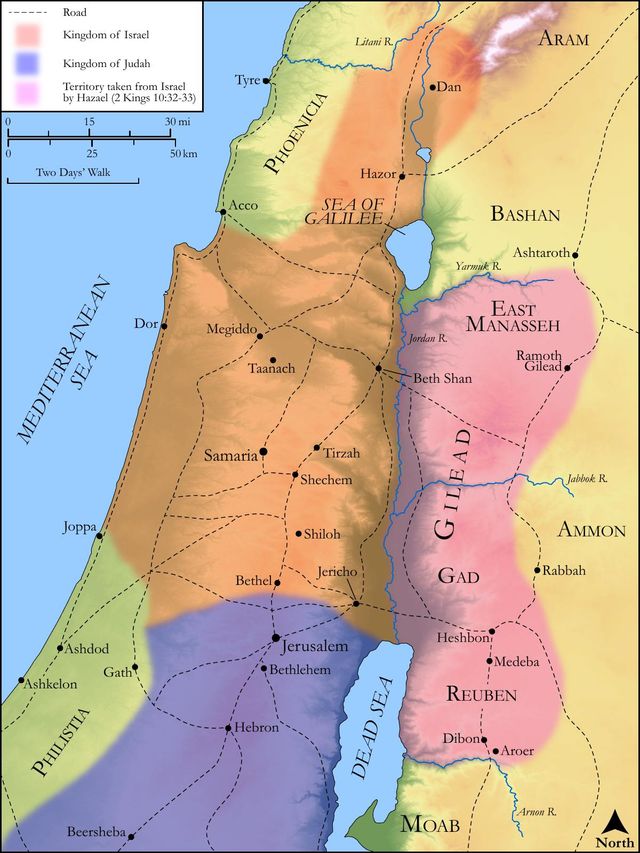
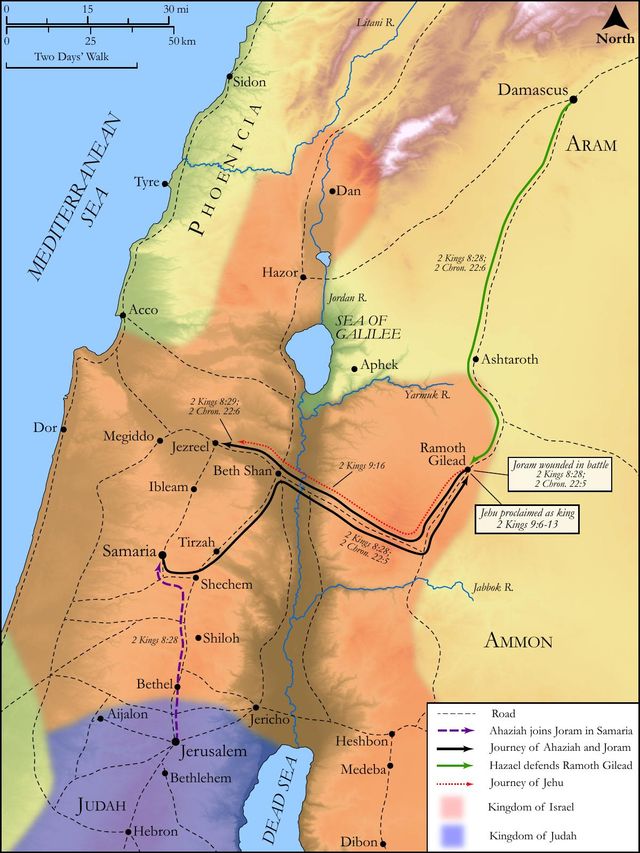
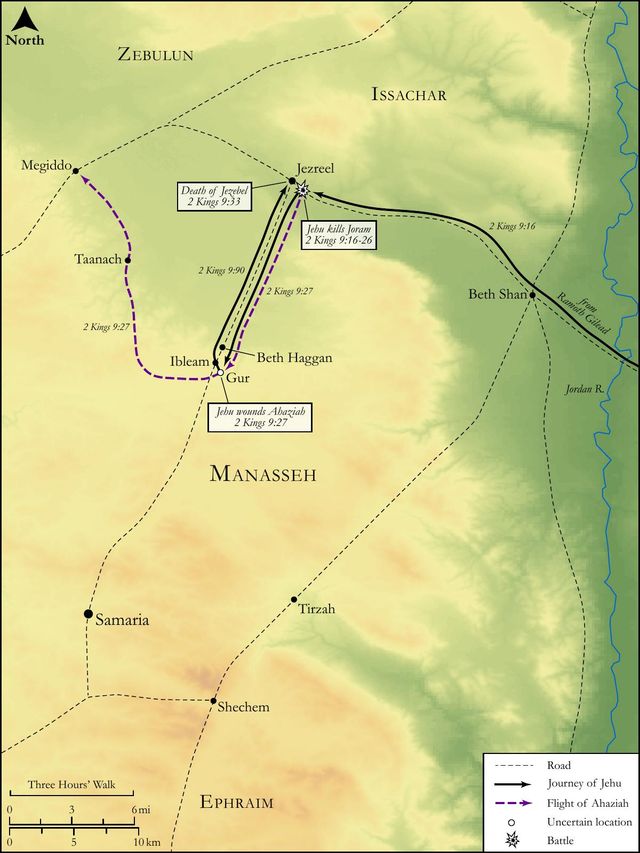
Study this verse
Public-domain commentary
Matthew Henry
From his Commentary on the Whole Bible. Henry comments on passages, not single verses — this entry covers 2 Kings 10:15–28. His three-level outline is real structure in the source text, so it is rendered as structure.
Jehu, pushing on his work, is here,
I.Courting the friendship of a good man, Jehonadab the son of Rechab, Kg2 10:15, Kg2 10:16.
This Jehonadab, though mortified to the world and meddling little with the business of it (as appears by his charge to his posterity, which they religiously observed 300 years after, not to drink wine nor dwell in cities, Jer 35:6, etc.), yet, upon this occasion, went to meet Jehu, that he might encourage him in the work to which God had called him. The countenance of good men is a thing which great men, if they be wise, will value, and value themselves by. David prayed, Let those that fear thee turn to me, Psa 119:79. This Jehonadab, though no prophet, priest, or Levite, no prince or ruler, was, we may suppose, very eminent for prudence and piety, and generally respected for that life of self-denial and devotion which he lived: Jehu, though a soldier, knew him and honoured him. He did not indeed think of sending for him, but when he met him (though it is likely he drove now as furiously as ever) he stopped to speak to him; and we are here told what passed between them.
1.Jehu saluted him; he blessed him (so the word is), paid him the respect and showed him the good-will that were due to so great an example of serious godliness.
2.Jehonadab assured him that he was sincerely in his interest and a hearty well-wisher to his cause. Jehu professed that his heart was right with him, that he had a true affection for his person and a veneration for the crown of his Nazariteship, and desired to know whether he had the same affection for him and satisfaction in that crown of royal dignity which God had put upon his head: Is thy heart right? a question we should often put to ourselves. "I make a plausible profession, have gained a reputation among men, but is my heart right? Am I sincere and inward with God?" Jehonadab gave him his word (It is), and gave him his hand as a pledge of his heart, yielded to him (so giving the hand is rendered, Ch2 30:8), concurred and covenanted with him, and owned him in the work both of revenge and of reformation he was now about.
3.Jehu took him up into his chariot and took him along with him to Samaria. He put some honour upon him, by taking him into the chariot with him (Jehonadab was not accustomed to ride in a chariot, much less with a king); but he received more honour from him, and from the countenance he gave to his present work. All sober people would think the better of Jehu when they saw Jehonadab in the chariot with him. This was not the only time in which the piety of some has been made to serve the policy of others, and designing men have strengthened themselves by drawing good men into their interests. Jehonadab is a stranger to the arts of fleshly wisdom, and has his conversation in simplicity and godly sincerity; and therefore, if Jehu be a servant of God and an enemy to Ball, he will be his faithful friend. "Come then" (says Jehu), "come with me, and see my zeal for the Lord; and then thou wilt see reason to espouse my cause." This is commonly taken as not well said by Jehu, and as giving cause to suspect that his heart was not right with God in what he did, and that the zeal he pretended for the Lord was really zeal for himself and his own advancement. For,
(1.)He boasted of it, and spoke as if God and man were mightily indebted to him for it.
(2.)He desired it might be seen and taken notice of, like the Pharisees, who did all to be seen of men. An upright heart approves itself to God and covets no more than his acceptance. If we aim at the applause of men, and make their praise our highest end, we are upon a false bottom. Whether Jehu looked any further we cannot judge; however Jehonadab went with him, and, it is likely, animated and assisted him in the further execution of his commission (Kg2 10:17), destroying all Ahab's friends in Samaria. A man may hate cruelty and yet love justice, may be far from thirsting after blood and yet may wash his feet in the blood of the wicked, Psa 58:10.
II.Contriving the destruction of all the worshippers of Baal.
The service of Baal was the crying sin of the house of Ahab: that root of this idolatry was plucked up, but multitudes yet remained that were infected with it, and would be in danger of infecting others. The law of God was express, that they were to be put to death; but they were so numerous, and so dispersed throughout all parts of the kingdom, and perhaps so alarmed with Jehu's beginnings, that it would be a hard matter to find them all out and an endless task to prosecute and execute them one by one. Jehu's project therefore is to cut them all off together.
1.By a wile, by a fraud, he brought them together to the temple of Baal. He pretended he would worship Baal more than ever Ahab had done, Kg2 10:18. Perhaps he spoke this ironically, or to try the body of the people whether they would oppose such a resolution as this, and would resent his threatening to increase his predecessor's exactions, and say, "If it be so, we have no part in Jehu, nor inheritance in the son of Nimshi." But it rather seems to have been spoken purposely to deceive the worshippers of Baal, and then it cannot be justified. The truth of God needs not any man's lie. He issued a proclamation, requiring the attendance of all the worshippers of Baal to join with him in a sacrifice to Baal (Kg2 10:19, Kg2 10:20), not only the prophets and priests, but all, throughout the kingdom, who worshipped Baal, who were not nearly so many as they had been in Elijah's time. Jehu's friends, we may suppose, were aware of what he designed, and were not offended at it; but the bigoted besotted Baalites began to think themselves very happy, and that now they should see golden days again. Joram had put away the image of Baal, Kg2 3:2. If Jehu will restore it, they have what they would have, and come up to Samaria with joy from all parts to celebrate the solemnity; and they are pleased to see the house of Baal crowded (Kg2 10:21), to see his priests in their vestments (Kg2 10:22), and themselves perhaps with some badges or other to notify their relation to Baal, for there were vestments for all his worshippers.
2.He took care that none of the servants of the Lord should be among them, Kg2 10:23. This they took as a provision to preserve the worship of Baal from being profaned by strangers; but it was a wonder that they did not, by this, see themselves brought into a snare and discern a design upon them. No marvel if those that suffer themselves to be deceived by Baal (as all idolaters were by their idols), are deceived by Jehu to their destruction.
3.He gave order for the cutting of them all off, and Jehonadab joined with him therein, Kg2 10:23. When a strict search was made lest any of the servants of God should, either for company or curiosity, have got among them - lest any wheat should be mixed with those tares, and when eighty men were set to stand guard at all the avenues to Baal's temple, that none might escape (Kg2 10:24), then the guards were sent in to put them all to the sword and to mingle their blood with their sacrifices, in a way of just revenge, as they themselves had sometimes done, when, in their blind devotion, they cut themselves with knives and lancets till the blood gushed out, Kg1 18:28. This was accordingly done, and the doing of it, though seemingly barbarous, was, considering the nature of their crime, really righteous. The Lord, whose name is jealous, is a jealous God.
4.The idolaters being thus destroyed, the idolatry itself was utterly abolished. The buildings about the house of Baal (which were so many and so stately that they are here called a city), where Baal's priests and their families lived, were destroyed; all the little images, statues, pictures, or shrines, which beautified Baal's temple, with the great image of Baal himself, were brought out and burnt (Kg2 10:26, Kg2 10:27), and the temple of Baal was broken down, and made a dunghill, the common sink, or sewer, of the city, that the remembrance of it might be blotted out or made infamous. Thus was the worship of Baal quite destroyed, at least for the present, out of Israel, though it had once prevailed so far that there were but 7000 of all the thousands of Israel that had not bowed the knee to Baal, and those concealed. Thus will God destroy all the gods of the heathen, and, sooner or later, triumph over them all.
Historical interpretation
Historical reception
1 surviving comment on this verse from the historical church.
This was also a pious man, and a relative of his. Indeed, his family constantly lived in tents and kept away from drunkenness. The prophet Jeremiah mentions them with praise, and history shows their piety. Therefore king Jehu, as soon as he saw him, blessed him, that is, greeted him. Then he asked, “Is your heart as true to mine as mine is to yours?” When he had answered, “It is,” Jehu said to him, “If it is, give me your hand.” Then, while he was taking him into his chariot, he said, “ ‘Come with me and see my zeal for the Lord.’ So he had him ride in his chariot.” From this it clearly appears that also among the ten tribes there were people endowed with piety, and thanks to them, God, who rules everything with wisdom, tolerated all the others.
Continue studying 2 Kings 10:16 across the web’s major study libraries — every link below opens this exact verse, chapter, or book on the destination site.
Read & Compare
 BibleGatewayThis verse in more than 200 translations and 70 languages.
 Bible.comThe YouVersion reader — hundreds of translations, reading plans, and highlights.
 ESV.orgCrossway's official English Standard Version reader.
 NET BibleThe NET translation with 60,000+ translators' notes on every rendering decision.
 STEP BibleTyndale House's free study tool — original text, vocabulary, and scholarly resources.
 BibliaLogos Bible Software's free web reader.
 USCCBThe New American Bible (Revised Edition) with the U.S. bishops' study notes.
Commentaries
 BibleHub CommentariesDozens of classic commentaries on this verse, gathered on one page.
 StudyLightMore than 100 commentary sets — the largest collection on the web.
 BibleRefPlain-English commentary on what this verse means, verse by verse.
 Enduring WordDavid Guzik's free commentary on this chapter, widely used by Bible teachers.
 Bible Study ToolsVerse commentary alongside Greek and Hebrew study aids.
Original Language & Research
- BibleHub InterlinearThe verse word by word — original language, transliteration, and English.
- BibleHub LexiconEvery word's original-language definition and Strong's entry.
 Blue Letter BibleDeep-study tools — Strong's numbers, concordance, and word studies.
 SefariaThe Hebrew text with Rashi and centuries of Jewish commentary.
Sermons, Hymns & Audio


TrulyRandomVerse is not affiliated with these sites and doesn’t control their content. They’re linked because they’re genuinely useful.
Summary
This verse encapsulates a pivotal moment in Jehu's divinely ordained purge of the house of Ahab and the systematic eradication of Baal worship in Israel. Having already executed key figures of the apostate regime, Jehu encounters Jehonadab, a righteous Rechabite known for his unwavering devotion to the LORD. Jehu extends a direct invitation, proclaiming, "Come with me, and see my zeal for the LORD," seeking not only a witness but also a moral endorsement for the violent yet necessary cleansing he was undertaking. Jehonadab's acceptance and shared ride in the chariot symbolize a public affirmation of Jehu's mission, setting the stage for the final, decisive blow against idolatry in Samaria.
Context
ShowHideLiterary Context
This verse is strategically positioned within the broader narrative of Jehu's violent coup, which commenced with his anointing by a prophet sent by Elisha, bearing a specific divine mandate to annihilate the house of Ahab and eradicate Baal worship from Israel (2 Kings 9:6-10). Prior to this encounter with Jehonadab, Jehu had already executed King Joram of Israel, King Ahaziah of Judah, and the notorious Queen Jezebel. He then orchestrated the massacre of Ahab's seventy sons in Samaria, effectively wiping out Ahab's lineage. As Jehu journeys towards Samaria to complete the purge of Baal worship, his meeting with Jehonadab serves as a crucial transition point, shifting the focus from the destruction of the royal house to the systematic eradication of the idolatrous cult itself. Jehonadab's presence provides a profound moral and spiritual validation for the impending actions against Baal, lending an air of divine approval to Jehu's otherwise brutal methods.
Historical & Cultural Context
The period of Jehu's reign (c. 841-814 BC) was characterized by intense political and religious upheaval in ancient Israel. The Omride dynasty, particularly under the influence of Ahab and Jezebel, had aggressively promoted the worship of Baal, leading to widespread apostasy and deep-seated conflict with the prophets of Yahweh. This religious syncretism was a direct violation of the Mosaic covenant and a persistent source of divine judgment upon the nation. Chariots among the kings of Israel were potent symbols of royal power, military might, and elevated status, as when Absalom prepared him chariots and horses. For Jehonadab, a Rechabite, to ride in Jehu's chariot was an act of profound significance. The Rechabites were a distinct group renowned for their ascetic lifestyle, strict adherence to nomadic traditions, and unwavering loyalty to Yahweh, abstaining from wine and settled living as a visible protest against the corrupting influences of Canaanite culture and idolatry (Jeremiah 35:6-10). Jehonadab's public association with Jehu therefore lent considerable moral and religious weight to Jehu's mission in the eyes of the devout Israelites, signaling divine approval.
Key Themes
ShowHideThe central themes converging in this verse include the divine mandate for judgment and the eradication of idolatry. Jehu's actions are presented as a direct fulfillment of God's prophetic word against the house of Ahab and the pervasive Baal worship that had corrupted Israel. His "zeal for the LORD" is portrayed as the driving force behind this violent purge, reflecting God's own jealous nature for His covenant people (Exodus 20:5). Another significant theme is the nature of zeal itself. While Jehu's zeal for purging Baal was commendable and divinely sanctioned, later verses reveal that his heart was not fully devoted to the LORD in all His ways (2 Kings 10:31), highlighting the crucial distinction between a specific obedience and comprehensive faithfulness. Finally, the theme of witness and endorsement is paramount, as Jehonadab's presence in Jehu's chariot serves as a public declaration that even a highly respected, righteous figure approved of and participated in the divine judgment against Baal.
Exposition and Analysis
ShowHideKey Word Analysis
ShowHideThe Hebrew word קִנְאָה (qinʼâh) denotes intense passion, jealousy, or indignation. It can be used positively to describe God's righteous jealousy for His own honor and covenant faithfulness (e.g., Isaiah 9:7), or human passion for righteousness (e.g., Phinehas's zeal in Numbers 25:11). However, it can also refer to negative human emotions like envy or wrath. Jehu uses it here to frame his violent actions as a righteous, God-directed passion to uphold the LORD's honor and eradicate idolatry, positioning himself as an agent of divine justice.
The use of יְהוָה (Yᵉhôvâh), the covenant name of God, is profoundly significant. It stands in stark contrast to Baal, the Canaanite storm god and rival deity. By declaring his zeal "for the LORD," Jehu explicitly aligns his mission with the singular, self-existent God of Israel, emphasizing the monotheistic imperative of the Mosaic covenant and the absolute rejection of all rival deities. This declaration underscores the deeply religious nature of his purge, transcending mere political ambition.
The term רֶכֶב (rekeb) refers to a vehicle, specifically a war chariot, which was a potent symbol of royal power, military might, and authority among the kings of that day. For Jehonadab to be made to ride in Jehu's chariot signifies more than just transportation; it symbolizes a shared purpose, a public display of alliance, and a powerful endorsement of Jehu's authority and mission. It visually communicates Jehonadab's moral sanction of Jehu's actions to the populace, lending immense legitimacy to the purge.
Verse Breakdown
ShowHide"And he said, Come with me"
Jehu initiates the interaction with a direct and purposeful invitation to Jehonadab. This is not a command but an appeal, suggesting Jehu desires Jehonadab's willing participation or at least his presence as a credible witness. It highlights Jehu's strategic awareness of Jehonadab's high moral standing and the significant benefit of his public endorsement.
"and see my zeal for the LORD"
This is Jehu's self-proclamation and explicit statement of motivation. He frames his impending actions not as personal vengeance or political ambition, but as a divinely inspired, fervent passion for the glory and honor of Yahweh. He wants Jehonadab, and by extension, the people, to recognize the profound religious imperative behind his violent purge of Baal worship, thus setting the stage for the dramatic and decisive destruction of the Baal temple that immediately follows.
"So they made him ride in his chariot"
This clause describes Jehonadab's acceptance of Jehu's invitation and his active, public participation in the journey. The phrase "they made him ride" implies Jehu's initiative in seating Jehonadab, and Jehonadab's willing compliance. His presence in the royal chariot, a prominent symbol of power and authority, publicly associates the respected Rechabite with Jehu's mission, lending it a crucial layer of moral and spiritual legitimacy in the eyes of the people and confirming the divine nature of the purge.
Literary Devices
ShowHideThe verse employs several significant literary devices. Symbolism is prominently featured, with the "chariot" representing not only Jehu's royal authority and military might but also the shared purpose and crucial endorsement between Jehu and Jehonadab. Jehonadab's presence in the chariot visually confirms his alignment with Jehu's divinely appointed mission. There is also an element of irony in Jehu's declaration of "zeal for the LORD." While his zeal for purging Baal worship is undeniable and divinely sanctioned, the broader narrative of 2 Kings 10:31 reveals that Jehu did not fully walk in the ways of the LORD, indicating a partial or incomplete zeal. This subtle irony foreshadows the mixed assessment of Jehu's reign. The scene also functions as a crucial narrative bridge, transitioning from the initial, bloody phase of Jehu's purge (the royal family) to the final, comprehensive eradication of Baal worship in Samaria.
Theological and Thematic Connections
ShowHideThis verse powerfully underscores God's unwavering commitment to His covenant with Israel, which demanded exclusive worship of Him and the absolute rejection of idolatry. Jehu's zeal, though later revealed to be imperfect in its broader application, serves as a potent instrument of divine judgment against the deep-seated apostasy introduced by the house of Ahab. It highlights that God, in His sovereignty, can use flawed human agents to accomplish His righteous purposes, particularly in executing judgment against sin and idolatry that defiles His name and people. The encounter with Jehonadab also emphasizes the importance of righteous witness and the moral authority that stems from a life devoted to God. True zeal for the LORD is not merely emotional fervor but a passionate commitment to God's holiness and justice, willing to confront anything that opposes His glory and the purity of His worship.
Reflection and Application
ShowHideJehu's bold invitation to Jehonadab to "see my zeal for the LORD" challenges us to deeply examine the nature and object of our own passions and commitments. While Jehu's zeal was instrumental in purging a great evil from Israel, the broader narrative reminds us that zeal, to be truly godly and enduring, must be rooted in a holistic and comprehensive commitment to God's character and His entire revealed will, not merely a select command or area of focus. As believers, we are called to be zealous for good works (Titus 2:14), for justice, for truth, for the purity of the church, and for the fervent spread of the Gospel. This requires a discerning spirit to ensure our passion is always aligned with God's heart and expressed in ways that honor Him and build up His kingdom. Furthermore, just as Jehonadab's presence lent moral weight and public endorsement to Jehu's mission, our lives as believers should consistently bear witness to God's truth and righteousness, providing a credible and compelling endorsement of His transformative work in the world. We are called to confront the "idols" in our own lives—anything that subtly or overtly takes God's rightful place—with a similar, though not violent, zeal for purity and singular devotion to Christ.
Questions for Reflection
ShowHideFAQ
ShowHideWas Jehu truly zealous for the LORD, or was he motivated by personal ambition?
ShowHideJehu's actions were undeniably driven by a strong zeal for the LORD, specifically in fulfilling the divine mandate to eradicate the house of Ahab and the pervasive Baal worship in Israel. His declaration "Come with me, and see my zeal for the LORD" was a genuine expression of this passion and a desire for Jehonadab to witness and affirm it. However, the biblical narrative offers a nuanced view. While Jehu was commended for his obedience in this specific task, and God promised him a dynasty for four generations because he "did well in executing what is right in My eyes" (2 Kings 10:30), the text also states that he "took no heed to walk in the law of the LORD God of Israel with all his heart; for he departed not from the sins of Jeroboam, which made Israel to sin" (2 Kings 10:31). This indicates that while his zeal for purging Baal was authentic and divinely sanctioned, it was not accompanied by a comprehensive, wholehearted devotion to the LORD in all aspects of his life and reign. His zeal was potent but ultimately incomplete, lacking a full commitment to God's covenant.
Who was Jehonadab, and why was his presence in Jehu's chariot so significant?
ShowHideJehonadab, the son of Rechab, was a prominent figure known for his strict adherence to the traditions of the Rechabites, a distinct group characterized by their nomadic lifestyle, abstinence from wine, and unwavering faithfulness to Yahweh. Their way of life was a visible and radical protest against the corrupting influences of Canaanite culture and idolatry in Israel (Jeremiah 35:6-10). Jehonadab was widely respected as a righteous man in Israel, embodying a rare purity of devotion to God in an era of widespread apostasy. His presence in Jehu's chariot was highly significant because it served as a powerful public endorsement of Jehu's mission. It signaled to the populace that even a devout and morally upright figure like Jehonadab recognized the divine necessity and righteousness of Jehu's violent purge against Baal worship. This public alignment lent immense moral authority and legitimacy to Jehu's actions, assuring the people that the purge was not merely a political coup but a divinely sanctioned act of national cleansing and restoration of Yahweh's exclusive worship.
Christ-Centered Fulfillment
ShowHideJehu's zeal for the LORD, though imperfectly expressed and incomplete in its scope, powerfully foreshadows the perfect and all-consuming zeal of Jesus Christ. Jehu was an instrument of judgment against a specific manifestation of idolatry in Israel, but Christ is the ultimate purger of sin and the perfect embodiment of divine zeal. Jesus' "zeal for your house has consumed me" (John 2:17) drove Him to cleanse the temple, confronting those who had turned God's sacred space into a "den of thieves." More profoundly, His ultimate zeal for the glory of God and the redemption of humanity led Him to the cross, where He became the ultimate sacrifice, the "Lamb of God, who takes away the sin of the world!" (John 1:29). Unlike Jehu, whose zeal was partial and whose obedience was flawed, Christ's obedience was perfect and complete, fulfilling all righteousness (Matthew 3:15). He did not merely purge external idolatry but dealt with the root of sin in the human heart, offering true spiritual cleansing, reconciliation with God, and the promise of new life. His glorious return will mark the final and complete eradication of all evil and idolatry, establishing His righteous kingdom forever (Revelation 19:11-16).