


2 Chronicles 30:25
Bible text: King James Version (1769 Blayney text) · Public domain
Bible text: King James Version with Strong's numbers · Public domain
Bible text: Berean Standard Bible · Public domain
Bible text: American Standard Version (1901) · Public domain
Bible text: World English Bible, Messianic edition · Public domain
Bible text: Geneva Bible (1599) · Public domain
Bible text: Young's Literal Translation · Public domain
- וַיִּשְׂמְחוּvai·yis·me·Chuand they rejoicedH8055Conj-w ¦ V-Qal-ConsecImperf-3mpVerb Qal Consecutive Imperfect 3rd Plural Masculineוַandיִּשְׂמְחוּthey rejoiced
- כָּלkolallH3605N-mscNoun Singular Masculine Construct
- קְהַלke·Hal[the] assembly ofH6951N-mscNoun Singular Masculine Construct
- יְהוּדָהye·hu·DahJudahH3063N-properNoun Proper Location
- וְהַכֹּהֲנִיםve·ha·ko·ha·Nimand the priestsH3548Conj-w ¦ Art ¦ N-mpNoun Plural Masculine Absoluteוְandהַtheכֹּהֲנִיםpriests
- וְהַלְוִיִּםve·hal·vi·Yimand the LevitesH3881Conj-w ¦ Art ¦ N-mpNoun Gentilic Plural Masculine AbsoluteוְandהַtheלְוִיִּםLevites
- וְכָלve·kholand allH3605Conj-w ¦ N-mscNoun Singular Masculine Constructוְandכָלall
- הַקָּהָלha·ka·Halthe assemblyH6951Art ¦ N-msNoun Singular Masculine Absoluteהַtheקָּהָלassembly
- הַבָּאִיםha·ba·'Imwhich were comingH935Art ¦ V-Qal-Prtcpl-mpVerb Qal Participle Plural Masculine Absoluteהַwhichבָּאִיםwere coming
- מִיִּשְׂרָאֵלmi·Yis·ra·'Elfrom IsraelH3478Prep-m ¦ N-properNoun Proper LocationמִfromיִּשְׂרָאֵלIsrael
- וְהַגֵּרִיםve·ha·ge·Rimand the sojournersH1616Conj-w ¦ Art ¦ N-mpNoun Plural Masculine Absoluteוְandהַtheגֵּרִיםsojourners
- הַבָּאִיםha·ba·'Imwho were comingH935Art ¦ V-Qal-Prtcpl-mpVerb Qal Participle Plural Masculine Absoluteהַwhoבָּאִיםwere coming
- מֵאֶרֶץme·'E·retzfrom [the] land ofH776Prep-m ¦ N-fscNoun Singular Feminine Constructמֵfromאֶרֶץ[the] land of
- יִשְׂרָאֵלYis·ra·'ElIsraelH3478N-properNoun Proper Location
- וְהַיּוֹשְׁבִיםve·hai·yo·she·Vimand who were dwellingH3427Conj-w ¦ Art ¦ V-Qal-Prtcpl-mpVerb Qal Participle Plural Masculine Absoluteוְandהַwhoיּוֹשְׁבִיםwere dwelling
- בִּיהוּדָהbi·hu·Dahin JudahH3063Prep-b ¦ N-properNoun Proper LocationבִּinיהוּדָהJudah
English is a literal word-by-word gloss of the Hebrew, not the KJV's wording. Why?
This is the original text the KJV's translators worked from — each Hebrew word with its own literal English meaning in this verse, prepared by scholars at Tyndale House, Cambridge. The KJV translates whole sentences, not word by word, so its wording differs: one Hebrew word can become several English words, and the KJV may choose “the LORD” where the gloss reads “Yahweh”. Both are faithful — they answer different questions. For the KJV's own rendering, switch to the KJV text.
Details
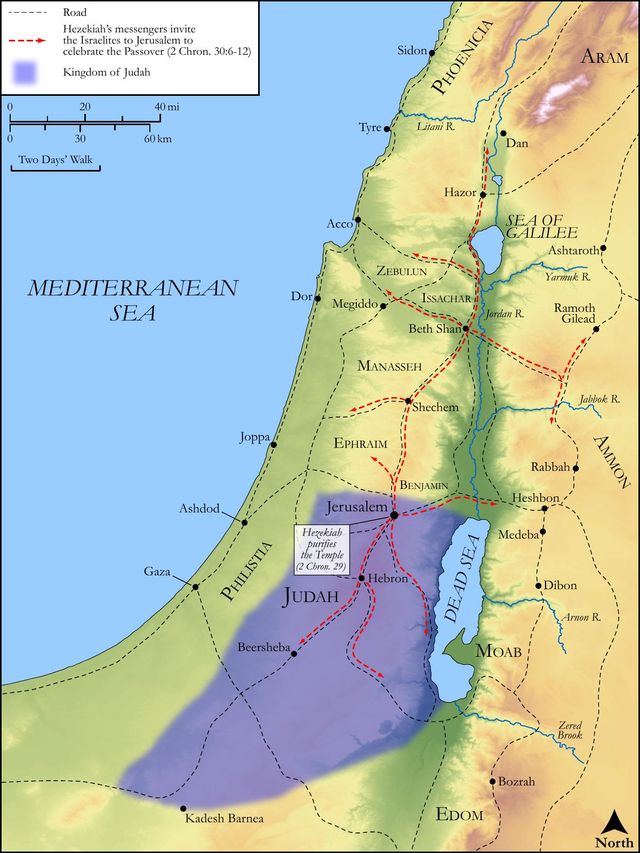
See on the biblical-era map
Study this verse
Public-domain commentary
Matthew Henry
From his Commentary on the Whole Bible. Henry comments on passages, not single verses — this entry covers 2 Chronicles 30:21–27.
After the passover followed the feast of unleavened bread, which continued seven days. How that was observed we are here told, and every thing in this account looks pleasant and lively. 1. Abundance of sacrifices were offered to God in peace-offerings, by which they both acknowledged and implored the favour of God, and on part of which the offerers feasted with their friends during these seven days (Ch2 30:22), in token of their communion with God and the comfort they took in his favour and their reconciliation to him. To keep up this part of the service, that God's altar might be abundantly regaled with the fat and blood and his priests and people with the flesh of the peace-offerings, Hezekiah gave out of his own stock 1000 bullocks and 7000 sheep, and the princes, excited by his pious example, gave the same number of bullocks and a greater number of sheep, and all for peace-offerings, Ch2 30:24. By this God was honoured, the joy of the festival was kept up, and the strangers were encouraged to come again to Jerusalem. It was generously done of the king and the princes thus plentifully to entertain the whole congregation; but what is a great estate good for but that it puts men into a capacity of doing so much the more good? Christ feasted those that followed him. I believe neither Hezekiah nor his princes were the poorer at the year's end for this their pious liberality. 2. Many good prayers were put up to God with the peace-offerings, Ch2 30:22. They made confession to the Lord God of their fathers, in which the intent and meaning of the peace-offerings were directed and explained. When the priests sprinkled the blood and burnt the fat they made confession, so did the people when they feasted on their part. They made a religious confession of their relation to God and dependence upon him, a penitent confession of their sins and infirmities, a thankful confession of God's mercies to them, and a supplicatory confession of their wants and desires; and, in all these, they had an eye to God as the God of their fathers, a God in covenant with them. 3. There was a great deal of good preaching. The Levites (whose office it was, Deu 33:10) taught the people the good knowledge of the Lord, read and opened the scriptures, and instructed the congregation concerning God and their duty to him; and great need there was of this, after so long a famine of the word as there had been in the last reign. Hezekiah did not himself preach, but he spoke comfortably to the Levites that did, attended their preaching, commended their diligence, and assured them of his protection and countenance. Hereby he encouraged them to study hard and take pains, and put a reputation upon them, that the people might respect and regard them the more. Princes and magistrates, by owning and encouraging faithful and laborious preachers, greatly serve the interest of God's kingdom among men. 4. They sang psalms every day (Ch2 30:21): The Levites and priests praised the Lord day by day, both with songs and musical instruments, thus expressing their own and exciting one another's joy in God and thankfulness to him. Praising God should be much of our work in our religious assemblies. 5. Having kept the seven days of the feast in this religious manner, they had so much comfort in the service that they kept other seven days, Ch2 30:23. They did not institute any new modes of worship, but repeated and continued the old. The case was extraordinary: they had been long without the ordinance; guilt had been contracted by the neglect of it; they had now got a very great congregation together, and were in a devout serious frame; they knew not when they might have such another opportunity, and therefore could not now find in their hearts to separate till they had doubled the time. Many of them were a great way from home, and had business in the country to look after, for, this being the second month, they were in the midst of their harvest; yet they were in no haste to return: the zeal of God's house made them forget their secular affairs. How unlike those who snuffed at God's service, and said, What a weariness is it! Or those who asked, When will the sabbath be gone? The servants of God should abound in his work. 6. All this they did with gladness (Ch2 30:23); they all rejoiced, and particularly the strangers, Ch2 30:25. So there was great joy in Jerusalem, Ch2 30:26. Never was the like since the dedication of the temple in Solomon's time. Note, Holy duties should be performed with holy gladness; we should be forward to them, and take pleasure in them, relish the sweetness of communion with God, and look upon it as matter of unspeakable joy and comfort that we are thus favoured and have such earnests of everlasting joy. 7. The congregation was at length dismissed with a solemn blessing, Ch2 30:27. (1.) The priests pronounced it; for it was part of their office to bless the people (Num 6:22, Num 6:23), in which they were both the people's mouth to God by way of prayer and God's mouth to the people by way of promise; for their blessing included both. In it they testified both their desire of the people's welfare and their dependence upon God and that word of his grace to which they commended them. What a comfort is it to a congregation to be sent home thus crowned! (2.) God said Amen to it. The voice of the priests, when they blessed the people, was heard in heaven and came up to the habitation of God's holiness. When they pronounced the blessing God commanded it, and perhaps gave some sensible token of the ratification of it. The prayer that comes up to heaven in a cloud of incense will come down again to this earth in showers of blessings.
Continue studying 2 Chronicles 30:25 across the web’s major study libraries — every link below opens this exact verse, chapter, or book on the destination site.
Read & Compare
 BibleGatewayThis verse in more than 200 translations and 70 languages.
 Bible.comThe YouVersion reader — hundreds of translations, reading plans, and highlights.
 ESV.orgCrossway's official English Standard Version reader.
 NET BibleThe NET translation with 60,000+ translators' notes on every rendering decision.
 STEP BibleTyndale House's free study tool — original text, vocabulary, and scholarly resources.
 BibliaLogos Bible Software's free web reader.
 USCCBThe New American Bible (Revised Edition) with the U.S. bishops' study notes.
Commentaries
 BibleHub CommentariesDozens of classic commentaries on this verse, gathered on one page.
 StudyLightMore than 100 commentary sets — the largest collection on the web.
 BibleRefPlain-English commentary on what this verse means, verse by verse.
 Enduring WordDavid Guzik's free commentary on this chapter, widely used by Bible teachers.
 Bible Study ToolsVerse commentary alongside Greek and Hebrew study aids.
Original Language & Research
- BibleHub InterlinearThe verse word by word — original language, transliteration, and English.
- BibleHub LexiconEvery word's original-language definition and Strong's entry.
 Blue Letter BibleDeep-study tools — Strong's numbers, concordance, and word studies.
 SefariaThe Hebrew text with Rashi and centuries of Jewish commentary.
Sermons, Hymns & Audio


TrulyRandomVerse is not affiliated with these sites and doesn’t control their content. They’re linked because they’re genuinely useful.
Summary
2 Chronicles 30:25 powerfully depicts the profound joy and remarkable unity experienced by a diverse assembly during King Hezekiah's extraordinary Passover celebration. This verse meticulously enumerates the various participants—the people of Judah, priests, Levites, remnants from the northern kingdom of Israel, and even resident foreigners—all united in worship and spiritual revival. It underscores the deep gladness that accompanies a communal return to God's commands and the restoration of proper, inclusive worship.
Context
ShowHideLiterary Context
This verse is strategically placed at the zenith of King Hezekiah's sweeping spiritual reforms, a narrative meticulously unfolded across 2 Chronicles 29 through 2 Chronicles 31. Following the cleansing and rededication of the Temple in 2 Chronicles 29, Hezekiah courageously reinstituted the long-neglected Passover celebration. The immediate narrative in 2 Chronicles 30 details the unprecedented invitation extended to all Israel, including the scattered northern tribes, to gather in Jerusalem for this sacred feast. Despite initial scorn from some (2 Chronicles 30:10), a significant remnant humbled themselves and came. Verses 2 Chronicles 30:21-24 describe the initial seven-day feast, which was so joyous that the assembly unanimously decided to extend it for another seven days. Verse 25 specifically lists the various groups participating in this extended, exuberant celebration, setting the stage for the summary of unprecedented joy in 2 Chronicles 30:26.
Historical & Cultural Context
King Hezekiah reigned over the southern kingdom of Judah during the late 8th century BC (c. 715-686 BC), a period marked by profound spiritual decline and widespread idolatry, particularly under his apostate father, Ahaz. The northern kingdom of Israel had already fallen to the Assyrian Empire in 722 BC, with many of its inhabitants deported, leaving only remnants. Hezekiah's reign represented a dramatic spiritual turning point, a resolute effort to reverse generations of apostasy and restore the exclusive worship of Yahweh. The Passover, a foundational feast commemorating Israel's miraculous deliverance from Egyptian bondage (Exodus 12), had likely not been observed nationally for a considerable time, if at all, in such a comprehensive manner. Hezekiah's audacious invitation to the remnants of the northern tribes was a remarkable act, signifying a profound desire for national reconciliation and a return to the unified worship of God, transcending the centuries-old political and religious schism. The explicit inclusion of "strangers" (resident aliens) further highlights the universal reach of this revival, aligning with Mosaic Law provisions that allowed foreigners to participate in such feasts if they committed to the covenant (e.g., Exodus 12:48).
Key Themes
ShowHideThis verse powerfully contributes to several overarching themes within 2 Chronicles and the broader biblical narrative. Firstly, it emphatically highlights unity and universal reach, demonstrating God's desire for all His people, regardless of tribal, national, or even ethnic origin, to worship Him together. The diverse composition of the assembly—Judah, Israel, priests, Levites, and strangers—serves as a compelling testament to God's welcoming and unifying nature, a theme also evident in the call for all Israel to come to Jerusalem in 2 Chronicles 30:1. Secondly, the repeated mention of "rejoiced" (2 Chronicles 30:21 and 2 Chronicles 30:23) underscores the profound theme of joy in God's presence and obedience. This was not a superficial happiness but a deep, spiritual gladness arising from national repentance, reconciliation with God, and the restoration of proper worship. Thirdly, the entire narrative surrounding Hezekiah's Passover exemplifies the theme of spiritual revival and reformation. Hezekiah's initiative led to a genuine turning back to God, demonstrating the transformative power of seeking the Lord with a whole heart, which brought profound spiritual and communal blessings, echoing the promises of restoration found in Deuteronomy 30:1-10.
Exposition and Analysis
ShowHideKey Word Analysis
ShowHideThe Hebrew verb שָׂמַח (sâmach), rendered "rejoiced," denotes a deep, heartfelt gladness, often associated with festive celebrations, divine blessing, and a profound sense of well-being. It signifies more than mere superficial happiness; it implies a joy that stems from a right relationship with God, participation in His redemptive acts, and the experience of His favor. The collective nature of this rejoicing in 2 Chronicles 30:25 highlights a shared spiritual experience and communal delight in God's restored presence among His people.
The term קָהָל (qâhâl) refers to an assembly, gathering, or community, often carrying a strong religious or covenantal connotation. It emphasizes the collective identity and unified purpose of the gathered people. Its repeated use in this verse for both "Judah" and "Israel" underscores the re-formation of a unified people of God, transcending historical divisions, for the express purpose of corporate worship and covenant renewal.
The Hebrew word גֵּר (gêr), translated "strangers" (plural gerim), refers to resident aliens or foreigners who lived among the Israelites. Their explicit inclusion in the Passover celebration is highly significant, demonstrating the universal reach of God's covenant and His desire for all who commit to Him to participate in His worship and blessings. This inclusion anticipates a broader, more universal scope of salvation, extending beyond ethnic Israel.
Verse Breakdown
ShowHide"And all the congregation of Judah"
This clause refers to the entirety of the people from the southern kingdom, who were under King Hezekiah's direct rule and formed the core participants and beneficiaries of his spiritual reforms. Their presence signifies the central, unified body of the revived community.
"with the priests and the Levites"
This phrase highlights the crucial role of the designated religious leaders and temple servants. Their active participation was indispensable for the proper execution of the elaborate Passover rituals, signifying their own renewed commitment to their sacred duties, having undergone a period of purification and rededication themselves (2 Chronicles 29:4-19).
"and all the congregation that came out of Israel"
This remarkable and poignant phrase refers to the remnants of the northern kingdom, those who had survived the Assyrian conquest and deportation, and who responded positively to Hezekiah's unprecedented invitation. Their presence was a powerful symbol of the potential for reconciliation and reunification of God's people, bridging centuries of political and religious division.
"and the strangers that came out of the land of Israel, and that dwelt in Judah"
This group encompasses non-Israelites who had either migrated from the territory of the former northern kingdom or were resident aliens living within Judah's borders. Their inclusion underscores the universal reach of God's covenant and the open invitation to all who would humble themselves and seek the Lord, regardless of ethnic or national origin.
"rejoiced"
This single, powerful word encapsulates the profound, unifying emotion that permeated the entire assembly. It signifies a deep spiritual gladness, a corporate celebration of God's grace, forgiveness, and the restoration of His presence among His people. This joy was the natural and overflowing fruit of repentance, obedience, and the communal experience of God's favor and blessing.
Literary Devices
ShowHideThe verse primarily employs Enumeration and Listing to emphasize the comprehensive and diverse nature of the assembly. By meticulously listing "all the congregation of Judah," "the priests and the Levites," "all the congregation that came out of Israel," and "the strangers," the text highlights the unprecedented breadth of participation in this Passover celebration. This detailed listing serves to underscore the profound Unity achieved, starkly contrasting with the long-standing political and spiritual divisions that had plagued Judah and Israel for centuries. The implicit Repetition of the theme of "rejoicing" (seen in 2 Chronicles 30:21, 2 Chronicles 30:23, and 2 Chronicles 30:26) functions as a Leitmotif, underscoring the dominant emotional and spiritual atmosphere of the entire event. The celebration itself, particularly its universal reach, serves as a powerful Symbolism of national repentance, divine forgiveness, and the restoration of the covenant relationship, pointing towards a future time of complete reconciliation and universal worship.
Theological and Thematic Connections
ShowHideThe widespread rejoicing and remarkably diverse participation described in 2 Chronicles 30:25 illustrate profound theological truths about God's character and His desires for His people. It reveals God's heart for unity, not just among His chosen nation, but extending to all who would turn to Him in humility and faith. The inclusion of both the long-divided kingdoms and "strangers" demonstrates unequivocally that God's covenant blessings are available to all who humbly seek Him and participate in His appointed worship according to His commands. This communal joy, born out of national repentance and obedience, serves as a powerful testament to the spiritual refreshment and profound gladness that accompany a genuine return to God's ways. It powerfully foreshadows the broader, universal scope of God's redemptive plan, where ethnic and social barriers are broken down, and all peoples are invited into His glorious presence.
Reflection and Application
ShowHide2 Chronicles 30:25 offers enduring and vital lessons for believers today, emphasizing the profound joy and unity found in genuine worship and spiritual renewal. It serves as a powerful reminder that God's desire is for one people gathered out of every nation, where all, regardless of background, past divisions, or perceived outsider status, are welcomed into His presence through Christ. The overwhelming joy experienced by this ancient assembly serves as a poignant reminder that true and lasting gladness is found not in worldly pursuits or self-gratification, but in drawing near to God, obeying His commands, and participating in corporate worship with His people. This passage challenges us to actively pursue unity within the body of Christ, to intentionally break down barriers that might hinder fellowship, and to create welcoming spaces where all can experience the transformative power of God's presence. It also calls us to seek personal and corporate revival, recognizing that when God's people humble themselves, pray, and seek His face, He can bring about widespread spiritual awakening and profound, unifying joy.
Questions for Reflection
ShowHideFAQ
ShowHideWhy was the participation of "strangers" (non-Israelites) in the Passover so significant in Hezekiah's revival?
ShowHideThe inclusion of "strangers" or resident aliens (gerim) in the Passover celebration, as explicitly mentioned in 2 Chronicles 30:25, was profoundly significant because it underscored the universal reach of God's covenant and His desire for all who commit to Him to participate in His worship and blessings. While the Passover was primarily a foundational Jewish feast commemorating Israel's unique deliverance, the Mosaic Law made explicit provisions for foreigners to participate if they were circumcised and committed themselves to the covenant stipulations (e.g., Exodus 12:48 and Numbers 9:14). Hezekiah's invitation and the strangers' enthusiastic response demonstrated a genuine spiritual awakening that transcended traditional ethnic boundaries. It was a powerful foreshadowing of the New Testament era, where God would open the doors of salvation to Gentiles, breaking down the dividing wall between Jew and Gentile, as seen in the early church's mission to all nations (e.g., Acts 10:34-35). Their participation highlighted God's impartial love and His ultimate intention to gather a people for Himself from every tribe, tongue, and nation.
Christ-Centered Fulfillment
ShowHideThe joyous and remarkably inclusive Passover celebration under King Hezekiah, as vividly described in 2 Chronicles 30:25, finds its ultimate and most profound fulfillment in the person and work of Jesus Christ. Hezekiah's earnest efforts to restore proper worship and bring scattered peoples together in Jerusalem powerfully foreshadow the redemptive work of Christ, who is the true and ultimate Passover Lamb. Just as the ancient Passover marked a deliverance from physical bondage, Christ's perfect sacrifice on the cross delivers humanity from the spiritual bondage of sin and death (John 1:29). The remarkable unity of Judah, Israel, priests, Levites, and strangers in Jerusalem points directly to the new covenant reality embodied in the Church, where in Christ, all former distinctions and dividing walls are abolished: "There is neither Jew nor Gentile, neither slave nor free, nor is there male and female, for you are all one in Christ Jesus" (Galatians 3:28). The profound, unifying joy experienced by the assembly in Hezekiah's day is but a glimpse of the far greater, eternal joy found in salvation through Christ, who reconciles all things to Himself and unites a diverse multitude from "every nation, tribe, people and language" to worship Him around His glorious throne (Revelation 7:9-10). Thus, Hezekiah's Passover stands as a beautiful Old Testament type, pointing forward to the comprehensive, universally inclusive, and eternally joyful redemption accomplished by Jesus, the one who truly gathers all God's people into a single, Spirit-filled congregation.