


1 Chronicles 16:16
Bible text: King James Version (1769 Blayney text) · Public domain
Bible text: Berean Standard Bible · Public domain
Bible text: American Standard Version (1901) · Public domain
Bible text: World English Bible, Messianic edition · Public domain
Bible text: Geneva Bible (1599) · Public domain
Bible text: Young's Literal Translation · Public domain
- אֲשֶׁר'a·SherwhichH834RelParticle Relative
- כָּרַתka·Rathe madeH3772V-Qal-Perf-3msVerb Qal Perfect 3rd Singular Masculine
- אֶת'etwithH854PrepPreposition
- אַבְרָהָם'av·ra·HamAbrahamH85N-proper-mNoun Proper Masculine
- וּשְׁבוּעָתוֹu·she·vu·'a·Toand his oathH7621Conj-w ¦ N-fsc ¦ 3msNoun Singular Feminine Constructוּandשְׁבוּעָתoathוֹhis
- לְיִצְחָקle·yitz·Chakto IsaacH3327Prep-l ¦ N-proper-mNoun Proper MasculineלְtoיִצְחָקIsaac
English is a literal word-by-word gloss of the Hebrew, not the KJV's wording. Why?
This is the original text the KJV's translators worked from — each Hebrew word with its own literal English meaning in this verse, prepared by scholars at Tyndale House, Cambridge. The KJV translates whole sentences, not word by word, so its wording differs: one Hebrew word can become several English words, and the KJV may choose “the LORD” where the gloss reads “Yahweh”. Both are faithful — they answer different questions. For the KJV's own rendering, switch to the KJV text.
Details
See on the biblical-era map
Study this verse
Public-domain commentary
Matthew Henry
From his Commentary on the Whole Bible. Henry comments on passages, not single verses — this entry covers 1 Chronicles 16:7–36.
We have here the thanksgiving psalm which David, by the Spirit, composed, and delivered to the chief musician, to be sung upon occasion of the public entry the ark made into the tent prepared for it. Some think he appointed this hymn to be daily used in the temple service, as duly as the day came; whatever other psalms they sung, they must not omit this. David had penned many psalms before this, some in the time of his trouble by Saul. This was composed before, but was now first delivered into the hand of Asaph, for the use of the church. It is gathered out of several psalms (from the beginning to Ch1 16:23 is taken from Psa 105:1, etc.; and then Ch1 16:23 is the whole 96th psalm, with little variation; Ch1 16:34 is taken from Psa 136:1 and divers others; and then the last two verses are taken from the close of Ps. 106), which some think warrants us to do likewise, and make up hymns out of David's psalms, a part of one and a part of another put together so as may be most proper to express and excite the devotion of Christians. These psalms will be best expounded in their proper places (if the Lord will); here we take them as they are put together, with a design to thank the Lord (Ch1 16:7), a great duty, to which we need to be excited and in which we need to be assisted. 1. Let God be glorified in our praises; let his honour be the centre in which all the lines meet. Let us glorify him by our thanksgivings (Give thanks to the Lord), by our prayers (Call on his name, Ch1 16:8), by our songs (Sing psalms unto him), by our discourse - Talk of all his wondrous works, Ch1 16:9. Let us glorify him as a great God, and greatly to be praised (Ch1 16:25), as supreme God (above all gods), as sole God, for all others are idols, Ch1 16:26. Let us glorify him as most bright and blessed in himself (Glory and honour are in his presence, Ch1 16:27), as creator (The Lord made the heavens), as the ruler of the whole creation (His judgments are in all the earth, Ch1 16:14), and as ours - He is the Lord our God. Thus must we give unto the Lord the glory due to his name (Ch1 16:28, Ch1 16:29), and own it, and much more, his due. 2. Let other be edified and instructed: Make known his deeds among the people (Ch1 16:8), declare his glory among the heathen (Ch1 16:24), that those who are strangers to him may be led into acquaintance with him, allegiance to him, and the adoration of him. Thus must we serve the interests of his kingdom among men, that all the earth may fear before him, Ch1 16:30. 3. Let us be ourselves encouraged to triumph and trust in God. Those that give glory to God's name are allowed to glory in it (Ch1 16:10), to value themselves upon their relation to God and venture themselves upon his promise to them. Let the heart of those rejoice that seek the Lord, much more of those that have found him. Seek him, and his strength, and his face: that is, seek him by the ark of his strength, in which he manifests himself. 4. Let the everlasting covenant be the great matter of our joy and praise (Ch1 16:15): Be mindful of his covenant. In the parallel place it is, He will be ever mindful of it, Psa 105:8. Seeing God never will forget it, we never must. The covenant is said to be commanded, because God has obliged us to obey the conditions of it, and because he has both authority to make the promise and ability to make it good. This covenant was ancient, yet never to be forgotten. It was made with Abraham, Isaac, and Jacob, who were long since dead (Ch1 16:16-18), yet still sure to the spiritual seed, and the promises of it pleadable. 5. Let God's former mercies to his people of old, to our ancestors and our predecessors in profession, be commemorated by us now with thankfulness to his praise. Let it be remembered how God protected the patriarchs in their unsettled condition. When they came strangers to Canaan and were sojourners in it, when they were few and might easily have been swallowed up, when they were continually upon the remove and so exposed, when there were many that bore them ill-will and sought to do them mischief, yet no man was suffered to do them wrong - not the Canaanites, Philistines, Egyptians. Kings were reproved and plagued for their sakes. Pharaoh was so, and Abimelech. They were the anointed of the Lord, sanctified by his grace, sanctified by his glory, and had received the unction of the Spirit. They were his prophets, instructed in the things of God themselves and commissioned to instruct others (and prophets are said to be anointed, Kg1 19:16; Isa 61:1); therefore, if any touch them, they touch the apple of God's eye; if any harm them, it is at their peril, Ch1 16:19-22. 6. Let the great salvation of the Lord be especially the subject of our praises (Ch1 16:23): Show forth from day to day his salvation, that is (says bishop Patrick), his promised salvation by Christ. We have reason to celebrate that from day to day; for we daily receive the benefits of it, and it is a subject that can never be exhausted. 7. Let God be praised by a due and constant attendance upon him in the ordinances he has appointed: Bring an offering, then the fruit of the ground, now the fruit of the lips, of the heart (Heb 13:15), and worship him in the beauty of holiness, in the holy places and in a holy manner, Ch1 16:29. Holiness is the beauty of the Lord, the beauty of all sanctified souls and all religious performances. 8. Let God's universal monarchy be the fear and joy of all people. Let us reverence it: Fear before him, all the earth. And let us rejoice in it: Let the heavens be glad and rejoice, because the Lord reigns, and by his providence establishes the world, so that, though it be moved, it cannot be removed, nor the measures broken which Infinite Wisdom has taken in the government of it, Ch1 16:30, Ch1 16:31. 9. Let the prospect of the judgment to come inspire us with an awful pleasure, Let earth and sea, fields and woods, though in the great day of the Lord they will all be consumed, yet rejoice that he will come, doth come, to judge the earth, Ch1 16:32, Ch1 16:33. 10. In the midst of our praises we must not forget to pray for the succour and relief of those saints and servants of God that are in distress (Ch1 16:35): Save us, gather us, deliver us from the heathen, those of us that are scattered and oppressed. When we are rejoicing in God's favours to us we must remember our afflicted brethren, and pray for their salvation and deliverance as our own. We are members one of another; and therefore when we mean, "Lord, save them," it is not improper to say, "Lord, save us." Lastly, Let us make God the Alpha and Omega of our praises. David begins with (Ch1 16:8), Give thanks to the Lord; he concludes (Ch1 16:36), Blessed be the Lord. And whereas in the place whence this doxology is taken (Psa 106:48) it is added, Let all the people say, Amen, Hallelujah, here we find they did according to that directory: All the people said, Amen, and praised the Lord. When the Levites had finished this psalm or prayer and praise, then, and not till then, the people that attended signified their consent and concurrence by saying, Amen, And so they praised the Lord, much affected no doubt with this newly instituted way of devotion, which had been hitherto used in the schools of the prophets only, Sa1 10:5. And, if this way of praising God please the Lord better than an ox or a bullock that has horns and hoofs, the humble shall see it and be glad, Psa 69:31, Psa 69:32.
Continue studying 1 Chronicles 16:16 across the web’s major study libraries — every link below opens this exact verse, chapter, or book on the destination site.
Read & Compare
 BibleGatewayThis verse in more than 200 translations and 70 languages.
 Bible.comThe YouVersion reader — hundreds of translations, reading plans, and highlights.
 ESV.orgCrossway's official English Standard Version reader.
 NET BibleThe NET translation with 60,000+ translators' notes on every rendering decision.
 STEP BibleTyndale House's free study tool — original text, vocabulary, and scholarly resources.
 BibliaLogos Bible Software's free web reader.
 USCCBThe New American Bible (Revised Edition) with the U.S. bishops' study notes.
Commentaries
 BibleHub CommentariesDozens of classic commentaries on this verse, gathered on one page.
 StudyLightMore than 100 commentary sets — the largest collection on the web.
 BibleRefPlain-English commentary on what this verse means, verse by verse.
 Enduring WordDavid Guzik's free commentary on this chapter, widely used by Bible teachers.
 Bible Study ToolsVerse commentary alongside Greek and Hebrew study aids.
Original Language & Research
- BibleHub InterlinearThe verse word by word — original language, transliteration, and English.
- BibleHub LexiconEvery word's original-language definition and Strong's entry.
 Blue Letter BibleDeep-study tools — Strong's numbers, concordance, and word studies.
 SefariaThe Hebrew text with Rashi and centuries of Jewish commentary.
Sermons, Hymns & Audio


TrulyRandomVerse is not affiliated with these sites and doesn’t control their content. They’re linked because they’re genuinely useful.
Summary
1 Chronicles 16:16 is a profound declaration embedded within King David's psalm of thanksgiving, recited during the momentous occasion of the Ark of the Covenant's arrival in Jerusalem. This verse, identical to Psalm 105:9, serves as a powerful reminder of God's unwavering faithfulness, specifically highlighting the eternal and unconditional covenant He established with Abraham and solemnly confirmed with Isaac. It underscores the foundational nature of these divine promises, which serve as the bedrock of Israel's identity, hope, and understanding of God's enduring commitment to His chosen people across generations.
Context
ShowHideLiterary Context
This verse is an integral part of a grand psalm of thanksgiving (1 Chronicles 16:7-36) that King David delivered to the assembled congregation when the Ark of the Covenant was successfully brought into Jerusalem and placed in the tent he had prepared for it. The psalm itself is a historical recounting of God's mighty deeds and covenant faithfulness to Israel, urging the people to "remember his marvelous works" 1 Chronicles 16:12. Verses 14-22 specifically emphasize God's covenant with the patriarchs, serving as the historical and theological foundation for Israel's unique relationship with Yahweh. The verbatim repetition of this verse in Psalm 105:9 further highlights its theological importance and enduring significance within Israel's worship and historical memory, affirming the continuity of God's redemptive plan.
Historical & Cultural Context
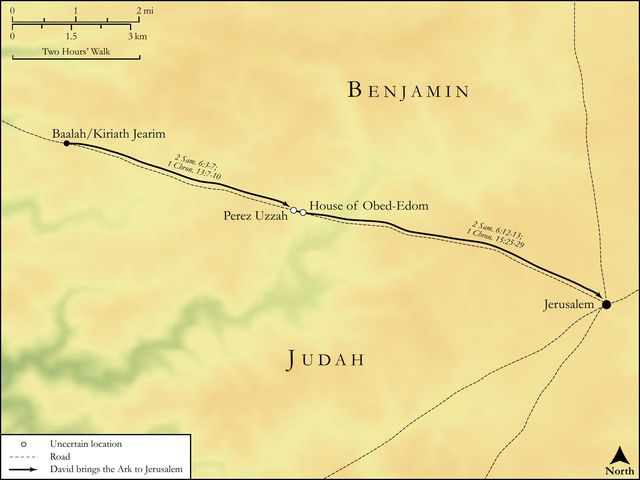
The setting is the newly established capital of Jerusalem, during the reign of King David, a period of significant national consolidation and religious centralization for Israel. The transfer of the Ark from Kiriath-Jearim to Jerusalem was a pivotal event, symbolizing God's dwelling among His people and legitimizing Jerusalem as the spiritual and political heart of the nation. In Scripture, covenants between men were common, often bilateral agreements, as between Abraham and Abimelech, but God's covenant with Abraham stood apart due to its unilateral, unconditional nature, initiated and guaranteed by God Himself. An "oath" in this context was the most solemn form of promise, often involving a self-malediction, making God's sworn word to Isaac an unbreakable guarantee of the covenant's continuation, transcending human fallibility and ensuring divine integrity.
Key Themes
ShowHideThe primary theme is Divine Covenant Fidelity, emphasizing God's absolute commitment to His promises. This verse highlights that God's word is not fleeting but is upheld with divine integrity across generations, forming the very basis of Israel's existence and future hope. Closely related is the theme of Election and Identity, as Israel's unique status as God's chosen people is rooted in this foundational covenant with Abraham and Isaac, reiterated in passages like Deuteronomy 7:6-8. Furthermore, the psalm, including this verse, underscores the theme of Worship and Remembrance, calling the people to recall God's mighty acts and covenant promises as a basis for their praise and trust. This historical recollection serves as a powerful reminder that God's faithfulness in the past provides assurance for His faithfulness in the present and future, a truth echoed in Psalm 77:11.
Exposition and Analysis
ShowHideKey Word Analysis
ShowHideWhile translated "made" in this context, the Hebrew root (H3772) signifies "to cut," specifically referring to the ancient practice of "cutting a covenant." This ritual, often involving the cutting of animals and parties passing between the pieces (as seen in Genesis 15), symbolized the solemnity and binding nature of the agreement, with an implied curse on the party who breaks it. When God "cuts" a covenant, it highlights His sovereign initiation and the unbreakable, self-maledictory nature of His commitment, establishing a divinely guaranteed relationship.
Derived from a root meaning "to swear," this term (H7621) denotes a solemn, binding declaration or promise made under an appeal to a higher power, in this case, God Himself. An oath elevates a promise to the highest level of certainty and irrevocability. God's oath to Isaac (as in Genesis 26:3) signifies that His word is not merely a statement but a self-binding commitment, guaranteed by His own divine character and integrity, ensuring its absolute fulfillment.
Verse Breakdown
ShowHide"[Even of the covenant] which he made with Abraham"
This phrase directly references the foundational Abrahamic Covenant, first detailed in Genesis 12 and further developed in Genesis 15 and Genesis 17. It highlights God's sovereign initiative in establishing a relationship with Abraham, promising him a great nation, a land, and that through him all the families of the earth would be blessed. This covenant is presented as an enduring, unconditional commitment from God, forming the bedrock of Israel's identity and future.
"and of his oath unto Isaac"
This clause emphasizes the continuation and confirmation of the Abrahamic covenant through Abraham's son, Isaac. As recorded in Genesis 26:3-5, God explicitly reaffirms the promises made to Abraham to Isaac, stating that He would be with him, bless him, and multiply his descendants. The mention of an "oath" underscores the absolute certainty and irrevocability of this divine promise, demonstrating that God's faithfulness extends across generations and that His word is utterly reliable.
Literary Devices
ShowHideThe verse employs several significant literary devices. Repetition is prominent, as this verse is a direct quotation from Psalm 105:9, emphasizing its critical theological importance and ensuring its memorability within Israel's collective consciousness and worship. The pairing of "covenant" and "oath" creates a powerful Emphasis through Intensification, reinforcing the unbreakable and utterly reliable nature of God's promises. While "covenant" denotes the agreement, "oath" underscores the divine guarantee of its fulfillment, leaving no doubt about God's commitment. Furthermore, the verse functions as a profound Historical Allusion, drawing the audience's attention back to the foundational narratives of their patriarchs, Abraham and Isaac, thereby grounding Israel's present identity and future hope in God's past faithfulness.
Theological and Thematic Connections
ShowHide1 Chronicles 16:16 profoundly articulates the unchanging nature of God and the enduring reliability of His divine promises. It serves as a theological anchor, reminding Israel, and by extension, all believers, that God's character is one of unwavering faithfulness. The covenant with Abraham and its confirmation through an oath to Isaac established not merely a historical lineage but a theological precedent: God is true to His word, and His plans will come to fruition regardless of human circumstances or failures. This divine fidelity forms the very basis of Israel's hope for the future and their understanding of their unique relationship with Yahweh. It teaches that God's commitment is not conditional on human performance but on His own righteous character, providing a powerful assurance that transcends generations and historical epochs.
Reflection and Application
ShowHideThe profound truth embedded in 1 Chronicles 16:16—that God remembers and upholds His covenant and oath across generations—offers immense comfort and a solid foundation for faith in our contemporary lives. Just as God was faithful to Abraham and Isaac, securing their future and the destiny of a nation through His unbreakable word, so too is He faithful to His promises to us. This verse encourages us to look back at God's historical faithfulness as a powerful testament to His character, providing a basis for present trust and future hope. In a world characterized by shifting sands of promises and broken commitments, God's unchanging nature stands as an immovable rock. We are invited to rest in the assurance that whatever God has promised, He will surely bring to pass, whether it pertains to our personal salvation, His provision, or His ultimate plan for redemption. This should inspire a deeper confidence in prayer, a steadfastness in trials, and a joyful anticipation of His future work, knowing that His past faithfulness is the guarantee of His future fulfillment.
Questions for Reflection
ShowHideFAQ
ShowHideWhy is this verse repeated in Psalm 105?
ShowHideThe repetition of 1 Chronicles 16:16 in Psalm 105:9 serves to emphasize its profound significance and theological weight. In ancient literature, repetition was a common rhetorical device used to highlight key truths, ensure memorability, and underscore the foundational nature of a statement. For Israel, God's covenant with Abraham and His oath to Isaac were not just historical facts but the very bedrock of their identity, their claim to the land, and their hope for the future. By including it in both a historical narrative (1 Chronicles) and a psalm of praise (Psalm 105), the inspired authors ensured that this truth would be continually recalled and celebrated in both their national history and their worship. It reinforces the message of God's unwavering covenant faithfulness across all contexts of Israel's life.
What is the significance of "oath" in addition to "covenant"?
ShowHideThe inclusion of "oath" alongside "covenant" is significant because it intensifies the commitment and irrevocability of God's promise. A "covenant" is a solemn, binding agreement, but an "oath" (Hebrew: shᵉbûwʻâh') is a sworn promise, often involving a divine self-curse or an appeal to God's own character as the guarantor. When God makes an oath, as He did to Isaac in Genesis 26:3, it means He is binding Himself by His very nature and integrity. It underscores that the promise is absolutely certain, unchangeable, and will be fulfilled regardless of human circumstances or failures. It leaves no room for doubt regarding the divine commitment, providing the strongest possible assurance of God's faithfulness to His word.
Christ-Centered Fulfillment
ShowHideThe covenant made with Abraham and the oath sworn to Isaac, as highlighted in 1 Chronicles 16:16, find their ultimate and most glorious fulfillment in Jesus Christ. The promises of a numerous "seed" and a universal "blessing to all nations" Genesis 12:3 are realized in Him. As the apostle Paul explains in Galatians 3:16, the "seed" to whom the promises were made is Christ Himself. Through His atoning sacrifice and resurrection, Jesus became the means by which the blessing of Abraham—salvation by faith—is extended to all, Jew and Gentile alike Galatians 3:8-9. The new covenant, inaugurated by Jesus' blood Luke 22:20, is the superior and eternal fulfillment of the spirit of the old, securing a spiritual inheritance and an everlasting relationship with God for all who believe Hebrews 9:15. Thus, God's unwavering faithfulness to Abraham and Isaac points directly to His ultimate faithfulness in sending His Son, who perfectly embodies and fulfills every divine promise, offering an eternal hope far surpassing the temporal promises of old.