


1 Chronicles 16:32
Bible text: King James Version (1769 Blayney text) · Public domain
Bible text: Berean Standard Bible · Public domain
Bible text: American Standard Version (1901) · Public domain
Bible text: World English Bible, Messianic edition · Public domain
Bible text: Geneva Bible (1599) · Public domain
Bible text: Young's Literal Translation · Public domain
- יִרְעַםyir·'Amlet it thunderH7481V-Qal-Imperf-3msVerb Qal Imperfect 3rd Singular Masculine
- הַיָּםhai·Yamthe seaH3220Art ¦ N-msNoun Singular Masculine Absoluteהַtheיָּםsea
- וּמְלוֹאוֹu·me·lo·'Oand what fills itH4393Conj-w ¦ N-msc ¦ 3msNoun Singular Masculine Constructוּandמְלוֹאwhat fillsוֹit
- יַעֲלֹץya·'a·Lotzlet it exultH5970V-Qal-Imperf-3msVerb Qal Imperfect 3rd Singular Masculine
- הַשָּׂדֶהha·sa·Dehthe fieldH7704Art ¦ N-msNoun Singular Masculine Absoluteהַtheשָּׂדֶהfield
- וְכָלve·kholand allH3605Conj-w ¦ N-msNoun Singular Masculine Absoluteוְandכָלall
- אֲשֶׁר'a·SherthatH834RelParticle Relative
- בּוֹbo[is] in itPrep-b ¦ 3msSuffix Personal 3rd Singular Masculineבּ[is] inוֹit
English is a literal word-by-word gloss of the Hebrew, not the KJV's wording. Why?
This is the original text the KJV's translators worked from — each Hebrew word with its own literal English meaning in this verse, prepared by scholars at Tyndale House, Cambridge. The KJV translates whole sentences, not word by word, so its wording differs: one Hebrew word can become several English words, and the KJV may choose “the LORD” where the gloss reads “Yahweh”. Both are faithful — they answer different questions. For the KJV's own rendering, switch to the KJV text.
Details
See on the biblical-era map
Study this verse
Public-domain commentary
Matthew Henry
From his Commentary on the Whole Bible. Henry comments on passages, not single verses — this entry covers 1 Chronicles 16:7–36.
We have here the thanksgiving psalm which David, by the Spirit, composed, and delivered to the chief musician, to be sung upon occasion of the public entry the ark made into the tent prepared for it. Some think he appointed this hymn to be daily used in the temple service, as duly as the day came; whatever other psalms they sung, they must not omit this. David had penned many psalms before this, some in the time of his trouble by Saul. This was composed before, but was now first delivered into the hand of Asaph, for the use of the church. It is gathered out of several psalms (from the beginning to Ch1 16:23 is taken from Psa 105:1, etc.; and then Ch1 16:23 is the whole 96th psalm, with little variation; Ch1 16:34 is taken from Psa 136:1 and divers others; and then the last two verses are taken from the close of Ps. 106), which some think warrants us to do likewise, and make up hymns out of David's psalms, a part of one and a part of another put together so as may be most proper to express and excite the devotion of Christians. These psalms will be best expounded in their proper places (if the Lord will); here we take them as they are put together, with a design to thank the Lord (Ch1 16:7), a great duty, to which we need to be excited and in which we need to be assisted. 1. Let God be glorified in our praises; let his honour be the centre in which all the lines meet. Let us glorify him by our thanksgivings (Give thanks to the Lord), by our prayers (Call on his name, Ch1 16:8), by our songs (Sing psalms unto him), by our discourse - Talk of all his wondrous works, Ch1 16:9. Let us glorify him as a great God, and greatly to be praised (Ch1 16:25), as supreme God (above all gods), as sole God, for all others are idols, Ch1 16:26. Let us glorify him as most bright and blessed in himself (Glory and honour are in his presence, Ch1 16:27), as creator (The Lord made the heavens), as the ruler of the whole creation (His judgments are in all the earth, Ch1 16:14), and as ours - He is the Lord our God. Thus must we give unto the Lord the glory due to his name (Ch1 16:28, Ch1 16:29), and own it, and much more, his due. 2. Let other be edified and instructed: Make known his deeds among the people (Ch1 16:8), declare his glory among the heathen (Ch1 16:24), that those who are strangers to him may be led into acquaintance with him, allegiance to him, and the adoration of him. Thus must we serve the interests of his kingdom among men, that all the earth may fear before him, Ch1 16:30. 3. Let us be ourselves encouraged to triumph and trust in God. Those that give glory to God's name are allowed to glory in it (Ch1 16:10), to value themselves upon their relation to God and venture themselves upon his promise to them. Let the heart of those rejoice that seek the Lord, much more of those that have found him. Seek him, and his strength, and his face: that is, seek him by the ark of his strength, in which he manifests himself. 4. Let the everlasting covenant be the great matter of our joy and praise (Ch1 16:15): Be mindful of his covenant. In the parallel place it is, He will be ever mindful of it, Psa 105:8. Seeing God never will forget it, we never must. The covenant is said to be commanded, because God has obliged us to obey the conditions of it, and because he has both authority to make the promise and ability to make it good. This covenant was ancient, yet never to be forgotten. It was made with Abraham, Isaac, and Jacob, who were long since dead (Ch1 16:16-18), yet still sure to the spiritual seed, and the promises of it pleadable. 5. Let God's former mercies to his people of old, to our ancestors and our predecessors in profession, be commemorated by us now with thankfulness to his praise. Let it be remembered how God protected the patriarchs in their unsettled condition. When they came strangers to Canaan and were sojourners in it, when they were few and might easily have been swallowed up, when they were continually upon the remove and so exposed, when there were many that bore them ill-will and sought to do them mischief, yet no man was suffered to do them wrong - not the Canaanites, Philistines, Egyptians. Kings were reproved and plagued for their sakes. Pharaoh was so, and Abimelech. They were the anointed of the Lord, sanctified by his grace, sanctified by his glory, and had received the unction of the Spirit. They were his prophets, instructed in the things of God themselves and commissioned to instruct others (and prophets are said to be anointed, Kg1 19:16; Isa 61:1); therefore, if any touch them, they touch the apple of God's eye; if any harm them, it is at their peril, Ch1 16:19-22. 6. Let the great salvation of the Lord be especially the subject of our praises (Ch1 16:23): Show forth from day to day his salvation, that is (says bishop Patrick), his promised salvation by Christ. We have reason to celebrate that from day to day; for we daily receive the benefits of it, and it is a subject that can never be exhausted. 7. Let God be praised by a due and constant attendance upon him in the ordinances he has appointed: Bring an offering, then the fruit of the ground, now the fruit of the lips, of the heart (Heb 13:15), and worship him in the beauty of holiness, in the holy places and in a holy manner, Ch1 16:29. Holiness is the beauty of the Lord, the beauty of all sanctified souls and all religious performances. 8. Let God's universal monarchy be the fear and joy of all people. Let us reverence it: Fear before him, all the earth. And let us rejoice in it: Let the heavens be glad and rejoice, because the Lord reigns, and by his providence establishes the world, so that, though it be moved, it cannot be removed, nor the measures broken which Infinite Wisdom has taken in the government of it, Ch1 16:30, Ch1 16:31. 9. Let the prospect of the judgment to come inspire us with an awful pleasure, Let earth and sea, fields and woods, though in the great day of the Lord they will all be consumed, yet rejoice that he will come, doth come, to judge the earth, Ch1 16:32, Ch1 16:33. 10. In the midst of our praises we must not forget to pray for the succour and relief of those saints and servants of God that are in distress (Ch1 16:35): Save us, gather us, deliver us from the heathen, those of us that are scattered and oppressed. When we are rejoicing in God's favours to us we must remember our afflicted brethren, and pray for their salvation and deliverance as our own. We are members one of another; and therefore when we mean, "Lord, save them," it is not improper to say, "Lord, save us." Lastly, Let us make God the Alpha and Omega of our praises. David begins with (Ch1 16:8), Give thanks to the Lord; he concludes (Ch1 16:36), Blessed be the Lord. And whereas in the place whence this doxology is taken (Psa 106:48) it is added, Let all the people say, Amen, Hallelujah, here we find they did according to that directory: All the people said, Amen, and praised the Lord. When the Levites had finished this psalm or prayer and praise, then, and not till then, the people that attended signified their consent and concurrence by saying, Amen, And so they praised the Lord, much affected no doubt with this newly instituted way of devotion, which had been hitherto used in the schools of the prophets only, Sa1 10:5. And, if this way of praising God please the Lord better than an ox or a bullock that has horns and hoofs, the humble shall see it and be glad, Psa 69:31, Psa 69:32.
Continue studying 1 Chronicles 16:32 across the web’s major study libraries — every link below opens this exact verse, chapter, or book on the destination site.
Read & Compare
 BibleGatewayThis verse in more than 200 translations and 70 languages.
 Bible.comThe YouVersion reader — hundreds of translations, reading plans, and highlights.
 ESV.orgCrossway's official English Standard Version reader.
 NET BibleThe NET translation with 60,000+ translators' notes on every rendering decision.
 STEP BibleTyndale House's free study tool — original text, vocabulary, and scholarly resources.
 BibliaLogos Bible Software's free web reader.
 USCCBThe New American Bible (Revised Edition) with the U.S. bishops' study notes.
Commentaries
 BibleHub CommentariesDozens of classic commentaries on this verse, gathered on one page.
 StudyLightMore than 100 commentary sets — the largest collection on the web.
 BibleRefPlain-English commentary on what this verse means, verse by verse.
 Enduring WordDavid Guzik's free commentary on this chapter, widely used by Bible teachers.
 Bible Study ToolsVerse commentary alongside Greek and Hebrew study aids.
Original Language & Research
- BibleHub InterlinearThe verse word by word — original language, transliteration, and English.
- BibleHub LexiconEvery word's original-language definition and Strong's entry.
 Blue Letter BibleDeep-study tools — Strong's numbers, concordance, and word studies.
 SefariaThe Hebrew text with Rashi and centuries of Jewish commentary.
Sermons, Hymns & Audio


TrulyRandomVerse is not affiliated with these sites and doesn’t control their content. They’re linked because they’re genuinely useful.
Summary
1 Chronicles 16:32 is a powerful and expansive summons for all creation—specifically the sea with its vastness and the fields with their abundance—to vocally and joyfully participate in praising God. This verse, situated within King David's profound psalm of thanksgiving for the Ark of the Covenant's sacred arrival in Jerusalem, transcends human-centric worship, portraying the natural world as inherently responsive and jubilant in acknowledging its Creator's majestic sovereignty. It encapsulates the exuberant spirit of a pivotal moment in Israel's history, inviting a universal chorus of exultation and homage.
Context
ShowHideLiterary Context
This verse is an integral part of a magnificent psalm of thanksgiving and praise (1 Chronicles 16:8-36) that King David delivered, or appointed to be sung, on the momentous day the Ark of the Covenant was brought into Jerusalem and placed within the tent he had prepared for it. This psalm is a masterful composite, drawing heavily from other Psalms, notably Psalm 105:1-15, Psalm 96:1-13, and Psalm 106:1, 47-48. The immediate verses preceding 1 Chronicles 16:32 (verses 23-31) repeatedly call for the nations and the heavens to declare God's glory, setting the stage for the earth itself to join this symphony of praise. The psalm culminates in a powerful doxology, emphasizing God's eternal goodness and salvation, thereby framing the entire passage as a comprehensive call to worship.
Historical & Cultural Context
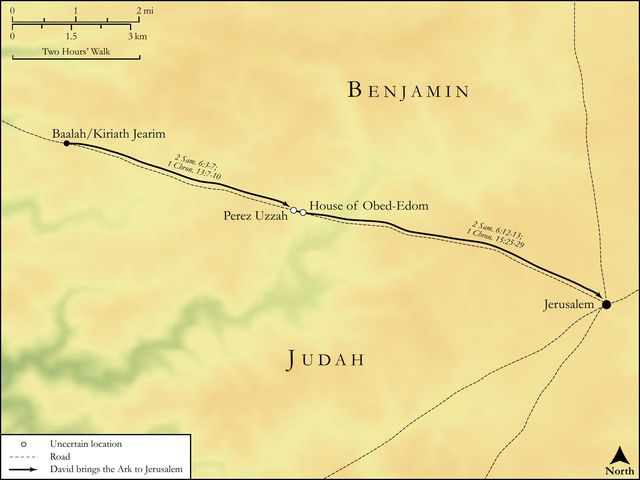
The bringing of the Ark to Jerusalem (1 Chronicles 15-16) was an event of immense theological and national significance, solidifying Jerusalem's status as both the political and spiritual capital of Israel. The Ark symbolized God's tangible presence among His people, and its proper return after years of neglect and wandering (since its capture by the Philistines and subsequent journey, as detailed in 1 Samuel 4-7) marked a profound moment of national restoration and spiritual revival. David's pivotal role in this event, not merely as king but also as a devout worshipper and orchestrator of cultic praise, underscores his deep commitment to centralizing worship and honoring God. Scripture often shows nature responding to the will of God, as when the prophet says that "all the trees of the field shall clap their hands," making the personification of the sea and fields in an act of praise a readily understandable and profoundly powerful image.
Key Themes
ShowHideThe verse powerfully contributes to several overarching themes within 1 Chronicles and the broader biblical narrative. Firstly, it underscores the theme of Universal Praise, demonstrating that God's glory is so vast and pervasive that all creation, not exclusively humanity, is compelled to acknowledge and celebrate Him. This expands the scope of worship to all creation, echoing the declaration in Psalm 19:1. Secondly, it highlights God's Absolute Sovereignty over all things; the imperative command for the sea to "roar" and the fields to "rejoice" implicitly reveals God's authoritative control over the natural world, which responds obediently to His divine will. Finally, the verse is saturated with Joy and Celebration, reflecting the exuberant spirit appropriate for the Ark's long-awaited return and encouraging a similar celebratory attitude in all worship. This theme is consistently found throughout David's psalms, such as Psalm 98:4-6.
Exposition and Analysis
ShowHideKey Word Analysis
ShowHideDerived from an unused root meaning "to roar," this term refers to a large body of water, specifically the sea, often associated with the noisy surf. In this context, it evokes the immense, powerful, and often tumultuous ocean, whose very sounds become a declaration of God's might.
A primitive root meaning "to tumble" or "be violently agitated," specifically to "crash" (like thunder) or "make to fret." When applied to the sea, it describes a thunderous, powerful, and awe-inspiring sound, suggesting a vibrant, dynamic, and emphatic form of praise that is far from gentle.
This word signifies "fulness" in both a literal and figurative sense, encompassing everything that fills or constitutes a space. Here, it refers to the entirety of the sea—its vast depths, its myriad creatures, and all its contents—emphasizing that every aspect of the marine world is included in this act of worship.
A primitive root meaning "to jump for joy" or "exult." This term conveys a strong sense of exultation, jubilation, and triumph, suggesting an active, expressive, and even leaping or dancing joy. For the fields, it implies a vibrant flourishing, a bountiful harvest, and a lively abundance that inherently declares God's goodness and provision.
Verse Breakdown
ShowHide"Let the sea roar, and the fulness thereof"
This initial clause issues an imperative command for the vast and powerful ocean, along with everything contained within its depths, to make a loud, thunderous sound. The "roar" here is not one of chaos or destruction, but rather of majestic, resounding praise, a natural and profound expression of awe before its Creator. It signifies the raw power, immensity, and dynamic nature of God's creation actively acknowledging His supreme sovereignty.
"let the fields rejoice, and all that [is] therein"
Following the call to the sea, the land—specifically the cultivated "fields"—is commanded to express joy. This creates a powerful contrast between the wild, untamed sea and the life-giving, fertile land, demonstrating that every aspect of the natural world, from the grandest and most untamed to the most mundane and cultivated, is called to respond with jubilation. "All that is therein" encompasses the flourishing crops, the diverse animals, and all the vibrant life supported by the earth, collectively celebrating God's abundant provision and life-sustaining power.
Literary Devices
ShowHide1 Chronicles 16:32 employs several profound literary devices to convey its message of universal praise. Personification is central, attributing human actions and emotions—specifically "roaring" and "rejoicing"—to inanimate or non-human entities like the sea and fields. This vivid imagery makes the abstract concept of creation praising God tangible and relatable, inviting the reader to imagine a creation alive with worship. The verse also utilizes Parallelism, specifically a form of synonymous parallelism where the two clauses ("Let the sea roar, and the fulness thereof: let the fields rejoice, and all that [is] therein") express similar ideas of creation's praise, but through different, yet complementary, natural elements. This structural repetition reinforces the universality and comprehensiveness of the call to worship. Furthermore, the use of the Imperative Mood ("Let the sea roar," "let the fields rejoice") functions as a poetic command, indicating God's absolute authority over creation and its inherent responsiveness to His divine will. This is not merely a description but an active summons, portraying creation as an obedient and eager participant in the divine symphony. The cumulative effect of these devices is a grand, sweeping vision of all creation united in exultant homage to its Creator.
Theological and Thematic Connections
ShowHideThis verse resonates deeply with the biblical understanding of creation as an eloquent testament to God's glory and power. It highlights that the natural world, by its very existence, intricate design, and dynamic operation, inherently declares the majesty of its Maker, inviting humanity to join in this chorus of praise. This perspective elevates our view of nature, not merely as a resource to be exploited, but as an active participant in God's ongoing narrative of worship. The profound theological implication is that God's glory is so immense and pervasive that it cannot be contained by human voices or temples alone; it spills over into every fiber of the created order, compelling even the non-rational elements to acknowledge His supreme worth and sovereignty. This universal call to praise also beautifully foreshadows the ultimate restoration of creation, when all things will fully and perfectly declare God's glory in the new heavens and new earth, unhindered by the effects of sin.
Reflection and Application
ShowHide1 Chronicles 16:32 serves as a profound and inspiring reminder that worship is not confined to human voices, sacred spaces, or prescribed rituals; it is an inherent and spontaneous response of all creation to its Maker. For believers today, this verse challenges us to expand our understanding and experience of worship, recognizing that every sunrise, every crashing wave, every blooming field, and every rustling leaf silently (or powerfully) declares God's majesty and worthiness. It encourages us to cultivate a spirit of profound joy, exuberance, and active gratitude in our own worship and daily lives, mirroring the celebratory tone of this ancient psalm. Furthermore, understanding that the earth and its fullness belong to the Lord should inspire us towards responsible and reverent stewardship of creation, recognizing its inherent value and its vital role in glorifying God. Our care for the environment thus becomes a tangible act of worship, joining the very ground beneath our feet in its ceaseless praise. This verse ultimately calls us to immerse ourselves in creation, not just to admire its beauty, but to actively listen for its perpetual song of praise and to join in with our own voices, actions, and lives.
Questions for Reflection
ShowHideFAQ
ShowHideWhy does the Bible personify natural elements like the sea and fields as praising God?
ShowHideThe personification of natural elements like the sea and fields (e.g., "roar," "rejoice") is a common and powerful poetic and theological device employed throughout Scripture. It serves to emphasize God's absolute sovereignty and the inherent, undeniable responsiveness of all creation to its Creator. It is not suggesting that the sea literally possesses emotions or vocal cords in a human sense, but rather that its powerful sounds, its immense forces, and the land's vibrant fertility and abundant life are natural, undeniable declarations of God's glory, power, and benevolent provision. This literary technique invites humans to perceive the world around them as actively participating in worship, thereby encouraging them to join this chorus of creation. It powerfully underscores that God's majesty is so immense that it compels even the non-rational elements of His creation to acknowledge Him, as vividly seen in Psalm 19:1.
What is the significance of "the fulness thereof" and "all that [is] therein" in this verse?
ShowHideThese phrases ("the fulness thereof" for the sea and "all that [is] therein" for the fields) are crucial for emphasizing the comprehensive and universal nature of the praise being commanded. "The fulness thereof" refers to everything that fills the sea—its vast depths, its countless and diverse creatures, and its immense power and mystery. Similarly, "all that is therein" for the fields encompasses all its produce, its varied animals, and the abundant life it sustains and supports. By explicitly including these phrases, the verse makes it abundantly clear that not just the broad categories of "sea" and "fields" are called to praise, but every single aspect, every creature, and every element within them. This reinforces the profound idea that no part of God's creation is outside the scope of His glory or His call to worship, underscoring the totality of His dominion and the pervasive nature of His presence throughout all things.
Christ-Centered Fulfillment
ShowHideWhile 1 Chronicles 16:32 celebrates creation's inherent and spontaneous praise of God, its ultimate Christ-centered fulfillment points profoundly to Jesus as the one through whom all things were created and by whom all things hold together (Colossians 1:16-17). The "roar" of the sea and the "rejoicing" of the fields, though powerful declarations of the Creator's glory, also hint at a creation that, since the Fall, has been subjected to futility and groans in eager anticipation of its ultimate redemption (Romans 8:19-22). Christ, as the Lamb of God who takes away the sin of the world, is the one through whom this groaning creation will be liberated from its bondage to decay. His redemptive work on the cross not only reconciles humanity to God but also initiates the reconciliation of all things, whether on earth or in heaven (Colossians 1:20). Therefore, the universal praise envisioned in 1 Chronicles 16:32 finds its perfect and eternal expression in the new heavens and new earth, where Christ will be all in all (Ephesians 1:10) and every creature will joyfully join in the chorus of worship, declaring His worthiness without hindrance (Revelation 5:13). The sea will roar and the fields will rejoice in a new creation, fully liberated and perfectly reflecting the resplendent glory of their Redeemer King.