


1 Chronicles 11:18
- וַיִּבְקְעוּvai·yiv·ke·'Uand they broke throughH1234Conj-w ¦ V-Qal-ConsecImperf-3mpVerb Qal Consecutive Imperfect 3rd Plural Masculineוַandיִּבְקְעוּthey broke through
- הַשְּׁלֹשָׁהha·she·lo·Shahthe threeH7969Art ¦ N-csNoun Singular common gender Absoluteהַtheשְּׁלֹשָׁהthree
- בְּמַחֲנֵהbe·ma·cha·Nehin [the] camp ofH4264Prep-b ¦ N-fscNoun Singular Feminine Constructבְּinמַחֲנֵה[the] camp of
- פְלִשְׁתִּיםfe·lish·Tim[the] PhilistinesH6430N-mpNoun Gentilic Plural Masculine Absolute
- וַיִּשְׁאֲבוּvai·yish·'a·vuand they drewH7579Conj-w ¦ V-Qal-ConsecImperf-3mpVerb Qal Consecutive Imperfect 3rd Plural Masculineוַandיִּשְׁאֲבוּthey drew
- מַיִםma·yimwaterH4325N-mpNoun Plural Masculine Absolute
- מִבּוֹרmi·Borfrom [the] well ofH953Prep-m ¦ N-mscNoun Singular Masculine Constructמִfromבּוֹר[the] well of
- בֵּיתbeitBeth-H1035N-properNoun Proper Location
- לֶחֶםle·chem-lehemH1035N-properNoun Proper Location
- אֲשֶׁר'a·SherwhichH834RelParticle Relative
- בַּשַּׁעַרba·Sha·'ar[was] at the gateH8179Prep-b ¦ N-msNoun Singular Masculine Absoluteבַּ[was] at theשַּׁעַרgate
- וַיִּשְׂאוּvai·yis·'Uand they carried [them]H5375Conj-w ¦ V-Qal-ConsecImperf-3mpVerb Qal Consecutive Imperfect 3rd Plural Masculineוַandיִּשְׂאוּthey carried [them]
- וַיָּבִאוּvai·ya·Vi·'uand they brought [them]H935Conj-w ¦ V-Hiphil-ConsecImperf-3mpVerb Hiphil Consecutive Imperfect 3rd Plural Masculineוַandיָּבִאוּthey brought [them]
- אֶל'eltoH413PrepPreposition
- דָּוִידda·VidDavidH1732N-proper-mNoun Proper Masculine
- וְלֹאve·lo'and notH3808Conj-w ¦ NegParticle Negativeוְandלֹאnot
- אָבָה'a·Vahhe was willingH14V-Qal-Perf-3msVerb Qal Perfect 3rd Singular Masculine
- דָוִידda·VidDavidH1732N-proper-mNoun Proper Masculine
- לִשְׁתּוֹתָםlish·to·Tamto drink themH8354Prep-l ¦ V-Qal-Inf ¦ 3mpVerb Qal Infinitive Constructלִtoשְׁתּוֹתָdrinkםthem
- וַיְנַסֵּךְvay·na·Sekhand he poured outH5258Conj-w ¦ V-Piel-ConsecImperf-3msVerb Piel Consecutive Imperfect 3rd Singular Masculineוַandיְנַסֵּךְhe poured out
- אֹתָם'o·Tam<obj.> themH853DirObjM ¦ 3mpParticle Object Indicatorאֹתָ<obj.>םthem
- לַיהוָהla·Yah·wehto YahwehH3068Prep-l ¦ N-properNoun Proper TitleלַtoיהוָהYahweh
English is a literal word-by-word gloss of the Hebrew, not the KJV's wording. Why?
This is the original text the KJV's translators worked from — each Hebrew word with its own literal English meaning in this verse, prepared by scholars at Tyndale House, Cambridge. The KJV translates whole sentences, not word by word, so its wording differs: one Hebrew word can become several English words, and the KJV may choose “the LORD” where the gloss reads “Yahweh”. Both are faithful — they answer different questions. For the KJV's own rendering, switch to the KJV text.
Details
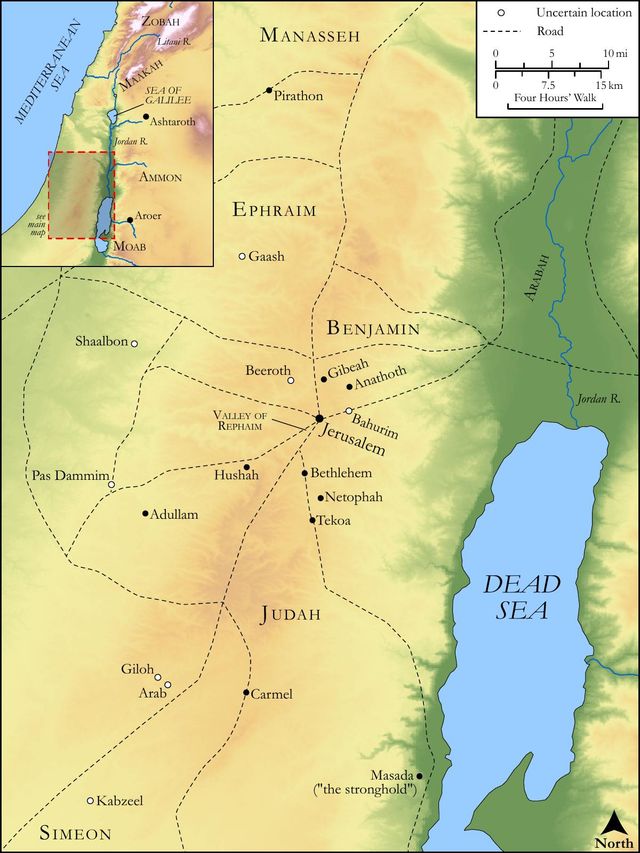
See on the biblical-era map
Study this verse
Public-domain commentary
Matthew Henry
From his Commentary on the Whole Bible. Henry comments on passages, not single verses — this entry covers 1 Chronicles 11:10–47. His two-level outline is real structure in the source text, so it is rendered as structure.
We have here an account of David's worthies, the great men of his time that served him and were preferred by him. The first edition of this catalogue we had, Sa2 23:8, etc. This is much the same, only that those named here from Ch1 11:41 to the end are added. Observe,
I.The connexion of this catalogue with that which is said concerning David, Ch1 11:9.
1.David waxed greater and greater, and these were his mighty men. Much of the strength and honour of great men is borrowed from their servants and depends upon them, which cannot but somewhat diminish pomp and power in the opinion of those that are wise. David is great because he has great men about him; take these away, and he is where he was.
2.The Lord of hosts was with him, and these were the mighty men which he had. God was with him and wrought for him, but by men and means and the use of second causes. By this it appeared that God was with him, that he inclined the hearts of those to come over to him that were able to serve his interest. As, if God be for us none can be against us, so, if God be for us, all shall be for us that we have occasion for. Yet David ascribed his success and increase, not to the hosts he had, but to the Lord of hosts, not to the mighty men that were with him, but to the mighty God whose presence with us is all in all.
II.The title of this catalogue (Ch1 11:10):
These are the men who strengthened themselves with him. In strengthening him they strengthened themselves and their own interest; for his advancement was theirs. What we do in our places for the support of the kingdom of the Son of David we shall be gainers by. In strengthening it we strengthen ourselves. It may be read, They held strongly with him and with all Israel. Note, When God has work to do he will not want fit instruments to do it with. If it be work that requires mighty men, mighty men shall either be found or made to effect it, according to the word of the Lord.
III.That which made all these men honourable was the good service that they did to their king and country; they helped to make David king (Ch1 11:10) - a good work. They slew the Philistines, and other public enemies, and were instrumental to save Israel. Note, The way to be great is to do good. Nor did they gain this honour without labour and the hazard of their lives. The honours of Christ's kingdom are prepared for those that fight the good fight of faith, that labour and suffer, and are willing to venture all, even life itself, for Christ and a good conscience. It is by a patient continuance in well-doing that we must seek for glory, and honour, and immortality; and those that are faithful to the Son of David shall find their names registered and enrolled much more to their honour than these are in the records of fame.
IV.Among all the great exploits of David's mighty men, here is nothing great mentioned concerning David himself but his pouring out water before the Lord which he had longed for, Ch1 11:18, Ch1 11:19. Four very honourable dispositions of David appeared in that action, which, for aught I know, made it as great as any of the achievements of those worthies.
1.Repentance for his own weakness. It is really an honour to a man, when he is made sensible that he has said or done any thing unadvisedly, to unsay it and undo it again by repentance, as it is a shame to a man when he has said or done amiss to stand to it.
2.Denial of his own appetite. He longed for the water of the well of Bethlehem; but, when he had it, he would not drink it, because he would not so far humour himself and gratify a foolish fancy. He that has such a rule as this over his own spirit is better than the mighty. It is an honour to a man to have the command of himself; but he that will command himself must sometimes cross himself.
3.Devotion towards God. That water which he thought too good, too precious, for his own drinking, he poured out to the Lord for a drink offering. If we have any thing better than another, let God be honoured with it, who is the best, and should have the best.
4.Tenderness of his servants. It put him into the greatest confusion imaginable to think that three brave men should hazard their lives to fetch water for him. In his account it turns the water into blood. It is the honour of great men not to be prodigal of the blood of those they employ, but, in all the commands they give them, to put their own souls into their souls' stead.
V.In the wonderful achievements of these heroes the power of God must be acknowledged.
How could one slay 300 and another the same number (Ch1 11:11, Ch1 11:20), another two lion-like men (Ch1 11:22), and another an Egyptian giant (Ch1 11:23), if they had not had the extraordinary presence of God with them, according to that promise, Jos 23:10, One man of you shall chase a thousand, for the Lord your God fighteth for you?
VI.One of these worthies is said to be an Ammonite (Ch1 11:39), another a Moabite (Ch1 11:46), and yet the law was that an Ammonite and a Moabite should not enter into the congregation of the Lord, Deu 23:3. These, it is likely, had approved themselves so hearty for the interest of Israel that in their case it was thought fit to dispense with that law, and the rather because it was an indication that the Son of David would have worthies among the Gentiles: with him there is neither Greek nor Jew.
Historical interpretation
Historical reception
2 surviving comments on this verse. Each one is dated, so this reads as a timeline rather than a list.
I must tell you that I have been led to praise God the more for your work by what I have learned from the report of my most believed son Probinus the presbyter; namely that, your excellency, having issued a certain ordinance against the perfidy of the Jews, those to whom it related attempted to bend the rectitude of your mind by offering a sum of money, which your excellency scorned, and, seeking to satisfy the judgment of almighty God, preferred innocence to gold. With regard to this, what was done by King David recurs to my mind, who, when he longed for water from the cistern of Bethlehem, which was wedged in by the enemy, had been brought him by obedient soldiers, said, “God forbid that I should drink the blood of righteous men.” And, because he poured it out and would not drink it, it is written, “He offered it a libation to the Lord.” If, then, water was scorned by the armed king and turned into a sacrifice to God, we may estimate what manner of sacrifice to almighty God has been offered by the king who for his love has scorned to receive not water but gold.
David desired long afterwards to drink water from the cistern of Bethlehem, which, when his bravest soldiers had brought to him, he refused to drink and poured it out as a libation to the Lord. For it was lawful for him to drink it, had he been so minded; but, because he remembered having done what was unlawful, he laudably abstained even from what was lawful. And he, who to his guilt previously feared not that the blood of dying soldiers should be shed, afterwards considered that, were he to drink the water, he would have shed the blood of living soldiers, saying, “Shall I drink the blood of these men who have put their lives in jeopardy?”
Continue studying 1 Chronicles 11:18 across the web’s major study libraries — every link below opens this exact verse, chapter, or book on the destination site.
Read & Compare
 BibleGatewayThis verse in more than 200 translations and 70 languages.
 Bible.comThe YouVersion reader — hundreds of translations, reading plans, and highlights.
 ESV.orgCrossway's official English Standard Version reader.
 NET BibleThe NET translation with 60,000+ translators' notes on every rendering decision.
 STEP BibleTyndale House's free study tool — original text, vocabulary, and scholarly resources.
 BibliaLogos Bible Software's free web reader.
 USCCBThe New American Bible (Revised Edition) with the U.S. bishops' study notes.
Commentaries
 BibleHub CommentariesDozens of classic commentaries on this verse, gathered on one page.
 StudyLightMore than 100 commentary sets — the largest collection on the web.
 BibleRefPlain-English commentary on what this verse means, verse by verse.
 Enduring WordDavid Guzik's free commentary on this chapter, widely used by Bible teachers.
 Bible Study ToolsVerse commentary alongside Greek and Hebrew study aids.
Original Language & Research
- BibleHub InterlinearThe verse word by word — original language, transliteration, and English.
- BibleHub LexiconEvery word's original-language definition and Strong's entry.
 Blue Letter BibleDeep-study tools — Strong's numbers, concordance, and word studies.
 SefariaThe Hebrew text with Rashi and centuries of Jewish commentary.
Sermons, Hymns & Audio


TrulyRandomVerse is not affiliated with these sites and doesn’t control their content. They’re linked because they’re genuinely useful.
Summary
1 Chronicles 11:18 recounts a deeply moving incident where three of David's most valiant warriors, driven by extraordinary loyalty, risked their lives to fulfill David's wistful desire for water from his hometown well in Bethlehem, which was then under Philistine occupation. Upon receiving this costly gift, David, recognizing the immense sacrifice and valuing their lives above his own comfort, refused to drink the water. Instead, he poured it out as a sacred libation to the LORD, transforming an act of human devotion into a profound expression of worship and consecration, acknowledging God as the ultimate recipient of such a precious offering.
Context
ShowHideLiterary Context
This verse is strategically placed within 1 Chronicles 11, a pivotal chapter that immediately follows David's anointing as king over all Israel (1 Chronicles 11:1-3) and his conquest of Jerusalem (1 Chronicles 11:4-9). The Chronicler's primary aim in detailing David's "mighty men" is not merely to list their heroic deeds, but to underscore the divine favor upon David's reign, the unwavering loyalty he commanded, and the providential hand of God in establishing his kingdom. This specific narrative, paralleled in 2 Samuel 23:13-17, serves as a powerful character study, illustrating the moral and spiritual caliber of David's leadership and the profound devotion he inspired, thereby setting a significant tone for the subsequent accounts of his kingship and the preparations for the temple.
Historical & Cultural Context
The events depicted in 1 Chronicles 11:18 occur early in David's reign, likely when he was based in a fortified stronghold, possibly the cave of Adullam, while the Philistines maintained a dominant military presence, even garrisoning strategic locations like Bethlehem, David's ancestral home. This period was marked by persistent conflict between Israel and the Philistines, rendering any incursion into enemy-held territory exceptionally dangerous and life-threatening. In the arid climate of ancient Israel, water was an invaluable and often scarce resource, necessitating significant effort to procure. A specific well, especially one from a hometown, could hold deep sentimental significance, evoking powerful feelings of nostalgia and longing. Culturally, the act of pouring out a liquid as an offering, known as a libation or drink offering, was a widely recognized form of worship throughout the ancient Near East, including Israel. Such offerings, as seen in various Old Testament passages like Exodus 29:40 and Numbers 15:5, signified dedication, gratitude, or propitiation to a deity, underscoring the sacred nature of David's spontaneous act.
Key Themes
ShowHideThe narrative of 1 Chronicles 11:18 illuminates several profound themes central to the Chronicler's theological agenda. Firstly, it vividly portrays extraordinary loyalty and selfless devotion, as David's three elite warriors exemplify a willingness to risk their very lives for their leader's mere wistful desire, transcending the normal call of duty and showcasing unparalleled commitment. Secondly, the passage highlights David's profound reverence and sacrificial leadership, revealing his spiritual sensitivity and his deep understanding of the sanctity of human life. By recognizing the "blood" (life-risk) inherent in the water, he values the lives of his men above his own comfort, a theme consistently echoed throughout biblical law regarding the sanctity of life (e.g., Leviticus 17:11). Finally, the verse powerfully illustrates consecration and true worship, as David transforms a personal gift, obtained at immense hazard, into a sacred offering to the LORD. This act demonstrates that genuine worship often involves the surrender of what is most precious, acknowledging God as the ultimate recipient and rightful owner of all costly sacrifices.
Exposition and Analysis
ShowHideKey Word Analysis
ShowHideThis verb, derived from H1234, signifies a forceful and violent action, meaning "to cleave; generally, to rend, break, rip or open; make a breach, break forth (into, out, in pieces, through, up)." It vividly conveys the sheer determination and perilous nature of the warriors' mission. They did not merely bypass or slip past the enemy; they "burst through" the Philistine host, emphasizing the extreme danger and the extraordinary effort required for their audacious act of devotion.
This term, from H5258, specifically refers to the act of pouring out a liquid, often in the context of a "libation" or "drink offering." It transforms a simple physical act into a ritualistic, sacred gesture. David's action is not a casual discarding of the water but a solemn performance of dedication, acknowledging that such a costly gift, representing the potential "blood" (life) of his men, was too sacred for personal consumption and could only be appropriately offered to the LORD Himself.
The use of the covenant name of God, H3068, "Jehovah, Jewish national name of God," emphasizes that David's offering was directed to the sovereign, covenant-keeping God of Israel. It underscores the profound theological depth of David's action, elevating it beyond a mere superstitious gesture to a profound act of worship and recognition of divine authority, holiness, and the ultimate source of all life and blessing.
Verse Breakdown
ShowHide"And the three brake through the host of the Philistines"
This opening clause immediately establishes the immense courage and danger inherent in the situation. The "three" are identified as the chief of David's mighty men, signifying their elite status and unparalleled bravery. Their action, described as "breaking through," implies a forceful penetration of enemy lines rather than a stealthy infiltration, highlighting their audacious loyalty and the high stakes involved in their mission.
"and drew water out of the well of Bethlehem, that [was] by the gate"
This clause specifies both the sentimental and strategic target. The "well of Bethlehem," David's hometown, held deep personal significance for him, evoking nostalgia. Its location "by the gate" suggests it was a prominent and likely guarded position, further emphasizing the extreme difficulty and risk the warriors undertook to obtain the water.
"and took [it], and brought [it] to David"
This details the successful completion of their perilous task. The water, obtained at such an extraordinary cost, was presented to David as a tangible and potent expression of their extreme loyalty and devotion, a deeply personal gift born of immense sacrifice and courage.
"but David would not drink [of] it, but poured it out to the LORD"
This is the pivotal moment of the verse, revealing David's profound spiritual discernment and moral integrity. His refusal to drink is not a rejection of their gift but a recognition of its sacred cost. He equates the water with the "blood" (life-force) of the men who risked everything, deeming it too precious for mere personal gratification. By pouring it out to the LORD, David transforms it into a solemn libation, an act of worship and consecration. He acknowledges that such a costly sacrifice, representing the very lives of his loyal men, could only be fittingly offered to God, the ultimate giver and sustainer of all life.
Literary Devices
ShowHideThe narrative of 1 Chronicles 11:18 is profoundly enriched by several literary devices. Most prominently, there is powerful Symbolism. The water, a basic necessity for life, transcends its literal meaning to become a potent symbol of life itself, and by extension, the precious lives of the men who risked everything to obtain it. David's refusal to drink it, and his subsequent act of pouring it out, transforms it into a symbolic offering of their "blood" or life force to God. This action elevates the physical water to a spiritual plane. Furthermore, the verse employs a strong element of Contrast: the violent, physical act of the warriors "breaking through" enemy lines is sharply juxtaposed with David's quiet, deeply spiritual act of pouring out the water. This contrast highlights the different yet equally profound forms of devotion and sacrifice. Finally, the narrative subtly uses Irony, as David's casual, almost wistful longing for a drink of water from his homeland leads to an act of immense sacrifice by his men, which then elicits an even more profound act of spiritual consecration from David himself. This elevates a simple human desire into a moment of deep theological significance and worship.
Theological and Thematic Connections
ShowHideThis incident profoundly illustrates the biblical principle of the sanctity of life and the nature of true sacrifice. David understood that the water, though physically just water, was imbued with the "blood" (life-risk) of his men. To consume it for his personal comfort would be to trivialize their immense sacrifice and disregard the sacredness of human life. His act of pouring it out to the LORD elevates the offering from a personal gift to a sacred libation, acknowledging that the ultimate value of life and costly sacrifice belongs to God alone. This teaches us that genuine worship often involves recognizing the true cost of things, valuing human life above personal desire, and consecrating our most precious possessions, efforts, or even desires to God. It is a powerful reminder that all good gifts ultimately come from God, and the most profound acts of gratitude and devotion are those that return the costly gifts to Him in worship, demonstrating that true honor is given to the Creator, not consumed by the creature.
Reflection and Application
ShowHideDavid's profound response to his mighty men's extraordinary sacrifice offers a timeless and powerful lesson in leadership, gratitude, and the very essence of true worship. It challenges us, as individuals and leaders, to look beyond the superficiality of gifts and services rendered to us, urging us to discern the true cost—the often unseen effort, profound sacrifice, and potential risk—that others undertake on our behalf. Are we prone to simply consume what is given, or do we, like David, pause to consider the "blood" (the life, time, energy, or resources) that was poured into it? This compelling story calls us to cultivate a profound sense of gratitude and to honor the sacrifices of others by not taking them lightly or for granted. Furthermore, David's decisive act of pouring out the water to the LORD serves as a potent reminder that our most costly and precious possessions, our unique talents, or even the fruits of others' sacrifices for us, are ultimately to be consecrated to God. True worship is not merely about what we give from our abundance, but rather what we are willing to surrender because of its sacred value, recognizing that all things ultimately belong to Him. It teaches us to transform personal gain and comfort into divine glory, valuing God's honor and the sanctity of life above our own immediate desires.
Questions for Reflection
ShowHideFAQ
ShowHideWhy did David pour out the water instead of drinking it?
ShowHideDavid refused to drink the water because he recognized the immense cost and the potential "blood" (life) of his men that had been risked to obtain it. He viewed the water as sacred, equating it with the lives of his loyal warriors who had broken through enemy lines. To consume it for his personal comfort would have been to trivialize their profound sacrifice. Instead, by pouring it out to the LORD, David performed an act of spiritual consecration, transforming the costly gift into a solemn libation—a drink offering—to God. This act acknowledged God as the ultimate recipient of such a profound sacrifice and demonstrated David's deep reverence for the sanctity of life and his commitment to honoring God above his own desires. It was an act of worship, recognizing that such a precious "gift" could only be fittingly offered to the divine.
What is a "drink offering" and why is it significant here?
ShowHideA "drink offering" (or libation) was a ritual in ancient Israelite worship where liquids, typically wine or water, were poured out as an act of dedication or worship to God. It was often offered alongside other sacrifices, symbolizing the pouring out of one's life or devotion to the LORD. In passages like Exodus 29:40 and Numbers 15:5, we see specific instructions for these offerings. David's spontaneous act of pouring out the water from Bethlehem is significant because it transforms a moment of personal desire and a heroic feat by his men into a profound act of spiritual worship. While not a prescribed ritual in this specific context, David's action reflects a deep understanding of consecration—that what is most valuable, especially that which involves the risk of life, should ultimately be dedicated to God. It signifies that the water, representing the very "blood" of his men, was too sacred for common use and could only be offered to the holy God.
Christ-Centered Fulfillment
ShowHideDavid's profound act of pouring out the water, which he considered the "blood" of his men, serves as a powerful Old Testament foreshadowing of the ultimate, perfect sacrifice of Jesus Christ. David, recognizing the immense cost of human life and the sacredness of a life-risking gift, refused to benefit from a sacrifice that was too great for him to personally consume, instead consecrating it to the LORD. In a far greater and infinitely more profound way, Jesus, the true Lamb of God who takes away the sin of the world, willingly poured out His own "blood"—His very life—not as a symbolic offering, but as the actual, atoning sacrifice for humanity's sin. Unlike the water that David could not drink, Christ's blood is given for us to partake of, offering eternal life and cleansing, as He Himself declared at the Last Supper when instituting the new covenant in His blood (e.g., Mark 14:24). David's reverence for the lives of his men, leading him to offer their "blood" to God, points to the infinitely greater love of God who, in Christ, "did not spare His own Son but gave Him up for us all" (Romans 8:32). Thus, David's noble act, while commendable, ultimately finds its complete fulfillment and redemptive power in the self-emptying sacrifice of Christ, who poured out His life as a fragrant offering and a sacrifice to God for our salvation (Ephesians 5:2).