


1 Chronicles 11:17
Bible text: King James Version (1769 Blayney text) · Public domain
Bible text: Berean Standard Bible · Public domain
Bible text: American Standard Version (1901) · Public domain
Bible text: World English Bible, Messianic edition · Public domain
Bible text: Geneva Bible (1599) · Public domain
Bible text: Young's Literal Translation · Public domain
- וַיִּתְאָיוvai·yit·'avand he cravedH183Conj-w ¦ V-Hithpael-ConsecImperf-3msVerb Hithpael Consecutive Imperfect 3rd Singular Masculineוַandיִּתְאָיוhe craved
- דָּוִידda·VidDavidH1732N-proper-mNoun Proper Masculine
- וַיֹּאמַרvai·yo·Marand he saidH559Conj-w ¦ V-Qal-ConsecImperf-3msVerb Qal Consecutive Imperfect 3rd Singular Masculineוַandיֹּאמַרhe said
- מִיmiwho?H4310InterrogPronoun Interrogative
- יַשְׁקֵנִיyash·Ke·niwill he give to drink meH8248V-Hiphil-Imperf-3ms ¦ 1csVerb Hiphil Imperfect 3rd Singular Masculineיַשְׁקֵwill he give to drinkנִיme
- מַיִםMa·yimwaterH4325N-mpNoun Plural Masculine Absolute
- מִבּוֹרmi·Borfrom [the] well ofH953Prep-m ¦ N-mscNoun Singular Masculine Constructמִfromבּוֹר[the] well of
- בֵּיתbeitBeth-H1035N-properNoun Proper Location
- לֶחֶםLe·chem-lehemH1035N-properNoun Proper Location
- אֲשֶׁר'a·SherwhichH834RelParticle Relative
- בַּשָּׁעַרba·Sha·'ar[is] at the gateH8179Prep-b ¦ N-msNoun Singular Masculine Absoluteבַּ[is] at theשָּׁעַרgate
English is a literal word-by-word gloss of the Hebrew, not the KJV's wording. Why?
This is the original text the KJV's translators worked from — each Hebrew word with its own literal English meaning in this verse, prepared by scholars at Tyndale House, Cambridge. The KJV translates whole sentences, not word by word, so its wording differs: one Hebrew word can become several English words, and the KJV may choose “the LORD” where the gloss reads “Yahweh”. Both are faithful — they answer different questions. For the KJV's own rendering, switch to the KJV text.
Details
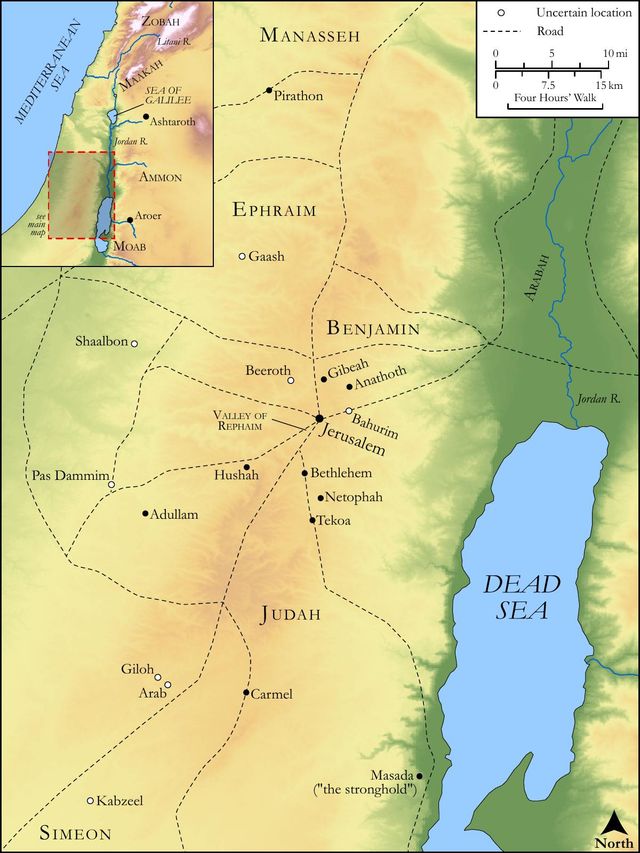
See on the biblical-era map
Study this verse
Public-domain commentary
Matthew Henry
From his Commentary on the Whole Bible. Henry comments on passages, not single verses — this entry covers 1 Chronicles 11:10–47. His two-level outline is real structure in the source text, so it is rendered as structure.
We have here an account of David's worthies, the great men of his time that served him and were preferred by him. The first edition of this catalogue we had, Sa2 23:8, etc. This is much the same, only that those named here from Ch1 11:41 to the end are added. Observe,
I.The connexion of this catalogue with that which is said concerning David, Ch1 11:9.
1.David waxed greater and greater, and these were his mighty men. Much of the strength and honour of great men is borrowed from their servants and depends upon them, which cannot but somewhat diminish pomp and power in the opinion of those that are wise. David is great because he has great men about him; take these away, and he is where he was.
2.The Lord of hosts was with him, and these were the mighty men which he had. God was with him and wrought for him, but by men and means and the use of second causes. By this it appeared that God was with him, that he inclined the hearts of those to come over to him that were able to serve his interest. As, if God be for us none can be against us, so, if God be for us, all shall be for us that we have occasion for. Yet David ascribed his success and increase, not to the hosts he had, but to the Lord of hosts, not to the mighty men that were with him, but to the mighty God whose presence with us is all in all.
II.The title of this catalogue (Ch1 11:10):
These are the men who strengthened themselves with him. In strengthening him they strengthened themselves and their own interest; for his advancement was theirs. What we do in our places for the support of the kingdom of the Son of David we shall be gainers by. In strengthening it we strengthen ourselves. It may be read, They held strongly with him and with all Israel. Note, When God has work to do he will not want fit instruments to do it with. If it be work that requires mighty men, mighty men shall either be found or made to effect it, according to the word of the Lord.
III.That which made all these men honourable was the good service that they did to their king and country; they helped to make David king (Ch1 11:10) - a good work. They slew the Philistines, and other public enemies, and were instrumental to save Israel. Note, The way to be great is to do good. Nor did they gain this honour without labour and the hazard of their lives. The honours of Christ's kingdom are prepared for those that fight the good fight of faith, that labour and suffer, and are willing to venture all, even life itself, for Christ and a good conscience. It is by a patient continuance in well-doing that we must seek for glory, and honour, and immortality; and those that are faithful to the Son of David shall find their names registered and enrolled much more to their honour than these are in the records of fame.
IV.Among all the great exploits of David's mighty men, here is nothing great mentioned concerning David himself but his pouring out water before the Lord which he had longed for, Ch1 11:18, Ch1 11:19. Four very honourable dispositions of David appeared in that action, which, for aught I know, made it as great as any of the achievements of those worthies.
1.Repentance for his own weakness. It is really an honour to a man, when he is made sensible that he has said or done any thing unadvisedly, to unsay it and undo it again by repentance, as it is a shame to a man when he has said or done amiss to stand to it.
2.Denial of his own appetite. He longed for the water of the well of Bethlehem; but, when he had it, he would not drink it, because he would not so far humour himself and gratify a foolish fancy. He that has such a rule as this over his own spirit is better than the mighty. It is an honour to a man to have the command of himself; but he that will command himself must sometimes cross himself.
3.Devotion towards God. That water which he thought too good, too precious, for his own drinking, he poured out to the Lord for a drink offering. If we have any thing better than another, let God be honoured with it, who is the best, and should have the best.
4.Tenderness of his servants. It put him into the greatest confusion imaginable to think that three brave men should hazard their lives to fetch water for him. In his account it turns the water into blood. It is the honour of great men not to be prodigal of the blood of those they employ, but, in all the commands they give them, to put their own souls into their souls' stead.
V.In the wonderful achievements of these heroes the power of God must be acknowledged.
How could one slay 300 and another the same number (Ch1 11:11, Ch1 11:20), another two lion-like men (Ch1 11:22), and another an Egyptian giant (Ch1 11:23), if they had not had the extraordinary presence of God with them, according to that promise, Jos 23:10, One man of you shall chase a thousand, for the Lord your God fighteth for you?
VI.One of these worthies is said to be an Ammonite (Ch1 11:39), another a Moabite (Ch1 11:46), and yet the law was that an Ammonite and a Moabite should not enter into the congregation of the Lord, Deu 23:3. These, it is likely, had approved themselves so hearty for the interest of Israel that in their case it was thought fit to dispense with that law, and the rather because it was an indication that the Son of David would have worthies among the Gentiles: with him there is neither Greek nor Jew.
Historical interpretation
Two Centuries of Reception
3 surviving comments on this verse. Each one is dated, so this reads as a timeline rather than a list.
Select a marker to jump to its quote. Markers stagger vertically where authors wrote within a few decades of each other.
The observance of Lent becomes not the curbing of old passions but an opportunity for new pleasures. Take measures in advance with as much diligence as possible to prevent these attitudes from creeping on you. Let frugality be joined to fasting. As satisfying the stomach is to be censured, so stimulants of the appetite must be eliminated. It is not that certain kinds of food are to be detested but that bodily pleasure is to be checked.… And holy King David repented of having excessively desired water.
I must tell you that I have been led to praise God the more for your work by what I have learned from the report of my most believed son Probinus the presbyter; namely that, your excellency, having issued a certain ordinance against the perfidy of the Jews, those to whom it related attempted to bend the rectitude of your mind by offering a sum of money, which your excellency scorned, and, seeking to satisfy the judgment of almighty God, preferred innocence to gold. With regard to this, what was done by King David recurs to my mind, who, when he longed for water from the cistern of Bethlehem, which was wedged in by the enemy, had been brought him by obedient soldiers, said, “God forbid that I should drink the blood of righteous men.” And, because he poured it out and would not drink it, it is written, “He offered it a libation to the Lord.” If, then, water was scorned by the armed king and turned into a sacrifice to God, we may estimate what manner of sacrifice to almighty God has been offered by the king who for his love has scorned to receive not water but gold.
David desired long afterwards to drink water from the cistern of Bethlehem, which, when his bravest soldiers had brought to him, he refused to drink and poured it out as a libation to the Lord. For it was lawful for him to drink it, had he been so minded; but, because he remembered having done what was unlawful, he laudably abstained even from what was lawful. And he, who to his guilt previously feared not that the blood of dying soldiers should be shed, afterwards considered that, were he to drink the water, he would have shed the blood of living soldiers, saying, “Shall I drink the blood of these men who have put their lives in jeopardy?”
Continue studying 1 Chronicles 11:17 across the web’s major study libraries — every link below opens this exact verse, chapter, or book on the destination site.
Read & Compare
 BibleGatewayThis verse in more than 200 translations and 70 languages.
 Bible.comThe YouVersion reader — hundreds of translations, reading plans, and highlights.
 ESV.orgCrossway's official English Standard Version reader.
 NET BibleThe NET translation with 60,000+ translators' notes on every rendering decision.
 STEP BibleTyndale House's free study tool — original text, vocabulary, and scholarly resources.
 BibliaLogos Bible Software's free web reader.
 USCCBThe New American Bible (Revised Edition) with the U.S. bishops' study notes.
Commentaries
 BibleHub CommentariesDozens of classic commentaries on this verse, gathered on one page.
 StudyLightMore than 100 commentary sets — the largest collection on the web.
 BibleRefPlain-English commentary on what this verse means, verse by verse.
 Enduring WordDavid Guzik's free commentary on this chapter, widely used by Bible teachers.
 Bible Study ToolsVerse commentary alongside Greek and Hebrew study aids.
Original Language & Research
- BibleHub InterlinearThe verse word by word — original language, transliteration, and English.
- BibleHub LexiconEvery word's original-language definition and Strong's entry.
 Blue Letter BibleDeep-study tools — Strong's numbers, concordance, and word studies.
 SefariaThe Hebrew text with Rashi and centuries of Jewish commentary.
Sermons, Hymns & Audio


TrulyRandomVerse is not affiliated with these sites and doesn’t control their content. They’re linked because they’re genuinely useful.
Summary
1 Chronicles 11:17 captures a deeply poignant and human moment in the life of King David. Amidst the strategic and physical demands of consolidating his kingdom and confronting the Philistine threat, David expresses a profound, almost wistful longing for water from the well of Bethlehem, his ancestral home. This seemingly simple, nostalgic desire, made perilous by the enemy occupation of Bethlehem, serves as the emotional catalyst for an extraordinary display of selfless loyalty and daring by his elite warriors, revealing the depth of their devotion to their king and the unique, unbreakable bond forged in shared purpose and sacrifice.
Context
ShowHideLiterary Context
This verse is strategically positioned within the Chronicler's narrative, immediately following David's anointing as king over all Israel and his successful capture of Jerusalem, which he established as his capital (1 Chronicles 11:1-9). The passage then transitions to list David's mighty men, highlighting their heroic deeds. Crucially, 1 Chronicles 11:16 explicitly sets the scene by noting the Philistine garrison's presence in Bethlehem, David's hometown, directly preceding his longing. This longing in verse 17 then acts as the dramatic trigger for the incredible acts of courage and loyalty performed by David's elite warriors, detailed in 1 Chronicles 11:18-19, making this verse the emotional heart of a narrative segment that showcases the profound bond between David and his devoted companions.
Historical & Cultural Context
David's early reign was characterized by persistent military engagements, particularly against the Philistines, who posed a formidable and ongoing threat to Israel's nascent sovereignty. At this specific juncture, David was likely situated in a fortified stronghold, possibly the cave of Adullam or a similar refuge, a common tactic during periods of intense conflict. Bethlehem, David's ancestral village, was under Philistine occupation, effectively making it enemy territory. The mention of the well "at the gate" is culturally significant, as city gates were not merely entry points but served as vital centers for commerce, legal proceedings, and defense. For a well to be located there meant it was a prominent, essential resource, but also a highly dangerous objective under enemy control. Water, especially during military campaigns and in the arid climate of ancient Israel, was a precious and often scarce commodity, making access to a well in an occupied city a perilous undertaking.
Key Themes
ShowHideThis verse powerfully highlights the humanity and vulnerability of David, portraying him not merely as an invincible warrior-king but as a man susceptible to simple, nostalgic desires, perhaps intensified by the relentless pressures of war and leadership. It also underscores the profound power of nostalgia and the emotional pull of home, as David's longing is not for just any water, but specifically for water from the well of Bethlehem, a place deeply connected to his personal history, identity, and the roots of his anointing. Furthermore, it serves as a dramatic introduction to the theme of extraordinary loyalty and selfless sacrifice, as David's seemingly casual wish immediately precedes one of the most remarkable displays of devotion by his elite warriors, as detailed in 1 Chronicles 11:18-19. This act, also recounted in 2 Samuel 23:15-17, serves as a testament to the deep bond and mutual respect between David and his most trusted companions, illustrating the kind of leadership that inspires such profound devotion.
Exposition and Analysis
ShowHideKey Word Analysis
ShowHideThe Hebrew verb H183, ʼâvâh, signifies a deep, intense yearning or craving, often bordering on desperation or wistfulness. It conveys a profound emotional pull rather than a mere physical thirst, suggesting an aching desire for something deeply personal or connected to one's past. In this context, it emphasizes the depth of David's emotional state, perhaps a momentary vulnerability or weariness amidst the rigors of leadership and war, elevating his desire from a simple physical need to a profound, almost aching, emotional connection to his past and home.
The Hebrew H1035, Bêyth Lechem, literally translates to "house of bread." This name is deeply significant, connecting the place to sustenance and life. For David, it was his hometown, the place of his birth and early life, and where he was first anointed by Samuel. His longing for water from this specific well underscores a deep emotional and historical connection, highlighting the powerful pull of one's origins and the nostalgic yearning for the familiar comforts of home, especially when under duress.
The Hebrew H8179, shaʻar, refers to an opening, specifically a door or gate, often signifying the main entrance to a city. City gates were not merely points of entry but were strategic locations, often fortified, where public life, commerce, and legal judgments took place. The well being "at the gate" of Bethlehem signifies its prominence and, crucially, its extreme vulnerability and danger due to the Philistine occupation. This detail vividly portrays the life-threatening nature of the task David's men would undertake, emphasizing the peril involved in reaching this vital resource.
Verse Breakdown
ShowHide"And David longed,"
This opening phrase immediately establishes the king's internal state. The verb "longed" (H183, ʼâvâh) conveys a deep, almost aching desire, revealing a moment of profound humanity and perhaps weariness in the midst of his kingly duties and military campaigns. It portrays a powerful leader in a vulnerable, contemplative posture, momentarily allowing his personal yearning to surface.
"and said,"
David vocalizes his intense longing, making his internal desire known to those around him. While not explicitly a command or order, this utterance is clearly heard and understood by his loyal men as a heartfelt wish from their king. This highlights the intimate relationship and deep understanding that existed between David and his elite warriors, setting the stage for their extraordinary and spontaneous response.
"Oh that one would give me drink of the water of the well of Bethlehem,"
This is the core of David's expressed desire. The specificity of "the well of Bethlehem" is crucial. It is not merely water for physical thirst, but water from his childhood home, a place deeply embedded in his personal history, identity, and anointing, now under enemy control. This emphasizes the nostalgic and deeply sentimental dimension of his longing, connecting him to his roots amidst the pressures of kingship and war.
"that [is] at the gate!"
This final clause underscores the extreme danger and peril involved in fulfilling David's wish. The well being "at the gate" means it was in a highly exposed and contested area, almost certainly guarded by the Philistine garrison. This detail vividly portrays the life-threatening nature of the task and dramatically sets the stage for the immense courage, loyalty, and self-sacrifice that would be demonstrated by David's mighty men in their immediate response.
Literary Devices
ShowHideThe passage employs several potent literary devices to convey its depth and significance. Nostalgia is central, as David's longing is not for arbitrary water but specifically for water from the well of his childhood home, Bethlehem. This evokes a profound emotional connection to his past and roots, creating a poignant contrast with his present reality as a king in a besieged stronghold. There is also a powerful element of Irony; the mighty King David, who has just unified Israel and captured Jerusalem, expresses a simple, almost wistful desire for water from a well in an occupied town, highlighting his human vulnerability amidst his immense power. Furthermore, the verse serves as a powerful instance of Foreshadowing, immediately preceding and setting the stage for the extraordinary act of loyalty and sacrifice by David's mighty men, who risk their lives to fulfill their king's heartfelt, yet seemingly casual, wish. This act of devotion underscores the profound and unique bond between David and his most trusted warriors, demonstrating the transformative power of a leader's vulnerability and the depth of his followers' love.
Theological and Thematic Connections
ShowHideThis poignant moment in David's life transcends a simple physical thirst, revealing the profound humanity of even the most powerful leaders and the deep emotional ties to one's origins. The subsequent selfless act of David's mighty men, spurred by this longing, elevates the narrative to a powerful demonstration of loyalty, sacrifice, and devotion that goes beyond mere duty. The water from the well, though physically satisfying, becomes a symbol of the cost of true leadership and the extraordinary lengths to which faithful followers will go for their beloved leader. This narrative invites reflection on the nature of service and the value of discerning the unspoken needs of those we lead or serve, highlighting that true devotion often involves risk and self-denial for the sake of another. It speaks to the reciprocal nature of genuine relationship between leader and led, where vulnerability can inspire immense courage and love.
Reflection and Application
ShowHideDavid's longing for water from Bethlehem's well offers a timeless mirror for our own desires and the depth of our commitment to others. It reminds us that even in positions of strength or leadership, we remain vulnerable humans with needs and emotional connections to our past. This passage challenges us to consider what we truly long for—is it fleeting comfort, or something deeper and more eternal, perhaps a spiritual thirst for God's presence or righteousness? More profoundly, it highlights the transformative power of selfless service and discerning loyalty. David's men didn't wait for a direct command; they perceived a heartfelt desire and acted with incredible courage, demonstrating a devotion that transcended mere obligation. This prompts us to examine the quality of our own service to God and others: are we merely fulfilling duties, or are we attuned to the deeper needs and longings, willing to go the extra mile, even at personal cost, out of genuine love and devotion? This narrative encourages us to cultivate a heart that is not only ready to serve but also sensitive to the unspoken needs of those around us, reflecting the sacrificial love exemplified by Christ.
Questions for Reflection
ShowHideFAQ
ShowHideWhy was David's longing for water from Bethlehem so significant?
ShowHideDavid's longing was significant for several reasons. First, it revealed his deep humanity and vulnerability, showing that even a mighty king could experience simple, nostalgic desires for his past. Second, Bethlehem was his hometown, making the desire for water from its well a sentimental connection to his roots and identity. Third, and most crucially, Bethlehem was under Philistine occupation at the time, making access to the well extremely dangerous. This elevated his seemingly simple wish into a perilous challenge, which his mighty men courageously undertook, thereby demonstrating their extraordinary loyalty and devotion. The act itself was a profound testament to the bond between David and his warriors, as detailed in 1 Chronicles 11:18-19.
Was David's longing a command or a casual wish?
ShowHideThe text suggests it was a heartfelt, wistful longing rather than a direct command. The Hebrew word for "longed" (H183, ʼâvâh) implies a deep yearning. David "said" it, indicating he vocalized his desire, but there's no indication he ordered his men to retrieve the water. However, his mighty men perceived it as a profound wish from their king and, out of their immense loyalty and devotion, took it upon themselves to fulfill it, risking their lives in the process. This highlights the depth of their relationship and their understanding of David's heart, as seen in the parallel account in 2 Samuel 23:15-17.
What happened after David's men brought him the water?
ShowHideAfter his mighty men risked their lives to bring him the water, David refused to drink it. Instead, he poured it out as an offering to the Lord, declaring, "Far be it from me, O my God, to do this! Shall I drink the blood of these men who went at the risk of their lives?" (as recorded in 1 Chronicles 11:19). This act demonstrated David's profound respect for the sacrifice of his men and his reverence for God, acknowledging that such a costly gift, obtained at the risk of human life, was too sacred for his own consumption and belonged only to the Lord. It underscored his deep understanding of the sanctity of life and sacrifice.
Christ-Centered Fulfillment
ShowHideThe seemingly simple longing of King David for water from the well of Bethlehem, a place under enemy occupation, carries profound Christ-centered resonances. Bethlehem, the very town from which David longed for water, would centuries later become the birthplace of Jesus Christ, the ultimate Living Water who truly quenches the deepest thirsts of humanity. David's men, risking their lives to bring him physical water, foreshadow the ultimate act of self-sacrificial love demonstrated by Jesus. Just as David's men faced peril at the "gate" of Bethlehem, Jesus, the Good Shepherd, willingly laid down His life, facing the ultimate enemy, death, at the "gate" of Jerusalem, to provide eternal life. David's refusal to drink the costly water, pouring it out as an offering to the Lord, powerfully points to Christ's perfect sacrifice—His "blood" (His very life) poured out not for His own benefit, but as a perfect, unblemished offering for the redemption of humanity, a sacrifice far greater than any earthly water, as prophesied in Isaiah 53:12. Jesus, the true King, did not merely long for water; He became the source of life-giving water, inviting all who are thirsty to come to Him and drink, offering a spiritual refreshment that transcends any physical longing and brings eternal satisfaction and salvation.