


1 Chronicles 11:19
- וַיֹּאמֶרvai·Yo·merand he saidH559Conj-w ¦ V-Qal-ConsecImperf-3msVerb Qal Consecutive Imperfect 3rd Singular Masculineוַandיֹּאמֶרhe said
- חָלִילָהcha·li·Lahfar be itH2486PrtParticle Interjection
- לִּיlito mePrep-l ¦ 1csSuffix Personal 1st Singular common genderלִּtoיme
- מֵאֱלֹהַיme·'e·lo·Haifrom my GodH430Prep-m ¦ N-mpc ¦ 1csNoun Plural Masculine ConstructמֵfromאֱלֹהַGodיmy
- מֵעֲשׂוֹתme·'a·Sotfrom doingH6213Prep-m ¦ V-Qal-InfVerb Qal Infinitive Constructמֵfromעֲשׂוֹתdoing
- זֹאתZotthis [thing]H2063PrtParticle Demonstrative
- הֲדַםha·Dam¿ [the] blood ofH1818Interrog ¦ N-mscNoun Singular Masculine Constructהֲ¿דַם[the] blood of
- הָאֲנָשִׁיםha·'a·na·Shimthe menH582Art ¦ N-mpNoun Plural Masculine Absoluteהָtheאֲנָשִׁיםmen
- הָאֵלֶּהha·'E·leh<the> theseH428Art ¦ PrtParticle Demonstrativeהָ<the>אֵלֶּהthese
- אֶשְׁתֶּה'esh·Tehwill I drinkH8354V-Qal-Imperf-1csVerb Qal Imperfect 1st Singular common gender
- בְנַפְשׁוֹתָםve·naf·sho·Tamby their livesH5315Prep-b ¦ N-fpc ¦ 3mpNoun Plural Feminine Constructבְbyנַפְשׁוֹתָlivesםtheir
- כִּיkiforH3588PrtParticle Conditional
- בְנַפְשׁוֹתָםve·naf·sho·Tamby their livesH5315Prep-b ¦ N-fpc ¦ 3mpNoun Plural Feminine Constructבְbyנַפְשׁוֹתָlivesםtheir
- הֱבִיאוּםhe·vi·'Umthey brought themH935V-Hiphil-Perf-3cp ¦ 3mpVerb Hiphil Perfect 3rd Plural common genderהֱבִיאוּthey broughtםthem
- וְלֹאve·Lo'and notH3808Conj-w ¦ NegParticle Negativeוְandלֹאnot
- אָבָה'a·Vahhe was willingH14V-Qal-Perf-3msVerb Qal Perfect 3rd Singular Masculine
- לִשְׁתּוֹתָםlish·to·Tamto drink themH8354Prep-l ¦ V-Qal-Inf ¦ 3mpVerb Qal Infinitive Constructלִtoשְׁתּוֹתָdrinkםthem
- אֵלֶּה'E·lehthese [things]H428PrtParticle Demonstrative
- עָשׂוּ'a·Suthey didH6213V-Qal-Perf-3cpVerb Qal Perfect 3rd Plural common gender
- שְׁלֹשֶׁתshe·Lo·shet[the] threeH7969N-cscNoun Singular common gender Construct
- הַגִּבּוֹרִיםha·gi·bo·Rimthe mighty [men]H1368Art ¦ N-mpNoun Plural Masculine Absoluteהַtheגִּבּוֹרִיםmighty [men]
English is a literal word-by-word gloss of the Hebrew, not the KJV's wording. Why?
This is the original text the KJV's translators worked from — each Hebrew word with its own literal English meaning in this verse, prepared by scholars at Tyndale House, Cambridge. The KJV translates whole sentences, not word by word, so its wording differs: one Hebrew word can become several English words, and the KJV may choose “the LORD” where the gloss reads “Yahweh”. Both are faithful — they answer different questions. For the KJV's own rendering, switch to the KJV text.
Details
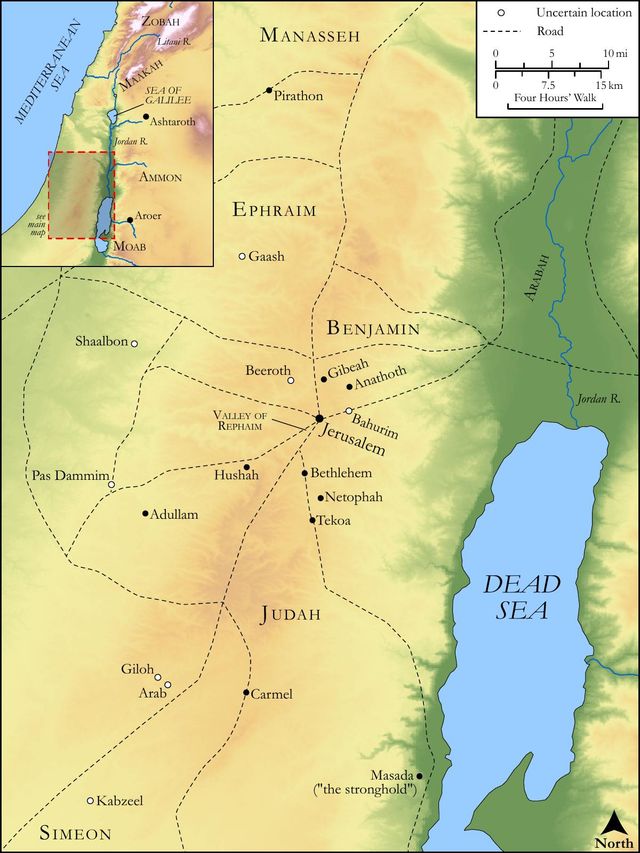
See on the biblical-era map
Study this verse
Public-domain commentary
Matthew Henry
From his Commentary on the Whole Bible. Henry comments on passages, not single verses — this entry covers 1 Chronicles 11:10–47. His two-level outline is real structure in the source text, so it is rendered as structure.
We have here an account of David's worthies, the great men of his time that served him and were preferred by him. The first edition of this catalogue we had, Sa2 23:8, etc. This is much the same, only that those named here from Ch1 11:41 to the end are added. Observe,
I.The connexion of this catalogue with that which is said concerning David, Ch1 11:9.
1.David waxed greater and greater, and these were his mighty men. Much of the strength and honour of great men is borrowed from their servants and depends upon them, which cannot but somewhat diminish pomp and power in the opinion of those that are wise. David is great because he has great men about him; take these away, and he is where he was.
2.The Lord of hosts was with him, and these were the mighty men which he had. God was with him and wrought for him, but by men and means and the use of second causes. By this it appeared that God was with him, that he inclined the hearts of those to come over to him that were able to serve his interest. As, if God be for us none can be against us, so, if God be for us, all shall be for us that we have occasion for. Yet David ascribed his success and increase, not to the hosts he had, but to the Lord of hosts, not to the mighty men that were with him, but to the mighty God whose presence with us is all in all.
II.The title of this catalogue (Ch1 11:10):
These are the men who strengthened themselves with him. In strengthening him they strengthened themselves and their own interest; for his advancement was theirs. What we do in our places for the support of the kingdom of the Son of David we shall be gainers by. In strengthening it we strengthen ourselves. It may be read, They held strongly with him and with all Israel. Note, When God has work to do he will not want fit instruments to do it with. If it be work that requires mighty men, mighty men shall either be found or made to effect it, according to the word of the Lord.
III.That which made all these men honourable was the good service that they did to their king and country; they helped to make David king (Ch1 11:10) - a good work. They slew the Philistines, and other public enemies, and were instrumental to save Israel. Note, The way to be great is to do good. Nor did they gain this honour without labour and the hazard of their lives. The honours of Christ's kingdom are prepared for those that fight the good fight of faith, that labour and suffer, and are willing to venture all, even life itself, for Christ and a good conscience. It is by a patient continuance in well-doing that we must seek for glory, and honour, and immortality; and those that are faithful to the Son of David shall find their names registered and enrolled much more to their honour than these are in the records of fame.
IV.Among all the great exploits of David's mighty men, here is nothing great mentioned concerning David himself but his pouring out water before the Lord which he had longed for, Ch1 11:18, Ch1 11:19. Four very honourable dispositions of David appeared in that action, which, for aught I know, made it as great as any of the achievements of those worthies.
1.Repentance for his own weakness. It is really an honour to a man, when he is made sensible that he has said or done any thing unadvisedly, to unsay it and undo it again by repentance, as it is a shame to a man when he has said or done amiss to stand to it.
2.Denial of his own appetite. He longed for the water of the well of Bethlehem; but, when he had it, he would not drink it, because he would not so far humour himself and gratify a foolish fancy. He that has such a rule as this over his own spirit is better than the mighty. It is an honour to a man to have the command of himself; but he that will command himself must sometimes cross himself.
3.Devotion towards God. That water which he thought too good, too precious, for his own drinking, he poured out to the Lord for a drink offering. If we have any thing better than another, let God be honoured with it, who is the best, and should have the best.
4.Tenderness of his servants. It put him into the greatest confusion imaginable to think that three brave men should hazard their lives to fetch water for him. In his account it turns the water into blood. It is the honour of great men not to be prodigal of the blood of those they employ, but, in all the commands they give them, to put their own souls into their souls' stead.
V.In the wonderful achievements of these heroes the power of God must be acknowledged.
How could one slay 300 and another the same number (Ch1 11:11, Ch1 11:20), another two lion-like men (Ch1 11:22), and another an Egyptian giant (Ch1 11:23), if they had not had the extraordinary presence of God with them, according to that promise, Jos 23:10, One man of you shall chase a thousand, for the Lord your God fighteth for you?
VI.One of these worthies is said to be an Ammonite (Ch1 11:39), another a Moabite (Ch1 11:46), and yet the law was that an Ammonite and a Moabite should not enter into the congregation of the Lord, Deu 23:3. These, it is likely, had approved themselves so hearty for the interest of Israel that in their case it was thought fit to dispense with that law, and the rather because it was an indication that the Son of David would have worthies among the Gentiles: with him there is neither Greek nor Jew.
Historical interpretation
Historical reception
2 surviving comments on this verse. Each one is dated, so this reads as a timeline rather than a list.
I must tell you that I have been led to praise God the more for your work by what I have learned from the report of my most believed son Probinus the presbyter; namely that, your excellency, having issued a certain ordinance against the perfidy of the Jews, those to whom it related attempted to bend the rectitude of your mind by offering a sum of money, which your excellency scorned, and, seeking to satisfy the judgment of almighty God, preferred innocence to gold. With regard to this, what was done by King David recurs to my mind, who, when he longed for water from the cistern of Bethlehem, which was wedged in by the enemy, had been brought him by obedient soldiers, said, “God forbid that I should drink the blood of righteous men.” And, because he poured it out and would not drink it, it is written, “He offered it a libation to the Lord.” If, then, water was scorned by the armed king and turned into a sacrifice to God, we may estimate what manner of sacrifice to almighty God has been offered by the king who for his love has scorned to receive not water but gold.
David desired long afterwards to drink water from the cistern of Bethlehem, which, when his bravest soldiers had brought to him, he refused to drink and poured it out as a libation to the Lord. For it was lawful for him to drink it, had he been so minded; but, because he remembered having done what was unlawful, he laudably abstained even from what was lawful. And he, who to his guilt previously feared not that the blood of dying soldiers should be shed, afterwards considered that, were he to drink the water, he would have shed the blood of living soldiers, saying, “Shall I drink the blood of these men who have put their lives in jeopardy?”
Continue studying 1 Chronicles 11:19 across the web’s major study libraries — every link below opens this exact verse, chapter, or book on the destination site.
Read & Compare
 BibleGatewayThis verse in more than 200 translations and 70 languages.
 Bible.comThe YouVersion reader — hundreds of translations, reading plans, and highlights.
 ESV.orgCrossway's official English Standard Version reader.
 NET BibleThe NET translation with 60,000+ translators' notes on every rendering decision.
 STEP BibleTyndale House's free study tool — original text, vocabulary, and scholarly resources.
 BibliaLogos Bible Software's free web reader.
 USCCBThe New American Bible (Revised Edition) with the U.S. bishops' study notes.
Commentaries
 BibleHub CommentariesDozens of classic commentaries on this verse, gathered on one page.
 StudyLightMore than 100 commentary sets — the largest collection on the web.
 BibleRefPlain-English commentary on what this verse means, verse by verse.
 Enduring WordDavid Guzik's free commentary on this chapter, widely used by Bible teachers.
 Bible Study ToolsVerse commentary alongside Greek and Hebrew study aids.
Original Language & Research
- BibleHub InterlinearThe verse word by word — original language, transliteration, and English.
- BibleHub LexiconEvery word's original-language definition and Strong's entry.
 Blue Letter BibleDeep-study tools — Strong's numbers, concordance, and word studies.
 SefariaThe Hebrew text with Rashi and centuries of Jewish commentary.
Sermons, Hymns & Audio


TrulyRandomVerse is not affiliated with these sites and doesn’t control their content. They’re linked because they’re genuinely useful.
Summary
1 Chronicles 11:19 powerfully illustrates King David's profound character and exemplary leadership. Following an extraordinary act of loyalty where three of his elite warriors risked their lives to retrieve water from Bethlehem's Philistine-occupied well, David utterly refused to drink it. He perceived their perilous endeavor as a sacred offering, equating the water with their very lifeblood, thus demonstrating an unparalleled respect for their sacrifice and a deep understanding of the cost of their devotion.
Context
ShowHideLiterary Context
This verse concludes a dramatic episode within the broader narrative of David's mighty men, detailed in 1 Chronicles 11:10-47. Immediately preceding it, 1 Chronicles 11:17-18 recounts David's casual longing for water from his hometown well in Bethlehem, then under Philistine control. Without explicit command, three of his most formidable warriors—Jashobeam, Eleazar, and Shammah—demonstrated unparalleled bravery by breaking through enemy lines to fetch the water. David's reaction in verse 19 serves as the climax to this specific incident, revealing his profound moral and spiritual response to their self-sacrificial loyalty. A parallel account of this event is also found in 2 Samuel 23:15-17, underscoring its significance in the biblical portrayal of David's character.
Historical & Cultural Context
In the ancient Near East, water was a precious and often scarce commodity, particularly during military campaigns or sieges, making its procurement a dangerous task. Bethlehem, David's hometown, was strategically important and often contested, and at this time, it was occupied by a Philistine garrison, making any approach to its well extremely perilous. David's act of pouring out the water, rather than drinking it, would have been understood by his contemporaries as a profound religious and ethical gesture. It was an act of consecration, akin to a libation or offering to God, signifying that something obtained at such a high cost was too sacred for common use. This act would have resonated deeply within a culture that understood the value of life, loyalty, and the sanctity of blood, often linked to the divine.
Key Themes
ShowHideThis passage powerfully contributes to several overarching themes within 1 Chronicles and the broader Davidic narrative. It highlights the theme of Exemplary Leadership, showcasing David not merely as a military commander but as a compassionate and morally upright king who deeply valued the lives of his subjects, contrasting sharply with the self-serving leadership often seen in the ancient world. The theme of Profound Sacrifice and Loyalty is central, as the warriors' willingness to risk everything for a king's casual wish underscores the deep bonds of devotion within David's army. Furthermore, it speaks to the Sanctity of Life, as David equates the water with the very "blood" or life-force of his men, refusing to consume something obtained at such an immense personal cost, a concept deeply rooted in Old Testament law (Leviticus 17:11). This act also subtly points to the theme of Divine Sovereignty and Providence, as David attributes the preservation of his men's lives and the success of their daring feat to God, making the offering to Him.
Exposition and Analysis
ShowHideKey Word Analysis
ShowHideThis strong interjection (H2486) expresses a fervent wish that something should not happen, often translated as "God forbid!" or "Far be it from me!" It signifies a powerful moral or religious aversion, indicating David's immediate and absolute rejection of the idea of drinking the water. It's not merely a refusal but a declaration of abhorrence, elevating the act to a matter of profound ethical and spiritual principle, implying that such an act would profane something sacred.
The Hebrew word nephesh (H5315), often translated as "soul" or "life," is used here in a construct form (bə·nap̄·šō·w·ṯām) meaning "with their lives" or "at the risk of their lives." The KJV's "jeopardy" accurately captures the sense of extreme peril and risk to life. It emphasizes that the warriors put their very existence on the line, highlighting the ultimate cost of their loyalty. The repetition of this concept ("put their lives in jeopardy," "with the jeopardy of their lives") underscores the gravity of their sacrifice.
While literally meaning "blood" (H1818), here it is used metaphorically to represent life itself. In ancient Israelite thought, blood was intrinsically linked to life and was considered sacred (Leviticus 17:11). David's refusal to "drink the blood" of his men means he would not consume something that was obtained at the cost of their life-force, treating the water as if it were their very essence poured out. This powerful metaphor elevates the water from a mere thirst-quencher to a sacred representation of their living sacrifice.
Verse Breakdown
ShowHide"And said, My God forbid it me, that I should do this thing:"
David's immediate and emphatic response. The phrase "My God forbid it me" (Hebrew: ḥālîlāh lî ʾĕlōhāy) is a strong expression of moral revulsion and a plea to God that he should not commit such an act. It indicates that David views drinking the water not merely as inappropriate but as an offense against God, given the circumstances of its acquisition. His personal God (My God) is invoked, making this a deeply personal and spiritual conviction.
"shall I drink the blood of these men that have put their lives in jeopardy?"
This rhetorical question underscores David's deep ethical dilemma and his profound respect for his warriors. The metaphorical "blood" signifies their life itself, emphasizing that the water was obtained at the ultimate risk. David recognizes that consuming it would be tantamount to disrespecting or trivializing their near-fatal sacrifice, effectively "drinking" their life-force.
"for with [the jeopardy of] their lives they brought it."
This clause provides the justification for David's refusal, reiterating the extreme cost. It emphasizes that the water was not simply fetched but was brought "with their lives," meaning it was obtained through an act that imperiled their very existence. The KJV's bracketed "the jeopardy of" clarifies the meaning of the Hebrew, which literally repeats "with their lives" (bə·nap̄·šō·w·ṯām), underscoring the profound personal cost.
"Therefore he would not drink it."
This straightforward statement confirms David's resolute decision. His refusal is not a momentary whim but a firm, principled stand, demonstrating his integrity and self-control. Instead of satisfying his personal desire, he prioritizes the honor and value of his men's lives, treating the water as a consecrated offering rather than a personal indulgence.
"These things did these three mightiest."
This concluding phrase serves as a powerful commendation and a summary of the extraordinary feat performed by the three warriors. It highlights their exceptional strength, courage, and loyalty, underscoring why David held their sacrifice in such high regard. It also sets this specific act apart as one of the defining moments of their "might," solidifying their place among David's elite.
Literary Devices
ShowHideThe passage employs several potent Literary Devices to convey its message. Most prominently, Metaphor is used when David equates the water with the "blood" of his men. This isn't a literal claim but a powerful symbolic representation, where "blood" stands for life itself, emphasizing the extreme cost and the sanctity of the sacrifice. This Hyperbole (exaggeration for effect) further amplifies the gravity of their act and David's reverence for it. The rhetorical question, "shall I drink the blood of these men...?" serves as a form of Apostrophe, a direct address to the moral implications of his potential action, and functions as a powerful Rhetorical Question to underscore the obvious ethical answer. The entire episode also serves as a Narrative Exemplum, providing a moral lesson through the actions of David, showcasing ideal leadership and the profound value of loyalty and sacrifice.
Theological and Thematic Connections
ShowHideDavid's refusal to drink the water from Bethlehem is a profound theological statement about the sanctity of life and the nature of true leadership. It demonstrates a deep reverence for human life, viewing it as something so precious that even a king's casual desire cannot justify its endangerment or trivialization. By pouring out the water as an offering, David implicitly acknowledges that the lives of his men, and indeed all life, ultimately belong to God. This act of self-denial and consecration elevates the warriors' sacrifice from a mere military feat to a sacred offering, aligning with the biblical principle that life, symbolized by blood, is sacred and belongs to the Creator. It also foreshadows a deeper understanding of costly devotion and the ultimate sacrifice required for true redemption.
Reflection and Application
ShowHideThe narrative of David and the water from Bethlehem offers timeless lessons for contemporary life, challenging us to re-evaluate our priorities and the way we interact with others. It calls us to cultivate a profound sense of gratitude, recognizing and honoring the sacrifices, small and large, that others make on our behalf. In a world often driven by self-interest and consumption, David's act of self-denial serves as a powerful counter-cultural example. It compels leaders in all spheres—family, community, business, and ministry—to embody humility, prioritize the well-being and dignity of those they lead, and never take their contributions for granted. Ultimately, it encourages us to consider the "cost" of our desires and to discern when our personal wants might inadvertently devalue the efforts or lives of others, prompting us instead towards acts of honor, appreciation, and even sacrificial generosity. This story reminds us that true leadership is not about what we gain, but what we are willing to give up for the sake of those entrusted to our care.
Questions for Reflection
ShowHideFAQ
ShowHideWhy did David pour out the water instead of drinking it?
ShowHideDavid poured out the water as a sacred offering to the Lord because he considered it too precious and too costly to drink. His three mighty men had risked their lives, breaking through enemy lines, to retrieve it from the well of Bethlehem. David viewed their act as a profound sacrifice, equating the water with their very "blood" or life-force. To drink it would have trivialized their immense loyalty and the danger they faced. By pouring it out, he consecrated it to God, acknowledging that such a life-threatening endeavor, and the lives of his men, belonged ultimately to the Lord. This act demonstrated his deep respect for his men, his humility, and his recognition of God's sovereignty over life, transforming a personal desire into an act of worship.
Was David's longing for water a sin?
ShowHideDavid's initial longing for water from Bethlehem, as described in 1 Chronicles 11:17, was not inherently sinful. It appears to have been a casual, perhaps wistful, expression of a desire for something familiar and comforting from his hometown. The sin, if any, would have been in carelessly expressing a desire that led others to put their lives in extreme jeopardy without a direct command or necessity. However, David's immediate and profound reaction in 1 Chronicles 11:19 demonstrates his deep regret and recognition of the immense cost his casual wish incurred. His refusal to drink and his act of pouring the water out show his moral sensitivity and his commitment to valuing his men's lives above his own comfort, transforming a potentially thoughtless moment into an act of exemplary leadership and devotion.
What does this story teach us about leadership?
ShowHideThis story provides a powerful model for ethical and empathetic leadership. It teaches that true leaders do not take the sacrifices of their subordinates for granted but deeply value their lives and contributions. David's humility is striking; despite being king, he did not feel entitled to the water obtained at such a high cost. Instead, he demonstrated self-denial and a profound respect for his men, fostering loyalty and trust. The narrative underscores that effective leadership involves a willingness to prioritize the well-being of others, to acknowledge and honor their efforts, and to lead by example in moral integrity and selflessness. It moves beyond mere command to genuine care and appreciation, solidifying the bonds between leader and led and inspiring greater devotion.
Christ-Centered Fulfillment
ShowHideThe profound self-denial and reverence for life displayed by King David in 1 Chronicles 11:19 finds its ultimate and perfect fulfillment in Jesus Christ. David refused to drink water obtained at the jeopardy of his men's lives, viewing it as their "blood," and instead poured it out as an offering to God. This act foreshadows the infinitely greater sacrifice of Christ, who did not merely refuse a costly drink but willingly poured out His own "blood"—His very life—not for a casual longing, but to secure eternal life for humanity. Just as David valued the lives of his warriors, Jesus, the Good Shepherd, laid down His life for His sheep (John 10:11). He did not consider His divine privilege something to be grasped, but emptied Himself, taking the form of a servant, even to the point of death on a cross (Philippians 2:6-8). The water, symbolic of life obtained at immense cost, points to the "living water" that Jesus offers freely, purchased by His ultimate sacrifice (John 4:10). Thus, David's act of consecration and self-denial, while noble, pales in comparison to the Lamb of God who truly takes away the sin of the world by shedding His own precious blood (John 1:29 and 1 Peter 1:18-19), ensuring that we might drink deeply from the wellspring of eternal life, a gift freely given through His costly love.