


Ruth 3:11
Bible text: King James Version (1769 Blayney text) · Public domain
Bible text: Berean Standard Bible · Public domain
Bible text: American Standard Version (1901) · Public domain
Bible text: World English Bible, Messianic edition · Public domain
Bible text: Geneva Bible (1599) · Public domain
Bible text: Young's Literal Translation · Public domain
- וְעַתָּהve·'a·Tahand thereforeH6258Conj-w ¦ AdvAdverbוְandעַתָּהtherefore
- בִּתִּיbi·Timy O daughterH1323N-fsc ¦ 1csNoun Singular Feminine ConstructבִּתִּO daughterיmy
- אַל'almay notH408NegParticle Negative
- תִּירְאִיtir·'Iyou fearH3372V-Qal-Imperf-2fsVerb Qal Imperfect 2nd Singular Feminine
- כֹּלkolallH3605N-msNoun Singular Masculine Absolute
- אֲשֶׁר'a·SherthatH834RelParticle Relative
- תֹּאמְרִיtom·Riyou are sayingH559V-Qal-Imperf-2fsVerb Qal Imperfect 2nd Singular Feminine
- אֶעֱשֶׂה'e·'e·sehI will doH6213V-Qal-Imperf-1csVerb Qal Imperfect 1st Singular common gender
- לָּךְLakhfor <the> youPrep-l ¦ 2fsSuffix Personal 2nd Singular Feminineלָּfor <the>ךְyou
- כִּיkiforH3588PrtParticle Conditional
- יוֹדֵעַyo·De·a'[is] knowingH3045V-Qal-Prtcpl-msVerb Qal Participle Singular Masculine Absolute
- כָּלkolallH3605N-mscNoun Singular Masculine Construct
- שַׁעַרSha·'ar[the] gate ofH8179N-mscNoun Singular Masculine Construct
- עַמִּי'a·Mimy peopleH5971N-msc ¦ 1csNoun Singular Masculine Constructעַמִּpeopleיmy
- כִּיkithatH3588PrtParticle Conditional
- אֵשֶׁת'E·shet[are] a woman ofH802N-fscNoun Singular Feminine Construct
- חַיִלCha·yilabilityH2428N-msNoun Singular Masculine Absolute
- אָתְּ'AtyouH859Pro-2fsPronoun Personal 2nd Singular Feminine
English is a literal word-by-word gloss of the Hebrew, not the KJV's wording. Why?
This is the original text the KJV's translators worked from — each Hebrew word with its own literal English meaning in this verse, prepared by scholars at Tyndale House, Cambridge. The KJV translates whole sentences, not word by word, so its wording differs: one Hebrew word can become several English words, and the KJV may choose “the LORD” where the gloss reads “Yahweh”. Both are faithful — they answer different questions. For the KJV's own rendering, switch to the KJV text.
Details
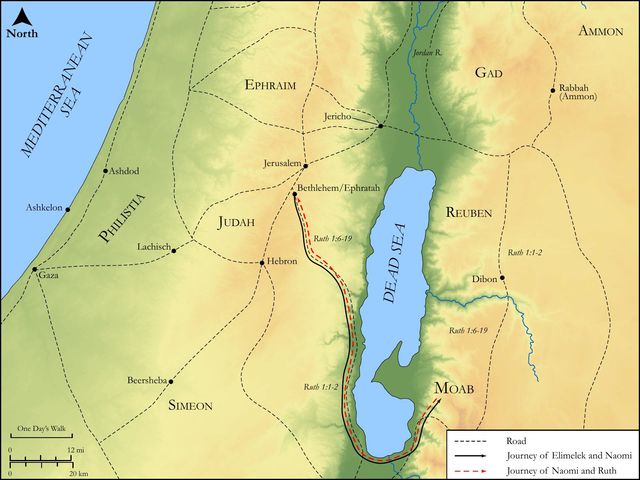
See on the biblical-era map
Study this verse
Public-domain commentary
Matthew Henry
From his Commentary on the Whole Bible. Henry comments on passages, not single verses — this entry covers Ruth 3:6–13. His four-level outline is real structure in the source text, so it is rendered as structure.
Here is, I. Boaz's good management of his common affairs. It is probable, according to the common usage, 1. When his servants winnowed, he was with them, and had his eye upon them, to prevent, not their stealing any of his corn (he had no reason to fear that), but their waste of it through carelessness in the winnowing of it. Masters may sustain great losses by servants that are heedless, though they be honest, which is a reason why men should be diligent to know the state of their own flocks, and look well to them. 2. When he had more than ordinary work to be done, he treated his servants with extraordinary entertainments, and, for their encouragement, did eat and drink with them. It well becomes those that are rich and great to be generous to, and also to be familiar with, those that are under them, and employed for them. 3. When Boaz had supped with his workmen, and been awhile pleasant with them, he went to bed in due time, so early that by midnight he had his first sleep (Rut 3:8), and thus he would be fit for his business betimes next morning. All that are good husbands will keep good hours, and not indulge themselves nor their families in unseasonable mirth. The Chaldee paraphrase tell us (Rut 3:7) that Boaz ate and drank and his heart was good (and so the Hebrew word is), and he blessed the name of the Lord, who had heard his prayers, and taken away the famine from the land of Israel. So that he went sober to bed, his heart was in a good frame, and not overcharged with surfeiting and drunkenness. And he did not go to bed without prayer. Now that he had eaten and was full he blessed the Lord, and now that he was going to rest he committed himself to the divine protection; it was well he did, for he had an unusual temptation before him, though he knew not of it. 4. He had his bed or couch laid at the end of the heap of corn; not because he had set his heart upon it, nor only that he might watch and keep it safe from thieves, but it was too late to go home to the city, and here he would be near his work, and ready for it next morning, and he would show that he was not nice or curious in his lodging, neither took state nor consulted his ease, but was, like his father Jacob, a plain man, that, when there was occasion, could make his bed in a barn, and, if need were, sleep contentedly in the straw.
II.Ruth's good assurance in the management of her affair.
She observed her mother's orders, went and laid herself down, not by his side, but overcross his bed's feet, in her clothes, and kept awake, waiting for an opportunity to tell her errand. When he awaked in the night, and perceived there was somebody at his feet, and enquired who it was, she told him her name and then her errand (Rut 3:9), that she came to put herself under his protection, as the person appointed by the divine law to be her protector: "Thou art he that has a right to redeem a family and an estate from perishing, and therefore let this ruin be under thy hand: and spread thy skirt over me - be pleased to espouse me and my cause." Thus must we by faith apply ourselves to Jesus Christ as our next kinsman, that is able to redeem us, come under his wings, as we are invited (Mat 23:37), and beg of him to spread his skirt over us. "Lord Jesus, take me into thy covenant and under thy care. I am oppressed, undertake for me."
III.The good acceptance Ruth gained with Boaz.
What she did had no ill-effect, either one way or other, so that Naomi was not mistaken in her good opinion of her kinsman. He knew her demand was just and honourable, and treated her accordingly, and did not deal with his sister as with a harlot, Gen 34:31. For,
1.He did not offer to violate her chastity, though he had all the opportunity that could be. The Chaldee paraphrase thus descants upon it: - He subdued his concupiscence, and did not approach to her, but did as Joseph the Just, who would not come near to his Egyptian mistress, and as Phaltiel the Pious, who, when Saul had given him Michal, David's wife (Sa1 25:44), put a sword between himself and her, that he might not touch her. Boaz knew it was not any sinful lust that brought her thither, and therefore bravely maintained both his own honour and hers.
2.He did not put any ill construction upon what she did, did not reproach her as an impudent woman and unfit to make an honest man a wife. She having approved herself well in the fields, and all her conduct having been modest and decent, he would not, from this instance, entertain the least suspicion of her character nor seem to do so, perhaps blaming himself that he had not offered the service of a kinsman to these distressed widows, and saved her this trouble, and ready to say as Judah concerning his daughter-in-law, She is more righteous than I. But on the contrary,
(1.)He commended her, spoke kindly to her, called her his daughter, and spoke honourably of her, as a woman of eminent virtue. She had shown in this instance more kindness to her mother-in-law, and to the family into which she had matched, than in any instance yet. It was very kind to leave her own country and come along with her mother to the land of Israel, to dwell with her, and help to maintain her. For this he had blessed her (Rut 2:12); but now he says, Thou hast shown more kindness in the latter end than at the beginning (Rut 3:10), in that she consulted not her own fancy, but her husband's family, in marrying again. She received not the addresses of young men (much less did she seek them) whether poor or rich, but was willing to marry as the divine law directed, though it was to an old man, because it was for the honour and interest of the family into which she had matched, and for which she had an entire kindness. Young people must aim, in disposing of themselves, not so much to please their own eye as to please God and their parents.
(2.)He promised her marriage (Rut 3:11): "Fear not that I will slight thee, or expose thee; no, I will do all that thou requirest, for it is the same that the law requires, from the next of kin, and I have no reason to decline it, for all the city of my people doth know that thou art a virtuous woman," Rut 3:11. Note,
[1.]Exemplary virtue ought to have its due praise (Phi 4:8), and it will recommend both men and women to the esteem of the wisest and best. Ruth was a poor woman, and poverty often obscures the lustre of virtue; yet Ruth's virtues, even in a mean condition, were generally taken notice of and could not be hid; nay, her virtues took away the reproach of her poverty. If poor people be but good people, they shall have honour from God and man. Ruth had been remarkable for her humility, which paved the way to this honour. The less she proclaimed her own goodness the more did her neighbours take notice of it.
[2.]In the choice of yoke-fellows, virtue should especially be regarded, known approved virtue. Let religion determine the choice, and it will certainly crown the choice and make it comfortable. Wisdom is better than gold, and, when it is said to be good with an inheritance, the meaning is that an inheritance is worth little without it.
(3.)He made his promise conditional, and could not do otherwise, for it seems there was a kinsman that was nearer than he, to whom the right of redemption did belong, v. 12. This he knew, but we may reasonably suppose Naomi (who had been long abroad, and could not be exact in the pedigree of her husband's family) was ignorant of it, otherwise she would never have sent her daughter to make her claim of Boaz. Yet he does not bid her go herself to this other kinsman; this would have been to put too great a hardship upon her: but he promises,
[1.]That he would himself propose it to the other kinsman, and know his mind. The Hebrew word for a widow signifies one that is dumb. Boaz will therefore open his mouth for the dumb (Pro 31:8), and will say that for this widow which she knew not how to say for herself.
[2.]That, if the other kinsman refused to do the kinsman's part, he would do it, would marry the widow, redeem the land, and so repair the family. This promise he backs with a solemn oath, for it was a conditional contract of marriage (Rut 3:13): As the Lord liveth. Thus keeping the matter in suspense, he bade her wait till morning. Bishop Hall thus sums up this matter in his contemplations: - "Boaz, instead of touching her as a wanton, blesseth her as a father, encourageth her as a friend, promiseth her as a kinsman, rewards her as a patron, and sends her away laden with hopes and gifts, no less chaste, more happy, than she came. O admirable temperance, worthy the progenitor of him in whose lips and heart there was no guile!"
Continue studying Ruth 3:11 across the web’s major study libraries — every link below opens this exact verse, chapter, or book on the destination site.
Read & Compare
 BibleGatewayThis verse in more than 200 translations and 70 languages.
 Bible.comThe YouVersion reader — hundreds of translations, reading plans, and highlights.
 ESV.orgCrossway's official English Standard Version reader.
 NET BibleThe NET translation with 60,000+ translators' notes on every rendering decision.
 STEP BibleTyndale House's free study tool — original text, vocabulary, and scholarly resources.
 BibliaLogos Bible Software's free web reader.
 USCCBThe New American Bible (Revised Edition) with the U.S. bishops' study notes.
Commentaries
 BibleHub CommentariesDozens of classic commentaries on this verse, gathered on one page.
 StudyLightMore than 100 commentary sets — the largest collection on the web.
 BibleRefPlain-English commentary on what this verse means, verse by verse.
 Enduring WordDavid Guzik's free commentary on this chapter, widely used by Bible teachers.
 Bible Study ToolsVerse commentary alongside Greek and Hebrew study aids.
Original Language & Research
- BibleHub InterlinearThe verse word by word — original language, transliteration, and English.
- BibleHub LexiconEvery word's original-language definition and Strong's entry.
 Blue Letter BibleDeep-study tools — Strong's numbers, concordance, and word studies.
 SefariaThe Hebrew text with Rashi and centuries of Jewish commentary.
Sermons, Hymns & Audio


TrulyRandomVerse is not affiliated with these sites and doesn’t control their content. They’re linked because they’re genuinely useful.
Summary
Ruth 3:11 marks a pivotal turning point in the narrative, as Boaz, the wealthy kinsman, responds to Ruth's bold request at the threshing floor with a profound and immediate pledge. He reassures her, promising to fulfill her every desire, not merely out of obligation, but because her sterling reputation as a woman of exceptional character and virtue is widely acknowledged and celebrated throughout the entire city of Bethlehem. This verse powerfully underscores Boaz's integrity and Ruth's profound moral excellence, setting the stage for the redemptive resolution of their story and the continuation of Naomi's lineage.
Context
ShowHideLiterary Context
Ruth 3:11 follows Ruth's audacious and vulnerable act of lying at Boaz's feet at the threshing floor, an action carefully orchestrated by Naomi in Ruth 3:1-5. Upon Boaz's awakening, Ruth identifies herself and makes a direct, symbolic appeal for him to "spread thy skirt over thine handmaid; for thou art a near kinsman" (Ruth 3:9). This was a culturally understood request for protection, provision, and marriage, invoking his duty as a goel or kinsman-redeemer. Boaz's immediate response in Ruth 3:10 commends Ruth for her remarkable loyalty and selflessness, particularly for not pursuing younger men, whether rich or poor, demonstrating her focus on family continuity rather than personal gain. Verse 11 then solidifies his commitment, offering a comprehensive assurance rooted in her publicly recognized character, thereby propelling the narrative toward the much-anticipated resolution of Ruth's and Naomi's precarious situation.
Historical & Cultural Context
The events of Ruth unfold in ancient Israel, specifically Bethlehem, during the tumultuous period of the Judges, a time often characterized by moral decline and social instability. The threshing floor, while a place of agricultural labor and communal gathering during the day, was also a secluded and vulnerable location at night, making Ruth's presence there a bold and risky move. Central to this narrative is the concept of the goel (kinsman-redeemer), a legal and social institution that obligated the nearest male relative to protect family interests, which could include avenging bloodshed, redeeming property, or, as in this case, marrying a deceased kinsman's widow to perpetuate his name and inheritance (cf. the levirate marriage laws in Deuteronomy 25:5-10). For Ruth, a foreign Moabite widow without male heirs or property, her social and economic position was profoundly precarious. Therefore, her reputation was her most valuable asset, serving as the primary currency for social standing, acceptance, and the possibility of a secure future. The public acknowledgment of her "virtuous" character by "all the city" is a powerful testament to her profound social integration and the respect she had garnered, effectively overcoming the significant stigma of her Moabite origin.
Key Themes
ShowHideThis verse serves as a powerful nexus for several key themes within the book of Ruth. It profoundly highlights the theme of redemption, as Boaz unequivocally embraces his crucial role as kinsman-redeemer, promising to act decisively on Ruth's behalf and secure her future. It further underscores the pervasive theme of loyalty and faithfulness, particularly Ruth's unwavering devotion to Naomi, which has not only earned her widespread admiration but also divine blessing (Ruth 2:11-12). The verse also powerfully emphasizes the importance of character and reputation, demonstrating that integrity, diligence, and virtue are not only recognized but are profoundly rewarded, even for an outsider who has committed herself to the God of Israel. Finally, it subtly but significantly points to the overarching theme of divine providence, as God's sovereign hand is clearly seen guiding these human interactions, choices, and relationships towards the fulfillment of His larger redemptive plan, ultimately leading to the lineage of David and, much later, the Messiah.
Exposition and Analysis
ShowHideKey Word Analysis
ShowHideThis primitive root means "to fear," but also "to revere" or "to be afraid." In this context, Boaz's command "fear not" is a common biblical expression of reassurance, often spoken by God or His representatives to those who are anxious, vulnerable, or facing uncertainty. Boaz's immediate use of this phrase demonstrates his compassionate and protective nature, acknowledging Ruth's precarious situation and her courageous, yet potentially frightening, request. It signals his benevolent intention to act favorably and remove her apprehension, setting a tone of security, trust, and comfort.
This word is derived from a root meaning "to be strong" or "to be able." It denotes "force," whether of men (an army), means (wealth, riches), or other resources. When applied to a person, especially a woman, as in 'eshet chayil ("woman of valor/virtue"), it signifies far more than mere moral purity; it encompasses strength of character, capability, diligence, competence, and overall moral and spiritual integrity. It is the same esteemed phrase used to describe the ideal wife in Proverbs 31:10, suggesting that Ruth embodied the highest qualities esteemed in Israelite society, despite her foreign background. This public recognition of her chayil is the very foundation of Boaz's commitment to her.
This primitive root means "to know," often implying a deep, experiential, and intimate understanding, not just intellectual acquaintance. It can also mean "to ascertain by seeing," "to recognize," or "to be aware." In this verse, "all the city... doth know" signifies a widespread, undeniable, and publicly acknowledged understanding of Ruth's character. It's not a rumor, but a settled conviction based on observation of her consistent actions. This public "knowing" validates Ruth's reputation and provides the solid social basis for Boaz's honorable decision.
Verse Breakdown
ShowHide"And now, my daughter, fear not;"
Boaz begins with a tender, paternal address, calling Ruth "my daughter." This term of endearment highlights his protective stance, his respect for her, and perhaps a recognition of her youth and vulnerability. The immediate command "fear not" serves as an instantaneous balm to Ruth's anxiety, signaling that her bold and potentially risky request has been received positively and that she is safe in his care. It establishes a tone of comfort, security, and benevolent intent.
"I will do to thee all that thou requirest:"
This is Boaz's solemn, comprehensive, and unqualified pledge. He commits to fulfilling her request for marriage and redemption, demonstrating his full understanding of what she asked for (to "spread thy skirt over thine handmaid; for thou art a near kinsman"). This promise showcases his integrity, his willingness to embrace his responsibility as a goel, and his deep respect for Ruth's character and the honorable nature of her request. It is a commitment that goes beyond mere obligation to a willing act of kindness and justice.
"for all the city of my people doth know that thou [art] a virtuous woman."
This clause provides the powerful and compelling justification for Boaz's commitment. His decision is not based on personal whim or fleeting emotion, but on Ruth's publicly recognized and undeniable reputation. The phrase "all the city of my people" underscores the widespread, unanimous, and authoritative nature of this recognition. Ruth, a Moabitess, has, through her unwavering loyalty to Naomi, her diligent work ethic, and her honorable conduct, earned the highest esteem and respect in Bethlehem, thereby validating her worthiness for such a significant act of redemption and marriage. Her character speaks for itself.
Literary Devices
ShowHideThe verse employs several impactful literary devices that deepen its meaning and emotional resonance. Affirmation is central, as Boaz's words serve to powerfully validate Ruth's character and her courageous actions, transforming her vulnerable petition into a celebrated act of virtue. There is a subtle but profound Irony at play: a foreign woman, a Moabitess, traditionally an outsider and even an enemy, is held up as the epitome of Israelite virtue, surpassing perhaps even some native women in her chayil. This challenges xenophobic prejudices and highlights that true character transcends ethnic origin or social status. The phrase "all the city of my people doth know" functions as a form of Public Acclamation, emphasizing the widespread and undeniable nature of Ruth's reputation, which in turn lends immense weight, legitimacy, and honor to Boaz's decision and their impending union. Finally, the verse serves as a crucial moment of Foreshadowing, signaling the imminent and positive resolution of the narrative through marriage and the continuation of Naomi's family line, which will ultimately lead to the Davidic dynasty and the lineage of the Messiah.
Theological and Thematic Connections
ShowHideRuth 3:11 beautifully illustrates the profound interplay between human faithfulness and divine providence. Ruth's consistent display of loyalty, diligence, humility, and self-sacrifice has cultivated a sterling reputation that not only earns her the respect and admiration of an entire community but also providentially opens the door for God's redemptive plan to unfold through Boaz. Her "virtuous" character, her chayil, is not merely a social nicety; it is a powerful testament to a life lived in accordance with God's principles, even by one who was initially outside the covenant people. Boaz's righteous response, rooted in this recognition of Ruth's integrity, reflects a man embodying the very nature of the God who provides for the vulnerable, honors those who walk in integrity, and works through human agents to accomplish His purposes. This interaction underscores the theological truth that God often uses the character and actions of His people, whether Israelite or Gentile, to bring about His purposes, demonstrating His care and faithfulness through their obedience and integrity.
Reflection and Application
ShowHideRuth 3:11 serves as a profound and enduring reminder of the transformative power of a sterling reputation, meticulously built on consistent character. In a world often driven by superficiality, self-promotion, and fleeting trends, Ruth's story powerfully highlights that true influence, favor, and security are often the quiet accumulation of integrity, unwavering loyalty, and diligent faithfulness. Her virtue was not a private matter but a public testimony that moved an entire city to acknowledge her worth and validate her position. This challenges us to deeply consider how our own lives are perceived by "all the city" – our families, our communities, our workplaces, and our wider social circles. Are we known for our faithfulness, our kindness, our unwavering commitment to what is right, even when it is difficult, costly, or goes unnoticed? Boaz's willingness to act decisively based on Ruth's established character also encourages us to be discerning, compassionate, and responsive to the needs of others, particularly those who are vulnerable, when their integrity and worth shine forth. Ultimately, this verse inspires us to live lives that genuinely reflect Christ's character, knowing that such a life is not only pleasing to God but also bears a powerful and compelling witness to the world, often opening doors for divine provision and the unfolding of God's redemptive purposes in and through us.
Questions for Reflection
ShowHideFAQ
ShowHideWhat does "virtuous woman" (אֵשֶׁת חַיִל) truly mean in the context of Ruth 3:11?
ShowHideThe Hebrew phrase 'eshet chayil (אֵשֶׁת חַיִל), translated as "virtuous woman," is far richer and more comprehensive than a simple moral descriptor. The word chayil (H2428) denotes strength, capability, valor, excellence, and moral integrity. It is used in various contexts to describe a warrior's might, a nation's wealth, or a person's noble character. In Ruth 3:11, when applied to Ruth, it signifies that she is a woman of exceptional strength of character, diligence, and moral excellence. This goes beyond mere chastity; it encompasses her unwavering loyalty to Naomi (Ruth 1:16-17), her tireless work ethic in the fields (Ruth 2:7), her humility, and her overall conduct that earned her widespread respect among the people of Bethlehem. It is the highest commendation for a woman in ancient Israelite society, famously detailed in Proverbs 31:10-31.
Why was Ruth's reputation so important for Boaz's decision to redeem her?
ShowHideRuth's reputation was absolutely crucial for several interconnected reasons. In ancient Israelite society, public perception, honor, and social standing were paramount. For Boaz, a respected and prominent figure in Bethlehem, taking a foreign widow as a wife, especially one with no immediate family ties to the land, carried significant social implications. However, the fact that "all the city of my people doth know that thou [art] a virtuous woman" provided a powerful, undeniable public endorsement of Ruth's character. This widespread recognition legitimized Boaz's decision to act as her kinsman-redeemer and marry her. It demonstrated that his actions were not based on fleeting emotion, personal gain, or impropriety, but on a well-established and publicly acknowledged foundation of Ruth's integrity, worthiness, and moral excellence. This public affirmation ensured the community's support and understanding for their union, which was vital for the continuation of Naomi's family line and the eventual lineage of David, a lineage that needed to be beyond reproach.
Christ-Centered Fulfillment
ShowHideRuth 3:11, with Boaz's solemn pledge to Ruth founded upon her virtuous character, powerfully foreshadows the ultimate Kinsman-Redeemer, Jesus Christ. Just as Boaz willingly embraced his responsibility to redeem Ruth from her desolate and vulnerable state, Christ, our divine Kinsman, stepped into humanity to redeem us from the bondage of sin and death. Ruth's "virtuous" character, her chayil, though commendable and exemplary, ultimately points to the perfect, unblemished, and infinitely chayil character of Christ, who alone is truly worthy to be our Redeemer (Hebrews 4:15). Her bold, faith-filled appeal to Boaz finds its ultimate echo in our own faith-filled appeal to Christ, who promises to do "all that thou requirest" for those who come to Him in faith, offering not just protection and provision, but eternal life, spiritual inheritance, and full adoption into God's family (John 6:37). The lineage that begins with Boaz and Ruth ultimately culminates in Christ (Matthew 1:5), demonstrating that God's meticulous, sovereign plan of redemption, initiated through human faithfulness and divine grace, finds its glorious and complete fulfillment in the Lamb of God, who takes away the sin of the world and redeems us by His precious blood (John 1:29).