


Matthew 27:30
Bible text: King James Version (1769 Blayney text) · Public domain
Bible text: Berean Standard Bible · Public domain
Bible text: American Standard Version (1901) · Public domain
Bible text: World English Bible, Messianic edition · Public domain
Bible text: Geneva Bible (1599) · Public domain
Bible text: Young's Literal Translation · Public domain
- καὶkaiAndG2532CONJConjunction
- ἐμπτύσαντεςemptusanteshaving spitG1716V-AAP-NPMVerb Aorist Active Participle Nominative Plural Masculine
- εἰςeisuponG1519PREPPreposition
- αὐτὸνautonHimG846P-ASMPersonal pronoun Accusative Singular Masculine
- ἔλαβονelabonthey tookG2983V-2AAI-3PVerb 2nd Aorist Active Indicative 3rd Plural
- τὸνtontheG3588T-ASMDefinite article Accusative Singular Masculine
- κάλαμονkalamonreedG2563N-ASMNoun Accusative Singular Masculine
- καὶkaiandG2532CONJConjunction
- ἔτυπτονetuptonwere striking [Him]G5180V-IAI-3PVerb Imperfect Active Indicative 3rd Plural
- εἰςeisonG1519PREPPreposition
- τὴνtēntheG3588T-ASFDefinite article Accusative Singular Feminine
- κεφαλὴνkephalēnheadG2776N-ASFNoun Accusative Singular Feminine
- αὐτοῦautouof HimG846P-GSMPersonal pronoun Genitive Singular Masculine
English is a literal word-by-word gloss of the Greek, not the KJV's wording. Why?
This is the original text the KJV's translators worked from — each Greek word with its own literal English meaning in this verse, prepared by scholars at Tyndale House, Cambridge. The KJV translates whole sentences, not word by word, so its wording differs: one Greek word can become several English words, and the KJV may choose “charity” where the gloss reads “love”. Both are faithful — they answer different questions. For the KJV's own rendering, switch to the KJV text.
Details
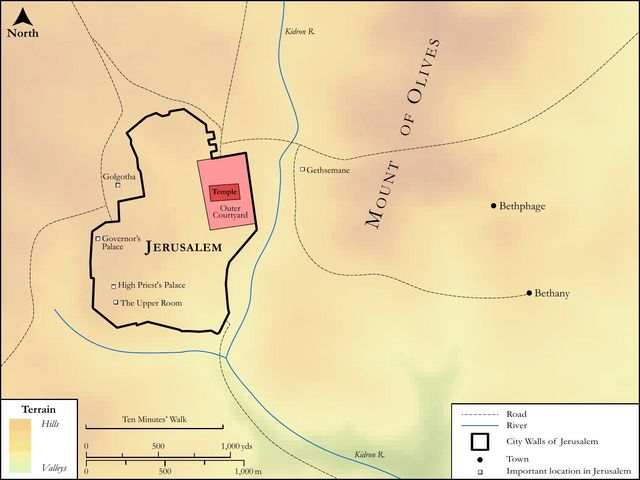
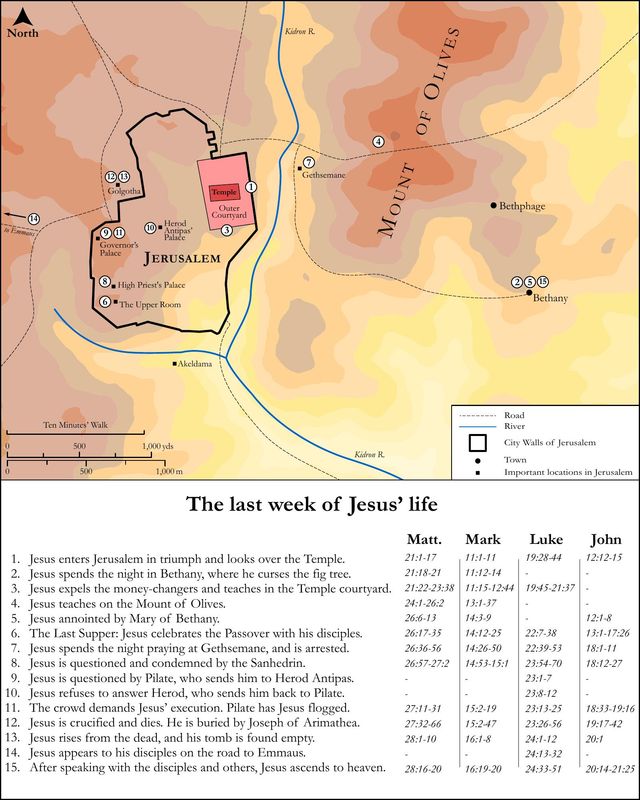
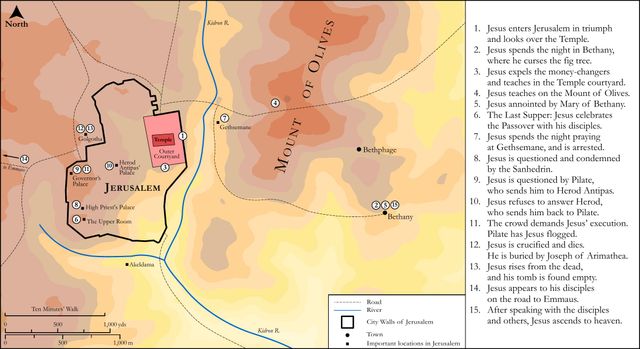
See on the biblical-era maps
Study this verse
Historical interpretation
Nine Centuries of Reception
13 surviving comments on this verse. Each one is dated, so this reads as a timeline rather than a list.
Select a marker to jump to its quote. Markers stagger vertically where authors wrote within a few decades of each other.
Or, The reed was a mystery signifying that before we believed we trusted in that reed of Egypt, or Babylon, or of some other kingdom opposed to God, which He took that He might triumph over it with the wood of the cross. With this reed they smite the head of Christ, because this kingdom ever beats against God the Father, who is the head of the Saviour.
What can be said about the reed they placed "in his right hand"? Here is my explanation: The reed embodied the hollow and fragile scepter that we all were leaning on before we saw it was a bad scepter, for we were trusting in the reed-shaped rod of Egypt or Babylon or some other kingdom opposed to God's kingdom. Then he took that reed and rod of the fragile kingdom from our hands, to subdue it and break it to pieces on the cross. In place of that reed we once were leaning on, he gave us the scepter of the heavenly kingdom and the rod mentioned in Scripture: "The rod of justice, the rod of your kingdom." In other words, the rod that chastens those who need to be chastened, as the apostle notes: "What do you want, that I come to you with a rod?" He also gave us a staff that we might celebrate the paschal feast (as Scripture says, "Let your staff be in your hand"), laying down that reed-shaped rod we once had before we celebrated the Lord's paschal feast.Then they took this fragile, hollow reed and struck the honorable head of Jesus with it, for that ever-adverse kingdom reviles and scourges God the Father, the head of the Lord and Savior. And amid all this, the only-begotten goodness itself was unharmed, nor did he suffer anything, "being made a curse for us," since by nature he is a blessing. But since he is a blessing, he destroyed and took away and dispelled all human malediction.
Or otherwise; The Lord having taken upon Him all the infirmities of our body, is then covered with the scarlet coloured blood of all the martyrs, to whom is due the kingdom with Him; He is crowned with thorns, that is, with the sins of the Gentiles who once pierced Him, for there is a prick in thorns of which is woven the crown of victory for Christ. In the reed, He takes into His hand and supports the weakness and frailty of the Gentiles; and His head is smitten therewith that the weakness of the Gentiles sustained by Christ's hand may rest on God the Father, who is His head.
The beaten Lord is dressed in a scarlet robe, a purple cloak and a crown of thorns, and a reed is placed on his right hand. Bending their knees before him, they mock him. Having taken upon himself all the infirmities of our bodies, he is covered with the scarlet blood of all the martyrs destined to reign with him, and he is cloaked with the high honor of the prophets and patriarchs in purple cloth. He is also crowned with thorns, that is, with the former sins of the remorseful Gentiles, so that glory might derive from the destructive and useless things, plaited on his divine head, which they contrive. The sharp points of the thorns aptly pertain to the sins from which a crown of victory is woven for Christ. The reed symbolizes the emptiness and weakness of all those Gentiles, which is held firm in his grasp. His head, moreover, is struck. As I believe, not much harm was done to his head from being struck with the reed; however, the typical explanation for this is that the bodily weakness of the Gentiles that was previously held in Christ’s hand finds comfort now in God the Father, for he is the head. But amid all this, while Christ is mocked, he is being adored.
It was not as though those men had the power [to do these deeds]. Rather, it seemed good to God that these events occur for the redemption of humanity. The “Lord of glory” was treated shamefully for us because of the dishonor due to us. He is now glorified while the day of the righteous is always mocked by the ignorant. Since the cloak was tinged with the color of blood, those murdering him dressed him with it, though they did not realize the significance of what they were doing. Instead, they clothed Jesus … in scarlet cloth and bound his hand with the symbol of one of the sons of Tamar and Judah. The cloak itself [represents] the blood shed by the world and by the people in it. The Savior was put to death for the salvation of all. But they who are choked by “worries, wealth and pleasure” have received the word of God but have not borne fruit. They weave thorns together and crown Jesus with them, dishonoring him.… Those who deemed his kingdom to be of little value placed a reed in his right hand.
These things were done to mock Jesus. But now we know these things happened through a heavenly mystery. Wickedness was at work among the former; among the latter, the mystery of faith and the light of truth. In the purple tunic Christ is dressed as king; and in the scarlet robe, as prince of martyrs, he is resplendent as precious scarlet in his sacred blood. He receives the crown as conqueror, for crowns are usually bestowed upon conquerors. He is adored as God by people on bended knees. Therefore he is vested in purple as king, in scarlet as prince of martyrs; he is crowned as conqueror, is hailed as Lord and is adored as God.We can recognize in the purple cloak also the church, married to Christ the king and resplendent with regal glory. Hence it is called by John in the Revelation a “royal nation.” As to this purple cloth, we read in the Song of Solomon: “His whole bed is purple.” For Christ rests on that bed where he is able to find purple cloth, that is, royal faith and a beautiful spirit.…
The crown of thorns which the Lord received on his head stands for our community, which came to faith from the Gentiles. At one time we were thorns—that is to say, sinners. Believing now in Christ, we have become a crown of righteousness, for we no longer cause pain or harm to the Savior. Rather, we surround his head with our profession of faith while we praise the Father in the Son, because the head of Christ is God, as the apostle says. This is the crown foretold by David in a psalm: “You placed a crown of precious stones on his head.” We were thorns at one time, but after we were included in the crown of Christ, we became precious stones. For he, who raised up children of Abraham from stones, made precious stones out of thorns.
This scriptural passage did not consider of trivial importance the fact that a reed was placed in the Lord’s right hand. Note what David says about Christ in the psalm: “My tongue is the pen of a ready writer.” As he was about to suffer, therefore, he took up the reed in his right hand, so that with a heavenly notation he might pardon us our misdeeds or inscribe his law in our hearts with divine letters. As he says through the prophet: “I will put my law within them.” … We may also infer other things about the reed, for it has many spiritual meanings. A reed that is hollow and without pith connotes the Gentile people, who were once without the pith of God’s law, empty of faith and devoid of grace. Therefore this type of reed, that is, the Gentile people, is put in the Lord’s right hand, for his left hand already contained the Jewish people who were persecuting him.
As though on some signal the devil then was entering in triumph into all. For, be it that Jews pining with envy and jealousy were mad against Him, as to the soldiers, whence was it, and from what sort of cause? Is it not clear that it was the devil who was then entering in fury into the hearts of all? For indeed they made a pleasure of their insults against Him, being a savage and ruthless set. I mean that, when they ought to have been awestruck, when they ought to have wept, which even the people did, this they did not, but, on the contrary, were despiteful, and insolent; perhaps themselves also seeking to please the Jews, or it may be doing all in conformity to their own evil nature.
And the insults were different, and varied For that Divine Head at one time they buffeted, at another they insulted with the crown of thorns, at another they smote with the reed, men unholy and accursed!
What plea shall we have after this for being moved by injuries, after Christ suffered these things? For what was done was the utmost limit of insolence. For not one member, but the whole entire body throughout was made an object of insolence; the head through the crown, and the reed, and the buffeting; the face, being spit upon; the cheeks, being smitten with the palms of the hands; the whole body by the stripes, by being wrapped in the robe, and by the pretended worship; the hand by the reed, which they gave him to hold instead of a sceptre; the mouth again by the offering of the vinegar. What could be more grievous than these things? What more insulting?
For the things that were done go beyond all language. For as though they were afraid lest they should seem to fall short at all in the crime, having killed the prophets with their own hands, but this man with the sentence of a judge, so they do in every deed; and make it the work of their own hands, and condemn and sentence both among themselves and before Pilate, saying, "His blood be on us and on our children," and insult Him, and do despite unto Him themselves, binding Him, leading Him away, and render themselves authors of the spiteful acts done by the soldiers, and nail Him to the cross. and revile Him, and spit at Him, and deride Him. For Pilate contributed nothing in this matter, but they themselves did every thing, becoming accusers, and judges, and executioners, and all.
(Hom. lxxxvii.) What should we henceforth care if any one insults us, after Christ has thus suffered? The utmost that cruel outrage could do was put in practice against Christ; and not one member only, but His whole body suffered injuries; His head from the crown, the reed, and the buffetings; His face which was spit upon; His cheeks which they smote with the palms of their hands; His whole body from the scourging, the stripping to put on the cloak, and the mockery of homage; His hands from the reed which they put into them in mimicry of a sceptre; as though they were afraid of omitting aught of indignity.
He had been styled King of the Jews, and the Scribes and Priests had brought this charge against Him, that He claimed sovereignty over the Jewish nation; hence this mockery of the soldiers, taking away His own garments, they put on Him a scarlet cloak to represent that purple fringe which kings of old used to wear, for the diadem they put on Him a crown of thorns, and for the regal sceptre give Him a reed, and perform adoration to Him as to a king.
All these things we may understand mystically. For as Caiaphas said that it is expedient that one man should die for the people, (John 11:50.) not knowing what he said, so these, in all they did, furnished sacraments to us who believe, though they did them with other intention. In the scarlet robe He bears the bloody works of the Gentiles; by the crown of thorns He takes away the ancient curse; with the reed He destroys poisonous animals; or He held the reed in His hand wherewith to write down the sacrilege of the Jews.
(Verse 30) And spitting on him, they took a reed and struck his head. At that time it was fulfilled; I did not turn my face away from the shame of spitting (Isaiah 50:6), yet when they strike his head with the reed, he endures everything patiently, to fulfill the true prophecy of Isaiah, which says: He will not break a bruised reed (Isaiah 42:3).
Or otherwise, By the scarlet robe is denoted the Lord's flesh, which is spoken of as red by reason of shedding of His blood; by the crown of thorns His taking upon Him our sins, because He appeared in the likeness of sinful flesh. (Rom. 8:3.)
Barabbas also, who headed a sedition among the people, is released to the Jews, that is the Devil, who to this day reigns among them, so that they cannot have peace.
They smite the head of Christ with a reed, who speak against His divinity, and endeavour to maintain their error by the authority of Holy Scripture, which is written by a reed. They spit upon His face who reject in abominable words the presence of His grace, and deny that Jesus is come in the flesh. And they mock Him with adoration who believe on Him, but despise Him with perverse works.
Here was fulfilled the word of David, "Thou hast made Me a reproach to the foolish" (Ps. 38:8). For the soldiers were foolish, and did things that befitted their foolishness: they clothed Him with a cloak as if it were the imperial purple; they gave Him a reed for a scepter and a crown of thorns for a diadem; they paid Him homage, in mockery, for this is the meaning of "bowed the knee." See how they performed every sort of insult and abuse: His face they reviled with spit, His head with a crown, His hand with a reed, the rest of His Body with a cloak, and His ears with words of mockery. But if they did these things in derision, you, O reader, must understand them also in a more spiritual manner, as something not merely done to, but accomplished by, Jesus. The scarlet cloak reveals our nature, bloody and murderous, which He assumed and sanctified by wearing it. The crown is made of thorns which are the sins resulting from our cares for this life; these Christ consumes with His own divinity, for His head represents His divinity. The reed is a symbol of our weak and crumbling nature which the Lord assumed, as David also says, "The right hand of the Lord hath I exalted me" (Ps. 117:16). By receiving insults in His ears, He healed Eve of the whispering of the serpent which had entered her ears.
Continue studying Matthew 27:30 across the web’s major study libraries — every link below opens this exact verse, chapter, or book on the destination site.
Read & Compare
 BibleGatewayThis verse in more than 200 translations and 70 languages.
 Bible.comThe YouVersion reader — hundreds of translations, reading plans, and highlights.
 ESV.orgCrossway's official English Standard Version reader.
 NET BibleThe NET translation with 60,000+ translators' notes on every rendering decision.
 STEP BibleTyndale House's free study tool — original text, vocabulary, and scholarly resources.
 BibliaLogos Bible Software's free web reader.
 USCCBThe New American Bible (Revised Edition) with the U.S. bishops' study notes.
Commentaries
 BibleHub CommentariesDozens of classic commentaries on this verse, gathered on one page.
 StudyLightMore than 100 commentary sets — the largest collection on the web.
 BibleRefPlain-English commentary on what this verse means, verse by verse.
 Enduring WordDavid Guzik's free commentary on this chapter, widely used by Bible teachers.
 Bible Study ToolsVerse commentary alongside Greek and Hebrew study aids.
Original Language & Research
- BibleHub InterlinearThe verse word by word — original language, transliteration, and English.
- BibleHub LexiconEvery word's original-language definition and Strong's entry.
 Blue Letter BibleDeep-study tools — Strong's numbers, concordance, and word studies.
 CNTR CollationThe earliest Greek manuscripts of this verse, collated letter by letter.
Sermons, Hymns & Audio


TrulyRandomVerse is not affiliated with these sites and doesn’t control their content. They’re linked because they’re genuinely useful.
Summary
Matthew 27:30 vividly portrays the profound physical abuse and humiliation Jesus endured at the hands of Roman soldiers just prior to His crucifixion. Following their elaborate mockery, which included dressing Him in a scarlet robe and crowning Him with thorns, the soldiers intensified their cruelty by repeatedly spitting upon Him and striking Him on the head with the very reed they had given Him as a mock scepter, demonstrating extreme contempt and violence.
Context
ShowHideLiterary Context
This verse is situated within the climactic Passion narrative in Matthew's Gospel, immediately following the Roman soldiers' elaborate charade of mocking Jesus as "King of the Jews." After Pontius Pilate delivered Jesus to be crucified (Matthew 27:26), the soldiers led Him into the Praetorium, the governor's headquarters, where they assembled the entire company. There, they stripped Him, dressed Him in a scarlet robe, placed a crown of thorns on His head, and a reed in His right hand, then knelt before Him in sarcastic homage, proclaiming, "Hail, King of the Jews!" (Matthew 27:28-29). Verse 30 is the culmination of this brutal mockery, detailing the physical assault that followed the verbal abuse and symbolic degradation, setting the stage for His removal to Golgotha for crucifixion (Matthew 27:31).
Historical & Cultural Context
The events described occurred within the Roman judicial and military system in Judea. The Praetorium was the official residence and administrative center of the Roman governor, a place of Roman authority and power. Roman soldiers were known for their brutality and often engaged in such acts of humiliation, especially towards those condemned as enemies of the state or perceived as threats to Roman order. Spitting upon someone was, in ancient Near Eastern and Roman cultures, an act of extreme contempt, revulsion, and public shaming, designed to utterly degrade the victim. Striking a person on the head, particularly with an object, was a severe physical assault, intended to inflict pain and further dishonor. The use of the "reed"—initially a mock scepter—as a weapon was a particularly cruel twist, transforming a symbol of false kingship into an instrument of real violence, underscoring the soldiers' disdain for Jesus' claims and their enjoyment of His suffering.
Key Themes
ShowHideMatthew 27:30 powerfully contributes to several overarching themes in the Gospel. Firstly, it highlights the Profound Humiliation and Suffering of Christ, emphasizing the depth of indignity and physical pain He willingly endured. This suffering is not random but is presented as the Fulfillment of Old Testament Prophecy, particularly passages like Isaiah 50:6 where the Suffering Servant declares, "I gave my back to the smiters, and my cheeks to them that plucked off the hair: I hid not my face from shame and spitting," and Psalm 22:7 which speaks of being scorned and mocked. Secondly, the verse underscores Jesus' Passive Endurance and perfect obedience to the Father's will. Despite the extreme provocation, Jesus remains silent and does not retaliate, embodying the humility and self-emptying described in Philippians 2:8. This scene thus serves as a stark reminder of the immense cost of redemption and the divine love that propelled Christ through such an ordeal.
Exposition and Analysis
ShowHideKey Word Analysis
ShowHideMeaning "to spit at or on." This verb denotes a deliberate and repeated action of spitting, signifying the highest degree of contempt, disgust, and public humiliation. In ancient cultures, spitting on someone was a profound insult, an act of utter degradation meant to strip the victim of all dignity. The imperfect tense in the Greek (ἔπτυον) suggests a continuous or repeated action, indicating sustained abuse rather than a single instance.
Referring to "a reed (the plant or its stem, or that of a similar plant); by implication, a pen." In this context, the kálamos was initially given to Jesus as a mock scepter, a cruel parody of royal authority. Its transformation from a symbol of false kingship into an instrument of physical violence underscores the soldiers' malicious intent and the depth of their mockery. It highlights the irony and brutality of the scene.
Meaning "to 'thump', i.e. cudgel or pummel (properly, with a stick or bastinado), but in any case by repeated blows." This verb implies forceful, repeated striking, distinguishing it from a single blow. The imperfect tense (ἔτυπτον) again emphasizes the continuous nature of the assault. The soldiers were not merely tapping Him but were repeatedly and violently striking Him on the head with the reed, inflicting pain and further humiliation.
Verse Breakdown
ShowHide"And they spit upon him"
This clause describes an act of profound social and personal degradation. The soldiers' spitting was not accidental but a deliberate, contemptuous gesture aimed at dishonoring Jesus publicly. It signified their utter disdain and revulsion, treating Him as the lowest of the low, unworthy of respect or even basic human dignity. This action was a direct assault on His person and reputation, designed to inflict shame and psychological torment.
"and took the reed"
This phrase highlights the deliberate re-purposing of an object. The "reed" had previously been placed in Jesus' hand as a mock scepter, a symbol of His supposed kingship. By taking it back, the soldiers were not merely removing a prop; they were seizing an object that had been part of their mockery, preparing to turn it into a weapon. This act adds a layer of calculated cruelty, transforming a symbol of their parody into an instrument of physical abuse.
"and smote him on the head"
This final clause details the physical violence. Using the reed, which was likely stiff and hard, the soldiers repeatedly struck Jesus on the head. This was not a light tap but a forceful, painful assault. The head, being a vulnerable and prominent part of the body, was a target for maximum pain and humiliation. This action completed the cycle of physical and symbolic abuse, demonstrating the full extent of the soldiers' brutality and Jesus' suffering.
Literary Devices
ShowHideMatthew 27:30 employs several powerful literary devices to convey the depth of Jesus' suffering and the nature of the soldiers' actions. Irony is central to the scene, as the very object given to Jesus as a mock scepter—the reed—is then used as a weapon to strike Him. This transformation of a symbol of false kingship into an instrument of violence intensifies the cruelty and underscores the soldiers' complete disdain for any notion of Jesus' authority. Symbolism is also evident in the acts themselves: spitting symbolizes extreme contempt and revulsion, while striking the head, the seat of reason and honor, represents a total assault on His dignity and person. The repeated nature of the actions, indicated by the imperfect tense verbs, creates a sense of Pathos, evoking deep sympathy and sorrow for Jesus' prolonged and intense suffering. Furthermore, the scene serves as powerful Foreshadowing of the ultimate physical and emotional torment Jesus would endure on the cross, connecting this preliminary abuse to His final sacrifice.
Theological and Thematic Connections
ShowHideMatthew 27:30 is not merely a historical account of suffering but a profound theological statement on the nature of Christ's redemptive work. It underscores the depths to which the Son of God condescended, willingly embracing utter humiliation and physical abuse to identify with fallen humanity and bear the full weight of sin's consequences. This scene reveals the inherent ugliness of sin and human depravity, as represented by the soldiers' cruelty, yet simultaneously highlights the divine love and sovereign purpose that allowed such suffering for the sake of salvation. Jesus' passive endurance in the face of such indignity exemplifies His perfect obedience to the Father's will, demonstrating that His suffering was not a failure but a determined act of self-sacrifice for the redemption of the world.
Reflection and Application
ShowHideMatthew 27:30 serves as a stark and sobering reminder of the immense cost of our salvation and the boundless love of God demonstrated through Christ's suffering. For believers, reflecting on this verse should cultivate a deeper appreciation for the sacrifice made on our behalf, moving us beyond intellectual assent to a heartfelt gratitude that transforms our lives. Jesus' willingness to endure such indignity without retaliation provides a profound model for how we, as His followers, are called to respond when faced with injustice, mockery, or persecution. It challenges us to cultivate humility, patience, and forgiveness, even when wronged, trusting in God's ultimate justice and sovereignty. This passage also invites us to consider the depths of human sin that necessitated such a sacrifice, prompting us to live lives that honor Christ's suffering by pursuing holiness and compassion.
Questions for Reflection
ShowHideFAQ
ShowHideWhy did the Roman soldiers engage in such cruel mockery and abuse?
ShowHideThe Roman soldiers' actions were driven by a combination of factors. Primarily, they were carrying out the orders of their superiors, which included the public humiliation of condemned criminals, especially those accused of sedition or challenging Roman authority. Jesus, having been presented as "King of the Jews" in a mock trial, was subjected to a cruel parody of a royal coronation. This mockery was also a common practice to break the spirit of the condemned and to entertain the soldiers, who often viewed their prisoners with disdain. Their actions were a display of power, contempt, and a dehumanizing ritual designed to underscore their absolute authority over the one being crucified.
What is the significance of the reed being used to strike Jesus?
ShowHideThe reed's significance lies in its dual role. Initially, it was given to Jesus as a mock scepter (Matthew 27:29), symbolizing His false kingship and serving as a cruel prop in their charade. By then taking the same reed and using it to strike Him on the head, the soldiers intensified the mockery and the physical abuse. This act transformed a symbol of their parody into an instrument of real violence, underscoring their utter contempt for Jesus and His claims. It highlighted the irony and brutality of the situation, turning an object of insult into a weapon of pain and further humiliation.
Does this event fulfill any Old Testament prophecies?
ShowHideYes, the events described in Matthew 27:30, particularly the spitting and physical abuse, are understood by scholars as direct fulfillments of Old Testament prophecies concerning the suffering Messiah. The most prominent example is Isaiah 50:6, where the Suffering Servant declares, "I gave my back to the smiters, and my cheeks to them that plucked off the hair: I hid not my face from shame and spitting." Additionally, Psalm 22:7 speaks of being scorned and mocked, which aligns with the soldiers' actions. These prophecies demonstrate that Jesus' suffering was not accidental or arbitrary, but part of God's predetermined plan for salvation, meticulously foretold centuries earlier.
Christ-Centered Fulfillment
ShowHideMatthew 27:30, depicting Jesus' profound humiliation and physical abuse, finds its ultimate Christ-centered fulfillment in the reality that the Son of God willingly subjected Himself to such ignominy as part of His redemptive mission. This suffering was not merely an unfortunate incident but a necessary component of His identification with humanity's sin and His substitutionary atonement. The spitting and striking, acts of utter contempt, foreshadow the complete rejection and condemnation Jesus bore on the cross, where He became sin for us (2 Corinthians 5:21). In His passive endurance, Jesus perfectly embodied the Suffering Servant of Isaiah, who was "oppressed and He was afflicted, yet He opened not His mouth" (Isaiah 53:7). This scene highlights the depth of Christ's humility, as He "emptied himself, by taking the form of a servant, being born in the likeness of men" (Philippians 2:7), ultimately humbling Himself to the point of death on a cross. His suffering in Matthew 27:30, therefore, is a vital part of the saving work by which He purchased our freedom, demonstrating the immeasurable love of God who "so loved the world, that he gave his only Son" (John 3:16). Through His willingness to endure such shame and pain, Jesus secured our eternal dignity and reconciliation with God, transforming the instruments of His suffering into symbols of our salvation.