


Mark 15:19
- καὶkaiAndG2532CONJConjunction
- ἔτυπτονetuptonthey were strikingG5180V-IAI-3PVerb Imperfect Active Indicative 3rd Plural
- αὐτοῦautouHisG846P-GSMPersonal pronoun Genitive Singular Masculine
- τὴνtēn<the>G3588T-ASFDefinite article Accusative Singular Feminine
- κεφαλὴνkephalēnheadG2776N-ASFNoun Accusative Singular Feminine
- καλάμῳkalamōwith a reedG2563N-DSMNoun Dative Singular Masculine
- καὶkaiandG2532CONJConjunction
- ἐνέπτυονeneptuonwere spittingG1716V-IAI-3PVerb Imperfect Active Indicative 3rd Plural
- αὐτῷautōon HimG846P-DSMPersonal pronoun Dative Singular Masculine
- καὶkaiandG2532CONJConjunction
- τιθέντεςtithentesbendingG5087V-PAP-NPMVerb Present Active Participle Nominative Plural Masculine
- τὰtatheG3588T-APNDefinite article Accusative Plural Neuter
- γόναταgonatakneesG1119N-APNNoun Accusative Plural Neuter
- προσεκύνουνprosekunounthey were kneeling downG4352V-IAI-3PVerb Imperfect Active Indicative 3rd Plural
- αὐτῷautōto HimG846P-DSMPersonal pronoun Dative Singular Masculine
English is a literal word-by-word gloss of the Greek, not the KJV's wording. Why?
This is the original text the KJV's translators worked from — each Greek word with its own literal English meaning in this verse, prepared by scholars at Tyndale House, Cambridge. The KJV translates whole sentences, not word by word, so its wording differs: one Greek word can become several English words, and the KJV may choose “charity” where the gloss reads “love”. Both are faithful — they answer different questions. For the KJV's own rendering, switch to the KJV text.
Details
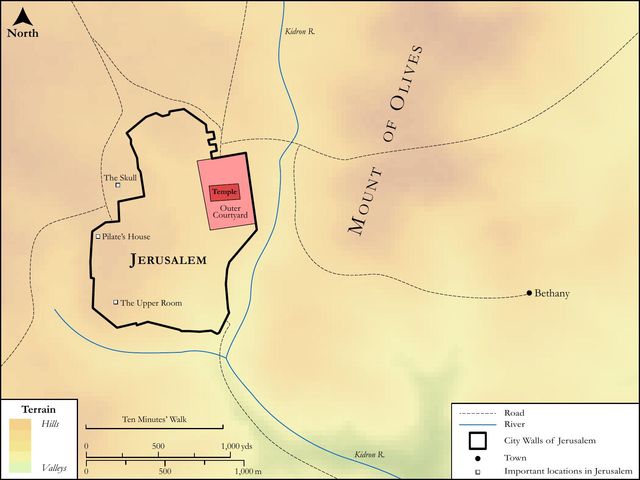
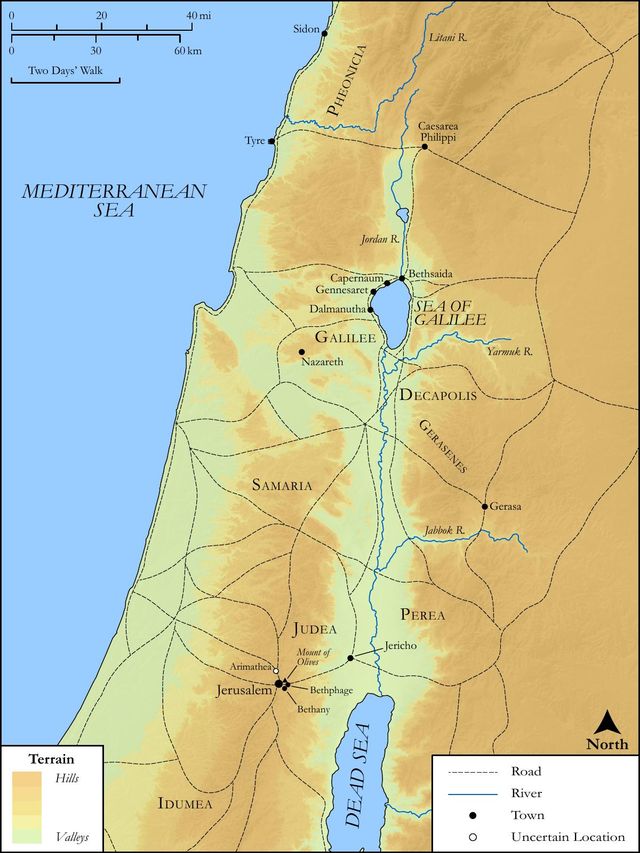
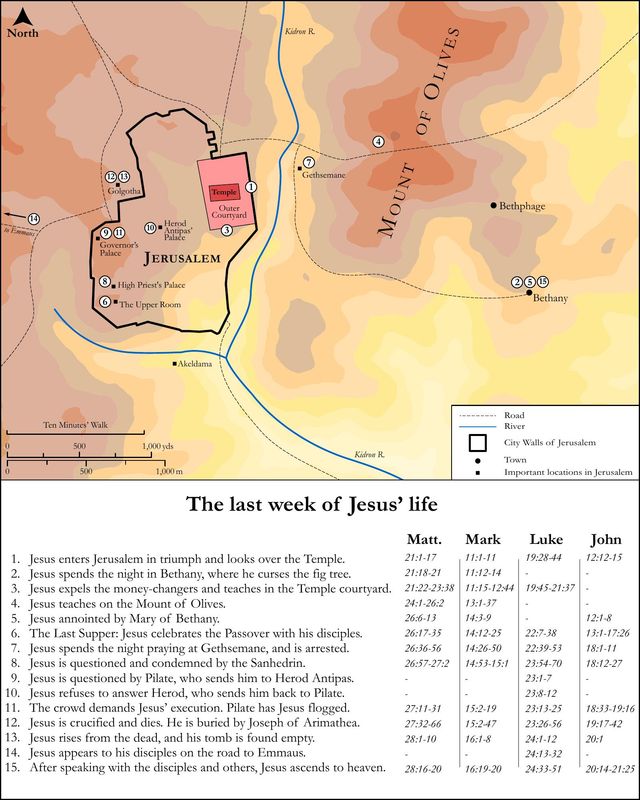
See on the biblical-era map
Study this verse
Public-domain commentary
Matthew Henry
From his Commentary on the Whole Bible. Henry comments on passages, not single verses — this entry covers Mark 15:15–21. His two-level outline is real structure in the source text, so it is rendered as structure.
Here, I. Pilate, to gratify the Jews' malice, delivers Christ to be crucified, Mar 15:15. Willing to content the people, to do enough for them (so the word is), and make them easy, that he might keep them quiet, he released Barabbas unto them, who was the scandal and plague of their nation, and delivered Jesus to be crucified, who was the glory and blessing of their nation. Though he had scourged him before, hoping that would content them, and then not designing to crucify him, yet he went on to that; for no wonder that he who could persuade himself to chastise one that was innocent (Luk 23:16), could by degrees persuade himself to crucify him.
Christ was crucified, for that was, 1. A bloody death, and without blood no remission, Heb 9:22. The blood is the life (Gen 9:4); it is the vehicle of the animal spirits, which connect the soul and body, so that the exhausting of the blood is the exhausting of the life. Christ was to lay down his life for us, and therefore shed his blood. Blood made atonement for the soul (Lev 17:11), and therefore in every sacrifice of propitiation special order was given for the pouring out of the blood, and the sprinkling of that before the Lord. Now, that Christ might answer all these types, he shed his blood. 2. It was a painful death; the pains were exquisite and acute, for death made its assaults upon the vitals by the exterior parts, which are quickest of sense. Christ died, so as that he might feel himself die, because he was to be both the priest and the sacrifice; so that he might be active in dying; because he was to make his soul an offering for sin. Tully calls crucifixion, Teterrimum supplicium - A most tremendous punishment: Christ would meet death in its greatest terror, and so conquer it. 3. It was a shameful death, the death of slaves, and the vilest malefactors; so it was accounted among the Romans. The cross and the shame are put together. God having been injured in his honour by the sin of man, it is in his honour that Christ makes him satisfaction, not only by denying himself in, and divesting himself of, the honours due to his divine nature, for a time, but by submitting the greatest reproach and ignominy the human nature was capable of being loaded with. Yet this was not the worst. 4. It was a cursed death; thus it was branded by the Jewish law (Deu 21:23); He that is hanged, is accursed of God, is under a particular mark of God's displeasure. It was the death that Saul's sons were put to, when the guilt of their father' bloody house was to be expiated, Sa2 21:6. Haman and his sons were hanged, Est 7:10; Est 9:13. We do not read any of the prophets of the Old Testament that were hanged; but now that Christ has submitted to be hanged upon a tree, the reproach and curse of that kind of death are quite rolled away, so that it ought to be any hindrance to the comfort of those who die either innocently or penitently, nor any diminution fRom. but rather an addition to, the glory of those who die martyrs for Christ, to be as he was, hanged upon a tree.
II.Pilate, to gratify the gay humour of the Roman soldiers, delivered him to them, to be abused and spitefully treated, while they were preparing for the execution. They called together the whole regiment that was then in waiting, and they went into an inner hall, where they ignominiously abused our Lord Jesus, as a king, just as in the high priest's hall his servants had ignominiously abused him as a Prophet and Saviour.
1.Do kings wear robes of purple or scarlet? They clothed him with purple. This abuse done to Christ in his apparel should be an intimation to Christians, not to make the putting on of apparel their adorning, Pe1 3:4. Shall a purple or scarlet robe be matter of pride to a Christian, which was matter of reproach and shame to Christ.
2.Do kings wear crowns? They platted a crown of thorns, and put it on his head. A crown of straw, or rushes, would have been banter enough; but this was pain also. He wore the crown of thorns which we had deserved, that we might wear the crown of glory which he merited. Let us be taught by these thorns, as Gideon taught the men of Succoth, to hate sin, and be uneasy under it, and to be in love with Jesus Christ, who is here a lily among thorns. If we be at any time afflicted with a thorn in the flesh, let it be our comfort, that our high priest is touched with the feelings of our infirmities, having himself known what thorns in the flesh meant.
3.Are kings attended with the acclamations of their subjects, O king, live for ever? That also is mimicked; they saluted him with "Hail, King of the Jews; such a prince, and such a people, even good enough for one another." 4. Kings have sceptres put into their hand, marks of dominion, as the crown is of dignity; to imitate this, they put a reed in his right hand. Those that despise the authority of Jesus Christ, as not to be observed and obeyed, who regard not either the precepts of his word, or the threatenings of his wrath, do, in effect, put a reed in his hand; nay, and, as these here, smite him on the head with it, such is the indignity they do him. 5. Subjects, when they swear allegiance, were wont to kiss their sovereign; and this they offered to do, but, instead of that, spit upon him. 6. Kings used to be addressed upon the knee; and this also they brought into the jest, they bowed the knee, and worshipped him; this they did in scorn, to make themselves and one another laugh. We were by sin become liable to everlasting shame and contempt, to deliver us from which, our Lord Jesus submitted to this shame and contempt for us. He was thus mocked, not in his own clothes, but in another's, to signify that he suffered not for his own sin; the crime was ours, the shame his. Those who pretend subjection to Christ, but at the same time give themselves up to the service of the world and the flesh, do, in effect, the same that they did, who bowed the knee to him in mockery, and abused him with, Hail, king of the Jews, when they said, We have no king but Caesar. Those that bow the knee to Christ, but do not bow the soul, that draw nigh to him with their mouths, and honour him with their lips, but their hearts are far from him, put the same affront upon him that these here did.
III.The soldiers, at the hour appointed, led him away from Pilate's judgment-hall to the place of execution (Mar 15:20), as a sheep to the slaughter; he was led forth with the workers of iniquity, though he did no sin. But lest his death, under the load of his cross, which he was to carry, should prevent the further cruelties they intended, they compelled one Simon of Cyrene to carry his cross for him. He passed by, coming out of the country or out of the fields, not thinking of any such matter. Note, We must not think it strange, if crosses come upon us suddenly, and we be surprised by them. The cross was a very troublesome unwieldy load: but he that carried it a few minutes, had the honour to have his name upon the record in the book of God, though otherwise an obscure person; so that, wherever this gospel is preached; so that, wherever this gospel is preached, there shall this be told for a memorial to him: in like manner, though no affliction, no cross, for the present, be joyous, but grievous, yet afterward it yields a crown of glory to them that are exercised thereby.
Historical interpretation
Eight Centuries of Reception
6 surviving comments on this verse. Each one is dated, so this reads as a timeline rather than a list.
Select a marker to jump to its quote. Markers stagger vertically where authors wrote within a few decades of each other.
His shame took away our shame; His bonds made us free; by the thorny crown of His head, we have obtained the crown of the kingdom; by His wounds we are healed.
But in a mystic sense, Jesus was stripped of His clothes, that is, of the Jews, and is clothed in a purple robe, that is, in the Gentile church, which is gathered together out of the rocks. Again, putting it off in the end, as offending, He again is clothed with the Jewish people, for when the fulness of the Gentiles is come in, then shall all Israel be saved. (Rom. 11:25.)
In that very hour of his passion and cross, before they had come to the cruel act of his slaughter and the shedding of his blood, what violent abuses he listened to with patience, and what shameful insults he endured! He was even covered with the spittle of his revilers, when, but a short time before, with his own spittle he had cured the eyes of the blind man.
And they were striking his head with a reed and spitting upon him. And kneeling down, they worshipped him. These things then the soldiers of Pilate did, these things up to today the heretics and pagans do, indeed the soldiers of the devil. For since Christ's head is God, they strike his head who deny that he is true God. And because Scripture is usually written with a reed, they strike the head of Christ as it were with a reed, who, denying his divinity, try to confirm their error with the authority of Sacred Scripture. They spit in his face, who reject his presence of grace with execrable words conceived from the insanity of a blinded mind, and deny that Jesus Christ has come in the flesh.
(ubi sup.) We must understand that Jesus was scourged by no other than Pilate himself. For John writes, Pilate took Jesus, and scourged him, (John 13:1) which we must suppose that he did, that the Jews might be satisfied with His pains and insults, and cease from thirsting for His blood.
(ubi sup.) For since He had been called King of the Jews, and the scribes and priests had objected to Him as a crime that He usurped rule over the Jewish people, they in derision strip Him of His former garments, and put on Him a purple robe, which ancient kings used to wear.
(ubi sup.) But instead of the diadem, they put on Him a crown of thorns, wherefore it goes on, And platted a crown of thorns, and put it about his head. And for a royal sceptre they give Him a reed, as Matthew writes, and they bow before Him as a king, wherefore there follows, And began to salute him, Hail, King of the Jews! And that the soldiers worshipped Him as one who falsely called Himself God, is clear from what is added: And bowing their knees, worshipped him, as though He pretended to be God.
Or else, by the purple robe, with which the Lord is clothed, is meant His flesh itself, which He gave up to suffering, and by the thorny crown which He carried is meant, the taking upon Him of our sins.
(ubi sup.) But they smite the head of Christ, who deny that He is very God. And because men are wont to use a reed to write with, they, as it were, smite the head of Christ with a reed, who speak against His divinity, and endeavour to confirm their error by the authority of Holy Writ. They spit in His face, who spit from them by their accursed words the presence of His grace. There are some also in this day, who adore Him, with a sure faith, as very God, but by their perverse actions, despise His words as though they were fabulous, and think the promises of that word inferior to worldly allurements. But just as Caiaphas said, though he knew not what it meant, It is expedient for us that one man should die for the people, (John 11:50) so also the soldiers do these things in ignorance.
And indeed the soldiers, as if he had falsely claimed to be God, mocked and adored him. But today there are those, with greater madness, who adore him with firm faith as true God, but by perverse actions soon despise his words as if fanciful, and place the promises of his kingdom far behind worldly allurements.
The vainglory of soldiers, ever rejoicing in disorder and in insult, here displayed what properly belonged to them. Wherefore it is said, And the soldiers led him away into the hall called Prætorium, and they call together the whole band, that is, the whole company of the soldiers, and they clothed him with purple as a king.
Let us also put on the purple and royal robe, because we must walk as kings treading on serpents and scorpions, and 1 having sin under our feet. For we are called Christians, that is, anointed ones, just as kings were then called anointed. Let us also take upon ourselves the crown of thorns, that is, let us make haste to be crowned with a strict life, with self-denials and purity.
Continue studying Mark 15:19 across the web’s major study libraries — every link below opens this exact verse, chapter, or book on the destination site.
Read & Compare
 BibleGatewayThis verse in more than 200 translations and 70 languages.
 Bible.comThe YouVersion reader — hundreds of translations, reading plans, and highlights.
 ESV.orgCrossway's official English Standard Version reader.
 NET BibleThe NET translation with 60,000+ translators' notes on every rendering decision.
 STEP BibleTyndale House's free study tool — original text, vocabulary, and scholarly resources.
 BibliaLogos Bible Software's free web reader.
 USCCBThe New American Bible (Revised Edition) with the U.S. bishops' study notes.
Commentaries
 BibleHub CommentariesDozens of classic commentaries on this verse, gathered on one page.
 StudyLightMore than 100 commentary sets — the largest collection on the web.
 BibleRefPlain-English commentary on what this verse means, verse by verse.
 Enduring WordDavid Guzik's free commentary on this chapter, widely used by Bible teachers.
 Bible Study ToolsVerse commentary alongside Greek and Hebrew study aids.
Original Language & Research
- BibleHub InterlinearThe verse word by word — original language, transliteration, and English.
- BibleHub LexiconEvery word's original-language definition and Strong's entry.
 Blue Letter BibleDeep-study tools — Strong's numbers, concordance, and word studies.
 CNTR CollationThe earliest Greek manuscripts of this verse, collated letter by letter.
Sermons, Hymns & Audio


TrulyRandomVerse is not affiliated with these sites and doesn’t control their content. They’re linked because they’re genuinely useful.
Summary
Mark 15:19 powerfully depicts the profound physical abuse and malicious mockery Jesus endured from the Roman soldiers immediately preceding His crucifixion. This passage is a stark portrayal of the depths of humiliation and suffering the Son of God willingly underwent, highlighting the intense animosity directed towards His claims of kingship and divine authority, yet paradoxically foreshadowing the ultimate triumph of His true sovereignty.
Context
ShowHideLiterary Context
Mark 15:19 is situated within the Passion narrative, specifically following Pilate's condemnation of Jesus and His delivery into the hands of the Roman soldiers in the Praetorium (the governor's headquarters), as detailed in Mark 15:16. The preceding verses (Mark 15:16-18) describe the soldiers gathering the whole cohort and dressing Jesus in a purple cloak, crowning Him with thorns, and saluting Him with "Hail, King of the Jews!" This verse, Mark 15:19, continues the escalating torment, detailing specific acts of physical violence and verbal abuse that culminate in the ultimate act of crucifixion, recounted in Mark 15:20-27. The sequence of events underscores the deliberate and systematic nature of Jesus's humiliation.
Historical & Cultural Context
The actions described in Mark 15:19 were characteristic of Roman military custom when dealing with condemned criminals, especially those accused of sedition or challenging Roman authority. Public humiliation was a standard component of capital punishment, designed to deter others and assert Roman dominance. The "reed" served as a mock scepter, a cruel parody of royal insignia, emphasizing their contempt for Jesus's alleged claim to be the "King of the Jews," a title Pilate himself would later inscribe on the cross (Mark 15:26). Spitting upon someone was an act of extreme public contempt and defilement in both Roman and Jewish cultures, signifying utter disdain and rejection. The feigned bowing of knees was a bitter mockery of homage, designed to amplify His degradation by twisting an act of reverence into one of profound insult.
Key Themes
ShowHideThis verse contributes significantly to several major themes in Mark's Gospel and the broader biblical narrative. It powerfully illustrates the theme of Suffering and Humiliation of the Messiah, portraying Jesus as the suffering servant prophesied in the Old Testament, who would be despised and rejected (Isaiah 53:3). It also highlights the Mockery of True Kingship, where earthly powers attempt to invalidate divine authority, yet unwittingly fulfill God's sovereign plan. The soldiers' actions, though intended to demean, ironically underscore Jesus's true royal identity, foreshadowing the day when every knee will truly bow before Him. Furthermore, it exemplifies the theme of Substitutionary Atonement, as Jesus endures this profound indignity and suffering on behalf of humanity, bearing the sin and shame that were rightfully ours, ultimately leading to the redemptive act on the cross in Mark 15.
Exposition and Analysis
ShowHideKey Word Analysis
ShowHideThis verb, G5180, signifies to "thump," "cudgel," or "pummel" with repeated blows, often with a stick. The imperfect tense in the original Greek (ἔτυπτον) suggests a continuous or repeated action, indicating that the soldiers were not merely striking Jesus once, but repeatedly hitting His head with the reed. This emphasizes the sustained and brutal nature of the abuse.
Derived from "en" (in) and "ptyō" (to spit), means to spit at or on. This action was a profound gesture of contempt and defilement in ancient cultures, particularly in the Middle East. It was a deliberate act of public humiliation, designed to strip the victim of all dignity and honor.
From "pros" (towards) and a derivative of "kyōn" (dog, implying licking a master's hand), means to fawn or crouch to, to prostrate oneself in homage, to do reverence to, or to adore. This is the standard Greek term for genuine adoration and homage, often directed towards deities or kings. Its use here highlights the stark and bitter irony of the soldiers' actions, performing an act of reverence while intending only scorn and derision, thereby amplifying Jesus's humiliation.
Verse Breakdown
ShowHide"And they smote him on the head with a reed"
This clause describes a specific act of physical violence. The soldiers used a reed, likely a flimsy stalk, not as a symbol of power but as an instrument of mockery and pain. Striking Jesus on the head, the seat of reason and authority, with such an object was a deliberate attempt to ridicule His intellectual and royal claims, while inflicting repeated blows.
"and did spit upon him"
This action signifies extreme contempt and public degradation. Spitting was a deeply insulting gesture, designed to defile and dishonor the recipient. It was a public display of utter disdain for Jesus's person and His claims, aiming to strip Him of any remaining dignity in the eyes of onlookers.
"and bowing [their] knees worshipped him"
This final clause portrays the ultimate act of sarcastic homage. The soldiers perform the outward gesture of worship—kneeling—but their intent is purely to mock. This "worship" is a cruel parody of genuine adoration, designed to highlight the perceived absurdity of Jesus's kingship and to further humiliate Him by twisting an act of reverence into an act of profound scorn.
Literary Devices
ShowHideMark 15:19 is rich with Irony, which is the most prominent literary device. The soldiers' actions—crowning Jesus with thorns, giving Him a reed scepter, and bowing their knees to "worship" Him—are all intended as cruel mockery of His claim to kingship. However, from a theological perspective, these actions are profoundly ironic because Jesus is, in fact, the true King of Kings and Lord of Lords, and their mock homage inadvertently foreshadows the genuine worship He will one day receive. There is also strong Symbolism at play: the reed, typically a weak and fragile plant, symbolizes the soldiers' perception of Jesus's powerlessness, yet it ironically becomes a symbol of His enduring strength in weakness. The purple robe and crown of thorns are symbols of mock royalty, yet they also symbolize His true, suffering kingship. The entire scene functions as Foreshadowing, hinting at the future reality of Christ's enthronement and the universal acknowledgment of His sovereignty, when every knee will indeed bow before Him in genuine adoration.
Theological and Thematic Connections
ShowHideMark 15:19 powerfully encapsulates the profound theological truth of Christ's voluntary suffering and humiliation as an essential component of His redemptive work. The abuse inflicted by the soldiers, though intended to degrade, paradoxically highlights Jesus's divine patience and unwavering commitment to His mission. This scene underscores the depth of human depravity and hostility towards God, yet simultaneously magnifies the boundless love of God who would allow His Son to endure such indignity for the sake of humanity's salvation. It reveals that true kingship, in God's economy, is not found in earthly power and pomp, but in self-sacrificial love and humble obedience, even unto death. This suffering was not an accident but a divinely ordained path to victory, demonstrating that God's strength is made perfect in weakness, and His ultimate triumph is achieved through apparent defeat.
Reflection and Application
ShowHideMark 15:19 serves as a profound call to reflect on the nature of true power, the cost of salvation, and the character of our Savior. Jesus, the King of the universe, subjected Himself to the utmost indignity and physical abuse, not because He deserved it, but out of perfect obedience to the Father and immeasurable love for humanity. This scene challenges our conventional understanding of strength and victory, revealing that God's triumph is often achieved through apparent weakness and suffering. For believers, it provides a powerful example of patient endurance in the face of injustice and mockery, reminding us that our identity and worth are not determined by the world's scorn but by God's unwavering love. It deepens our gratitude for the immense sacrifice made on our behalf and calls us to a life of humble service, willing to bear reproach for Christ's name.
Questions for Reflection
ShowHideFAQ
ShowHideWhy did the Roman soldiers mock Jesus in this specific way?
ShowHideThe Roman soldiers mocked Jesus with a "reed" as a scepter, a purple robe, a crown of thorns, and feigned worship because they perceived Him as a Jewish rebel claiming to be a king, which was a direct challenge to Roman imperial authority. Their actions were a cruel form of sport and a deliberate attempt to humiliate and degrade Him publicly. By mimicking the regalia and homage due to a king, they amplified their contempt for His claims, turning what should have been an honorable title into an object of derision. This was a common practice for Roman soldiers dealing with condemned individuals who were seen as threats to the empire's order, aimed at breaking their spirit and deterring others.
Was the soldiers' "worship" of Jesus genuine?
ShowHideNo, the soldiers' "worship" of Jesus was not genuine. The Greek word proskynéō (G4352) typically refers to genuine adoration and homage, but in the context of Mark 15:19, it is used with profound irony. Their bowing of knees was a sarcastic parody, intended to mock Jesus's claims to kingship and to further humiliate Him. They were performing the outward gesture of reverence while harboring deep scorn and disdain, highlighting the stark contrast between their intent and the actual truth of Jesus's divine identity as King.
Christ-Centered Fulfillment
ShowHideMark 15:19, though a scene of profound suffering and mockery, finds its Christ-centered fulfillment not in Jesus's degradation, but in the ultimate triumph of His true kingship and His redemptive work. The soldiers' actions, intended to strip Him of dignity, unwittingly serve to highlight His unique role as the Suffering Servant, foretold in Isaiah 53. Jesus's patient endurance of this abuse is a powerful demonstration of His obedience to the Father, even unto death on the cross, as articulated in Philippians 2:8. His willingness to be "smitten" and "spit upon" foreshadows His bearing of humanity's sin and shame, becoming the perfect sacrifice that takes away the sin of the world (John 1:29). The mock worship, intended to ridicule, paradoxically anticipates the day when every knee will indeed bow and every tongue confess that Jesus Christ is Lord, to the glory of God the Father (Philippians 2:10-11). Thus, this moment of extreme humiliation is not an end in itself, but a necessary step in the divine plan for redemption, revealing the depth of God's love and the ultimate victory of Christ's kingdom, which is not of this world (John 18:36), yet will ultimately reign supreme.