


Matthew 26:2
Bible text: King James Version (1769 Blayney text) · Public domain
Bible text: Berean Standard Bible · Public domain
Bible text: American Standard Version (1901) · Public domain
Bible text: World English Bible, Messianic edition · Public domain
Bible text: Geneva Bible (1599) · Public domain
Bible text: Young's Literal Translation · Public domain
- οἴδατεoidateYou knowG1492V-RAI-2PVerb Perfect Active Indicative 2nd Plural
- ὅτιhotithatG3754CONJConjunction
- μετὰmetaafterG3326PREPPreposition
- δύοduotwoG1417A-NUIAdjective
- ἡμέραςhēmerasdaysG2250N-APFNoun Accusative Plural Feminine
- τὸtotheG3588T-NSNDefinite article Nominative Singular Neuter
- πάσχαpaschaPassoverG3957N-NSN-TNoun Nominative Singular Neuter Title
- γίνεταιginetaitakes placeG1096V-PNI-3SVerb Present Middle Or Passive Deponent Indicative 3rd Singular
- καὶkaiandG2532CONJConjunction
- ὁhotheG3588T-NSMDefinite article Nominative Singular Masculine
- υἱὸςhuiosSonG5207N-NSM-TNoun Nominative Singular Masculine Title
- τοῦtou<the>G3588T-GSMDefinite article Genitive Singular Masculine
- ἀνθρώπουanthrōpouof ManG444N-GSM-TNoun Genitive Singular Masculine Title
- παραδίδοταιparadidotaiis deliveredG3860V-PPI-3SVerb Present Passive Indicative 3rd Singular
- εἰςeisoverG1519PREPPreposition
- τὸto<the>G3588T-ASNDefinite article Accusative Singular Neuter
- σταυρωθῆναιstaurōthēnaito be crucifiedG4717V-APNVerb Aorist Passive Infinitive
English is a literal word-by-word gloss of the Greek, not the KJV's wording. Why?
This is the original text the KJV's translators worked from — each Greek word with its own literal English meaning in this verse, prepared by scholars at Tyndale House, Cambridge. The KJV translates whole sentences, not word by word, so its wording differs: one Greek word can become several English words, and the KJV may choose “charity” where the gloss reads “love”. Both are faithful — they answer different questions. For the KJV's own rendering, switch to the KJV text.
Details
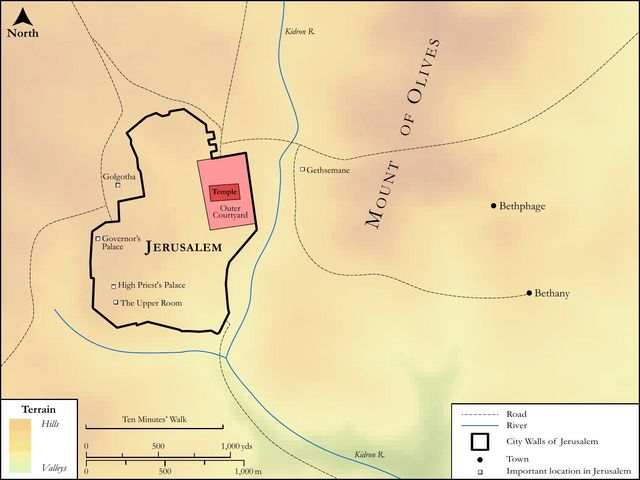
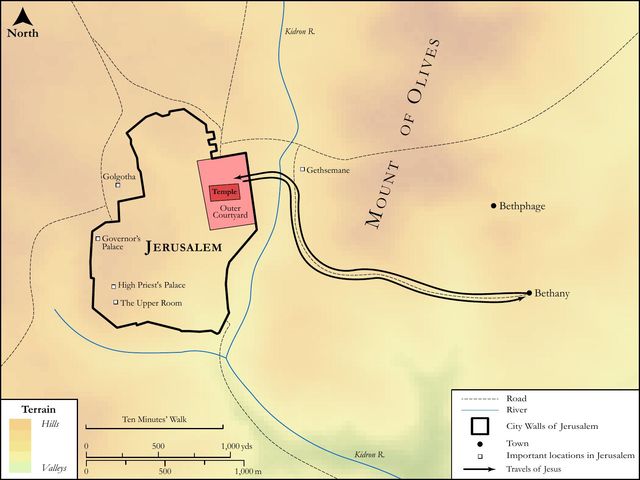
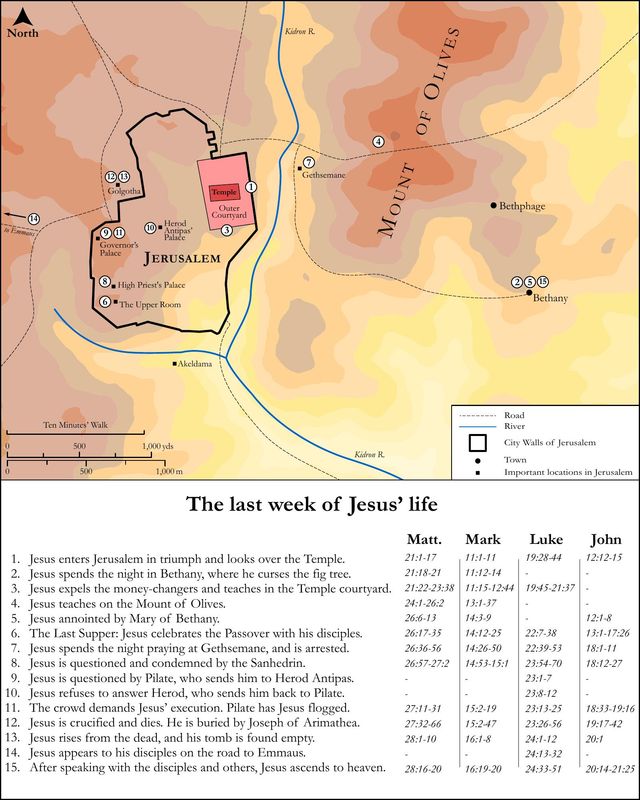
See on the biblical-era maps
Study this verse
Historical interpretation
Nine Centuries of Reception
11 surviving comments on this verse. Each one is dated, so this reads as a timeline rather than a list.
Select a marker to jump to its quote. Markers stagger vertically where authors wrote within a few decades of each other.
He therefore used the verb impersonally—that is, "he will be delivered up." He did not say by whom, because the words apply to all those who delivered him up. But not everyone delivered him up in the same way. God delivered him up out of mercy for the human race: he "has not spared even his own Son but has delivered him for us all." But the rest delivered him up for a bad reason, each one according to his own malice: Judas out of greed, the priests out of jealousy and the devil out of fear—lest the human race be plucked from his hands because of Christ's teaching, little knowing that the human race would be plucked away more through his death than through his teaching and miracles. He was in fact delivered up "to be crucified" so that, "disarming the principalities and powers," he might triumph over them on the cross.
He foretels His crucifixion to His disciples, adding, And the Son of Man shall be delivered to be crucified; thus fortifying them against that shock of surprise, which the sight of their Master, led forth to crucifixion, would otherwise have occasioned them. And He expresses it impersonally shall be delivered, because God delivered Him up in mercy to the human race, Judas from covetousness, the Priest for envy, the Devil through fear that through His teaching the human race would be plucked out of His hand, little aware how much more that would be effected by His death, than either by His teaching or miracles.
After the discourse in which the Lord had declared that He should return in splendour, He announces to them His approaching Passion, that they might learn the close connection between the sacrament of the Cross, and the glory of eternity.
"And it came to pass, when Jesus had finished these sayings, He said unto His disciples, Ye know that after two days is the passover, and the Son of Man is betrayed to be crucified." In good season again doth He speak of the passion, when He had reminded them of the kingdom, and of the recompense there, and of the deathless punishment; as though He had said, Why are ye afraid at the dangers that are for a season, when such good things await you?
But mark thou, I pray thee, how He hath in all His first sayings after a new manner worked up and thrown into the shade what was most painful to them. For He said not, Ye know that after two days I am betrayed, but, "Ye know that after two days is the passover," to show that what is done is a mystery and that a feast and celebration is being kept for the salvation of the world, and that with foreknowledge He suffered all. So then, as though this were sufficient consolation for them, He did not even say anything to them now about a resurrection; for it was superfluous, after having discoursed so much about it, to speak of it again. And moreover, as I said, He shows that even His very passion is a deliverance from countless evils, having by the passover reminded them of the ancient benefits in Egypt.
(Chapter 26, Verses 1 and following) And it came to pass, when Jesus had finished saying all these words, He said to His disciples: You know that after two days the Passover will take place, and the Son of Man will be handed over to be crucified. Let those who think that the Savior feared death be ashamed, and let them realize that He spoke out of fear of suffering when He said, 'Father, if it is possible, let this cup pass from Me' (Luke 22:42). He knew that He would be handed over to be crucified two days after the Passover, and yet He does not avoid the snares, nor does He flee in fear, to the extent that, even when the others do not want to go, He continues boldly, as Thomas says: 'Let us also go, that we may die with Him' (John 11:16). And desiring to put an end to the carnal celebration, and while the shadow is passing, to restore the truth of Easter, he said: ‘With desire I have desired to eat this pasch with you, before I suffer’ (Luke 22:15). Indeed, our pasch is sacrificed, Christ, if, however, we eat it in the unleavened bread of sincerity and truth (1 Corinthians 5:7). Furthermore, when he says ‘After two days the pasch shall be’ (Matthew 26:2), let us seek with a simple understanding that which is sacred, without neglecting the sacrament. After two days of clear light, the true Passover of the world is celebrated, of the old and new Testament. The Passover, which is called in Hebrew Phase (), is not named after suffering as many suppose, but after the passage: because the exterminator, seeing the blood, passed over the doors of the Israelites and did not strike them. Or rather the Lord himself, providing assistance, walked above his people. In the book of Exodus (Ch. XI, XII), which we will discuss more fully if life permits, we can find more about this. But our passage, that is, the Passover, is celebrated in such a way that, leaving behind earthly things and Egypt, we hasten to heavenly things.
The Passover, called in Hebrew Phase, does not come as most think from πασχεῖν 'to suffer,' but from the Hebrew word signifying 'to pass over;' because the destroyer passed over when he saw the blood on the doors of the Israelites, and smote them not; or the Lord Himself walked on high, succouring His people.
After the two days of the shining light of the Old and of the New Testament, the true Passover is slain for the world. Also our Passover is celebrated when we leave the things of earth, and hasten to the things of heaven.
Let them blush with shame who think the Savior dreaded death and said out of fear of suffering, “Father, if it be possible, let this cup pass from me.” After two days, about to celebrate the Passover, he knew that he was to be betrayed and crucified. However, he did not turn away from the snares or take flight in fear. While the rest were unwilling to proceed, he remained unruffled when Thomas said, “Let us go that we may die with him.” Wishing to put an end to the earthly festivity and to declare the truth in the passing shadow of Passover, he said, “I have earnestly desired to eat this Passover with you before I suffer.” Indeed, “Christ, our paschal lamb, has been sacrificed” if we eat it with “the unleavened bread of sincerity and truth.” Furthermore, because he says, “After two days the Passover will be here” and omits a simple explanation, we should seek what is holy. After two days of the brilliant light of the Old and New Testaments, the Passover is celebrated for the world. This Passover, called pesaḥin Hebrew, is not named after Christ’s suffering as many believe.It refers to the “passing over,” when the destroying angel saw the blood on the doors of the Israelites, passed by and did not strike them down. In other words, the Lord, giving help to his people, came down from above. Our passing over—that is to say, pesaḥ—will be celebrated if we put behind us both earthly things and Egypt and move on to heavenly things.
(de Cons. Ev. ii. 78.) We gather from John's account, that six days before the Passover, Jesus came to Bethany, and thence entered Jerusalem sitting upon the ass, after which were done the things related to have been done at Jerusalem. We understand therefore that four days elapsed from His coming to Bethany, to make this two days before the Passover. (v. 17.) The difference between the Passover and the feast of unleavened bread is this; the name Passover is given to that one day on which the lamb was slain in the evening, that is, the fourteenth moon of the first month; and on the fifteenth moon, the day that the people came out of Egypt, followed the festival of unleavened bread. (vid. Acts 12:3.) But the Evangelists seem to use the terms indifferently.
Or, because by the help of the Lord the Israelitish people, freed from Egyptian bondage, passed forth into liberty.
Mystically, that is called the Passover, because on that day Christ passed out of the world to His Father, from corruption to incorruption, from life to death, or because He redeemed the world by causing it savingly to pass from the slavery of the Devil.
All these sayings, i. e. about the consummation of the world, and the day of judgment. Or, finished, because He had fulfilled in doing and preaching all things from the beginning of the Gospel to His Passion.
After speaking of the kingdom and of retribution, it was opportune that He should then speak also concerning His own Passion, all but saying, "And those who crucify Me shall merit the fire."
Continue studying Matthew 26:2 across the web’s major study libraries — every link below opens this exact verse, chapter, or book on the destination site.
Read & Compare
 BibleGatewayThis verse in more than 200 translations and 70 languages.
 Bible.comThe YouVersion reader — hundreds of translations, reading plans, and highlights.
 ESV.orgCrossway's official English Standard Version reader.
 NET BibleThe NET translation with 60,000+ translators' notes on every rendering decision.
 STEP BibleTyndale House's free study tool — original text, vocabulary, and scholarly resources.
 BibliaLogos Bible Software's free web reader.
 USCCBThe New American Bible (Revised Edition) with the U.S. bishops' study notes.
Commentaries
 BibleHub CommentariesDozens of classic commentaries on this verse, gathered on one page.
 StudyLightMore than 100 commentary sets — the largest collection on the web.
 BibleRefPlain-English commentary on what this verse means, verse by verse.
 Enduring WordDavid Guzik's free commentary on this chapter, widely used by Bible teachers.
 Bible Study ToolsVerse commentary alongside Greek and Hebrew study aids.
Original Language & Research
- BibleHub InterlinearThe verse word by word — original language, transliteration, and English.
- BibleHub LexiconEvery word's original-language definition and Strong's entry.
 Blue Letter BibleDeep-study tools — Strong's numbers, concordance, and word studies.
 CNTR CollationThe earliest Greek manuscripts of this verse, collated letter by letter.
Sermons, Hymns & Audio


TrulyRandomVerse is not affiliated with these sites and doesn’t control their content. They’re linked because they’re genuinely useful.
Summary
Matthew 26:2 presents a profound and pivotal declaration by Jesus to His disciples, precisely two days before the Jewish Passover feast. In this concise statement, Jesus reveals His complete foreknowledge and sovereign control over the impending events of His passion, explicitly prophesying His betrayal and crucifixion. This announcement serves as a critical transition from His eschatological discourse to the immediate unfolding of His redemptive work, emphasizing the deliberate and preordained nature of His sacrifice.
Context
ShowHideLiterary Context
This verse immediately follows the conclusion of Jesus' extensive Olivet Discourse in Matthew 24-25, where He delivered prophecies concerning the destruction of the temple, the signs of His coming, and the end of the age. The shift in Matthew 26 is abrupt and intentional, moving from future eschatological events to the imminent, personal suffering of Jesus. It sets the stage for the passion narrative, beginning with the conspiracy of the chief priests and elders, Judas's betrayal, the Last Supper, Gethsemane, and the trials, all culminating in the crucifixion. This direct prophecy underscores Jesus' active role and divine awareness, rather than His being a mere victim of circumstance.
Historical & Cultural Context
The Passover (Pesach) was one of the most significant annual festivals in Judaism, commemorating God's miraculous deliverance of the Israelites from slavery in Egypt (as recounted in Exodus 12). It involved the sacrifice of a lamb, the application of its blood to doorposts, and a communal meal. The timing of Jesus' prophecy – "after two days is the feast of the passover" – is crucial, deliberately linking His impending death to this ancient sacrificial tradition. Jerusalem would have been bustling with pilgrims for the festival, and the atmosphere would have been charged with religious fervor and political tension, as Roman authorities were particularly vigilant during such gatherings. The method of crucifixion was a brutal form of capital punishment reserved by the Roman Empire primarily for slaves, rebels, and non-Roman citizens, designed to inflict maximum suffering and public humiliation.
Key Themes
ShowHideMatthew 26:2 contributes significantly to several overarching themes within the Gospel of Matthew and the broader biblical narrative. Firstly, it highlights Divine Foreknowledge and Sovereignty, demonstrating that Jesus' suffering and death were not accidental but part of God's predetermined plan for salvation, as seen in passages like Acts 2:23. Secondly, the use of the title "Son of Man" emphasizes Jesus' dual nature—His true humanity and His unique messianic authority, drawing from prophetic visions such as Daniel 7:13-14. This title underscores His identity as the one destined to suffer and reign. Thirdly, the explicit mention of Imminent Betrayal and Crucifixion foreshadows the treachery of Judas Iscariot (as detailed in Matthew 26:14-16) and the horrific method of His execution, emphasizing the depth of His suffering for humanity. Finally, the connection to the Passover underscores the theme of Sacrificial Fulfillment, portraying Jesus as the ultimate Passover Lamb, whose blood establishes a new covenant and provides atonement for sin.
Exposition and Analysis
ShowHideKey Word Analysis
ShowHideThis verb primarily means "to see" (literally or figuratively), but in the perfect tense, as used here, it implies "to know" or "to be aware." Jesus' use of "ye know" indicates that this information was not new or surprising to the disciples, perhaps referencing previous, less explicit predictions of His passion. It also subtly emphasizes Jesus' own perfect knowledge of the future, a divine attribute.
This word means "to surrender," "yield up," "entrust," or "transmit." While it can be neutral, in this context, it carries the sinister connotation of being "handed over" by treachery. It refers specifically to Judas Iscariot's act of delivering Jesus to the authorities, an act that was both humanly sinful and divinely ordained to fulfill prophecy.
This verb means "to impale on the cross." It describes the specific, brutal method of execution that Jesus would undergo. The word itself evokes the immense suffering, humiliation, and public spectacle of death on a cross, a fate reserved for the most despised criminals. The passive voice ("is betrayed to be crucified") highlights that Jesus is the recipient of these actions, yet His foreknowledge implies His willing submission.
Verse Breakdown
ShowHide"Ye know that after two days is the feast of the passover,"
This clause establishes the precise temporal context for Jesus' prophecy. The disciples are already aware of the approaching Passover festival, a central event in the Jewish calendar. Jesus' statement grounds His impending suffering within a familiar and highly significant religious framework, setting the stage for His role as the ultimate Passover sacrifice. The phrase "after two days" indicates the extreme imminence of the events, creating a sense of urgency and gravity.
"and the Son of man is betrayed to be crucified."
This second clause delivers the shocking and explicit prophecy of Jesus' fate. The conjunction "and" links the sacred feast directly to His violent death, highlighting the stark contrast and yet profound connection between the two. Jesus refers to Himself as "the Son of man," a title emphasizing His humanity and His messianic role as the suffering servant and future judge. The passive voice of "is betrayed" and "to be crucified" indicates that these actions will be performed by others, yet Jesus' foreknowledge demonstrates His sovereign consent to these events, which are part of God's redemptive plan.
Literary Devices
ShowHideMatthew 26:2 is rich in literary devices that amplify its profound theological message. Foreshadowing is prominent, as Jesus explicitly predicts His betrayal and crucifixion, setting up the entire passion narrative that follows. This is not a vague prediction but a precise declaration of timing and method. The statement also functions as a powerful Prophecy, fulfilling numerous Old Testament scriptures concerning the suffering Messiah. There is also a strong element of Irony: the very feast celebrating deliverance from bondage (Passover) becomes the backdrop for the betrayal and execution of the ultimate Deliverer. Furthermore, the verse employs Symbolism, as Jesus' death is implicitly linked to the Passover lamb, transforming an ancient ritual into a profound symbol of His substitutionary atonement. The stark contrast between the festive atmosphere of Passover and the brutal reality of crucifixion creates a powerful Juxtaposition, underscoring the gravity of Jesus' sacrifice.
Theological and Thematic Connections
ShowHideMatthew 26:2 is a cornerstone for understanding the sovereignty of God and the willing obedience of Christ in the face of suffering. It reveals that Jesus' death was not a tragic accident but a divinely orchestrated event, known and embraced by Him from eternity. This foreknowledge underscores His unique identity as the Son of God, who deliberately walked the path to the cross to fulfill His redemptive mission. The connection to the Passover feast is deeply significant, establishing Jesus as the ultimate Passover Lamb, whose sacrifice inaugurates a new covenant and provides true liberation from the bondage of sin and death. This verse reminds believers that the cross, though an act of human wickedness, was simultaneously the very means of God's saving grace, demonstrating His profound love and unwavering purpose.
Reflection and Application
ShowHideMatthew 26:2 offers profound comfort and challenge to believers. Jesus' complete foreknowledge and willing submission to His betrayal and crucifixion demonstrate His unwavering commitment to God's redemptive plan, even when it meant unimaginable suffering. This should deepen our trust in God's sovereignty, assuring us that even in our darkest moments, His purposes are being worked out for our good and His glory. It calls us to reflect on the immense cost of our salvation and the depth of God's love, which motivated Christ's voluntary sacrifice. Understanding that Jesus walked into His suffering with full awareness should inspire us to face our own trials with courage and faith, knowing that He has gone before us. It also compels us to live lives of gratitude and obedience, recognizing that our redemption was secured not by chance, but by the deliberate, loving act of our Savior.
Questions for Reflection
ShowHideFAQ
ShowHideWhy does Jesus explicitly state the timing of His death?
ShowHideJesus explicitly states the timing of His death ("after two days is the feast of the passover") for several crucial reasons. Firstly, it underscores His divine foreknowledge and sovereignty over all events, demonstrating that His death was not an accident or a failure, but a preordained act within God's redemptive plan (compare Acts 2:23). Secondly, it deliberately links His sacrifice to the Jewish Passover, identifying Himself as the ultimate Passover Lamb whose blood would establish a new covenant and bring true liberation from sin, fulfilling Old Testament types and shadows. This precise timing also serves to prepare His disciples, though they initially struggled to comprehend it, for the traumatic events that were about to unfold, reinforcing the truth of His words.
Christ-Centered Fulfillment
ShowHideMatthew 26:2 finds its profound Christ-centered fulfillment in the person and work of Jesus as the ultimate sacrifice and the inaugurator of the New Covenant. Just as the original Passover lamb's blood protected Israel from death, Jesus, the Lamb of God, sheds His blood to atone for the sins of humanity, establishing a new and eternal deliverance. His betrayal, far from being a defeat, was a necessary step in God's plan, fulfilling prophecies like Psalm 41:9 and leading to the cross where He bore the full weight of sin. The crucifixion, though a brutal Roman method of execution, became the very means by which Christ conquered sin and death, transforming an instrument of shame into a symbol of ultimate victory and love. This verse, therefore, points directly to the institution of the Lord's Supper, where Jesus' body and blood are remembered as the foundation of the New Covenant, a covenant of grace and forgiveness made possible by His voluntary sacrifice (as echoed in Hebrews 9:11-14). His foreknowledge and willing submission to this path highlight His perfect obedience to the Father's will, securing eternal life for all who believe (as proclaimed in John 3:16).