


Mark 9:30
Bible text: King James Version (1769 Blayney text) · Public domain
Bible text: Berean Standard Bible · Public domain
Bible text: American Standard Version (1901) · Public domain
Bible text: World English Bible, Messianic edition · Public domain
Bible text: Geneva Bible (1599) · Public domain
Bible text: Young's Literal Translation · Public domain
- ΚἀκεῖθενKakeithenAnd from thereG1564CONJ + G1564=ADV
- ἐξελθόντεςexelthonteshaving gone forthG1831V-2AAP-NPMVerb 2nd Aorist Active Participle Nominative Plural Masculine
- παρεπορεύοντοpareporeuontothey were passing throughG3899V-INI-3PVerb Imperfect Middle Or Passive Deponent Indicative 3rd Plural
- διὰdiathroughG1223PREPPreposition
- τῆςtēs<the>G3588T-GSFDefinite article Genitive Singular Feminine
- ΓαλιλαίαςGalilaiasGalileeG1056N-GSF-LNoun Genitive Singular Feminine Location
- καὶkaiandG2532CONJConjunction
- οὐκouknotG3756PRT-NNegative Particle Negative
- ἤθελενēthelenwas He wantingG2309V-IAI-3SVerb Imperfect Active Indicative 3rd Singular
- ἵναinathatG2443CONJConjunction
- τιςtisanyoneG5100X-NSMIndefinite pronoun Nominative Singular Masculine
- γνοῖ·gnoimay know [it]G1097V-2AAS-3SVerb 2nd Aorist Active Subjunctive 3rd Singular
English is a literal word-by-word gloss of the Greek, not the KJV's wording. Why?
This is the original text the KJV's translators worked from — each Greek word with its own literal English meaning in this verse, prepared by scholars at Tyndale House, Cambridge. The KJV translates whole sentences, not word by word, so its wording differs: one Greek word can become several English words, and the KJV may choose “charity” where the gloss reads “love”. Both are faithful — they answer different questions. For the KJV's own rendering, switch to the KJV text.
Details
See on the biblical-era maps
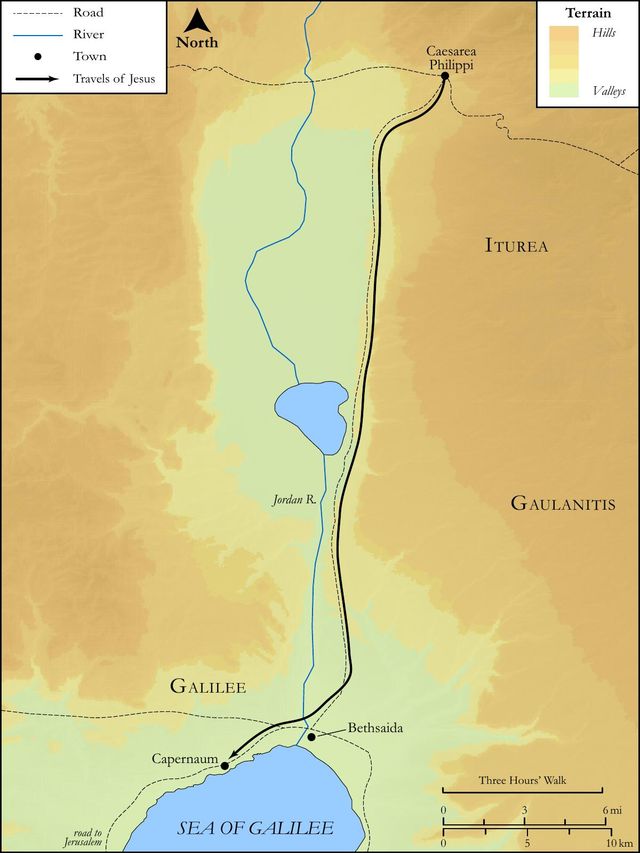
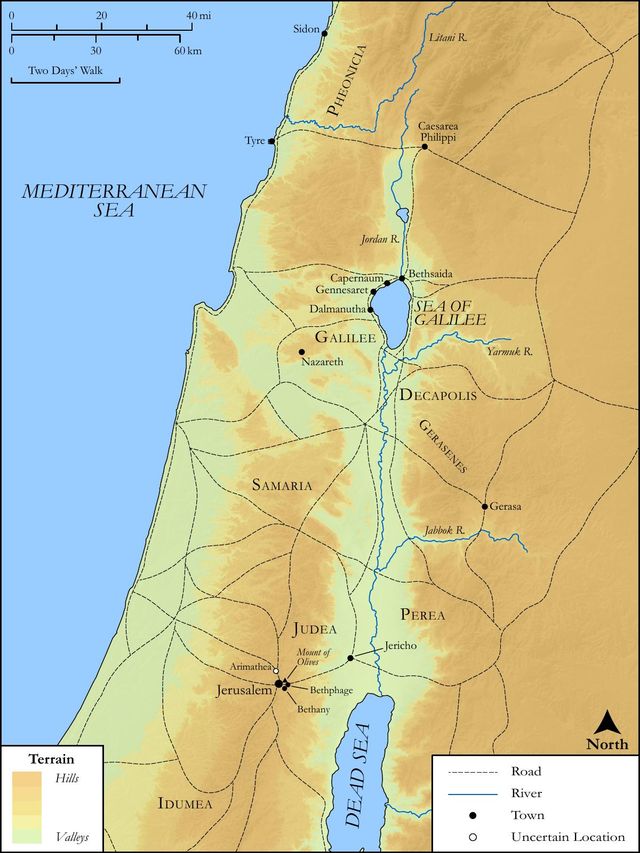
Study this verse
Public-domain commentary
Matthew Henry
From his Commentary on the Whole Bible. Henry comments on passages, not single verses — this entry covers Mark 9:30–40. His three-level outline is real structure in the source text, so it is rendered as structure.
Here, I. Christ foretels his own approaching sufferings. He passed through Galilee with more expedition than usual, and would not that any man should know of it (Mar 9:30); because he had done many mighty and good works among them in vain, they shall not be invited to see them and have the benefit of them, as they have been. The time of his sufferings drew nigh, and therefore he was willing to be private awhile, and to converse only with his disciples, to prepare them for the approaching trial, Mar 9:31. He said to them, The Son of man is delivered by the determinate council and fore-knowledge of God into the hands of men (Mar 9:31), and they shall kill him. He had been delivered into the hands of devils, and they had worried him, it had not been so strange; but that men, who have reason, and should have love, that they should be thus spiteful to the Son of man, who came to redeem and save them, is unaccountable. But still it is observable that when Christ spoke of his death, he alway spoke of his resurrection, which took away the reproach of it from himself, and should have taken away the grief of it from his disciples. But they understood not that saying, Mar 9:32. The words were plain enough, but they could not be reconciled to the thing, and therefore would suppose them to have some mystical meaning which they did not understand, and they were afraid to ask him; not because he was difficult of access, or stern to those who consulted him, but either because they were loth to know the truth, or because they expected to be chidden for their backwardness to receive it. Many remain ignorant because they are ashamed to enquire.
II.He rebukes his disciples for magnifying themselves.
When he came to Capernaum, he privately asked his disciples what it was they disputed among themselves by the way, Mar 9:33. He knew very well what the dispute was, but he would know it from them, and would have them to confess their fault and folly in it. Note,
1.We must all expect to be called to an account by our Lord Jesus, concerning what passes while we are in the way in this state of passage and probation.
2.We must in a particular manner be called to an account about our discourses among ourselves; for by our words we must be justified or condemned.
3.As our other discourses among ourselves by the way, so especially our disputes, will be all called over again, and we shall be called to an account about them.
4.Of all disputes, Christ will be sure to reckon with his disciples for their disputes about precedency and superiority: that was the subject of the debate here, who should be the greater, Mar 9:34. Nothing could be more contrary to the two great laws of Christ's kingdom, lessons of his school, and instructions of his example, which are humility and love, than desiring preferment in the world, and disputing about it. This ill temper he took all occasions to check, both because it arose from a mistaken notion of his kingdom, as if it were of this world, and because it tended so directly to be debasing of the honour, and the corrupting of the purity, of his gospel, and, he foresaw, would be so much the bane of the church.
Now, (1.) They were willing to cover this fault (Mar 9:34); they held their peace. As they would not ask (Mar 9:32), because they were ashamed to own their ignorance, so here they would not answer because they were ashamed to own their pride. (2.) He was willing to amend this fault in them, and to bring them to a better temper; and therefore sat down, that he might have a solemn and full discourse with them about this matter; he called the twelve to him, and told them, [1.] That ambition and affectation of dignity and dominion, instead of gaining them preferment in his kingdom, would but postpone their preferment; If any man desire and aim to be first, he shall be last; he that exalteth himself, shall be abased, and men's pride shall bring them low. [2.] That there is no preferment to be had under him, but an opportunity for, and an obligation to, so much the more labour and condescension; If any man desire to be first, when he is so, he must be much the more busy and serviceable to every body. He that desires the office of a bishop, desires a good work, for he must, as St. Paul did, labour the more abundantly, and make himself the servant of all. [3.] That those who are most humble and self-denying, do most resemble Christ, and shall be most tenderly owned by him. This he taught them by a sign; He took a child in his arms, that had nothing of pride and ambition in it. "Look you," saith he; "whosoever shall receive one like this child, receives me. Those of a humble, meek, mild disposition are such as I will own and countenance, and encourage every body else to do so too, and will take what is done to them as done to myself; and so will my Father too, for he who thus receiveth me, receiveth him that sent me, and it shall be placed to his account, and repaid with interest."
III.He rebukes them for vilifying all but themselves; while they are striving which of them should be greatest, they will not allow those who are not in communion with them to be any thing. Observe,
1.The account which John gave him, of the restraint they had laid upon one from making use of the name of Christ, because he was not of their society. Though they were ashamed to own their contests for preferment, they seem to boast of this exercise of their authority, and expected their Master would not only justify them in it, but commend them for it; and hoped he would not blame them for desiring to be great, when they would thus use their power for maintaining the honour of the sacred college. Master, saith John, we saw one casting out devils in thy name, but he followeth not us, Mar 9:38.
(1.)It was strange that the one who was not a professed disciple and follower of Christ, should yet have power to cast out devils, in his name, for that seemed to be peculiar to those whom he called, Mar 6:7. But some think that he was a disciple of John, who made use of the name of the Messiah, not as come, but as near at hand, not knowing that Jesus was he. It should rather seem that he made use of the name of Jesus, believing him to be the Christ, as the other disciples did. And why not he receive that power from Christ, whose Spirit, like the wind, blows where it listeth, without such an outward call as the apostles had? And perhaps there were many more such. Christ's grace is not tied to the visible church.
(2.)It was strange that one who cast out devils in the name of Christ, did not join himself to the apostles, and follow Christ with them, but should continue to act in separation from them. I know of nothing that could hinder him from following them, unless because he was loth to leave all to follow them; and if so, that was an ill principle. The thing did not look well, and therefore the disciples forbade him to make use of Christ's name as they did, unless he would follow him as they did. This was like the motion Joshua made concerning Eldad and Medad, that prophesied in the camp, and went not up with the rest to the door of the tabernacle; "My lord Moses, forbid them (Num 11:28); restrain them, silence them, for it is a schism." Thus apt are we to imagine that those do not follow Christ at all, who do not follow him with us, and that those do nothing well, who do not just as we do. But the Lord knows them that are his, however they are dispersed; and this instance gives us a needful caution, to take heed lest we be carried, by an excess of zeal for the unity of the church, and for that which we are sure is right and good, to oppose that which yet may tend to the enlargement of the church, and the advancement of its true interests another way.
2.The rebuke he gave to them for this (Mar 9:39); Jesus said, "Forbid him not, nor any other that does likewise." This was like the check Moses gave to Joshua; Enviest thou for my sake? Note, That which is good, and doeth good, must not be prohibited, though there be some defect or irregularity in the manner of doing it. Casting out devils, and so destroying Satan's kingdom, doing this in Christ's name, and so owning him to be sent of God, and giving honour to him as the Fountain of grace, preaching down sin, and preaching up Christ, are good things, very good things, which ought not to be forbidden to any, merely because they follow not with us. If Christ be preached, Paul therein doth, and will rejoice, though he be eclipsed by it, Phi 1:18. Two reasons Christ gives why such should not be forbidden.
(1.)Because we cannot suppose that any man who makes use of Christ's name in working miracles, should blaspheme his name, as the scribes and Pharisees did. There were those indeed that did in Christ's name cast out devils, and yet in other respects were workers of iniquity; but they did not speak evil of Christ.
(2.)Because those that differed in communion, while they agreed to fight against Satan under the banner of Christ, ought to look upon one another as on the same side, notwithstanding that difference. He that is not against us is on our part. As to the great controversy between Christ an Beelzebub, he had said, He that is not with me is against me, Mat 12:30. He that will not own Christ, owns Satan. But as to those that own Christ, though not in the same circumstances, that follow him, though not with us, we must reckon that though these differ from us, they are not against us, and therefore are on our part, and we must not be any hindrance to their usefulness.
Historical interpretation
Seven Centuries of Reception
7 surviving comments on this verse. Each one is dated, so this reads as a timeline rather than a list.
Select a marker to jump to its quote. Markers stagger vertically where authors wrote within a few decades of each other.
Or else, the folly which is connected with the softness of the flesh, is healed by fasting; anger and laziness are healed by prayer. Each wound has its own medicine, which must be applied to it; that which is used for the heel will not cure the eye; by fasting, the passions of the body, by prayer, the plagues of the soul, are healed.
Capernaum means the city of consolation, and agrees with the former sentence, which He had spoken: And after that he is killed, he shall arise the third day. There follows: And being in the house he asked them, What was it that ye disputed among yourselves by the way? But they held their peace.
It was fit also that they should dispute concerning the chief place by the way; the dispute is like the place where it is held; for lofty station is only entered upon to be quitted: as long as a man keeps it, it is slippery, and it is uncertain at what stage, that is, on what day, it will end.
Where it is to be observed, that the disciples disputed by the way concerning the chief place, but Christ Himself sat down to teach humility; for princes toil while the humble repose.
(Vict. Ant. e Cat. in Marc.) Matthew however says, that the disciples came to Jesus, saying, Who is the greatest in the kingdom of heaven? (Matt. 18:1) The reason is, that he did not begin the narrative from its commencement, but omitted our Saviour's knowledge of the thoughts and words of His disciples; unless we understand Him to mean, that even what they thought and said, when away from Christ, was said unto Him, since it was as well known to Him as if it had been said to Him. It goes on: For by the way they had disputed among themselves, who should be the greatest. (Luke 9:46. Vulg.) But Luke says, that "the thought entered into the disciples which of them should be the greatest;" for the Lord laid open their thought and intention from their private discourse1 according to the Gospel narrative.
(Vict. Ant. e Cat. in Marc.) The disciples indeed wished to receive honour at the hands of the Lord; they also had a desire to be made great by Christ, for the greater a man is, the more worthy of honour he becomes, for which reason He did not throw an obstacle in the way of that desire, but brought in humility.
(in Marc. 3, 39) He always mingles together sorrowful and joyful things, that sorrow should not by its suddenness frighten the Apostles, but be borne by them with prepared minds.
(ubi sup.) This ignorance of the disciples proceeds not so much from slowness of intellect, as from love for the Saviour, for they were as yet carnal, and ignorant of the mystery of the cross, they could not therefore believe that He whom they had recognised as the true God, was about to die; being accustomed then to hear Him often talk in figures, and shrinking from the event of His death, they would have it, that something was conveyed figuratively in those things, which he spoke openly concerning His betrayal and passion. It goes on: And they came to Capernaum.
(ubi sup.) The reason why the dispute concerning the chief place arose amongst the disciples seems to have been, that Peter, James, and John, were led apart from the rest into the mountain, and that something secret was there entrusted to them, also that the keys of the kingdom of heaven were promised to Peter, according to Matthew. Seeing however the thoughts of the disciples, the Lord takes care to heal the desire of glory by humility; for He first, by simply commanding humility, admonishes them that a high station was not to be aimed at. Wherefore it goes on: And he sat down, and called the twelve, and saith unto them, If any man desire to be first, the same shall be last of all, and servant of all.
(ubi sup.) By which, He either simply shows, that those who would become greater must receive the poor of Christ in honour of Him, or He would persuade them to be in malice children, to keep simplicity without arrogance, charity without envy, devotedness without anger. Again, by taking the child into His arms, He implies that the lowly are worthy of His embrace and love. He adds also, In my name, that they might, with the fixed purpose of reason, follow for His name's sake that mould of virtue to which the child keeps, with nature for his guide. And because He taught that He Himself was received in children, lest it should be thought that there was nothing in Him but what was seen, he added, And whosoever shall receive me, receiveth not me, but Him that sent me; thus wishing, that we should believe Him to be of the same nature and of equal greatness with His Father.
And departing from there, they passed through Galilee, and he did not want anyone to know. But he was teaching his disciples, and saying to them, "The Son of Man will be delivered into the hands of men, and they will kill him. And after being killed, on the third day he will rise again." He always mixes sorrow with prosperity, so that when they suddenly come, they will not terrify the apostles, but their minds will endure them by premeditation. For if it grieves them that he is to be killed, it ought to gladden them that he will rise again on the third day.
It is after miracles that the Lord inserts a discourse concerning His Passion, lest it should be thought that He suffered because He could not help it; wherefore it is said, And they departed thence, and passed through Galilee: and he would not that any man should know it. For he taught his disciples, and said unto them, The Son of man is delivered into the hands of men, and they shall kill him.
After, however, saying what was sorrowful, He adds what ought to rejoice them; wherefore it goes on: And after that he is killed, he shall rise the third day; in order that we may learn that joys come on after struggles. There follows: But they understood not that saying, and were afraid to ask him.
For His wish is not that we should usurp for ourselves chief places, but that we should attain to lofty heights by lowliness. He next admonishes them by the example of a child's innocence; wherefore there follows: And he took a child, and set him in the midst of them.
See, how great is humility, for it wins for itself the indwelling of the Father, and of the Son, and also of the Holy Ghost.
Whenever the Lord spoke of His passion on the cross, He would precede and follow His words with miracles, so that no one could think that He would suffer because He was powerless. And when He spoke sad words, such as, they shall kill Him, He would add words of joy, He shall rise the third day, teaching us that gladness always follows after grief, and that we should not anguish needlessly in our sorrows, but should hope for better things.
Continue studying Mark 9:30 across the web’s major study libraries — every link below opens this exact verse, chapter, or book on the destination site.
Read & Compare
 BibleGatewayThis verse in more than 200 translations and 70 languages.
 Bible.comThe YouVersion reader — hundreds of translations, reading plans, and highlights.
 ESV.orgCrossway's official English Standard Version reader.
 NET BibleThe NET translation with 60,000+ translators' notes on every rendering decision.
 STEP BibleTyndale House's free study tool — original text, vocabulary, and scholarly resources.
 BibliaLogos Bible Software's free web reader.
 USCCBThe New American Bible (Revised Edition) with the U.S. bishops' study notes.
Commentaries
 BibleHub CommentariesDozens of classic commentaries on this verse, gathered on one page.
 StudyLightMore than 100 commentary sets — the largest collection on the web.
 BibleRefPlain-English commentary on what this verse means, verse by verse.
 Enduring WordDavid Guzik's free commentary on this chapter, widely used by Bible teachers.
 Bible Study ToolsVerse commentary alongside Greek and Hebrew study aids.
Original Language & Research
- BibleHub InterlinearThe verse word by word — original language, transliteration, and English.
- BibleHub LexiconEvery word's original-language definition and Strong's entry.
 Blue Letter BibleDeep-study tools — Strong's numbers, concordance, and word studies.
 CNTR CollationThe earliest Greek manuscripts of this verse, collated letter by letter.
Sermons, Hymns & Audio


TrulyRandomVerse is not affiliated with these sites and doesn’t control their content. They’re linked because they’re genuinely useful.
Summary
Mark 9:30 describes a pivotal moment in Jesus' ministry following the Transfiguration and the healing of the demon-possessed boy, as He and His disciples embark on a deliberate, private journey through Galilee. Jesus actively sought anonymity during this period, not out of fear or weakness, but to create an exclusive environment for intensive, unhindered instruction, specifically preparing His inner circle for the profound and challenging truths of His impending suffering, death, and resurrection.
Context
ShowHideLiterary Context
This verse serves as a crucial transition point in Mark's Gospel. It immediately follows the awe-inspiring event of the Transfiguration on the mountain, where Jesus' divine glory was momentarily revealed to Peter, James, and John (Mark 9:2-8). This profound display of His deity was quickly followed by the challenging episode of the demon-possessed boy, which exposed the disciples' lack of faith and inability to cast out the demon, leading to Jesus' lament about their unbelief (Mark 9:14-29). In the wake of these intense and revealing experiences, Jesus intentionally seeks privacy. The very next verse, Mark 9:31, records Jesus' second explicit prediction of His passion, highlighting the purpose of this secluded journey: to prepare His disciples for the shocking reality of His suffering and death.
Historical & Cultural Context
Galilee, a region in northern Israel, was Jesus' primary area of ministry, known for its diverse population, including many Gentiles, and its more rural, less religiously rigid character compared to Judea. Traveling through Galilee would typically involve encountering crowds and public recognition, given Jesus' widespread fame as a miracle worker and teacher. His deliberate desire for secrecy ("he would not that any man should know it") stands in stark contrast to the usual public nature of His ministry in this region. This choice reflects a strategic shift from public proclamation to private, intensive discipleship, indicative of the escalating tension with religious authorities in Jerusalem and the need to prepare His followers for a Messiah who would suffer, rather than immediately establish an earthly kingdom.
Key Themes
ShowHideThis verse powerfully illustrates several recurring themes in Mark's Gospel. Firstly, it underscores the Messianic Secret, a prominent motif where Jesus often commands silence about His identity or miracles. This was not due to a lack of power, but often to manage public expectations, prevent premature political uprisings, or to control the timing and nature of His full revelation, particularly His path to the cross (Mark 8:29-30). Secondly, it highlights the theme of Private Discipleship. Away from the clamor of the crowds and the demands of public ministry, Jesus could provide intimate, focused instruction to His inner circle, delving into deeper truths about His mission and the nature of true discipleship, which included suffering and service (Mark 10:45). Lastly, it emphasizes Divine Timing and Purpose. Jesus' actions were always intentional and aligned with God's perfect plan. His desire for secrecy here signals a shift in His ministry's focus, moving from public demonstration of power to the crucial preparation of His disciples for the ultimate sacrifice, a necessary step in God's redemptive timeline.
Exposition and Analysis
ShowHideKey Word Analysis
ShowHideThis verb, meaning "to issue forth" or "to come out," indicates a purposeful and decisive movement away from a previous location. It suggests that Jesus and His disciples intentionally left the area where the Transfiguration and the healing of the demon-possessed boy had taken place, signifying a deliberate change of setting and focus.
This compound verb, combining "alongside" (para) and "to go" (poreuomai), describes a journey that involves traveling through or alongside a region, rather than stopping to engage publicly. It implies a discreet and unobserved transit, reinforcing the idea of a desire for privacy during their journey through Galilee.
The Greek verb thélō, combined with the negative particle ou (ou thélō), expresses a strong, active, and deliberate will or intention. It signifies that Jesus was not merely indifferent or passively hoping for privacy; He actively willed and determined that their presence and movements remain unknown. This underscores His strategic control over His ministry's pace and revelation.
This verb implies more than just intellectual awareness; it often denotes a deeper, experiential knowledge, recognition, or understanding. Jesus desired that no one should come to recognize or fully comprehend their presence and purpose during this private journey, reinforcing the theme of the Messianic Secret and His strategic control over the timing of His full revelation.
Verse Breakdown
ShowHide"And they departed thence, and passed through Galilee;"
This clause sets the scene for Jesus' intentional withdrawal. Following the intense spiritual and physical events that just transpired, Jesus and His disciples deliberately leave that location and begin a journey through the region of Galilee. The phrasing suggests a journey of movement rather than a period of public engagement, indicating a shift in the nature of their activity.
"and he would not that any man should know [it]."
This is the pivotal clause, revealing Jesus' explicit and strong desire for privacy. The phrase "he would not" (Greek: ouk ēthelen) conveys His active will and determination. The "it" refers to their presence, their movements, and implicitly, the profound teachings He was imparting to His disciples. This desire for anonymity was strategic, aimed at controlling the timing and nature of His revelation, particularly as He prepared His disciples for His impending suffering and death, a truth the public was not yet ready to grasp.
Literary Devices
ShowHideMark 9:30 employs several literary devices to convey its profound meaning. The most prominent is Narrative Transition, as the verse marks a distinct shift in the Gospel's narrative focus from public ministry and miraculous displays to a period of private, intensive discipleship. This transition is crucial for preparing the reader, and the disciples, for the impending Passion narrative. There is also an element of Foreshadowing, as Jesus' deliberate desire for secrecy immediately precedes His second explicit prediction of His suffering and death. This quiet journey through Galilee serves as a secluded space for the disciples to grapple with this shocking truth, hinting at the hidden nature of God's redemptive plan. Furthermore, the verse subtly employs Irony, as the Son of God, the Light of the World, actively seeks obscurity. This paradox highlights the counter-intuitive nature of God's kingdom, where true power and revelation often manifest through humility and hiddenness, rather than overt public display, challenging conventional expectations of a conquering Messiah.
Theological and Thematic Connections
ShowHideMark 9:30 highlights Jesus' strategic control over His ministry and the deliberate pacing of divine revelation. His desire for secrecy is not a sign of weakness but a purposeful act to cultivate an environment for intimate, transformative teaching for His disciples. This period of withdrawal underscores the critical importance of private discipleship, where foundational truths about the nature of the Messiah's mission—especially His suffering and death—could be imparted without the distractions or misunderstandings of public acclaim. It emphasizes that true understanding of Christ often requires a quiet, focused posture, preparing believers for the counter-cultural demands of following a crucified Lord.
Reflection and Application
ShowHideMark 9:30 offers a profound lesson for contemporary believers: not all significant spiritual growth or deep learning happens in the public spotlight. Just as Jesus intentionally sought a period of privacy to instruct His disciples, we too need to cultivate intentional spaces for quiet reflection, study, and prayer, away from the clamor and distractions of the world. These periods of "passing through" in obscurity can be crucial for deepening our understanding of Christ's mission, preparing us for future challenges, and refining our faith. It teaches us the value of humility, the importance of discerning God's timing, and the necessity of prioritizing intimate communion with Him over external validation or public recognition. In a world that often celebrates visibility, Jesus' example reminds us that true spiritual formation often occurs in hidden, sacred moments, equipping us to embrace the full, often challenging, implications of following Him.
Questions for Reflection
ShowHideFAQ
ShowHideWhy did Jesus want to keep His movements secret in Galilee?
ShowHideJesus' desire for secrecy in Mark 9:30 was a strategic decision, not a sign of weakness or fear. It served several key purposes. Firstly, it was part of the "Messianic Secret" motif in Mark's Gospel, where Jesus often controlled the timing and nature of His revelation to prevent premature public acclaim that might misinterpret His mission as primarily political or earthly. Secondly, and most importantly for this context, it allowed Him to have private, uninterrupted time with His disciples. Immediately following this verse, Jesus gives His second explicit prediction of His suffering, death, and resurrection (Mark 9:31). He needed to prepare His disciples for this shocking truth, which required focused, intimate teaching away from the crowds and their expectations. This period was crucial for their spiritual formation before the ultimate events in Jerusalem.
Christ-Centered Fulfillment
ShowHideJesus' deliberate desire for obscurity in Mark 9:30 is profoundly Christ-centered, revealing His sovereign control over His redemptive mission. This hidden journey through Galilee is not merely a tactical retreat but a purposeful preparation for the ultimate revelation of His identity as the Suffering Servant. By seeking privacy, Jesus models the humility and self-emptying that would characterize His entire life and culminates in His atoning death. He is the divine Teacher, carefully nurturing His disciples' understanding of His true purpose: to give His life as a ransom for many (Mark 10:45). This period of quiet instruction foreshadows the profound, often hidden, work of the cross, where the world's salvation would be accomplished not through public spectacle but through the sacrificial Lamb of God (John 1:29). His temporary hiddenness in Galilee ultimately leads to His public humiliation and glorious exaltation on the cross, the very means by which He draws all people to Himself (John 12:32). Thus, His desire for anonymity here is a testament to His perfect timing and commitment to fulfilling the Father's will, ensuring His disciples were equipped to understand and proclaim the full scope of His redemptive work.