


Mark 10:10
Bible text: King James Version (1769 Blayney text) · Public domain
Bible text: Berean Standard Bible · Public domain
Bible text: American Standard Version (1901) · Public domain
Bible text: World English Bible, Messianic edition · Public domain
Bible text: Geneva Bible (1599) · Public domain
Bible text: Young's Literal Translation · Public domain
- ΚαὶKaiAndG2532CONJConjunction
- εἰςeisinG1519PREPPreposition
- τὴνtēntheG3588T-ASFDefinite article Accusative Singular Feminine
- οἰκίανoikianhouseG3614N-ASFNoun Accusative Singular Feminine
- πάλινpalinagainG3825ADVAdverb
- οἱhoitheG3588T-NPMDefinite article Nominative Plural Masculine
- μαθηταὶmathētaidisciplesG3101N-NPMNoun Nominative Plural Masculine
- αὐτοῦautouof itG846P-GSNPersonal pronoun Genitive Singular Neuter
- περὶpericoncerningG4012PREPPreposition
- τοῦtouthe [meaning] ofG3588T-GSNDefinite article Genitive Singular Neuter
- τούτουtoutouthisG3778D-GSNDemonstrative pronoun Genitive Singular Neuter
- ἐπηρώτωνepērōtōnwere questioningG1905V-IAI-3PVerb Imperfect Active Indicative 3rd Plural
- αὐτόνautonHimG846P-ASMPersonal pronoun Accusative Singular Masculine
English is a literal word-by-word gloss of the Greek, not the KJV's wording. Why?
This is the original text the KJV's translators worked from — each Greek word with its own literal English meaning in this verse, prepared by scholars at Tyndale House, Cambridge. The KJV translates whole sentences, not word by word, so its wording differs: one Greek word can become several English words, and the KJV may choose “charity” where the gloss reads “love”. Both are faithful — they answer different questions. For the KJV's own rendering, switch to the KJV text.
Details
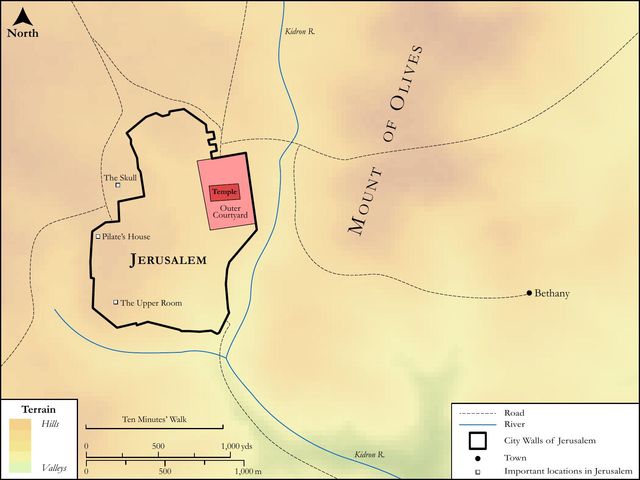
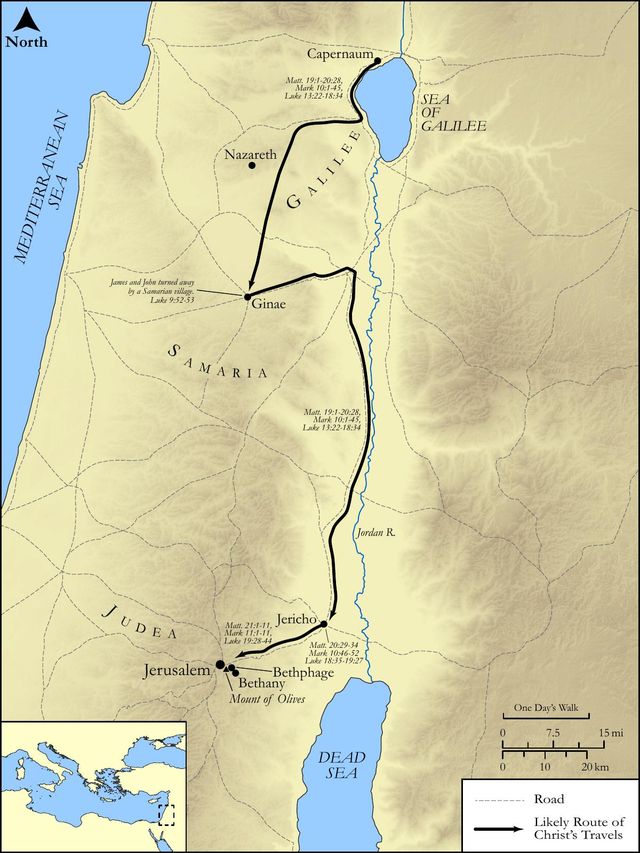
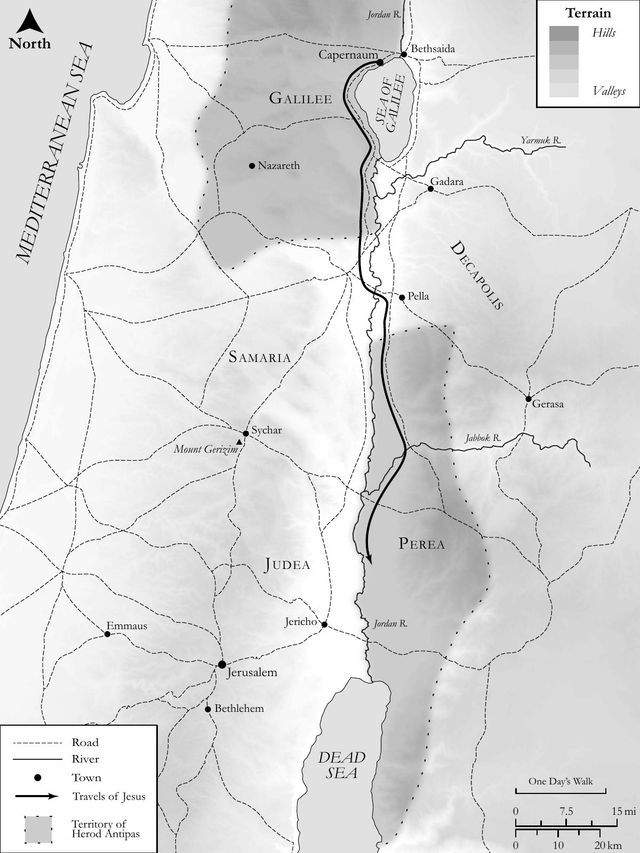
See on the biblical-era maps
Study this verse
Public-domain commentary
Matthew Henry
From his Commentary on the Whole Bible. Henry comments on passages, not single verses — this entry covers Mark 10:1–12. His three-level outline is real structure in the source text, so it is rendered as structure.
Our Lord Jesus was an itinerant Preacher, did not continue long in a place, for the whole land of Canaan was his parish, or diocese, and therefore he would visit every part of it, and give instructions to those in the remotest corners of it. Here we have him in the coasts of Judea, by the further side of Jordan eastward, as we found him, not long since, in the utmost borders westward, near Tyre and Sidon. Thus was his circuit like that of the sun, from whose light and heat nothing is hid. Now here we have him,
I.Resorted to by the people, Mar 10:1.
Wherever he was, they flocked after him in crowds; they came to him again, as they had done when he had formerly been in these parts, and, as he was wont, he taught them again. Note, Preaching was Christ's constant practice; it was what he was used to, and, wherever he came, he did as he was wont. In Matthew it is said, He healed them; here it is said, He taught them: his cures were to confirm his doctrine, and to recommend it, and his doctrine was to explain his cures, and illustrate them. He taught them again. Note, Even those whom Christ hath taught, have need to be taught again. Such is the fulness of the Christian doctrine, that there is still more to be learned; and such our forgetfulness, that we need to be reminded of what we do know.
II.We have him disputed with by the Pharisees, who envied the progress of his spiritual arms, and did all they could to obstruct and oppose it; to divert him, to perplex him, and to prejudice the people against him.
Here is, 1. A question they started concerning divorce (Mar 10:2); Is it lawful for a man to put away his wife? This was a good question, if it had been well put, and with a humble desire to know the mind of God in this matter; but they proposed it, tempting him, seeking an occasion against him, and an opportunity to expose him, which side soever he should take of the question. Ministers must stand upon their guard, lest, under pretence of being advised with, they be ensnared.
2.Christ's reply to them with a question (Mar 10:3); What did Moses command you? This he asked them, to testify his respect to the law of Moses, and to show that he came not to destroy it; and to engage them to a universal impartial respect for Moses's writings and to compare one part of them with another.
3.The fair account they gave of what they found in the law of Moses, expressly concerning divorce, Mar 10:4. Christ asked, What did Moses command you? They own that Moses only suffered, or permitted, a man to write his wife a bill of divorce, and to put her away, Deu 24:1. "If you will do it, you must do it in writing, delivered into her own hand, and so put her away, and never return to her again."
4.The answer that Christ gave to their question, in which he abides by the doctrine he had formerly laid down in this case (Mat 5:32), That whosoever puts away his wife, except for fornication, causeth her to commit adultery. And to clear this he here shows,
(1.)That the reason why Moses, in his law, permitted divorce, was such, as that they ought not to make use of that permission; for it was only for the hardness of their hearts (Mar 10:5), lest, if they were not permitted to divorce their wives, they should murder them; so that none must put away their wives but such as are willing to own that their hearts were so hard as to need this permission.
(2.)That the account which Moses, in this history, gives of the institution of marriage, affords such a reason against divorce, as amounts to a prohibition of it. So that if the question be, What did Moses command? (Mar 10:3), it must be answered, "Though by a temporary proviso he allowed divorce to the Jews, yet by an eternal reason he forbade it to all the children of Adam and Eve, and that is it which we must abide by."
Moses tells us, [1.] That God made man male and female, one male, and one female; so that Adam could not put away his wife and take another, for there was no other to take, which was an intimation to all his sons, that they must not. [2.] When this male and this female were, by the ordinance of God, joined together in holy marriage, the law was, That a man must leave his father and mother, and cleave to his wife (Mar 10:7); which intimates not only the nearness of the relation, but the perpetuity of it; he shall so cleave to his wife as not to be separated from her. [3.] The result of the relation is, That, though they are two, yet they are one, they are one flesh, Mar 10:8. The union between them is the most intimate that can be, and, as Dr. Hammond expresses it, a sacred thing that must not be violated. [4.] God himself was joined them together; he has not only, as Creator, fitted them to be comforts and helps meet for each other, but he has, in wisdom and goodness, appointed them who are thus joined together, to live together in love till death parts them. Marriage is not an invention of men, but a divine institution, and therefore is to be religiously observed, and the more, because it is a figure of the mystical inseparable union between Christ and his church.
Now from all this he infers, that men ought not to put their wives asunder from them, whom God has put so near them. The bond which God himself has tied, is not to be lightly untied. They who are divorcing their wives for every offence, would do well to consider what would become of them, if God should in like manner deal with them. See Isa 50:1; Jer 3:1.
5.Christ's discourse with his disciples, in private, about this matter, Mar 10:10-12. It was an advantage to them, that they had opportunity of personal converse with Christ, not only about gospel mysteries, but about moral duties, for further satisfaction. No more is here related of this private conference, that the law Christ laid down in this case - That it is adultery for a man to put away his wife, and marry another; it is adultery against the wife he puts away, it is a wrong to her, a breach of his contract with her, Mar 10:11. He adds, If a woman shall put away her husband, that is, elope from him, leave him by consent, and be married to another, she commits adultery (Mar 10:12), and it will be no excuse at all for her to say that it was with the consent of her husband. Wisdom and grace, holiness and love, reigning in the heart, will make those commands easy which to the carnal mind may be as a heavy yoke.
Historical interpretation
Nine Centuries of Reception
7 surviving comments on this verse. Each one is dated, so this reads as a timeline rather than a list.
Select a marker to jump to its quote. Markers stagger vertically where authors wrote within a few decades of each other.
This second question is said to be asked again by the Apostles, because it is on the subject of which the Pharisees had asked Him, that is, concerning the state of marriage; and this is said by Mark in his own person.
(Vict. Ant. e Cat. in Marc. et v. Chrys. Hom. 62) For being asked, whether it is lawful, he does not immediately reply, it is not lawful, lest they should raise an outcry, but He first wished them to answer Him as to the sentence of the law, that they by their answer might furnish Him with what it was right to say. Wherefore it goes on, And he answered and said unto them, What did Moses command you? And afterwards, And they said, Moses suffered to write a bill of divorcement, and to put her away. They put forward indeed this that Moses had said either on account of the question of our Saviour, or wishing to excite against Him a multitude of men. For divorce was an indifferent thing among the Jews, and all practised it, as though it were permitted by the law.
(ubi sup.) If however he had wished one wife to be put away and another to be brought in, He would have created several women. Nor did God only join one woman to one man, but He also bade a man quit his parents and cleave to his wife. Wherefore it goes on: And he said, (that is, God said by Adam,) For this cause shall a man leave his father and mother, and cleave to his wife. From the very mode of speech, showing the impossibility of severing marriage, because He said, He shall cleave.
(ubi sup.) Being framed out of one root, they will join into one body. It goes on: So then they are no more twain, but one flesh.
(ubi sup.) After this, bringing forward an awful argument, He said not, do not divide, but He concluded, What therefore God hath joined together, let not man put asunder.
(non occ.) But if two persons, whom God has joined together, are not to be separated; much more is it wrong to separate from Christ, the Church, which God has joined to Him.
(Cat. in Marc. Oxon.) Or else, it is said, For the hardness of your hearts, because it is possible for a soul purged from desires and from anger to bear the worst of women; but if those passions have a redoubled force over the mind, many evils will arise from hatred in marriage. (Chrys. ubi sup.). Thus then, He saves Moses, who had given the law, from their accusation, and turns the whole upon their head. But since what He had said was grievous to them, He at once brings back the discourse to the old law, saying, But from the beginning of the creation, God made them male and female.
(Vict. Ant. e Cat. in Marc.) The Lord calls by the name of adultery cohabitation with her who is not a man's wife; she is not, however, a wife, whom a man has taken to him, after quitting his first; and for this reason he commits adultery upon her, that is, upon the second, whom he brings in. And the same thing is true in the case of the woman; wherefore it goes on, And if a woman shall put away her husband, and marry another, she committeth adultery; for she cannot be joined to another as her own husband, if she leave him who is really her own husband. The law indeed forbade what was plainly adultery; but the Saviour forbids this, which was neither plain, nor known to all, though it was contrary to nature.
(Vict. Ant. e Cat. in Marc.) There is no contrariety in Matthew's relating that He spoke these words to the Pharisees, though Mark says that they were spoken to the disciples; for it is possible that He may have spoken them to both.
(in Marc. 3, 40) Up to this time Mark hath related what our Lord said and did in Galilee; here he begins to relate what He did, taught, or suffered in Judæa, and first indeed across the Jordan on the east; and this is what is said in these words: And he arose from thence, and cometh into the coasts of Jadœa, by the farther side of Jordan; then also on this side Jordan, when He came to Jericho, Bethany, and Jerusalem. And though all the province of the Jews is generally called Judæa, to distinguish it from other nations, more especially, however, its southern portion was called Judæa, to distinguish it from Samaria, Galilee, Decapolis, and the other regions in the same province.
(ubi sup.) Mark the difference of temper in the multitude and in the Pharisees. The former meet together, in order to be taught, and that their sick may be healed, as Matthew relates; the latter come to Him, to try to deceive their Saviour by tempting Him. Wherefore there follows, And the Pharisees came to him, and asked him, Is it lawful for a man to put away his wife? tempting Him. (Matt. 19:2)
(ubi sup.) He says not male and females, which the sense would have required had it referred to the divorce of former wives, but male and female, so that they might be bound by the tie of one wife.
(ubi sup.) And in like manner, because He says, he shall cleave to his wife, not wives. It goes on: And they twain shall be one flesh.
(ubi sup.) The reward then of marriage is of two to become one flesh. Virginity being joined to the Spirit, becomes of one spirit.
(ubi sup.) What therefore God hath conjoined by making one flesh of a man and a woman, that man cannot separate, but God alone. Man separates, when we dismiss the first wife because we desire a second; but it is God who separates, when by common consent, for the sake of serving God, we so have wives as though we had none.n
(ubi sup.) In Matthew it is more fully expressed, Whosoever shall put away his wife, except it be for fornication. (Matt. 19:9.) The only carnal cause then is fornication; the only spiritual cause is the fear of God, that a man should put away his wife to enter into religiono, as we read that many have done. But there is no cause allowed by the law of God for marrying another, during the lifetime of her who is quitted.
And in the house again, His disciples asked Him about the same matter. And He said to them: Whoever divorces his wife and marries another commits adultery against her. And if a woman divorces her husband and marries another, she commits adultery. In Matthew, it is written more fully: Whoever divorces his wife except for fornication, and marries another, commits adultery (Matthew V).
But He enters the region of Judæa, which the envy of the Jews had often caused Him to leave, because His Passion was to take place there. He did not, however, then go up to Jerusalem, but to the confines of Judæa, that He might do good to the multitudes, who were not evil; for Jerusalem was, from the malice of the Jews, the worker of all the wickedness. Wherefore it goes on: And the people resort unto him again, and, as he was wont, he taught them again.
They come to Him indeed, and do not quit Him, lest the multitudes should believe on Him; and by continually coming to Him, they thought to bring Him into difficulty, and to confuse Him by their questions. For they proposed to Him a question, which had on either side a precipice, so that whether He said that it was lawful for a man to put away his wife, or that it was not lawful, they might accuse Him, and contradict what He said, out of the doctrines of Moses. Christ, therefore, being Very Wisdom, in answering their question, avoids their snares.
But the disciples were offended, as not being fully satisfied with what had been said; for this reason they again question Him, wherefore there follows, And in the house, his disciples asked him again of the same matter.
(non occ.) For a repetition of a saying of the Word, produces not weariness, but thirst and hunger; (Ecclus. 24:29) wherefore it is said, They that eat me shall yet be hungry, and they that drink me shall yet be thirsty; for the tasting of the honied words of wisdom yields all manner of savour to them who love her. Wherefore the Lord instructs His disciples over again; for it goes on, And he saith unto them, Whosoever shall put away his wife and marry another, committeth adultery upon her.
Continue studying Mark 10:10 across the web’s major study libraries — every link below opens this exact verse, chapter, or book on the destination site.
Read & Compare
 BibleGatewayThis verse in more than 200 translations and 70 languages.
 Bible.comThe YouVersion reader — hundreds of translations, reading plans, and highlights.
 ESV.orgCrossway's official English Standard Version reader.
 NET BibleThe NET translation with 60,000+ translators' notes on every rendering decision.
 STEP BibleTyndale House's free study tool — original text, vocabulary, and scholarly resources.
 BibliaLogos Bible Software's free web reader.
 USCCBThe New American Bible (Revised Edition) with the U.S. bishops' study notes.
Commentaries
 BibleHub CommentariesDozens of classic commentaries on this verse, gathered on one page.
 StudyLightMore than 100 commentary sets — the largest collection on the web.
 BibleRefPlain-English commentary on what this verse means, verse by verse.
 Enduring WordDavid Guzik's free commentary on this chapter, widely used by Bible teachers.
 Bible Study ToolsVerse commentary alongside Greek and Hebrew study aids.
Original Language & Research
- BibleHub InterlinearThe verse word by word — original language, transliteration, and English.
- BibleHub LexiconEvery word's original-language definition and Strong's entry.
 Blue Letter BibleDeep-study tools — Strong's numbers, concordance, and word studies.
 CNTR CollationThe earliest Greek manuscripts of this verse, collated letter by letter.
Sermons, Hymns & Audio


TrulyRandomVerse is not affiliated with these sites and doesn’t control their content. They’re linked because they’re genuinely useful.
Summary
After Jesus' public discourse on marriage and divorce, His disciples sought a private audience in a house to clarify the challenging implications of His teaching. This intimate setting underscores Jesus' commitment to nurturing His followers' understanding, providing further, more detailed instruction on a topic that profoundly reshaped the prevailing cultural norms regarding the sanctity and indissolubility of the marital covenant.
Context
ShowHideLiterary Context
Mark 10:10 immediately follows Jesus' direct confrontation with the Pharisees regarding the lawfulness of divorce (Mark 10:2-9). In that exchange, Jesus refuted the prevailing interpretations of the Mosaic Law, which allowed for divorce, by pointing back to God's original design for marriage in creation (Genesis 1:27 and Genesis 2:24). His teaching was revolutionary, challenging established societal practices and deeply ingrained legalistic interpretations. The disciples' subsequent private inquiry in Mark 10:10 indicates that they, too, found Jesus' uncompromising stance perplexing or difficult to reconcile with their understanding, prompting them to seek further clarification away from the public eye. This pattern of public teaching followed by private explanation to the disciples is characteristic of Mark's Gospel, as seen elsewhere (e.g., Mark 4:10-12).
Historical & Cultural Context
First-century Jewish society, particularly under the influence of rabbinic schools, had developed various interpretations of Deuteronomy 24:1-4, which permitted a man to divorce his wife for "some indecency." The School of Hillel allowed divorce for almost any reason, even trivial ones like burning a meal, while the stricter School of Shammai limited it primarily to sexual immorality. Divorce was a common practice, and women had very few rights in this process, often being dismissed at the husband's discretion. Jesus' teaching in Mark 10:2-9 directly challenged this cultural norm, asserting the permanence of marriage based on the Creator's design, where "what therefore God has joined together, let not man separate" (Mark 10:9). The disciples, steeped in this cultural context, would have found Jesus' radical reinterpretation of marriage and divorce to be a profound and potentially unsettling departure from their societal norms, necessitating further discussion.
Key Themes
ShowHideThis verse contributes to several overarching themes within Mark's Gospel and the broader biblical narrative. Firstly, it highlights the disciples' ongoing struggle to comprehend Jesus' teachings, especially when those teachings directly contradict their preconceived notions or cultural conditioning. Their repeated questioning demonstrates their earnest, albeit often slow, journey toward understanding the Kingdom of God. Secondly, it underscores Jesus' patient and personalized instruction of His inner circle. He consistently takes time to explain complex truths privately, nurturing their spiritual growth and preparing them for their future ministry, as He does with the parables in Mark 4:34. Finally, while not explicitly stated in this verse, the "matter" itself points to the foundational theme of the sanctity and indissolubility of marriage, a core aspect of Jesus' ethical teaching that elevates marriage from a mere social contract to a sacred covenant established by God. This theme is further developed in Mark 10:11-12.
Exposition and Analysis
ShowHideKey Word Analysis
ShowHideThis word refers to a residence or abode, often implying a private, domestic setting. In this context, it signifies a shift from the public discourse with the Pharisees to a more intimate and personal environment, conducive to private instruction and deeper inquiry. The disciples' decision to ask "in the house" suggests a desire for a less formal, more confidential discussion about a sensitive topic.
Derived from a word meaning "to learn," a disciple is a learner or pupil. This term emphasizes their role as followers who are actively engaged in learning from Jesus. Their act of asking "again" highlights their ongoing process of discipleship, which involves wrestling with challenging truths and seeking clarity from their Teacher.
This verb means "to ask for," "inquire," or "seek." It implies a direct, purposeful questioning, indicating a desire for information or clarification. The use of this verb, combined with "again," suggests that the disciples were not merely curious but were grappling with the implications of Jesus' teaching on divorce and needed further, perhaps more detailed, explanation.
Verse Breakdown
ShowHide"And in the house"
This phrase marks a significant transition from the public setting where Jesus debated with the Pharisees to a private, domestic space. This shift is crucial, as Jesus often reserved deeper, more challenging teachings for His disciples in intimate settings, allowing for more focused and personal instruction away from the scrutinizing crowds.
"his disciples asked him again"
This clause highlights the persistent nature of the disciples' inquiry. The word "again" (Greek, pálin) indicates a repetition or a renewed engagement with a topic previously discussed. It suggests that Jesus' public teaching on divorce, while clear, had left them with unresolved questions or a sense of bewilderment, prompting them to revisit the subject. Their willingness to ask again demonstrates their earnestness to understand, despite the difficulty of the teaching.
"of the same [matter]"
This refers directly back to the preceding discussion on marriage and divorce. The "matter" (implied from the context, as the Greek word pragma meaning "thing" or "affair" is often used) was the controversial and counter-cultural teaching Jesus had just delivered. The disciples were seeking further elucidation on the profound implications of Jesus' uncompromising stance on the indissolubility of marriage, which challenged deeply ingrained societal norms and interpretations of the Mosaic Law.
Literary Devices
ShowHideThe verse employs Setting to emphasize a shift from public discourse to private instruction, highlighting the intimate nature of Jesus' teaching to His disciples. The use of Repetition through the word "again" underscores the disciples' persistent struggle to grasp Jesus' radical teachings, indicating their need for further clarification and Jesus' patience in providing it. This also serves as a form of Foreshadowing, as the subsequent verses (Mark 10:11-12) reveal Jesus' more explicit and even more challenging pronouncements on divorce and remarriage, which He reserves for this private setting. The entire scene functions as a Microcosm of the disciples' journey: initial confusion followed by private, patient instruction from Jesus, leading to deeper understanding.
Theological and Thematic Connections
ShowHideMark 10:10 serves as a pivotal moment, revealing the profound impact of Jesus' teachings on His closest followers and His method of discipleship. The disciples' need for private clarification underscores the revolutionary nature of Jesus' ethical demands, which often transcended or reinterpreted existing legal and cultural norms. This intimate setting highlights Jesus' commitment to nurturing individual understanding, demonstrating that spiritual growth often requires patient, one-on-one engagement with difficult truths. The "matter" of marriage and divorce, which prompts their inquiry, is foundational to understanding God's design for human relationships and the sanctity of covenant, a theme that reverberates throughout Scripture from creation to consummation.
Reflection and Application
ShowHideMark 10:10 offers profound insights into the nature of discipleship and the process of spiritual growth. It reminds us that understanding God's truth is not always immediate or easy, especially when it challenges our deeply ingrained beliefs or cultural norms. Like the disciples, we are called to be learners who are willing to wrestle with difficult passages and seek deeper clarity. Jesus' patience in providing private instruction models for us the importance of creating spaces for honest inquiry and thoughtful processing of God's Word. It encourages us to cultivate a posture of humility, recognizing that even foundational truths may require repeated engagement and personal reflection to truly grasp their implications for our lives. This verse also underscores the value of community and mentorship in our spiritual journey, as we learn from those who have walked before us and from the patient guidance of the Holy Spirit.
Questions for Reflection
ShowHideFAQ
ShowHideWhy did the disciples ask Jesus about divorce again, and what does "the same matter" refer to?
ShowHideThe disciples asked Jesus "again" because His public teaching on divorce, particularly in Mark 10:2-9, was revolutionary and deeply counter-cultural. It challenged the prevailing interpretations of the Mosaic Law and societal practices that permitted easy divorce. "The same matter" refers specifically to the subject of marriage and divorce that Jesus had just discussed with the Pharisees. Their repeated inquiry indicates their perplexity, perhaps even discomfort, with Jesus' uncompromising stance on the indissolubility of marriage. They likely sought further clarification or a more detailed explanation of the implications of His teaching, especially since it deviated so significantly from the norms they were accustomed to.
Christ-Centered Fulfillment
ShowHideMark 10:10, though seemingly a simple transitional verse, profoundly points to Christ as the ultimate Teacher and the embodiment of truth. The disciples' need for private clarification on the "matter" of divorce highlights Jesus' role not merely as a law-giver but as one who reveals the original, perfect will of God, restoring the divine standard for marriage established at creation (Genesis 2:24). This foreshadows His greater work of bringing all things into conformity with God's perfect design. As the Word made flesh (John 1:14), Jesus Himself is the ultimate "matter" of divine revelation, the one in whom "are hidden all the treasures of wisdom and knowledge" (Colossians 2:3). His patient, private instruction to His disciples here prefigures His ongoing work through the Holy Spirit to illuminate truth for believers, guiding them "into all the truth" (John 16:13). Ultimately, Christ's teaching on marriage, like all His teachings, reveals the nature of God's covenant faithfulness, which finds its ultimate expression in His own unbreakable covenant with His church, His bride (Ephesians 5:25-27).