


Judges 8:21
Bible text: King James Version (1769 Blayney text) · Public domain
Bible text: King James Version with Strong's numbers · Public domain
Bible text: Berean Standard Bible · Public domain
Bible text: American Standard Version (1901) · Public domain
Bible text: World English Bible, Messianic edition · Public domain
Bible text: Geneva Bible (1599) · Public domain
Bible text: Young's Literal Translation · Public domain
- וַיֹּאמֶרvai·Yo·merand he saidH559Conj-w ¦ V-Qal-ConsecImperf-3msVerb Qal Consecutive Imperfect 3rd Singular Masculineוַandיֹּאמֶרhe said
- זֶבַחZe·vachZebahH2078N-proper-mNoun Proper Masculine
- וְצַלְמֻנָּעve·tzal·mu·Na'and ZalmunnaH6759Conj-w ¦ N-proper-mNoun Proper MasculineוְandצַלְמֻנָּעZalmunna
- קוּםkumariseH6965V-Qal-Imp-2msVerb Qal Imperative 2nd Singular Masculine
- אַתָּה'a·TahyouH859Pro-2msPronoun Personal 2nd Singular Masculine
- וּפְגַעu·fe·ga'and fallH6293Conj-w ¦ V-Qal-Imp-2msVerb Qal Imperative 2nd Singular Masculineוּandפְגַעfall
- בָּנוּBa·nuon <the> usPrep-b ¦ 1cpSuffix Personal 1st Plural common genderבָּon <the>נוּus
- כִּיkiforH3588PrtParticle Conditional
- כָאִישׁkha·'Ish[is] like the manH376Prep-k ¦ N-msNoun Singular Masculine Absoluteכָ[is] like theאִישׁman
- גְּבוּרָתוֹge·vu·ra·Tohis strengthH1369N-fsc ¦ 3msNoun Singular Feminine Constructגְּבוּרָתstrengthוֹhis
- וַיָּקָםvai·Ya·komand he aroseH6965Conj-w ¦ V-Qal-ConsecImperf-3msVerb Qal Consecutive Imperfect 3rd Singular Masculineוַandיָּקָםhe arose
- גִּדְעוֹןgid·'onGideonH1439N-proper-mNoun Proper Masculine
- וַיַּהֲרֹגvai·ya·ha·Rogand he killedH2026Conj-w ¦ V-Qal-ConsecImperf-3msVerb Qal Consecutive Imperfect 3rd Singular Masculineוַandיַּהֲרֹגhe killed
- אֶת'et<obj.>H853DirObjMParticle Object Indicator
- זֶבַחZe·vachZebahH2078N-proper-mNoun Proper Masculine
- וְאֶתve·'Etand <obj.>H853Conj-w ¦ DirObjMParticle Object Indicatorוְandאֶת<obj.>
- צַלְמֻנָּעtzal·mu·Na'ZalmunnaH6759N-proper-mNoun Proper Masculine
- וַיִּקַּחvai·yi·Kachand he tookH3947Conj-w ¦ V-Qal-ConsecImperf-3msVerb Qal Consecutive Imperfect 3rd Singular Masculineוַandיִּקַּחhe took
- אֶת'et<obj.>H853DirObjMParticle Object Indicator
- הַשַּׂהֲרֹנִיםha·Sa·ha·ro·Nimthe ornamentsH7720Art ¦ N-mpNoun Plural Masculine Absoluteהַtheשַּׂהֲרֹנִיםornaments
- אֲשֶׁר'a·SherwhichH834RelParticle Relative
- בְּצַוְּארֵיbe·tza·ve·Rei[were] on [the] necks ofH6677Prep-b ¦ N-mpcNoun Plural Masculine Constructבְּ[were] onצַוְּארֵי[the] necks of
- גְמַלֵּיהֶםge·ma·lei·Hemtheir camelsH1581N-mpc ¦ 3mpNoun Plural Masculine Constructגְמַלֵּיcamelsהֶםtheir
English is a literal word-by-word gloss of the Hebrew, not the KJV's wording. Why?
This is the original text the KJV's translators worked from — each Hebrew word with its own literal English meaning in this verse, prepared by scholars at Tyndale House, Cambridge. The KJV translates whole sentences, not word by word, so its wording differs: one Hebrew word can become several English words, and the KJV may choose “the LORD” where the gloss reads “Yahweh”. Both are faithful — they answer different questions. For the KJV's own rendering, switch to the KJV text.
Details
See on the biblical-era maps
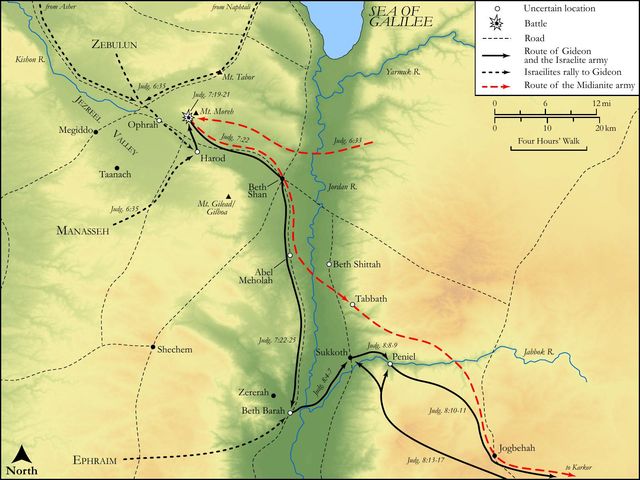
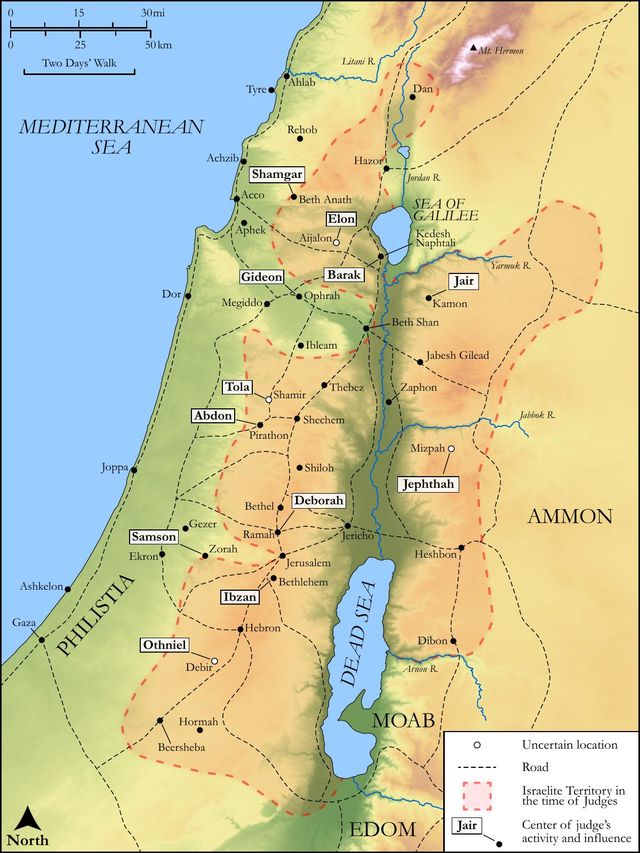
Study this verse
Public-domain commentary
Matthew Henry
From his Commentary on the Whole Bible. Henry comments on passages, not single verses — this entry covers Judges 8:18–21.
Judgment began at the house of God, in the just correction of the men of Succoth and Penuel, who were Israelites, but it did not end there. The kings of Midian, when they had served to demonstrate Gideon's victories, and grace his triumphs, must now be reckoned with. 1. They are indicted for the murder of Gideon's brethren some time ago at Mount Tabor. When the children of Israel, for fear of the Midianites, made themselves dens in the mountains (Jdg 6:2), those young men, it is likely, took shelter in that mountain, where they were found by these two kings, and most basely and barbarously slain in cold blood. When he asks them what manner of men they were (Jdg 8:18), it is not because he was uncertain of the thing, or wanted proof of it; he was not so little concerned for his brethren's blood as not to enquire it out before now, nor were these proud tyrants solicitous to conceal it. But he puts that question to them that by their acknowledgment of the more than ordinary comeliness of the persons they slew their crime might appear the more heinous, and consequently their punishment the more righteous. They could not but own that, though they were found in a mean and abject condition, yet they had an unusual greatness and majesty in their countenances, not unlike Gideon himself at this time: they resembled the children of a king, born for something great. 2. Being found guilty of this murder by their own confession, Gideon, though he might have put them to death as Israel's judge for the injuries done to that people in general, as Oreb and Zeeb (Jdg 7:25), yet chooses rather to put on the character of an avenger of blood, as next of kin to the persons slain: They were my brethren, Jdg 8:19. Their other crimes might have been forgiven, at least Gideon would not have slain them himself, let them have answered it to the people; but the voice of his brethren's blood cries, cries to him, now it is in the power of his hand to avenge it, and therefore there is no remedy - by him must their blood be shed, though they were kings. Little did they think to hear of this so long after; but murder seldom goes unpunished even in this life. 3. The execution is done by Gideon himself with his own hand, because he was the avenger of blood; he bade his son slay them, for he was a near relation to the persons murdered, and fittest to be his father's substitute and representative, and he would thus train him up to the acts of justice and boldness, Jdg 8:20. But, (1.) The young man himself desired to be excused; he feared, though they were bound and could make no resistance, because he was yet a youth, and not used to such work: courage does not always run in the blood. (2.) The prisoners themselves desired that Gideon would excuse it (Jdg 8:21), begged that, if they must die, they might die by his own hand, which would be somewhat more honourable to them, and more easy; for by his great strength they would sooner be dispatched and rid out of their pain. As is the man, so is his strength. Either they mean it of themselves (they were men of such strength as called for a better hand than that young man's to overpower quickly) or of Gideon, "Thou art at thy full strength; he has not yet come to it; therefore be thou the executioner." From those that are grown up to maturity, it is expected that what they do in any service be done with so much the more strength. Gideon dispatched them quickly, and seized the ornaments that were on their camels' necks, ornaments like the moon, so it is in the margin, either badges of their royalty or perhaps of their idolatry, for Ashteroth was represented by the moon, as Baal by the sun. With there he took all their other ornaments, as appears Jdg 8:26, where we find that he did not put them to so good a use as one would have wished. The destruction of these two kings, and that of the two princes (Jdg 7:25) is long afterwards pleaded as a precedent in prayer for the ruin of others of the church's enemies, Psa 83:11, Make their nobles like Oreb and Zeeb, and all their princes as Zebah and Zalmunna, let them all be but off in like manner.
Continue studying Judges 8:21 across the web’s major study libraries — every link below opens this exact verse, chapter, or book on the destination site.
Read & Compare
 BibleGatewayThis verse in more than 200 translations and 70 languages.
 Bible.comThe YouVersion reader — hundreds of translations, reading plans, and highlights.
 ESV.orgCrossway's official English Standard Version reader.
 NET BibleThe NET translation with 60,000+ translators' notes on every rendering decision.
 STEP BibleTyndale House's free study tool — original text, vocabulary, and scholarly resources.
 BibliaLogos Bible Software's free web reader.
 USCCBThe New American Bible (Revised Edition) with the U.S. bishops' study notes.
Commentaries
 BibleHub CommentariesDozens of classic commentaries on this verse, gathered on one page.
 StudyLightMore than 100 commentary sets — the largest collection on the web.
 BibleRefPlain-English commentary on what this verse means, verse by verse.
 Enduring WordDavid Guzik's free commentary on this chapter, widely used by Bible teachers.
 Bible Study ToolsVerse commentary alongside Greek and Hebrew study aids.
Original Language & Research
- BibleHub InterlinearThe verse word by word — original language, transliteration, and English.
- BibleHub LexiconEvery word's original-language definition and Strong's entry.
 Blue Letter BibleDeep-study tools — Strong's numbers, concordance, and word studies.
 SefariaThe Hebrew text with Rashi and centuries of Jewish commentary.
Sermons, Hymns & Audio


TrulyRandomVerse is not affiliated with these sites and doesn’t control their content. They’re linked because they’re genuinely useful.
Summary
Judges 8:21 vividly recounts the decisive culmination of Gideon's campaign against the Midianites, detailing the execution of their kings, Zebah and Zalmunna, and the seizure of their royal adornments. Captured after a relentless pursuit, the Midianite kings, acknowledging Gideon's formidable strength and leadership, request a swift and honorable death at his hands rather than by his inexperienced son. Gideon's personal and decisive act brings divine justice to bear upon the oppressors of Israel and avenges the death of his brothers, symbolizing the complete triumph over Midianite power and the finality of their subjugation.
Context
ShowHideLiterary Context
This verse serves as the climactic resolution to Gideon's military campaign, following his miraculous victory over the Midianite horde with only 300 men in Judges 7. After the initial rout, Gideon pursued the fleeing Midianite kings, Zebah and Zalmunna, across the Jordan, capturing them in Judges 8:12. The immediate preceding verses recount Gideon's questioning of the kings, where they admit to killing his brothers at Tabor (Judges 8:18-19), providing a deeply personal motive for Gideon's actions beyond his role as deliverer. Gideon's initial command for his young son Jether to execute them, and Jether's hesitation due to fear (Judges 8:20), sets the stage for the kings' plea to Gideon himself in this verse, underscoring the weight and finality of the moment.
Historical & Cultural Context
The period of the Judges was characterized by cycles of apostasy, oppression, and divine deliverance. The Midianites, a nomadic people, had severely oppressed Israel for seven years, raiding their crops and livestock and impoverishing the land (Judges 6:1-6). Among the nations of that day, the treatment of captured kings often involved public humiliation or execution, but a swift death at the hands of a renowned warrior was considered more honorable. The kings' plea, "for as the man [is, so is] his strength," reflects a cultural value placed on a warrior's prowess and the dignity of being dispatched by a formidable opponent. This cultural norm contrasts sharply with the earlier divine strategy, where God deliberately chose a small, seemingly weak army to demonstrate that victory came from His strength, not human might (Judges 7:2).
Key Themes
ShowHideJudges 8:21 powerfully illustrates several key themes. Firstly, it highlights Divine Justice and Retribution, as God's judgment is executed upon those who oppressed His people and personally wronged His chosen leader. The kings' demise underscores the principle that wickedness, especially against God's covenant people, ultimately faces consequences. Secondly, it showcases Gideon's Resolve and Leadership. Despite his earlier hesitations and requests for signs, Gideon demonstrates unwavering determination to complete the mission God entrusted to him, personally carrying out the execution and signifying the complete triumph over Midianite oppression. Thirdly, the verse subtly touches on the Nature of True Strength, contrasting the Midianite kings' worldly understanding of strength (physical prowess, warrior status) with the divine power that enabled Gideon's victory, which was not dependent on human might but on God's intervention, as seen in Judges 7:22. Finally, the taking of the "ornaments" signifies the Complete Defeat and Plunder of the enemy, marking the end of their reign and the appropriation of their symbols of power and wealth, some of which may have had pagan significance (Judges 8:26).
Exposition and Analysis
ShowHideKey Word Analysis
ShowHideThis feminine passive participle refers to force, valor, victory, mastery, might, or power. In the context of the kings' plea, it denotes the decisive, potent force of a mature warrior, implying a swift and dignified death. Their request is an acknowledgment of Gideon's proven military prowess and leadership, recognizing that his strength would ensure a quick and honorable end, unlike the hesitant hand of his son.
A primitive root meaning "to smite with deadly intent," "kill," or "murder." This word emphasizes the deliberate and final nature of Gideon's action. It is not an accidental death but a purposeful execution, fulfilling both the divine judgment against the Midianite oppressors and Gideon's personal vendetta for his slain brothers. The use of this strong verb underscores the gravity and finality of the moment.
This term refers to a round pendant for the neck, often crescent-shaped, like the moon. These were common adornments for camels and people among the Midianites and Ishmaelites. While decorative, they frequently held religious or superstitious significance, possibly functioning as talismans or symbols of pagan deities (such as the moon god, common in Midianite worship). Their seizure by Gideon symbolizes not just the plunder of wealth, but the complete dismantling of Midianite power, including their idolatrous practices and symbols.
Verse Breakdown
ShowHide"Then Zebah and Zalmunna said, Rise thou, and fall upon us:"
The Midianite kings, facing certain death, issue a direct command to Gideon. Their request is a plea for a quick, decisive, and therefore more honorable execution. They prefer to die by the hand of a recognized warrior and leader, Gideon, rather than the inexperienced hand of his son, Jether, whom Gideon had initially commanded to kill them (Judges 8:20). This highlights their concern for dignity even in defeat, acknowledging Gideon's superior martial capability.
"for as the man [is, so is] his strength."
This is a proverb or maxim. It means that a man's actions, particularly in battle or execution, reflect his true character, prowess, and power. The kings are essentially saying, "Be the strong, capable warrior you are, and give us a death worthy of your might." It underscores their respect for Gideon's demonstrated strength and their desire for a death that aligns with their own warrior code, contrasting with the perceived weakness of an untried youth.
"And Gideon arose, and slew Zebah and Zalmunna,"
Gideon's action is swift and decisive. This personal execution signifies the full completion of his mission as deliverer and avenger. It brings a definitive end to the Midianite oppression and fulfills the personal justice for his slain brothers, demonstrating Gideon's resolve and commitment to God's purpose, even in a grim task. His readiness to act where his son hesitated marks his full assumption of his role as Israel's judge and deliverer.
"and took away the ornaments that [were] on their camels' necks."
This act signifies the complete subjugation and plunder of the Midianite kings and their forces. The "ornaments" were valuable spoils of war, likely crescent-shaped decorations that may have also served as pagan symbols related to moon worship. Their seizure represents not only the acquisition of wealth but also the dismantling of Midianite power and their idolatrous practices, further emphasizing the totality of Israel's victory and the stripping away of the enemy's identity and influence.
Literary Devices
ShowHideThe verse employs several powerful literary devices. Irony is evident in the Midianite kings, once powerful oppressors, now humbling themselves to plead for a dignified death from their captor, Gideon. Their worldly understanding of "strength" is ironically contrasted with the divine strength that empowered Gideon's small, weak army to defeat their vast forces, highlighting that true power comes from God, not human might. Symbolism is rich here: Gideon's personal execution of the kings symbolizes the complete and personal nature of divine justice and vengeance for his brothers. The "ornaments" taken from the camels are not just material spoils but also symbolize the stripping away of Midianite wealth, power, and their pagan religious influence, marking a comprehensive victory. The narrative uses Contrast by juxtaposing Jether's youthful fear and hesitation with Gideon's mature, decisive action, emphasizing Gideon's growth into his role as a divinely appointed leader.
Theological and Thematic Connections
ShowHideJudges 8:21 stands as a stark testament to the outworking of divine justice and the consequences of rebellion against God and His people. Gideon's execution of Zebah and Zalmunna is not merely an act of personal vengeance but a fulfillment of God's judgment upon the Midianites, who had severely oppressed Israel. It underscores God's sovereignty in using human agents, even imperfect ones like Gideon, to bring about His righteous purposes. The finality of this act signals the end of a period of severe oppression and the restoration of a measure of peace for Israel, demonstrating that God is faithful to deliver His people and to hold wicked rulers accountable. This passage reminds us that while God is merciful, His justice is also sure and will ultimately prevail against all forms of wickedness and oppression, ensuring that the oppressors face the consequences of their actions.
Reflection and Application
ShowHideJudges 8:21, though a scene of grim justice, offers profound lessons for contemporary believers. It reminds us that God often calls His servants to complete difficult and sometimes uncomfortable tasks in the spiritual battle. Like Gideon, we are called to be resolute in seeing God's purposes through to completion, even when the path is challenging or requires us to confront uncomfortable truths. This passage highlights the importance of spiritual discernment, understanding that true strength comes not from worldly might or human prowess, but from obedient reliance on God. It also serves as a stark reminder of the ultimate consequences for those who persistently oppose God and His people, while also showcasing the personal cost and responsibility of leadership in times of spiritual conflict. We are to be instruments of God's will, ensuring that His justice and truth prevail in our spheres of influence, while always remembering that our ultimate battle is spiritual, not against flesh and blood, and that divine power empowers our service.
Questions for Reflection
ShowHideFAQ
ShowHideWhy did Zebah and Zalmunna ask Gideon to kill them, and not his son Jether?
ShowHideAmong warriors like the kings of Midian, there was a strong emphasis on dignity in death, especially for captured kings. Zebah and Zalmunna preferred to be executed by a renowned warrior and leader like Gideon, whose strength and prowess had been clearly demonstrated. They likely considered it more honorable to die by the hand of a formidable opponent rather than by Gideon's young, inexperienced son, Jether, whom Gideon had initially commanded to kill them (Judges 8:20). Their plea, "for as the man [is, so is] his strength," was an appeal to Gideon's established reputation as a mighty warrior, requesting a swift and decisive end that accorded with their warrior code.
What is the significance of Gideon taking the "ornaments that were on their camels' necks"?
ShowHideThe "ornaments" (Hebrew: sahărôn) were crescent-shaped pendants or necklaces, likely made of gold or other precious metals, commonly used as adornments for camels and people among the Midianites and Ishmaelites. Their significance is twofold: Firstly, they represented the wealth and spoils of war, symbolizing the complete defeat and plunder of the Midianite kings. Secondly, these crescent-shaped ornaments often carried religious or superstitious significance, possibly being associated with pagan deities (like the moon god, a common deity in Midianite worship) or serving as amulets. By taking them, Gideon not only claimed the material spoils but also symbolically stripped the Midianites of their power, their dignity, and potentially their idolatrous symbols, signifying a comprehensive victory over their oppressive and pagan influence. This act foreshadows the later mention of Gideon using some of the gold to create an ephod, which unfortunately became an idol for Israel (Judges 8:27).
Christ-Centered Fulfillment
ShowHideGideon's decisive execution of Zebah and Zalmunna, bringing an end to Midianite oppression and avenging his brothers, powerfully foreshadows the ultimate and perfect justice executed by Jesus Christ. While Gideon's act was a temporal, earthly judgment, Christ's work on the cross and His resurrection represent the definitive triumph over the true enemies of humanity: sin, death, and the spiritual powers of darkness. Just as Gideon brought an end to an era of oppression, Jesus, the true Lamb of God who takes away the sin of the world, definitively took away the sin of the world, and as the Lion of the Tribe of Judah, He executes divine judgment. He did not merely defeat earthly kings but disarmed the principalities and powers, triumphing over them by the cross (Colossians 2:15). The "strength" the Midianite kings appealed to in Gideon pales in comparison to the divine strength of Christ, who, though appearing weak in His crucifixion, utterly vanquished all spiritual opposition. His final return will be as the righteous King, riding forth to judge and make war, bringing ultimate and eternal justice to all who oppose God (Revelation 19:11-16). Through Christ, the true Deliverer, the spoils of victory are not mere earthly ornaments, but the eternal liberation and redemption of His people, and the complete subjugation of every spiritual foe.