


Jeremiah 41:18
Bible text: King James Version (1769 Blayney text) · Public domain
Bible text: King James Version with Strong's numbers · Public domain
Bible text: Berean Standard Bible · Public domain
Bible text: American Standard Version (1901) · Public domain
Bible text: World English Bible, Messianic edition · Public domain
Bible text: Geneva Bible (1599) · Public domain
Bible text: Young's Literal Translation · Public domain
- מִפְּנֵיmi·pe·Neifrom beforeH6440Prep-m ¦ N-mpcNoun Plural Masculine Constructמִfromפְּנֵיbefore
- הַכַּשְׂדִּיםha·kas·Dimthe ChaldeansH3778Art ¦ N-mpNoun Gentilic Plural Masculine AbsoluteהַtheכַּשְׂדִּיםChaldeans
- כִּיkiforH3588PrtParticle Conditional
- יָרְאוּya·re·'Uthey were afraidH3372V-Qal-Perf-3cpVerb Qal Perfect 3rd Plural common gender
- מִפְּנֵיהֶםmi·pe·nei·Hemof <before> themH6440Prep-m ¦ N-mpc ¦ 3mpNoun Plural Masculine Constructמִofפְּנֵי<before>הֶםthem
- כִּיkiforH3588PrtParticle Conditional
- הִכָּהhi·Kahhe had struck downH5221V-Hiphil-Perf-3msVerb Hiphil Perfect 3rd Singular Masculine
- יִשְׁמָעֵאלyish·ma·'ElIshmaelH3458N-proper-mNoun Proper Masculine
- בֶּןben[the] son ofH1121N-mscNoun Singular Masculine Construct
- נְתַנְיָהne·tan·YahNethaniahH5418N-proper-mNoun Proper Masculine
- אֶת'et<obj.>H853DirObjMParticle Object Indicator
- גְּדַלְיָהוּge·dal·Ya·huGedaliahH1436N-proper-mNoun Proper Masculine
- בֶּןben[the] son ofH1121N-mscNoun Singular Masculine Construct
- אֲחִיקָם'a·chi·KamAhikamH296N-proper-mNoun Proper Masculine
- אֲשֶׁר'a·SherwhomH834RelParticle Relative
- הִפְקִידhif·Kidhe had appointedH6485V-Hiphil-Perf-3msVerb Hiphil Perfect 3rd Singular Masculine
- מֶלֶךְMe·lekh[the] king ofH4428N-mscNoun Singular Masculine Construct
- בָּבֶלba·VelBabylonH894N-properNoun Proper Location
- בָּאָרֶץba·'A·retzover the landH776Prep-b ¦ N-fsNoun Singular Feminine Absoluteבָּover theאָרֶץland
English is a literal word-by-word gloss of the Hebrew, not the KJV's wording. Why?
This is the original text the KJV's translators worked from — each Hebrew word with its own literal English meaning in this verse, prepared by scholars at Tyndale House, Cambridge. The KJV translates whole sentences, not word by word, so its wording differs: one Hebrew word can become several English words, and the KJV may choose “the LORD” where the gloss reads “Yahweh”. Both are faithful — they answer different questions. For the KJV's own rendering, switch to the KJV text.
Details
See on the biblical-era map
Study this verse
Public-domain commentary
Matthew Henry
From his Commentary on the Whole Bible. Henry comments on passages, not single verses — this entry covers Jeremiah 41:11–18.
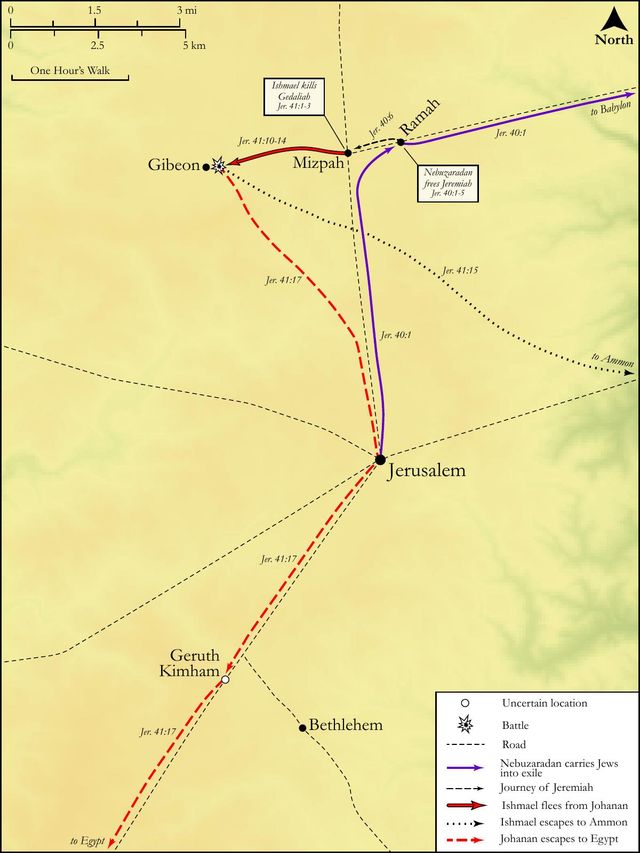
It would have been well if Johanan, when he gave information to Gedaliah of Ishmael's treasonable design, though he could not obtain leave to kill Ishmael and to prevent it that way, yet had staid with Gedaliah; for he, and his captains, and their forces, might have been a life-guard to Gedaliah and a terror to Ishmael, and so have prevented the mischief without the effusion of blood: but, it seems they were out upon some expedition, perhaps no good one, and so were out of the way when they should have been upon the best service. Those that affect to ramble are many times out of their place when they are most needed. However, at length they hear of all the evil that Ishmael had done (Jer 41:11), and are resolved to try an after-game, which we have an account of in these verses. 1. We heartily wish Johanan could have taken revenge upon the murderers, but he prevailed only to rescue the captives. Those that had shed so much blood, it was a pity but their blood should have been shed; and it is strange that vengeance suffered them to live; yet it did. Johanan gathered what forces he could and went to fight with Ishmael (Jer 41:12), upon notice of the murders he had committed (for though he concealed it for a time, Jer 41:4, yet murder will out) and which way he was gone; he pursued him, and overtook him by the great pool of Gibeon, which we read of, Sa2 2:13. And, upon his appearing with such a force, Ishmael's heart failed him, his guilty conscience flew in his face, and he durst not stand his ground against an enemy that was something like a match for him. The most cruel are often the most cowardly. The poor captives were glad when they saw Johanan and the captains that were with him, looking upon them as their deliverers (Jer 41:13), and they immediately found a way to wheel about and come over to them (Jer 41:14), Ishmael not offering to detain them when he saw Johanan. Note, Those that would be helped must help themselves. These captives staid not till their conquerors were beaten, but took the first opportunity to make their escape, as soon as they saw their friends appear and their enemies thereby disheartened. Ishmael quitted his pray to save his life, and escaped with eight men, Jer 41:15. it seems, two of his ten men, that were his banditti or assassins (spoken of Jer 41:1), either deserted him or were killed in the engagement; but he made the best of his way to the Ammonites, as a perfect renegado, that had quite abandoned all relation to the commonwealth of Israel, though he was of the seed royal, and we hear no more of him. 2. We heartily wish that Johanan, when he had rescued the captives, would have sat down quietly with them, and governed them peaceably, as Gedaliah did; but, instead of that, he is for leading them into the land of Egypt, as Ishmael would have led them into the land of the Ammonites; so that though he got the command over them in a better way than Ishmael did, and honestly enough, yet he did not use it much better. Gedaliah, who was of a meek and quiet spirit, was a great blessing to them; but Johanan, who was of a fierce and restless spirit, was set over them for their hurt, and to complete their ruin, even after they were, as they thought, redeemed. Thus did God still walk contrary to them. (1.) The resolution of Johanan and the captains was very rash; nothing would serve them but they would go to enter into Egypt (Jer 41:17), and, in order to that, they encamped for a time in the habitation of Chimham, by Bethlehem, David's city. Probably it was some land which David gave to Chimham, the son of Barzillai, which, though it returned to David's family at the year of the Jubilee, yet still bore the name of Chimham. Here Johanan made his headquarters, steering his course towards Egypt, either from a personal affection to that country or an ancient national confidence in the Egyptians for help in distress. Some of the mighty men of war, it seems had escaped; those he took with him, and the women and children, whom he had recovered from Ishmael, who were thus emptied from vessel to vessel, because they were yet unchanged. (2.) The reason for this resolution was very frivolous. They pretended that they were afraid of the Chaldeans, that they would come and do I know not what with them, because Ishmael had killed Gedaliah, Jer 41:18. I cannot think they really had any apprehensions of danger upon this account; for, though it is true that the Chaldeans had cause enough to resent the murder of their viceroy, yet they were not so unreasonable, or unjust, as to revenge it upon those who appeared so vigorously against the murderers. But they only make use of this as a sham to cover that corrupt inclination of their unbelieving ancestors, which was so strong in them, to return into Egypt. Those will justly lose their comfort in real fears that excuse themselves in sin with pretended fears.
Continue studying Jeremiah 41:18 across the web’s major study libraries — every link below opens this exact verse, chapter, or book on the destination site.
Read & Compare
 BibleGatewayThis verse in more than 200 translations and 70 languages.
 Bible.comThe YouVersion reader — hundreds of translations, reading plans, and highlights.
 ESV.orgCrossway's official English Standard Version reader.
 NET BibleThe NET translation with 60,000+ translators' notes on every rendering decision.
 STEP BibleTyndale House's free study tool — original text, vocabulary, and scholarly resources.
 BibliaLogos Bible Software's free web reader.
 USCCBThe New American Bible (Revised Edition) with the U.S. bishops' study notes.
Commentaries
 BibleHub CommentariesDozens of classic commentaries on this verse, gathered on one page.
 StudyLightMore than 100 commentary sets — the largest collection on the web.
 BibleRefPlain-English commentary on what this verse means, verse by verse.
 Enduring WordDavid Guzik's free commentary on this chapter, widely used by Bible teachers.
 Bible Study ToolsVerse commentary alongside Greek and Hebrew study aids.
Original Language & Research
- BibleHub InterlinearThe verse word by word — original language, transliteration, and English.
- BibleHub LexiconEvery word's original-language definition and Strong's entry.
 Blue Letter BibleDeep-study tools — Strong's numbers, concordance, and word studies.
 SefariaThe Hebrew text with Rashi and centuries of Jewish commentary.
Sermons, Hymns & Audio


TrulyRandomVerse is not affiliated with these sites and doesn’t control their content. They’re linked because they’re genuinely useful.
Summary
Jeremiah 41:18 encapsulates the profound fear that gripped the Jewish remnant following the treacherous assassination of Gedaliah, the Babylonian-appointed governor, by Ishmael. This apprehension was rooted in the acute awareness of the formidable power and punitive measures of the Chaldeans (Babylonians). The people dreaded the inevitable and severe retribution that Nebuchadnezzar's empire would exact for the murder of his representative, a fear so potent it compelled their desperate search for refuge and ultimately, their consideration of fleeing to Egypt.
Context
ShowHideLiterary Context
Jeremiah 41:18 serves as the climactic explanation for the Jewish remnant's actions in the immediate aftermath of Gedaliah's assassination and Ishmael's subsequent flight. Chapters 40 and 41 meticulously detail the precarious peace established by Gedaliah, the shocking act of betrayal by Ishmael, and the ensuing panic and pursuit. Specifically, Jeremiah 41:1-3 describes Ishmael's cold-blooded murder of Gedaliah and his companions, followed by his massacre of eighty pilgrims and abduction of the remaining populace from Mizpah. Jeremiah 41:11-15 recounts Johanan ben Kareah's successful rescue of the captives from Ishmael, who then flees to the Ammonites. This verse, Jeremiah 41:18, provides the crucial underlying motivation for the remnant's decision to relocate to Geruth Chimham near Bethlehem, a strategic move intended to facilitate their potential escape to Egypt. This fear-driven decision sets the stage for their pivotal consultation with the prophet Jeremiah in Jeremiah 42, where they seek divine guidance for their future.
Historical & Cultural Context
This period immediately followed the catastrophic destruction of Jerusalem and its Temple in 586 BC by Nebuchadnezzar's Neo-Babylonian Empire. The Babylonians, often referred to as the Chaldeans, had deported much of Judah's population, but left a remnant in the land under the governorship of Gedaliah, son of Ahikam. Gedaliah was a respected figure, known for his wisdom and his protection of Jeremiah (Jeremiah 39:14). His appointment was a strategic move by Babylon to maintain control and extract tribute without needing a large military presence. His assassination by Ishmael, a member of the royal family (Jeremiah 41:1), was an act of both political rebellion and personal treachery, likely fueled by jealousy and perhaps incited by the Ammonite king Baalis (Jeremiah 40:14). The Jewish remnant understood that the murder of a Babylonian-appointed governor was a direct affront to Nebuchadnezzar's authority, an act that would undoubtedly provoke swift and brutal retaliation from the Chaldeans, who had already demonstrated their ruthlessness in the siege and destruction of Jerusalem. This deep-seated fear, born of recent traumatic experience, explains their desperate desire to flee the land.
Key Themes
ShowHideJeremiah 41:18 highlights several prominent themes within the book of Jeremiah. First, the consequences of disobedience and treachery are starkly evident; Ishmael's act of violence not only claimed innocent lives but also plunged the entire remnant into a state of extreme vulnerability and fear, threatening their very survival in the land God had promised. Second, the theme of fear versus faith is central. The people's overwhelming fear of the Chaldeans, though understandable given their recent history, ultimately drives them towards a decision to flee to Egypt, a move explicitly forbidden by God through Jeremiah (Jeremiah 42:19). This illustrates the human tendency to rely on perceived safety in the face of danger rather than trusting in divine protection. Finally, the verse underscores the fragility of peace and stability in a land under foreign domination. The brief period of order under Gedaliah was shattered by internal strife, demonstrating how easily external powers could be provoked and how precarious the existence of the remnant truly was. This internal collapse, exacerbated by fear, directly contributes to the ongoing narrative of Judah's judgment and dispersion.
Exposition and Analysis
ShowHideKey Word Analysis
ShowHideThis term (H3778) refers to the inhabitants of Chaldea, a region in southern Mesopotamia, and by implication, the dominant ethnic group of the Neo-Babylonian Empire. Their name became synonymous with the formidable military and political authority of Babylon. The fear expressed by the remnant was not just of a generic enemy, but of this specific, powerful, and recently victorious empire known for its decisive and often brutal actions. The mention of "Chaldeans" immediately evokes the image of overwhelming power, the trauma of recent conquest, and the certainty of swift retribution for any perceived rebellion.
Derived from a primitive root (H3372) meaning "to fear," this word encompasses both a general sense of being frightened and a moral sense of reverence. In this context, it unequivocally denotes a profound, paralyzing fear. The remnant was "afraid of them" (the Chaldeans), indicating a deep dread of their punitive power. This fear was not irrational but based on their recent, traumatic experience of Babylonian conquest and the knowledge that the murder of a Babylonian-appointed governor would incur severe wrath. The word highlights the psychological state of the people, driven by terror rather than faith.
This primitive root (H5221) means "to strike," but its usage ranges from a light tap to a severe, decisive blow, often resulting in death. Here, it signifies the violent and definitive act of murder. Ishmael "had slain" Gedaliah, emphasizing the finality, brutality, and premeditated nature of the act. The use of this word underscores the gravity of Ishmael's crime and its direct consequence: the profound, justified fear that gripped the remnant, knowing that such a significant act of violence against a Babylonian appointee would not go unpunished by the imperial power.
Verse Breakdown
ShowHide"Because of the Chaldeans:"
This opening phrase immediately establishes the primary cause of the remnant's actions and their overwhelming emotional state. It points directly to the external, formidable power of the Babylonian Empire, whose authority had been directly challenged by Ishmael's act. The Chaldeans represent the impending threat of retribution, acting as the ultimate catalyst for the remnant's fear.
"for they were afraid of them,"
This clause elaborates on the initial "because of" statement, explicitly articulating the emotional state of the remnant. Their fear was not abstract but directed at the known power, ruthlessness, and historical actions of the Chaldeans. This fear was a rational and deeply ingrained response to the recent history of Babylonian conquest and their understanding of imperial justice, which demanded severe punishment for any defiance.
"because Ishmael the son of Nethaniah had slain Gedaliah the son of Ahikam,"
This section provides the direct, immediate cause of the fear. Ishmael's act of regicide (in effect, as Gedaliah was a governor) against a figure appointed by Nebuchadnezzar was an unpardonable offense in the eyes of the Babylonian Empire. The detailed identification of Ishmael and Gedaliah underscores the specific nature of the crime and its profound political and theological implications, highlighting the human agency that triggered the crisis.
"whom the king of Babylon made governor in the land."
This final clause emphasizes the official status of Gedaliah and the direct challenge Ishmael's act posed to the supreme authority of Nebuchadnezzar. Gedaliah was not merely a local leader but a direct representative of the conquering power, entrusted with maintaining order in the conquered territory. His murder was an act of rebellion against the "king of Babylon," validating the remnant's profound fear of severe imperial reprisal and explaining their desperate need to flee.
Literary Devices
ShowHideJeremiah 41:18 powerfully employs Cause and Effect, establishing a clear chain reaction: Ishmael's treacherous act of assassinating Gedaliah (the cause) directly leads to the profound, paralyzing fear experienced by the Jewish remnant (the effect), which in turn motivates their desperate flight. There is also a strong element of Pathos, evoking deep sympathy for the vulnerable remnant caught between the brutality of an internal traitor and the anticipated, overwhelming wrath of a powerful external empire. The verse also contains an implicit Foreshadowing of the remnant's subsequent decision to flee to Egypt, despite Jeremiah's divine warnings, driven by this very fear. Furthermore, a tragic Irony is present: the fragile peace and stability established by the Babylonians through Gedaliah, intended to allow the remnant to remain in the land, is shattered not by external force but by internal betrayal, ultimately leading to the very outcome (further displacement and scattering) that Gedaliah had tried to prevent and which God had warned against.
Theological and Thematic Connections
ShowHideJeremiah 41:18 profoundly illustrates the destructive power of human sin and the pervasive nature of fear in the face of overwhelming circumstances. The treachery of Ishmael not only resulted in bloodshed but also created a ripple effect of terror, driving an entire community to the brink of despair and prompting decisions based on human wisdom rather than divine counsel. Theologically, it highlights the tension between human agency and divine sovereignty; while human actions like Ishmael's betrayal have real and devastating consequences, God's ultimate plan for His people continues to unfold, often through trials that test their faith and obedience. The profound fear of the Chaldeans underscores the human tendency to trust in flight or human solutions when faced with danger, rather than resting in God's protection and guidance, a theme that Jeremiah consistently addresses as he calls the people to trust in the Lord alone.
Reflection and Application
ShowHideJeremiah 41:18 serves as a poignant reminder of how individual acts of violence and betrayal can unleash widespread fear and instability, impacting entire communities with devastating ripple effects. The remnant's desperate flight, driven by their terror of Babylonian retribution, powerfully illustrates the profound and often irrational influence of fear on human decision-making. In our own lives, we frequently encounter "Chaldeans"—overwhelming external pressures, perceived threats, or the painful consequences of others' actions—that can incite panic and tempt us to make impulsive choices, rather than seeking divine wisdom and patiently waiting on God's guidance. This verse challenges us to examine the sources of our fears and consider whether they are leading us away from God's will or towards a deeper reliance on Him. It underscores the critical importance of resisting the urge to succumb to fear-driven impulses, instead cultivating a spirit of trust and seeking counsel from God's Word and His faithful servants, even when circumstances seem daunting, chaotic, and the future profoundly uncertain. The narrative vividly depicts how sin, both personal and communal, can dismantle peace and security, urging us to consider the broader implications of our actions and the profound need for integrity, reconciliation, and peace within our communities and in our relationship with God.
Questions for Reflection
ShowHideFAQ
ShowHideWhy were the people so afraid of the Chaldeans?
ShowHideThe Jewish remnant's fear of the Chaldeans (Babylonians) was deeply rooted in their recent traumatic history. Just a few years prior, the Chaldeans had besieged, conquered, and destroyed Jerusalem, including the Temple, and had deported a significant portion of the population to Babylon. They were known for their overwhelming military might, their efficiency in conquest, and their severe punitive measures against those who rebelled or undermined their authority. The assassination of Gedaliah, whom the king of Babylon had personally appointed as governor, was a direct and egregious affront to Nebuchadnezzar's rule. The remnant correctly anticipated that such an act would provoke swift and brutal retaliation from the Chaldeans, who would likely hold the entire remaining population accountable for the actions of one man. Their fear was a rational response to a very real and immediate threat of further violence, enslavement, or deportation, based on their fresh memories of Babylonian ruthlessness.
What was Gedaliah's role and why was his death so significant?
ShowHideGedaliah, the son of Ahikam, was appointed by the king of Babylon, Nebuchadnezzar, to be the governor over the remaining Jewish population in the land of Judah after the fall of Jerusalem. His role was crucial: to maintain order, encourage the people to live peacefully under Babylonian rule, and ensure the collection of tribute. He was a respected figure, known for his wisdom and for having protected Jeremiah during the siege (Jeremiah 39:14). His death was profoundly significant because it shattered the fragile peace and stability he had established, which was the last hope for the remnant to remain in their homeland. As a direct representative of the Babylonian king, his assassination by Ishmael was an act of rebellion against the mighty empire. This act removed the last vestige of legitimate Jewish leadership in the land and directly provoked the wrath of the Chaldeans, leading to the widespread fear and eventual flight of the remnant, further destabilizing the region.
Who was Ishmael and what motivated his actions?
ShowHideIshmael was the son of Nethaniah and a member of the royal family, a descendant of King David (Jeremiah 41:1). His motivations appear to be a complex mix of jealousy, ambition, and external incitement. As a member of the former royal house, he likely resented Gedaliah's appointment as governor, viewing it as a usurpation of his own perceived right to rule. He was also incited by Baalis, the king of the Ammonites, who sought to destabilize the region and undermine Babylonian control (Jeremiah 40:14). Ishmael's actions were driven by a desire for power and a rejection of the Babylonian-imposed order, leading him to commit a treacherous act of murder against Gedaliah and many others, plunging the already vulnerable remnant into further chaos and fear. His betrayal highlights the destructive power of internal strife and unbridled ambition.
Christ-Centered Fulfillment
ShowHideThe profound fear and instability described in Jeremiah 41:18, born from human treachery and the overwhelming power of an earthly empire, find their ultimate resolution and contrast in the person and work of Jesus Christ. The Jewish remnant, terrified of the Chaldeans' retribution, sought refuge in flight and human schemes, yet these efforts ultimately proved futile and contrary to God's will, leading them further from the land. In contrast, Christ is the true King and Governor, appointed not by an earthly power but by God the Father, whose reign brings true and lasting peace, not fear. He is the one who overcomes the fear of man and the consequences of sin, declaring, "Peace I leave with you; my peace I give you. I do not give to you as the world gives. Do not let your hearts be troubled and do not be afraid" (John 14:27). While Gedaliah was "slain" by human treachery, foreshadowing the ultimate sacrifice, Christ is the Lamb of God, who takes away the sin of the world, whose death was not a defeat but a decisive victory over sin and death, bringing reconciliation and eternal life to all who believe. Through His sacrifice, He disarms the powers that instill fear and offers a secure refuge that no earthly empire or human betrayal can disrupt. He is the faithful Shepherd who gathers His scattered flock, promising, "I will never leave you nor forsake you" (Hebrews 13:5), contrasting sharply with the abandonment and vulnerability experienced by the remnant. In Christ, the fear of retribution is replaced by the assurance of forgiveness and grace, and the precariousness of human governance is superseded by the steadfastness of His eternal kingdom, where true safety, peace, and hope are found for all eternity.