


Jeremiah 41:17
Bible text: King James Version (1769 Blayney text) · Public domain
Bible text: Berean Standard Bible · Public domain
Bible text: American Standard Version (1901) · Public domain
Bible text: World English Bible, Messianic edition · Public domain
Bible text: Geneva Bible (1599) · Public domain
Bible text: Young's Literal Translation · Public domain
- וַיֵּלְכוּvai·ye·le·Khuand they wentH1980Conj-w ¦ V-Qal-ConsecImperf-3mpVerb Qal Consecutive Imperfect 3rd Plural Masculineוַandיֵּלְכוּthey went
- וַיֵּשְׁבוּvai·ye·she·Vuand they remainedH3427Conj-w ¦ V-Qal-ConsecImperf-3mpVerb Qal Consecutive Imperfect 3rd Plural Masculineוַandיֵּשְׁבוּthey remained
- בְּגֵרוּתbe·ge·Rutat GeruthH1628Prep-b ¦ N-fscNoun Singular Feminine ConstructבְּatגֵרוּתGeruth
- כִּמְהָםkhem·hamKimhamH3644N-properNoun Proper Location
- אֲשֶׁר'a·SherwhichH834RelParticle Relative
- אֵצֶל'E·tzel[is] besideH681N-cscNoun Singular common gender Construct
- בֵּיתbeitBeth-H1035N-properNoun Proper Location
- לָחֶםLa·chem-lehemH1035N-properNoun Proper Location
- לָלֶכֶתla·Le·khetto goH1980Prep-l ¦ V-Qal-InfVerb Qal Infinitive Constructלָtoלֶכֶתgo
- לָבוֹאla·Vo'to goH935Prep-l ¦ V-Qal-InfVerb Qal Infinitive Constructלָtoבוֹאgo
- מִצְרָיִםmitz·Ra·yimEgyptH4714N-properNoun Proper Location
English is a literal word-by-word gloss of the Hebrew, not the KJV's wording. Why?
This is the original text the KJV's translators worked from — each Hebrew word with its own literal English meaning in this verse, prepared by scholars at Tyndale House, Cambridge. The KJV translates whole sentences, not word by word, so its wording differs: one Hebrew word can become several English words, and the KJV may choose “the LORD” where the gloss reads “Yahweh”. Both are faithful — they answer different questions. For the KJV's own rendering, switch to the KJV text.
Details
See on the biblical-era map
Study this verse
Public-domain commentary
Matthew Henry
From his Commentary on the Whole Bible. Henry comments on passages, not single verses — this entry covers Jeremiah 41:11–18.
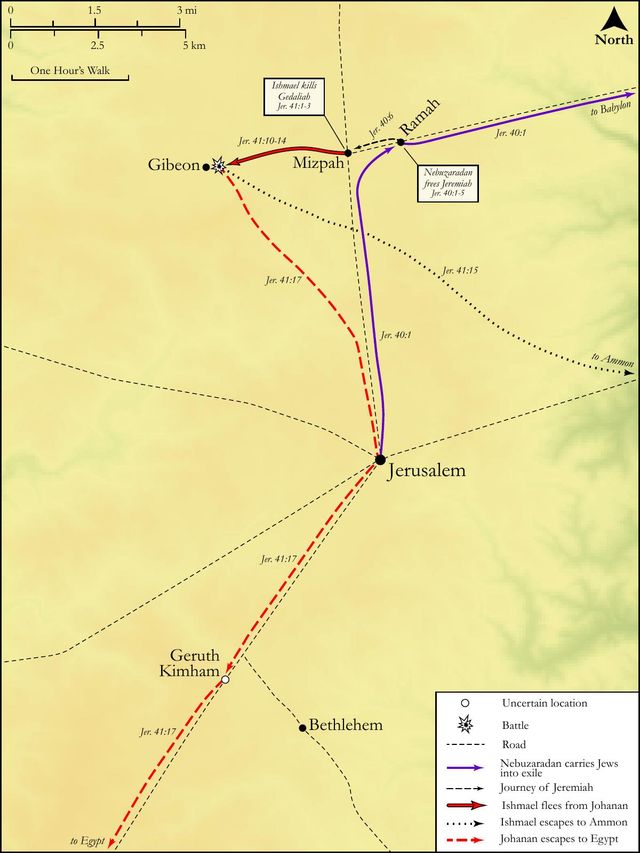
It would have been well if Johanan, when he gave information to Gedaliah of Ishmael's treasonable design, though he could not obtain leave to kill Ishmael and to prevent it that way, yet had staid with Gedaliah; for he, and his captains, and their forces, might have been a life-guard to Gedaliah and a terror to Ishmael, and so have prevented the mischief without the effusion of blood: but, it seems they were out upon some expedition, perhaps no good one, and so were out of the way when they should have been upon the best service. Those that affect to ramble are many times out of their place when they are most needed. However, at length they hear of all the evil that Ishmael had done (Jer 41:11), and are resolved to try an after-game, which we have an account of in these verses. 1. We heartily wish Johanan could have taken revenge upon the murderers, but he prevailed only to rescue the captives. Those that had shed so much blood, it was a pity but their blood should have been shed; and it is strange that vengeance suffered them to live; yet it did. Johanan gathered what forces he could and went to fight with Ishmael (Jer 41:12), upon notice of the murders he had committed (for though he concealed it for a time, Jer 41:4, yet murder will out) and which way he was gone; he pursued him, and overtook him by the great pool of Gibeon, which we read of, Sa2 2:13. And, upon his appearing with such a force, Ishmael's heart failed him, his guilty conscience flew in his face, and he durst not stand his ground against an enemy that was something like a match for him. The most cruel are often the most cowardly. The poor captives were glad when they saw Johanan and the captains that were with him, looking upon them as their deliverers (Jer 41:13), and they immediately found a way to wheel about and come over to them (Jer 41:14), Ishmael not offering to detain them when he saw Johanan. Note, Those that would be helped must help themselves. These captives staid not till their conquerors were beaten, but took the first opportunity to make their escape, as soon as they saw their friends appear and their enemies thereby disheartened. Ishmael quitted his pray to save his life, and escaped with eight men, Jer 41:15. it seems, two of his ten men, that were his banditti or assassins (spoken of Jer 41:1), either deserted him or were killed in the engagement; but he made the best of his way to the Ammonites, as a perfect renegado, that had quite abandoned all relation to the commonwealth of Israel, though he was of the seed royal, and we hear no more of him. 2. We heartily wish that Johanan, when he had rescued the captives, would have sat down quietly with them, and governed them peaceably, as Gedaliah did; but, instead of that, he is for leading them into the land of Egypt, as Ishmael would have led them into the land of the Ammonites; so that though he got the command over them in a better way than Ishmael did, and honestly enough, yet he did not use it much better. Gedaliah, who was of a meek and quiet spirit, was a great blessing to them; but Johanan, who was of a fierce and restless spirit, was set over them for their hurt, and to complete their ruin, even after they were, as they thought, redeemed. Thus did God still walk contrary to them. (1.) The resolution of Johanan and the captains was very rash; nothing would serve them but they would go to enter into Egypt (Jer 41:17), and, in order to that, they encamped for a time in the habitation of Chimham, by Bethlehem, David's city. Probably it was some land which David gave to Chimham, the son of Barzillai, which, though it returned to David's family at the year of the Jubilee, yet still bore the name of Chimham. Here Johanan made his headquarters, steering his course towards Egypt, either from a personal affection to that country or an ancient national confidence in the Egyptians for help in distress. Some of the mighty men of war, it seems had escaped; those he took with him, and the women and children, whom he had recovered from Ishmael, who were thus emptied from vessel to vessel, because they were yet unchanged. (2.) The reason for this resolution was very frivolous. They pretended that they were afraid of the Chaldeans, that they would come and do I know not what with them, because Ishmael had killed Gedaliah, Jer 41:18. I cannot think they really had any apprehensions of danger upon this account; for, though it is true that the Chaldeans had cause enough to resent the murder of their viceroy, yet they were not so unreasonable, or unjust, as to revenge it upon those who appeared so vigorously against the murderers. But they only make use of this as a sham to cover that corrupt inclination of their unbelieving ancestors, which was so strong in them, to return into Egypt. Those will justly lose their comfort in real fears that excuse themselves in sin with pretended fears.
Continue studying Jeremiah 41:17 across the web’s major study libraries — every link below opens this exact verse, chapter, or book on the destination site.
Read & Compare
 BibleGatewayThis verse in more than 200 translations and 70 languages.
 Bible.comThe YouVersion reader — hundreds of translations, reading plans, and highlights.
 ESV.orgCrossway's official English Standard Version reader.
 NET BibleThe NET translation with 60,000+ translators' notes on every rendering decision.
 STEP BibleTyndale House's free study tool — original text, vocabulary, and scholarly resources.
 BibliaLogos Bible Software's free web reader.
 USCCBThe New American Bible (Revised Edition) with the U.S. bishops' study notes.
Commentaries
 BibleHub CommentariesDozens of classic commentaries on this verse, gathered on one page.
 StudyLightMore than 100 commentary sets — the largest collection on the web.
 BibleRefPlain-English commentary on what this verse means, verse by verse.
 Enduring WordDavid Guzik's free commentary on this chapter, widely used by Bible teachers.
 Bible Study ToolsVerse commentary alongside Greek and Hebrew study aids.
Original Language & Research
- BibleHub InterlinearThe verse word by word — original language, transliteration, and English.
- BibleHub LexiconEvery word's original-language definition and Strong's entry.
 Blue Letter BibleDeep-study tools — Strong's numbers, concordance, and word studies.
 SefariaThe Hebrew text with Rashi and centuries of Jewish commentary.
Sermons, Hymns & Audio


TrulyRandomVerse is not affiliated with these sites and doesn’t control their content. They’re linked because they’re genuinely useful.
Summary
Jeremiah 41:17 chronicles a pivotal moment in the post-Babylonian exile narrative, detailing the flight of the Jewish remnant under Johanan son of Kareah. Driven by profound fear of Babylonian reprisal following Gedaliah's assassination, they temporarily settled at the habitation of Chimham near Bethlehem, with the explicit and fateful intention of seeking refuge in Egypt. This verse encapsulates their spiritual disorientation and reliance on human strategy, setting the stage for their impending disobedience to God's explicit command against returning to Egypt, a decision that would ultimately lead to further divine judgment.
Context
ShowHideLiterary Context
This verse immediately follows the dramatic and tragic events of Jeremiah 41. After Ishmael's treacherous assassination of Gedaliah, the Babylonian-appointed governor, Ishmael took many captives, including the king's daughters. Johanan son of Kareah and his forces pursued Ishmael, successfully rescuing the captives near Gibeon, as detailed in Jeremiah 41:11-16. With the captives freed from Ishmael but still deeply fearful of Babylonian retaliation for Gedaliah's murder, the people gather. Jeremiah 41:17 describes their next strategic move: their departure from the Gibeon area and their temporary encampment as they prepare for a larger, fateful journey. This verse serves as a direct and crucial prelude to the intense confrontation between Johanan and Jeremiah in Jeremiah 42, where the remnant seeks divine counsel but ultimately rejects it, determined to flee to Egypt.
Historical & Cultural Context
The setting is the chaotic aftermath of Jerusalem's destruction and the Temple's fall in 586 BC by Nebuchadnezzar's Babylonian forces. Judah was a desolate ruin, its leadership exiled, and only a vulnerable remnant remained under Gedaliah's brief governorship. Ishmael's assassination of Gedaliah, a Babylonian appointee, plunged the remaining population into terror, as they rightly anticipated severe and swift Babylonian retribution. In the geopolitics of that day, Egypt, despite its past role as an oppressor and its current diminished state, was still perceived by some as a potential haven or a powerful counterweight to dominant empires like Babylon. However, throughout Israel's history, God had consistently warned His people against relying on Egypt for security or returning there, as explicitly stated in Deuteronomy 17:16. Their intent to go to Egypt, therefore, represented a profound lack of trust in Yahweh's ability to protect them in the land He had promised, marking a return to a destructive pattern of disobedience.
Key Themes
ShowHideThis verse powerfully contributes to several overarching themes within the book of Jeremiah and broader prophetic literature. Firstly, it underscores the pervasive theme of Flight and Fear, illustrating how human terror, even when seemingly justified by circumstances, can override divine guidance and lead to disastrous decisions. The people's palpable fear of Babylonian reprisal is the primary driver of their immediate actions. Secondly, it highlights the theme of Disobedience Foreshadowed, as their stated intention to "go to enter into Egypt" directly sets the stage for the explicit divine prohibition against this very act, delivered through Jeremiah in Jeremiah 42:19 and subsequent verses. This foreshadows their ultimate rejection of God's word and the subsequent judgment detailed in Jeremiah 44. Finally, the verse exemplifies the stark contrast between Human Strategy vs. Divine Will. The people's decision to flee to Egypt is a pragmatic, human-devised solution to their perceived danger, standing in direct opposition to God's command for them to remain in the land, trust His protection, and rebuild. Their choice reveals a deep-seated spiritual failure to rely on the Lord in a time of profound crisis.
Exposition and Analysis
ShowHideKey Word Analysis
ShowHideA primitive root meaning "to walk (literally or figuratively); causatively, to carry." It denotes a wide range of motion, including "go," "come," "bear," "bring," and "depart." In this context, it signifies a decisive movement away from their previous location, indicating a deliberate act of leaving. The repetition of this root (implied in "to go to enter") emphasizes the strong intent and purpose behind their journey towards Egypt.
A primitive root meaning "to sit down; by implication, to dwell, to remain; causatively, to settle, to marry." While it can imply permanent dwelling, here, especially when combined with "habitation" (gêrûwth, a temporary residence), it signifies a temporary settling or encampment. They paused their journey, taking up residence for a period, but with the clear intention of moving on.
Meaning "house of bread." This is the renowned town in Palestine, historically significant as the birthplace of King David and, prophetically, of the Messiah. Its mention here anchors the narrative geographically to a place of profound historical and theological significance within Israel's covenant history, adding a layer of poignant irony to the people's fear-driven flight from the promised land.
Verse Breakdown
ShowHide"And they departed, and dwelt in the habitation of Chimham,"
Following their rescue from Ishmael's captivity, the remnant, now under Johanan's leadership, initiates a deliberate movement. They do not immediately flee but establish a temporary dwelling place. The "habitation of Chimham" (gêrûwth Kimhâm) suggests a known, perhaps established, temporary residence, caravanserai, or a family estate. Chimham is likely the son of Barzillai the Gileadite, a loyal supporter of King David, who was granted a place near Jerusalem by David (2 Samuel 19:37-38). This location would have served as a recognizable landmark, providing a brief respite or staging ground for their larger, intended journey.
"which is by Bethlehem,"
This phrase precisely locates Chimham's habitation in relation to Bethlehem, a town approximately six miles south of Jerusalem. The proximity to Bethlehem is deeply significant, as it is a foundational place in Israel's history, the ancestral home of King David, and a site of immense prophetic importance. Their temporary stop here, on the very cusp of abandoning the promised land for Egypt, creates a poignant contrast between their current fear-driven flight and the rich covenantal history tied to this sacred location.
"to go to enter into Egypt,"
This final clause unequivocally reveals the ultimate destination and purpose of their journey. It is not merely a temporary relocation but a determined intent to flee to Egypt. The repetition of verbs of motion ("to go to enter") emphasizes the firm resolve and settled purpose of the people. This decision, driven by their overwhelming fear of Babylonian reprisal, directly contravenes God's repeated warnings to His people against seeking refuge or strength in Egypt, foreshadowing their subsequent disobedience and the severe judgments that would inevitably follow.
Literary Devices
ShowHideJeremiah 41:17 employs several potent literary devices to convey its profound message. Irony is prominent, as the people seek "safety" in Egypt, a land that historically represented both a place of bitter bondage and a symbol of worldly reliance, repeatedly forbidden by God as a source of help or security. Their flight to Egypt, intended to secure their lives, ultimately leads to further divine judgment, creating a tragic paradox where their chosen path to preservation becomes their undoing. Foreshadowing is also a key device; this verse explicitly states their intention to go to Egypt, which directly sets up the subsequent narrative where Jeremiah delivers God's explicit prohibition against this very act (Jeremiah 42) and the dire consequences of their disobedience (Jeremiah 44). Finally, the mention of Bethlehem serves as powerful Symbolism. Bethlehem, the "house of bread" and the birthplace of David, represents the heart of God's covenant, His enduring promises, and the future hope for Israel. Their departure from this symbolically rich heartland towards Egypt underscores their spiritual abandonment of God's promises and their reliance on human solutions rather than divine faithfulness.
Theological and Thematic Connections
ShowHideJeremiah 41:17 is a profound theological statement on the human tendency to prioritize perceived safety over divine obedience, especially in times of profound crisis. The remnant's decision to flee to Egypt, a land God had explicitly forbidden them to return to for refuge, illustrates a fundamental distrust in God's ability or willingness to protect them in the promised land. This act of self-reliance, born of understandable fear, sets them on a path of direct rebellion against Yahweh's explicit will, revealing a deeper spiritual malaise where human reasoning and pragmatic solutions supplant divine command. It underscores the critical biblical principle that true security and lasting peace are found not in human strategies or worldly alliances, but in faithful adherence to God's word, even when circumstances seem dire or counter-intuitive. Their choice highlights the ongoing struggle between faith and fear, and the tragic consequences of choosing the latter.
Reflection and Application
ShowHideJeremiah 41:17 provides a timeless and poignant lesson for believers navigating uncertainty and fear in their own lives. The remnant's decision, though entirely understandable from a purely human perspective given the chaos and danger, serves as a powerful cautionary tale against allowing fear to dictate our spiritual direction and override divine guidance. In moments of crisis, the temptation to devise our own "escape plans" or seek refuge in worldly solutions can be overwhelming, promising immediate relief. However, this passage reminds us that true security and wisdom lie in diligently seeking and faithfully obeying God's will, even when it seems counter-intuitive, demands radical trust, or appears to put us in greater peril. Our faith is most profoundly tested not when circumstances are easy, but when they are dire and all human options seem bleak. Just as the people of Judah were called to trust God's provision and protection in the land He had given them, we are called to abide in Christ and His word, believing that His commands are for our ultimate good, protection, and flourishing. This verse challenges us to critically examine where we place our ultimate trust: in our own ingenuity, resources, and perceived provisions, or in the sovereign, faithful, and all-sufficient care of the Almighty God.
Questions for Reflection
ShowHideFAQ
ShowHideWhy were the people going to Egypt?
ShowHideThe people were going to Egypt primarily out of intense fear of Babylonian reprisal. After Ishmael's assassination of Gedaliah, the Babylonian-appointed governor, the Jewish remnant believed that Nebuchadnezzar would retaliate severely against them for the murder of his appointee. They saw Egypt as a safe haven from this anticipated wrath, a place where they could escape Babylonian control and secure their lives. This decision, however, was made without seeking God's will and directly against His previous commands to His people not to return to Egypt for refuge or strength, as seen in passages like Deuteronomy 17:16.
Who was Chimham, and what was his "habitation"?
ShowHideChimham (H3643, Kimhâm) was likely the son of Barzillai the Gileadite, a wealthy and loyal supporter of King David during Absalom's rebellion (see 2 Samuel 19:37-38). David had offered to take Barzillai to Jerusalem and provide for him, but Barzillai, being old, sent his son Chimham instead. It is probable that Chimham, or his descendants, were granted land or a dwelling place near Bethlehem as a result of this royal favor. The "habitation of Chimham" (H1628, gêrûwth) refers to a temporary residence, possibly a caravanserai, an inn, or a family estate that served as a well-known landmark or stopping point for travelers. It was a strategic location where the remnant could gather and prepare for their onward journey to Egypt.
What is the significance of Bethlehem being mentioned in this verse?
ShowHideThe mention of Bethlehem (H1035, Bêyth Lechem, "house of bread") is profoundly significant and adds a layer of poignant irony to the narrative. Bethlehem is famously the birthplace of King David (1 Samuel 17:12) and, prophetically, the birthplace of the Messiah (Micah 5:2). It represents a foundational place in Israel's covenant history, tied to God's enduring promises of a king and a future deliverer. For the remnant to pause at this sacred, hope-filled site, only to then turn their backs on the promised land and flee to Egypt, underscores their spiritual disorientation and their abandonment of God's covenant faithfulness in favor of human fear and self-preservation. It highlights the tragic contrast between God's enduring promises and the people's immediate disobedience and lack of faith.
Christ-Centered Fulfillment
ShowHideJeremiah 41:17, with its depiction of a fearful remnant abandoning the promised land for the perceived safety of Egypt, finds profound Christ-centered fulfillment in several ways. The people's flight represents humanity's futile attempts to find security and salvation apart from God's divine will, a pattern of disobedience that Christ perfectly reverses through His life and ministry. While the remnant fled to Egypt out of fear and ultimately faced judgment, Jesus Himself, as an infant, was taken to Egypt by divine command (Matthew 2:13-15) to escape Herod's wrath, fulfilling prophecy and demonstrating His perfect obedience to the Father's sovereign plan. Unlike the people who sought refuge in a worldly power, Christ is the ultimate and true refuge, the Lamb of God who takes away the sin of the world, offering spiritual safety that transcends any earthly threat or circumstance. The "fear" that drove the remnant is ultimately overcome by the perfect love found in Christ (1 John 4:18), which casts out all fear. Moreover, the mention of Bethlehem, the "house of bread," where the remnant briefly paused before their fateful journey, is prophetically fulfilled in Christ, who was born there (Matthew 2:1) and declared Himself the Bread of Life, offering true spiritual sustenance and eternal security to all who come to Him. In stark contrast to Israel's repeated failure to trust God and their reliance on human schemes, Christ embodies perfect trust and obedience, becoming the Way, the Truth, and the Life who leads His people not into worldly bondage, but into eternal freedom, abundant life, and reconciliation with God.