


Jeremiah 42:11
Bible text: King James Version (1769 Blayney text) · Public domain
Bible text: King James Version with Strong's numbers · Public domain
Bible text: Berean Standard Bible · Public domain
Bible text: American Standard Version (1901) · Public domain
Bible text: World English Bible, Messianic edition · Public domain
Bible text: Geneva Bible (1599) · Public domain
Bible text: Young's Literal Translation · Public domain
- אַל'almay notH408NegParticle Negative
- תִּירְאוּti·re·'Uyou be afraidH3372V-Qal-Imperf-2mpVerb Qal Imperfect 2nd Plural Masculine
- מִפְּנֵיmi·pe·Neiof <the face of>H6440Prep-m ¦ N-mpcNoun Plural Masculine Constructמִofפְּנֵי<the face of>
- מֶלֶךְMe·lekh[the] king ofH4428N-mscNoun Singular Masculine Construct
- בָּבֶלba·VelBabylonH894N-properNoun Proper Location
- אֲשֶׁר'a·SherwhomH834RelParticle Relative
- אַתֶּם'a·TemyouH859Pro-2mpPronoun Personal 2nd Plural Masculine
- יְרֵאִיםye·re·'Im[are] afraidH3373Adj-mpAdjective Plural Masculine Absolute
- מִפָּנָיוmi·pa·Navof <before> himH6440Prep-m ¦ N-mpc ¦ 3msNoun Plural Masculine Constructמִofפָּנָי<before>וhim
- אַל'almay notH408NegParticle Negative
- תִּירְאוּti·re·'Uyou be afraidH3372V-Qal-Imperf-2mpVerb Qal Imperfect 2nd Plural Masculine
- מִמֶּנּוּmi·Me·nufrom himH4480Prep ¦ 3msPreposition Definiteמִמֶּfromנּוּhim
- נְאֻםne·'um[the] utterance ofH5002N-mscNoun Singular Masculine Construct
- יְהוָהYah·wehYahwehH3068N-properNoun Proper Title
- כִּיkithatH3588PrtParticle Conditional
- אִתְּכֶם'i·te·Khem[am] with youH854Prep ¦ 2mpPreposition Definiteאִתְּ[am] withכֶםyou
- אָנִי'A·niIH589Pro-1csPronoun Personal 1st Singular common gender
- לְהוֹשִׁיעַle·ho·Shi·a'to saveH3467Prep-l ¦ V-Hiphil-InfVerb Hiphil Infinitive Constructלְtoהוֹשִׁיעַsave
- אֶתְכֶם'et·Khem<obj.> youH853DirObjM ¦ 2mpParticle Object Indicatorאֶתְ<obj.>כֶםyou
- וּלְהַצִּילu·le·ha·Tziland to deliverH5337Conj-w ¦ Prep-l ¦ V-Hiphil-InfVerb Hiphil Infinitive Constructוּandלְtoהַצִּילdeliver
- אֶתְכֶם'et·Khem<obj.> youH853DirObjM ¦ 2mpParticle Object Indicatorאֶתְ<obj.>כֶםyou
- מִיָּדוֹmi·ya·Dofrom his handH3027Prep-m ¦ N-csc ¦ 3msNoun Singular common gender Constructמִfromיָּדhandוֹhis
English is a literal word-by-word gloss of the Hebrew, not the KJV's wording. Why?
This is the original text the KJV's translators worked from — each Hebrew word with its own literal English meaning in this verse, prepared by scholars at Tyndale House, Cambridge. The KJV translates whole sentences, not word by word, so its wording differs: one Hebrew word can become several English words, and the KJV may choose “the LORD” where the gloss reads “Yahweh”. Both are faithful — they answer different questions. For the KJV's own rendering, switch to the KJV text.
Details
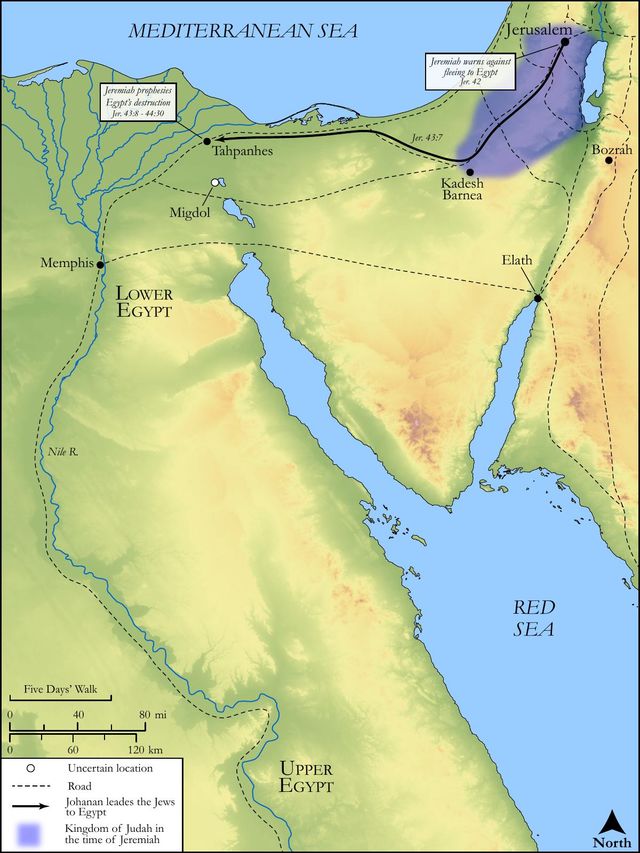
See on the biblical-era map
Study this verse
Public-domain commentary
Matthew Henry
From his Commentary on the Whole Bible. Henry comments on passages, not single verses — this entry covers Jeremiah 42:7–22. His three-level outline is real structure in the source text, so it is rendered as structure.
We have here the answer which Jeremiah was sent to deliver to those who employed him to ask counsel of God.
I.It did not come immediately, not till ten days after, Jer 42:7.
They were thus long held in suspense, perhaps, to punish them for their hypocrisy or to show that Jeremiah did not speak of himself, nor what he would, for he could not speak when he would, but must wait for instructions. However, it teaches us to continue waiting upon God for direction in our way. The vision is for an appointed time, and at the end it shall speak.
II.When it did come he delivered it publicly, both to the captains and to all the people, from the meanest to those in the highest station; he delivered it fully and faithfully as he received it, as he had promised that he would keep nothing back from them. If Jeremiah had been to direct them by his own prudence, perhaps he could not have told what to advise them to, the case was so difficult; but what he has to advise is what the Lord the God of Israel saith, to whom they had sent him, and therefore they were bound in honour and duty to observe it. And this he tells them,
1.That it is the will of God that they should stay where they are, and his promise that, if they do so, it shall undoubtedly be well with them he would have them still to abide in this land, Jer 42:10. Their brethren were forced out of it into captivity, and this was their affliction; let those therefore count it a mercy that they may stay in it and a duty to stay in it. Let those whose lot is in Canaan never quit it while they can keep it. It would have been enough to oblige them if God had only said, "I charge you upon your allegiance to abide still in the land;" but he rather persuades them to it as a friend than commands it as a prince.
(1.)He expresses a very tender concern for them in their present calamitous condition: It repenteth me of the evil that I have done unto you. Though they had shown small sign of their repenting of their sins, yet God, as one grieved for the misery of Israel (Jdg 10:16), begins to repent of the judgments he had brought upon them for their sins. Not that he changed his mind, but he was very ready to change his way and to return in mercy to them. God's time to repent himself concerning his servants is when he sees that, as here, their strength is gone, and there is none shut up or left, Deu 32:36.
(2.)He answers the argument they had against abiding in this land. They feared the king of Babylon (Jer 41:18), lest he should come and avenge the death of Gedaliah upon them, though they were no way accessory to it, nay, had witnessed against it. The surmise was foreign and unreasonable; but, if there had been any ground for it, enough is here said to remove it (Jer 42:11): "Be not afraid of the king of Babylon, though he is a man of great might and little mercy, and a very arbitrary prince, whose will is a law, and therefore you are afraid he will upon this pretence, though without colour of reason, take advantage against you; be not afraid of him, for that fear will bring a snare: fear not him, for I am with you; and, if God be for you to save you, who can be against you to hurt you?" Thus has God provided to obviate and silence even the causeless fears of his people, which discourage them in the way of their duty; there is enough in the promises to encourage them.
(3.)He assures them that if they will still abide in this land they shall not only be safe from the king of Babylon, but be made happy by the King of kings: "I will build you and plant you; you shall take root again, and be the new foundation of another state, a phoenix-kingdom, rising out of the ashes of the last." It is added (Jer 42:12), I will show mercies unto you. Note, In all our comforts we may read God's mercies. God will show them mercy in this, that not only the king of Babylon shall not destroy them, but he shall have mercy upon them and help to settle them. Note, Whatever kindness men do us we must attribute it to God's kindness. He makes those whom he pities to be pitied even by those who carried them captives, Psa 106:46. "The king of Babylon, having now the disposal of the country, shall cause you to return it to your own land, shall settle you again in your own habitations and put you in possession of the lands that formerly belonged to you." Note, God has made that our duty which is really our privilege, and our obedience will be its own recompence. "Abide in this land, and it shall be your own land again and you shall continue in it. Do not quit it now that you stand so fair for the enjoyment of it again. Be no so unwise as to forsake your own mercies for lying vanities."
2.That as they tender the favour of God and their own happiness they must by no means think of going into Egypt, not thither of all places, not to that land out of which God had delivered their fathers and which he had so often warned them not to make alliance with nor to put confidence in. Observe here,
(1.)The sin they are supposed to be guilty of (and to him that knew their hearts it was more than a supposition): "You begin to say, We will not dwell in this land (Jer 42:13); we will never think that we can be safe in it, no, not though God himself undertake our protection. We will not continue in it, no, not in obedience to the voice of the Lord our God. He may say what he please, but we will do what we please. We will go into the land of Egypt, and there will we dwell, whether God give us leave and go along with us or no," Jer 42:14. It is supposed that their hearts were upon it: "If you wholly set your faces to enter into Egypt, and are obstinately resolved that you will go and sojourn there, though God oppose you in it both by his word and by his providence, then take what follows." Now the reason they go upon in this resolution is that "in Egypt we shall see no war, nor have hunger of bread,; as we have had for a long time in this land," Jer 42:14. Note, It is folly to quit our place, especially to quit the holy land, because we meet with trouble in it; but greater folly to think by changing our place to escape the judgments of God, and that evil which pursues sinners in every way of disobedience, and which there is no escaping but by returning to our allegiance.
(2.)The sentence passed upon them for this sin, if they will persist in it. It is pronounced in God's name (Jer 42:15): "Hear the word of the Lord, you remnant of Judah, who think that because you are a remnant you must be spared of course (Jer 42:2) and indulged in your own humour." [1.] Did the sword and famine frighten them? Those very judgments shall pursue them into Egypt, shall overtake them, and overcome them there (Jer 42:16, Jer 42:17): "You think, because war and famine have long been raging in this land, that they are entailed upon it; whereas, if you trust in God, he can make even this land a land of peace to you; you think they are confined to it, and, if you can get clear of this land, you shall get out of the reach of them, but God will send them after you wherever you go." Note, the evils we think to escape by sin we certainly and inevitably run ourselves upon. The men that go to Egypt in contradiction to God's will, to escape the sword and famine, shall die in Egypt by sword and famine. We may apply it to the common calamities of human life; those that are impatient of them, and think to avoid them by changing their place, will find that they are deceived and that they do not at all better themselves. The grievances common to men will meet them wherever they go. All our removes in this world are but from one wilderness to another; still we are where we were. [2.] Did the desolations of Jerusalem frighten them? Were they willing to get as far as they could from them? They shall meet with the second part of them too in Egypt (Jer 42:18): As my anger and fury have been poured out here upon Jerusalem, so they shall be poured out upon you in Egypt. Note, Those that have by sin made God their enemy will find him a consuming fire wherever they go. And then you shall be an execration and an astonishment. The Hebrews were of old an abomination to the Egyptians (Gen 43:32), and now they shall be made more so than ever. When God's professing people mingle with infidels, and make their court to them, they lose their dignity and make themselves a reproach.
3.That God knew their hypocrisy in their enquiries of him, and that when they asked what he would have them to do they were resolved to take their own way; and therefore the sentence which was before pronounced conditionally is made absolute. Having set before them good and evil, the blessing and the curse, in the close he makes application of what he had said. And here, (1.) He solemnly protests that he had faithfully delivered his message, Jer 42:19. The conclusion of the whole matter is, "Go not down into Egypt; you disobey the command of God if you do, and what I have said to you will be a witness against you; for know certainly that, whether you will hear or whether you will forbear, I have plainly admonished you; you cannot now plead ignorance of the mind of God." (2.) He charges them with base dissimulation in the application they made to him for divine direction (Jer 42:20): "You dissembled in your hearts; you professed one thing and intended another, promising what you never meant to perform." You have used deceit against your soul (so the margin reads it); for those that think to put a cheat upon God will prove in the end to have put a damning cheat upon themselves. (3.) He is already aware that they are determined to go contrary to the command of God; probably they discovered it in their countenance and secret mutterings already, before he had finished his discourse. However, he spoke from him who knew their hearts: "You have not obeyed the voice of the Lord your God; you have not a disposition to obey it." Thus Moses, in the close of his farewell sermon, had told them (Deu 31:27, Deu 31:29), I know thy rebellion and thy stiff neck, and that you will corrupt yourselves. Admire the patience of God, that he is pleased to speak to those who, he knows, will not regard him, and deal with those who, he knows, will deal very treacherously, Isa 48:8. (4.) He therefore reads them their doom, ratifying what he had said before: Know certainly that you shall die by the sword, Jer 42:22. God's threatenings may be vilified, but cannot be nullified, by the unbelief of man. Famine and pestilence shall pursue these sinners; for there is no place privileged from divine arrests, nor can any malefactors go out of God's jurisdiction. You shall die in the place whither you desire to go. Note, We know not what is good for ourselves; and that often proves afflictive, and sometimes fatal, which we are most fond of and have our hearts most set upon.
Continue studying Jeremiah 42:11 across the web’s major study libraries — every link below opens this exact verse, chapter, or book on the destination site.
Read & Compare
 BibleGatewayThis verse in more than 200 translations and 70 languages.
 Bible.comThe YouVersion reader — hundreds of translations, reading plans, and highlights.
 ESV.orgCrossway's official English Standard Version reader.
 NET BibleThe NET translation with 60,000+ translators' notes on every rendering decision.
 STEP BibleTyndale House's free study tool — original text, vocabulary, and scholarly resources.
 BibliaLogos Bible Software's free web reader.
 USCCBThe New American Bible (Revised Edition) with the U.S. bishops' study notes.
Commentaries
 BibleHub CommentariesDozens of classic commentaries on this verse, gathered on one page.
 StudyLightMore than 100 commentary sets — the largest collection on the web.
 BibleRefPlain-English commentary on what this verse means, verse by verse.
 Enduring WordDavid Guzik's free commentary on this chapter, widely used by Bible teachers.
 Bible Study ToolsVerse commentary alongside Greek and Hebrew study aids.
Original Language & Research
- BibleHub InterlinearThe verse word by word — original language, transliteration, and English.
- BibleHub LexiconEvery word's original-language definition and Strong's entry.
 Blue Letter BibleDeep-study tools — Strong's numbers, concordance, and word studies.
 SefariaThe Hebrew text with Rashi and centuries of Jewish commentary.
Sermons, Hymns & Audio


TrulyRandomVerse is not affiliated with these sites and doesn’t control their content. They’re linked because they’re genuinely useful.
Summary
Jeremiah 42:11 delivers a profound divine assurance to the fearful Jewish remnant in Judah, directly confronting their terror of the mighty Babylonian empire. Through the prophet Jeremiah, the LORD commands them to abandon their fear, reiterating His unwavering presence and commitment to actively save and deliver them from the oppressive power of their formidable enemy. This verse serves as a powerful declaration of God's sovereignty and faithfulness, calling His people to trust in His protective care rather than succumbing to human fear or seeking their own solutions.
Context
ShowHideLiterary Context
Jeremiah 42:11 is situated within a pivotal section of the book of Jeremiah (chapters 40-44) that chronicles the events immediately following the destruction of Jerusalem in 586 BC and the initial stages of the Babylonian exile. Specifically, this verse is part of God's direct response to a desperate plea from Johanan, the military leader, and the remnant of Judah who remained in the land. After the assassination of Gedaliah, the Babylonian-appointed governor, the people feared retaliation from Nebuchadnezzar and contemplated fleeing to Egypt for safety. Before making this crucial decision, they approached Jeremiah, solemnly promising to obey whatever word the LORD gave them, as seen in the earnest plea and promise in Jeremiah 42:5-6. Jeremiah 42:11 is a core component of God's unambiguous instruction for them to remain in the land, a command directly addressing their overwhelming fear of Babylon and providing the divine rationale for their obedience.
Historical & Cultural Context
The historical backdrop is the devastating aftermath of the Babylonian conquest of Judah. Jerusalem had been destroyed, the Temple burned, and many of the population exiled to Babylon. A small, vulnerable remnant was left behind, living under the shadow of Babylonian imperial power. The "king of Babylon," Nebuchadnezzar, represented an overwhelming military and political force, known for his ruthless campaigns and the complete subjugation of conquered peoples. The people's fear was entirely rational from a human perspective; they had witnessed Babylon's might firsthand and now feared retribution for the assassination of Gedaliah. Culturally, fleeing to Egypt was a recurring temptation for Israel in times of crisis, often viewed as a place of refuge and strength, yet frequently condemned by prophets as a reliance on human power rather than divine provision, as seen in Isaiah 30:1-3 and Hosea 7:11. God's command here directly challenges this deeply ingrained cultural inclination to seek security in worldly alliances or geographical escape.
Key Themes
ShowHideJeremiah 42:11 powerfully articulates several key themes pervasive throughout the book of Jeremiah and the Old Testament. Firstly, it highlights Divine Sovereignty over Nations, demonstrating that even mighty empires like Babylon are instruments in God's hand, subject to His ultimate control, as detailed in Jeremiah 27:6-7. Secondly, the repeated command "Be not afraid" underscores the theme of Trust vs. Fear, urging God's people to place their confidence in His character and promises rather than succumbing to human anxieties. Thirdly, the declaration "I am with you" is a foundational expression of Covenant Faithfulness and God's Presence, a recurring motif throughout redemptive history, assuring His people of His active, intimate involvement in their lives, as promised to figures like Jacob in Genesis 28:15 and Joshua in Joshua 1:9. Finally, the promise "to save you, and to deliver you from his hand" emphasizes God's unwavering commitment to Deliverance and Salvation for His obedient remnant, even amidst seemingly insurmountable odds.
Exposition and Analysis
ShowHideKey Word Analysis
ShowHideThis root (H3372, H3373) appears multiple times in the verse, underscoring the intensity of the people's fear and the divine insistence on overcoming it. While its primary meaning is "to fear," it can also carry the nuance of "to revere" or "to dread." In this context, it speaks to a profound terror that threatens to paralyze and misdirect the remnant. God acknowledges their very real human fear but commands them to shift their focus from the object of their dread (Babylon) to the object of their reverence and trust (Himself).
This (H3068) is the covenant name of God, emphasizing His self-existence, eternality, and His personal relationship with Israel. When the verse states, "saith the LORD," it signifies that this is not merely a human opinion or prophetic counsel, but a direct, authoritative utterance from the sovereign God who keeps His promises. His covenant name undergirds the reliability of the assurance that follows, establishing His unique identity as the one true God.
This primitive root (H3467) means "to be open, wide or free," and by implication, "to be safe." Causatively, it means "to free or succor," encompassing concepts like deliverance, help, preservation, and salvation. In Jeremiah 42:11, it signifies God's comprehensive action to bring His people to a state of safety and well-being, not just from physical harm but from the oppressive power and control of Babylon. It speaks to a holistic rescue and restoration, ensuring their security and freedom.
Verse Breakdown
ShowHide"Be not afraid of the king of Babylon, of whom ye are afraid;"
This opening clause directly addresses the people's primary and overwhelming fear. The repetition of "afraid" emphasizes the depth of their terror and God's direct confrontation of it. He acknowledges their very real human emotion but immediately issues a divine counter-command, setting the stage for a call to trust over fear.
"be not afraid of him, saith the LORD:"
The command is reiterated for emphasis and reinforced by the divine authority, "saith the LORD." This phrase underscores that the instruction is not merely Jeremiah's advice but a direct, authoritative word from the covenant-keeping God. The repetition serves to firmly implant the command in the hearers' minds, highlighting its critical importance and the necessity of absolute obedience to divine instruction.
"for I am with you to save you, and to deliver you from his hand."
This is the theological bedrock of the command, providing the irrefutable reason for the remnant's confidence. The divine presence, "I am with you," is the foundation for overcoming fear, a foundational covenant promise assuring intimate involvement and active help. God then specifies the outcome of His presence: "to save you" (from danger, bringing to safety and security) and "to deliver you from his hand" (from the power, control, or oppressive grasp of the king of Babylon). The "hand" here is a powerful symbol of authority and dominion, from which God promises complete liberation.
Literary Devices
ShowHideJeremiah 42:11 employs several powerful literary devices to convey its message with force and clarity. The most prominent is Repetition, particularly of the phrase "Be not afraid" (Hebrew: al-tira). This immediate and repeated command serves to underscore the intensity of the people's fear and the divine insistence on overcoming it. The repetition acts as a forceful rhetorical device, aiming to engrave the command into the hearts of the fearful remnant, emphasizing its critical importance. Another key device is Divine Assurance, encapsulated in the foundational covenant formula, "I am with you." This phrase, frequently used throughout the Old Testament, functions as a powerful declaration of God's unwavering presence, active support, and intimate involvement with His people. It directly counteracts the people's sense of abandonment and vulnerability. Furthermore, there is a clear Contrast established between the object of human fear (the king of Babylon, a temporal and limited power) and the object of divine trust (the LORD, the omnipotent and eternal God). This highlights the spiritual battle between reliance on human strength or perceived circumstances and faith in God's sovereign power. Finally, the use of "hand" in "deliver you from his hand" is a form of Synecdoche or Metonymy, where a part (the hand) represents the whole (the king's power, authority, and oppressive control). This vividly portrays the extent of the deliverance God promises.
Theological and Thematic Connections
ShowHideJeremiah 42:11 resonates deeply with the overarching biblical narrative of God's faithfulness to His covenant people, even when they are disobedient or fearful. It affirms God's absolute sovereignty over all earthly powers, including the most formidable empires like Babylon. The divine command "Be not afraid" is not a dismissal of legitimate danger but a profound call to reorient one's trust from human might or perceived threats to the omnipotent and ever-present LORD. God's promise "I am with you" is the bedrock of His covenant relationship, signifying His active, protective presence and His commitment to deliver His people from any adversary. This verse teaches that true security is found not in strategic alliances or geographical escape, but in obedient reliance on God's unfailing word and His powerful hand. It foreshadows the ultimate deliverance God provides through His redemptive plan, reminding us that His presence is the antidote to fear.
Reflection and Application
ShowHideJeremiah 42:11 offers timeless encouragement and a profound challenge for believers today. Just as the ancient Israelites faced a formidable "king of Babylon" in the form of a terrifying empire, we too encounter situations that incite deep fear: economic instability, global pandemics, political unrest, personal health crises, relational conflicts, or spiritual attacks. This verse reminds us that God is intimately aware of our anxieties and directly addresses them with His unchanging promise: "I am with you." It calls us to actively choose trust over terror, to anchor our hope in His sovereign power and abiding presence rather than succumbing to panic or seeking our own solutions apart from His will. The command "Be not afraid" is not a passive suggestion but an imperative to engage our will, to consciously lean into God's protective care, knowing that He is able to save and deliver us from any "hand" that seeks to oppress or control us. Our peace is found in His presence and His power, enabling us to walk in obedience even when circumstances seem dire, remembering that His faithfulness is our ultimate security.
Questions for Reflection
ShowHideFAQ
ShowHideWhy were the people afraid of the king of Babylon?
ShowHideThe people were afraid of the king of Babylon, Nebuchadnezzar, for very legitimate reasons. Babylon had recently conquered Judah, destroyed Jerusalem, and exiled a significant portion of the population. The remnant left in the land had witnessed firsthand Babylon's overwhelming military might and ruthless tactics. Furthermore, the assassination of Gedaliah, the Babylonian-appointed governor, by Ishmael (as detailed in Jeremiah 41) created a deep fear of severe Babylonian retaliation against those who remained. Their fear was a rational response to a powerful and vengeful empire that had already demonstrated its capacity for destruction.
What does "I am with you" signify in this context?
ShowHideThe phrase "I am with you" (Hebrew: ani itchem) is a profound declaration of God's covenant faithfulness and active presence. In this context, it signifies that despite the overwhelming power of Babylon, the LORD Himself is personally present with His people, not as a distant observer but as an active protector and deliverer. It implies His unwavering commitment, His intimate involvement in their circumstances, and His assurance that they are not abandoned. This promise is a recurring motif throughout the Bible, often given to individuals or groups facing daunting tasks or dangers, such as to Jacob in Genesis 28:15 and Joshua in Joshua 1:9, serving as the foundation for courage and obedience.
Did the people obey God's command in Jeremiah 42:11?
ShowHideTragically, no. Despite their solemn promise to obey whatever the LORD commanded (as seen in Jeremiah 42:5-6), the remnant ultimately chose to disregard God's clear instruction through Jeremiah. Driven by their persistent fear of Babylon and a misguided trust in Egypt, they migrated to Egypt, taking Jeremiah with them against his will. This act of disobedience is recounted in Jeremiah 43:7, leading to further judgment and demonstrating the severe consequences of choosing human wisdom and fear over divine command. Their failure to trust God's promise of presence and deliverance resulted in their continued suffering.
Christ-Centered Fulfillment
ShowHideJeremiah 42:11, with its divine command to "Be not afraid" grounded in the promise "I am with you to save you, and to deliver you from his hand," finds its ultimate and most profound fulfillment in Jesus Christ. He is the very embodiment of God's promised presence, Immanuel, "God with us," as prophesied in Isaiah 7:14 and confirmed in Matthew 1:23. While the remnant feared the temporal power of the king of Babylon, humanity's greatest fear is the spiritual dominion of sin and death, and the ultimate adversary, Satan. Christ came to confront this ultimate "king of Babylon," not with military might, but through His sacrificial death and resurrection. He disarmed the powers and authorities, triumphing over them by the cross, as declared in Colossians 2:15. Through Him, we are delivered from the "hand" of spiritual darkness and transferred into the kingdom of His beloved Son, as celebrated in Colossians 1:13. Jesus's final promise to His disciples, "And behold, I am with you always, to the end of the age" (Matthew 28:20), echoes Jeremiah's assurance, providing an eternal and indissoluble presence that conquers all fear and guarantees ultimate salvation from every spiritual enemy, offering a peace that surpasses all understanding, as promised in Philippians 4:7.