


Genesis 24:40
Bible text: King James Version (1769 Blayney text) · Public domain
Bible text: King James Version with Strong's numbers · Public domain
Bible text: Berean Standard Bible · Public domain
Bible text: American Standard Version (1901) · Public domain
Bible text: World English Bible, Messianic edition · Public domain
Bible text: Geneva Bible (1599) · Public domain
Bible text: Young's Literal Translation · Public domain
- וַיֹּאמֶרvai·Yo·merand he saidH559Conj-w ¦ V-Qal-ConsecImperf-3msVerb Qal Consecutive Imperfect 3rd Singular Masculineוַandיֹּאמֶרhe said
- אֵלָי'e·Laito meH413Prep ¦ 1csPreposition Definiteאֵלָtoיme
- יְהוָהYah·wehYahwehH3068N-properNoun Proper Title
- אֲשֶׁר'a·SherwhomH834RelParticle Relative
- הִתְהַלַּכְתִּיhit·ha·Lakh·tiI have walked aboutH1980V-Hithpael-Perf-1csVerb Hithpael Perfect 1st Singular common gender
- לְפָנָיוle·fa·Nav<to> before himH6440Prep-l ¦ N-mpc ¦ 3msNoun Plural Masculine Constructלְ<to>פָנָיbeforeוhim
- יִשְׁלַחyish·Lachhe will sendH7971V-Qal-Imperf-3msVerb Qal Imperfect 3rd Singular Masculine
- מַלְאָכוֹmal·'a·Khohis angelH4397N-msc ¦ 3msNoun Singular Masculine Constructמַלְאָכangelוֹhis
- אִתָּךְ'i·toKhwith youH854Prep ¦ 2msPreposition Definiteאִתָּwithךְyou
- וְהִצְלִיחַve·hitz·Li·achand he will make successfulH6743Conj-w ¦ V-Hiphil-ConsecPerf-3msVerb Hiphil Consecutive Perfect 3rd Singular Masculineוְandהִצְלִיחַhe will make successful
- דַּרְכֶּךָdar·Ke·khayour journeyH1870N-csc ¦ 2msNoun Singular common gender Constructדַּרְכֶּjourneyךָyour
- וְלָקַחְתָּve·la·kach·Taand you will takeH3947Conj-w ¦ V-Qal-ConsecPerf-2msVerb Qal Consecutive Perfect 2nd Singular Masculineוְandלָקַחְתָּyou will take
- אִשָּׁה'i·Shaha wifeH802N-fsNoun Singular Feminine Absolute
- לִבְנִיliv·Nifor my sonH1121Prep-l ¦ N-msc ¦ 1csNoun Singular Masculine Constructלִforבְנִsonיmy
- מִמִּשְׁפַּחְתִּיmi·mish·pach·Tifrom my familyH4940Prep-m ¦ N-fsc ¦ 1csNoun Singular Feminine Constructמִfromמִּשְׁפַּחְתִּfamilyיmy
- וּמִבֵּיתu·mi·Beitand from [the] household ofH1004Conj-w ¦ Prep-m ¦ N-mscNoun Singular Masculine Constructוּandמִfromבֵּית[the] household of
- אָבִי'a·Vimy fatherH1N-msc ¦ 1csNoun Singular Masculine Constructאָבִfatherיmy
English is a literal word-by-word gloss of the Hebrew, not the KJV's wording. Why?
This is the original text the KJV's translators worked from — each Hebrew word with its own literal English meaning in this verse, prepared by scholars at Tyndale House, Cambridge. The KJV translates whole sentences, not word by word, so its wording differs: one Hebrew word can become several English words, and the KJV may choose “the LORD” where the gloss reads “Yahweh”. Both are faithful — they answer different questions. For the KJV's own rendering, switch to the KJV text.
Details
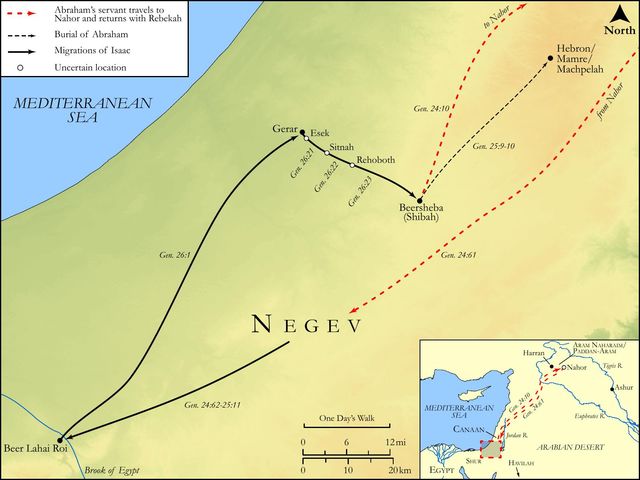
See on the biblical-era maps


Study this verse
Public-domain commentary
Matthew Henry
From his Commentary on the Whole Bible. Henry comments on passages, not single verses — this entry covers Genesis 24:29–53. His four-level outline is real structure in the source text, so it is rendered as structure.
We have here the making up of the marriage between Isaac and Rebekah. It is related very largely and particularly, even to the minute circumstances, which, we should think, might have been spared, while other things of great moment and mystery (as the story of Melchizedek) are related in few words. Thus God conceals that which is curious from the wise and prudent, reveals to babes that which is common and level to their capacity (Mat 11:25), and rules and saves the world by the foolishness of preaching, Co1 1:21. Thus also we are directed to take notice of God's providence in the little common occurrences of human life, and in them also to exercise our own prudence and other graces; for the scripture was not intended for the use of philosophers and statesmen only, but to make us all wise and virtuous in the conduct of ourselves and families. Here is,
I.The very kind reception given to Abraham's servant by Rebekah's relations.
Her brother Laban went to invite and conduct him in, but not till he saw the ear-rings and the bracelets upon his sister's hands, Gen 24:30. "O," thinks Laban, "here is a man that there is something to be got by, a man that is rich and generous; we will be sure to bid him welcome!" We know so much of Laban's character, by the following story, as to think that he would not have been so free of his entertainment if he had not hoped to be well paid for it, as he was, Gen 24:53. Note, A man's gift maketh room for him (Pro 18:16), which way soever it turneth, it prospereth, Pro 17:8.
1.The invitation was kind: Come in, thou blessed of the Lord, Gen 24:31. They saw he was rich, and therefore pronounced him blessed of the Lord; or, perhaps, because they heard from Rebekah (Gen 24:28) or the gracious words which proceeded out of his mouth, they concluded him a good man, and therefore blessed of the Lord. Note, Those that are blessed of God should be welcome to us. It is good owning those whom God owns.
2.The entertainment was kind, Gen 24:32, Gen 24:33. Both the house and stable were well furnished, and Abraham's servant was invited to the free use of both. Particular care was taken of the camels; for a good man regardeth the life of his beast, Pro 12:10. If the ox knows his owner to serve him, the owner should know his ox to provide for him that which is fitting for him.
II.The full account which he gave them of his errand, and the court he made to them for their consent respecting Rebekah. Observe,
1.How intent he was upon his business; though he had come off a journey, and come to a good house, he would not eat, till he had told his errand, Gen 24:33. Note, The doing of our work, and the fulfilling of our trusts, either for God or man, should be preferred by us before our necessary food: it was our Saviour's meat and drink, Joh 4:34.
2.How ingenious he was in the management of it; he approved himself, in this matter, both a prudent man and a man of integrity, faithful to his master by whom he was trusted, and just to those with whom he now treated.
(1.)He gives a short account of the state of his master's family, Joh 4:34-36. He was welcome before, but we may suppose him doubly welcome when he said, I am Abraham's servant. Abraham's name, no doubt, was well known among them and respected, and we might suppose them not altogether ignorant of his state, for Abraham knew theirs, Gen 22:20-24. Two things he suggests, to recommend his proposal: - [1.] That his master Abraham, through the blessing of God, had a very good estate; and, [2.] That he had settled it all upon Isaac, for whom he was now a suitor.
(2.)He tells them the charge his master had given him, to fetch a wife for his son from among his kindred, with the reason of it, Gen 24:37, Gen 24:38. Thus he insinuates a pleasing hint, that, though Abraham had removed to a country at so great a distance, yet he still retained the remembrance of his relations that he had left behind, and a respect for them. The highest degrees of divine affection must not divest us of natural affection. He likewise obviates an objection, That, if Isaac were deserving, he needed not send so far off for a wife: why did he not marry nearer home? "For a good reason," says he; "my master's son must not match with a Canaanite." He further recommends his proposal,
[1.]From the faith his master had that it would succeed, Gen 24:40. Abraham took encouragement from the testimony of his conscience that he walked before God in a regular course of holy living, and thence inferred that God would prosper him; probably he refers to that covenant which God had made with him (Gen 17:1), I am God, all-sufficient, walk before me. Therefore, says he the God before whom I walk will send his angel. Note, While we make conscience of our part of the covenant, we may take the comfort of God's part of it; and we should learn to apply general promises of particular cases, as there is occasion.
[2.]From the care he himself had taken to preserve their liberty of giving or refusing their consent, as they should see cause, without incurring the guilt of perjury (Gen 24:39-41), which showed him, in general, to be a cautious man, and particularly careful that their consent might not be forced, but be either free or not at all.
(3.)He relates to them the wonderful concurrence of providences, to countenance and further the proposal, plainly showing the finger of God in it.
[1.]He tells them how he had prayed for direction by a sign, Gen 24:42-44. Note, It is good dealing with those who be prayer take God along with them in their dealings.
[2.]How God had answered his prayer in the very letter of it. Though he did but speak in his heart (Gen 24:45), which perhaps he mentions, lest it should be suspected that Rebekah had overheard his prayer and designedly humoured it. "No," says he, "I spoke it in my heart, so that none heard it but God, to whom thought are word, and from him the answer came," Gen 24:46, Gen 24:47.
[3.]How he had immediately acknowledged God's goodness to him therein, leading him, as he here expresses it, in the right way. Note, God's way is always the right way (Psa 107:7), and those are well led whom he leads.
(4.)He fairly refers the matter to their consideration, and waits their decision (Gen 24:49): "If you will deal kindly and truly with my master, well and good: if you will be sincerely kind, you will accept the proposal, and I have what I came for; if not, do not hold me in suspense." Note, Those who deal fairly have reason to expect fair dealing.
(5.)They freely and cheerfully close with the proposal upon a very good principle (Gen 24:50): "The thing proceedeth from the Lord, Providence smiles upon it, and we have nothing to say against it." They do not object distance of place, Abraham's forsaking them, or his having no land in possession, but person estate only: they do not question the truth of what this man said; but,
[1.]They trust much to his integrity. It were well if honesty did so universally prevail among men that it might be as much an act of prudence as it is of good nature to take a man's word.
[2.]They trust more to God's providence, and therefore by silence give consent, because it appears to be directed and disposed by Infinite Wisdom. Note, A marriage is then likely to be comfortable when it appears to proceed from the Lord.
(6.)Abraham's servant makes a thankful acknowledgment of the good success he had met with,
[1.]To God: He worshipped the Lord, Gen 24:52. Observe, First, As his good success went on, he went on to bless God. Those that pray without ceasing should in every thing give thanks, and own God in every step of mercy. Secondly, God sent his angel before him, and so gave him success, Gen 24:7, Gen 24:40. But when he has the desired success, he worships God, not the angel. Whatever benefit we have by the ministration of angels, all the glory must be given to the Lord of the angels, Rev 22:9.
[2.]He pays his respects to the family also, and particularly to the bride, Gen 24:53. He presented her, and her mother, and brother, with many precious things, both to give a real proof of his master's riches and generosity and in gratitude for their civility to him, and further to ingratiate himself with them.
Continue studying Genesis 24:40 across the web’s major study libraries — every link below opens this exact verse, chapter, or book on the destination site.
Read & Compare
 BibleGatewayThis verse in more than 200 translations and 70 languages.
 Bible.comThe YouVersion reader — hundreds of translations, reading plans, and highlights.
 ESV.orgCrossway's official English Standard Version reader.
 NET BibleThe NET translation with 60,000+ translators' notes on every rendering decision.
 STEP BibleTyndale House's free study tool — original text, vocabulary, and scholarly resources.
 BibliaLogos Bible Software's free web reader.
 USCCBThe New American Bible (Revised Edition) with the U.S. bishops' study notes.
Commentaries
 BibleHub CommentariesDozens of classic commentaries on this verse, gathered on one page.
 StudyLightMore than 100 commentary sets — the largest collection on the web.
 BibleRefPlain-English commentary on what this verse means, verse by verse.
 Enduring WordDavid Guzik's free commentary on this chapter, widely used by Bible teachers.
 Bible Study ToolsVerse commentary alongside Greek and Hebrew study aids.
Original Language & Research
- BibleHub InterlinearThe verse word by word — original language, transliteration, and English.
- BibleHub LexiconEvery word's original-language definition and Strong's entry.
 Blue Letter BibleDeep-study tools — Strong's numbers, concordance, and word studies.
 SefariaThe Hebrew text with Rashi and centuries of Jewish commentary.
Sermons, Hymns & Audio


TrulyRandomVerse is not affiliated with these sites and doesn’t control their content. They’re linked because they’re genuinely useful.
Summary
Genesis 24:40 encapsulates Abraham's profound conviction in God's active and benevolent involvement in the critical mission of securing a wife for Isaac. Abraham confidently assures his servant that the LORD, with whom he maintains a consistent and obedient walk, will dispatch His divine messenger to guide and ensure the success of the journey, guaranteeing that a suitable spouse for Isaac will be found from Abraham's own extended family and ancestral home. This declaration underscores Abraham's unwavering faith in God's providential care over the covenant lineage.
Context
ShowHideLiterary Context
This verse is a pivotal moment within the larger narrative of Genesis 24, which details Abraham's meticulous efforts to secure a wife for his son Isaac. Having reached an advanced age and desiring to see his son married appropriately, Abraham sends his most trusted servant on a crucial mission. The immediate literary context is the servant's recounting of Abraham's instructions to Rebekah's family in Haran. This repetition of Abraham's words, first spoken in Genesis 24:7, serves to underscore the divine mandate behind the mission and to reassure Rebekah's family of the legitimacy and divine backing of the servant's request. It frames the entire journey not as a mere human endeavor but as a divinely orchestrated event, emphasizing Abraham's deep faith and reliance on God's promises.
Historical & Cultural Context
The practice of endogamy, marrying within one's extended family or tribe, was a deeply ingrained cultural norm in Terah's line, particularly for patriarchal households like Abraham's. This custom was vital for several reasons: preserving family lineage and identity, maintaining tribal purity, safeguarding inheritance rights, and ensuring continuity of cultural and religious traditions. For Abraham, it was paramount that Isaac's wife not be a Canaanite woman, who worshipped foreign gods, but someone from his own "kindred" and "father's house" in Mesopotamia. This was not merely a social preference but a theological imperative, as the purity of the covenant line, through which God's promises would be fulfilled, depended on it. The role of the trusted senior servant in such a critical family matter was also customary, as he acted as an extension of the patriarch's authority and will.
Key Themes
ShowHideGenesis 24:40 powerfully contributes to several overarching themes within the book of Genesis and the broader biblical narrative. Foremost is the theme of Divine Providence and Guidance, demonstrating God's active involvement in the minute details of human life, particularly in fulfilling His covenant promises. Abraham's "walk" with God highlights the theme of Faith and Obedience, portraying a relationship where trust in God's character leads to confident expectation of His intervention. The mention of "His angel" introduces the theme of Angelic Ministry, showcasing angels as divine agents who execute God's will and provide protection and direction to His people. Finally, the meticulous search for Isaac's wife underscores the Significance of Marriage and Lineage within God's redemptive plan, emphasizing that even seemingly personal decisions are woven into the tapestry of God's overarching purposes for His chosen people and the future Messiah. This careful selection ensures the continuation of the covenant line established in Genesis 12:1-3.
Exposition and Analysis
ShowHideAbraham's words in Genesis 24:40 provide a profound insight into his intimate relationship with God and his unwavering trust in divine providence, serving as a powerful testament to his faith.
Key Word Analysis
ShowHideThis is the Tetragrammaton, the personal, covenantal name of God, signifying "the self-Existent or Eternal." Abraham's use of "LORD" (Jehovah) here is significant; it is not a generic term for deity but refers to the specific God who entered into covenant with him, revealed Himself, and made promises. This name evokes God's faithfulness, His unchanging nature, and His sovereign power to bring His plans to fruition, forming the bedrock of Abraham's confidence in His intervention.
The verb "walk" in this context, particularly with the preposition "before whom I walk" (literally, "before His face"), denotes a continuous, habitual manner of life characterized by intimate fellowship, obedience, and conscious awareness of God's presence. It is a metaphor for one's spiritual journey and conduct, signifying a life lived in alignment with God's will and in His sight. This "walking with God" (as seen in Genesis 5:24 and Genesis 6:9) is the foundation of Abraham's assurance that God will act on his behalf.
This primitive root means "to push forward," "to advance," "to succeed," or "to be profitable." When applied to God, as here, it implies divinely-enabled success. It is not merely good fortune but God's active intervention to remove obstacles, clear the path, and ensure a favorable outcome. Abraham's confidence is that God will not just guide, but will actively make the servant's mission successful, achieving the desired result of finding a suitable wife.
Verse Breakdown
ShowHide"And he said unto me, The LORD, before whom I walk,"
This opening clause establishes the speaker (Abraham, through the servant's narration) and immediately grounds the subsequent promise in Abraham's personal, enduring, and obedient relationship with God. Abraham's confidence is not presumption but stems from a life lived in conscious fellowship and submission to the sovereign God, YHWH. This "walking before" the Lord signifies a consistent posture of faith, trust, and obedience, making God's intervention a natural outflow of their covenant relationship.
"will send his angel with thee, and prosper thy way;"
Here, Abraham articulates the mechanism of God's intervention. The "angel" (Hebrew: mal'akh, meaning "messenger") is God's divine agent, dispatched to ensure the mission's success. This is a promise of direct, supernatural assistance and guidance. The phrase "prosper thy way" indicates that God will not merely accompany the servant but will actively facilitate the journey and negotiations, removing obstacles and arranging circumstances to ensure a successful outcome, demonstrating God's meticulous care and control over the details.
"and thou shalt take a wife for my son of my kindred, and of my father's house:"
This final clause specifies the precise objective of the mission, reiterating the cultural and theological imperative of endogamy. The emphasis on "my kindred" and "my father's house" highlights the importance of preserving the purity of the covenant lineage. Abraham's unwavering belief that God will ensure this specific outcome, despite the geographical distance and human complexities involved, underscores his absolute reliance on divine providence for the continuation of the promised seed.
Literary Devices
ShowHideThe verse employs several significant literary devices. Emphasis is achieved through repetition, as Abraham's assurance to the servant is recounted by the servant to Rebekah's family, reinforcing the divine nature of the mission. The phrase "before whom I walk" serves as a powerful Metonymy, where "walking" represents Abraham's entire life of faith, obedience, and intimate relationship with God. The "angel" functions as Symbolism for God's direct, active, and supernatural intervention and guidance, assuring the servant of divine backing. Furthermore, the entire narrative surrounding the search for Isaac's wife, initiated by Abraham's faith-filled declaration in this verse, serves as Foreshadowing of God's meticulous care in preserving the lineage through which the Messiah would eventually come, highlighting His sovereign hand in human affairs.
Theological and Thematic Connections
ShowHideGenesis 24:40 is a rich theological statement, encapsulating core truths about God's character and His interaction with humanity. It profoundly illustrates God's active and sovereign involvement in the lives of His people, even in what might seem like personal or familial matters. Abraham's unwavering confidence stems from his deeply cultivated relationship with the LORD, demonstrating that a life of consistent obedience and trust ("walking before God") is the foundation for experiencing divine guidance and blessing. This verse affirms that God is not a distant deity but one who dispatches His agents and orchestrates circumstances to ensure the fulfillment of His purposes, particularly those related to His covenant promises. The careful selection of Isaac's wife, divinely guided, underscores the spiritual significance of marriage as a foundational institution for the propagation of a godly lineage and the advancement of God's redemptive plan.
Reflection and Application
ShowHideGenesis 24:40 offers profound encouragement for believers navigating significant life decisions, reminding us that God is intimately involved in the details of our lives. Just as Abraham trusted God with the pivotal matter of Isaac's marriage, we are called to seek divine guidance and place our unwavering trust in God's providence in our own major choices—whether in career paths, relocations, or, especially, in seeking a spouse. Abraham's confidence was rooted in his "walking before" the Lord, a consistent and obedient relationship that served as the wellspring of his assurance. This challenges us to cultivate a deep, daily walk with God, knowing that as we align our lives with His will, He promises to "prosper our way." While we may not always perceive angelic assistance in the same tangible way as Abraham's servant, God continues to work through various means—His Holy Spirit, His Word, wise counsel from His people, and the providential arrangement of circumstances—to accomplish His will and guide those who walk faithfully with Him. Our responsibility is to trust, obey, and acknowledge Him in all our ways, confident that He will direct our paths.
Questions for Reflection
ShowHideFAQ
ShowHideWhat does 'before whom I walk' signify about Abraham's relationship with God?
ShowHideThe phrase "before whom I walk" (Hebrew: 'asher hithallakti lephanav) signifies a profound, intimate, and consistent relationship of obedience and fellowship with God. The Hebrew verb halakh (to walk) in this intensive form (Hithpael) denotes a continuous, habitual manner of life. It means Abraham lived his life in conscious awareness of God's presence, continually submitting to His will, and striving to please Him. It's not merely physical movement but a spiritual posture of devotion and trust, forming the basis for his unwavering faith and expectation of divine intervention, echoing God's earlier command to Abraham in Genesis 17:1: "walk before me, and be thou perfect."
Does 'God will send his angel' imply direct angelic appearance for all believers today?
ShowHideWhile God certainly can and does use angels to accomplish His will, as illustrated throughout Scripture (e.g., Hebrews 1:14), the primary implication of Abraham's statement in Genesis 24:40 is the assurance of divine intervention and guidance, rather than a guarantee of visible angelic appearances for every believer in every situation. God works in diverse ways to "prosper our way"—through His Holy Spirit, through His Word, through wise counsel from others, and through the providential arrangement of circumstances. The core message is that God actively oversees and ensures the success of His purposes for those who walk with Him, whether through direct angelic intervention or other means of divine providence.
Christ-Centered Fulfillment
ShowHideGenesis 24:40, with its emphasis on divine guidance in securing a wife for Isaac, profoundly points forward to Christ and His ultimate redemptive mission. The meticulous care taken to preserve Abraham's lineage through Isaac's divinely-arranged marriage was not merely a family affair but a crucial step in God's overarching plan to bring forth the promised "seed" through whom all nations would be blessed. This foreshadows God's ultimate and perfect plan for humanity's redemption through Jesus Christ. Just as Abraham confidently declared that God would send His angel to prosper the servant's way, God sent His ultimate "Angel" or Messenger, Jesus Christ Himself, to accomplish the greatest mission: to secure a bride for Himself—the Church—from among all nations (Revelation 21:2). Christ, the true "seed" of Abraham (Galatians 3:16), is the ultimate fulfillment of God's covenant promises. His life, sacrificial death, and glorious resurrection are the ultimate demonstration of God's unwavering faithfulness and His perfect plan to "prosper the way" of salvation for all who believe, bringing them into eternal union with Him, the Bridegroom (Ephesians 5:25-27).