


Genesis 24:39
Bible text: King James Version (1769 Blayney text) · Public domain
Bible text: Berean Standard Bible · Public domain
Bible text: American Standard Version (1901) · Public domain
Bible text: World English Bible, Messianic edition · Public domain
Bible text: Geneva Bible (1599) · Public domain
Bible text: Young's Literal Translation · Public domain
- וָאֹמַרva·'o·Marand I saidH559Conj-w ¦ V-Qal-ConsecImperf-1csVerb Qal Consecutive Imperfect 1st Singular common genderוָandאֹמַרI said
- אֶל'eltoH413PrepPreposition
- אֲדֹנִי'a·do·Nimy masterH113N-msc ¦ 1csNoun Singular Masculine Constructאֲדֹנִmasterיmy
- אֻלַי'u·LaiperhapsH194AdvAdverb
- לֹאlo'notH3808NegParticle Negative
- תֵלֵךְte·Lekhshe will goH1980V-Qal-Imperf-3fsVerb Qal Imperfect 3rd Singular Feminine
- הָאִשָּׁהha·'i·Shahthe womanH802Art ¦ N-fsNoun Singular Feminine Absoluteהָtheאִשָּׁהwoman
- אַחֲרָי'a·cha·Raiafter meH310Adj-mpc ¦ 1csAdjective Numerical Plural Masculine Constructאַחֲרָafterיme
English is a literal word-by-word gloss of the Hebrew, not the KJV's wording. Why?
This is the original text the KJV's translators worked from — each Hebrew word with its own literal English meaning in this verse, prepared by scholars at Tyndale House, Cambridge. The KJV translates whole sentences, not word by word, so its wording differs: one Hebrew word can become several English words, and the KJV may choose “the LORD” where the gloss reads “Yahweh”. Both are faithful — they answer different questions. For the KJV's own rendering, switch to the KJV text.
Details
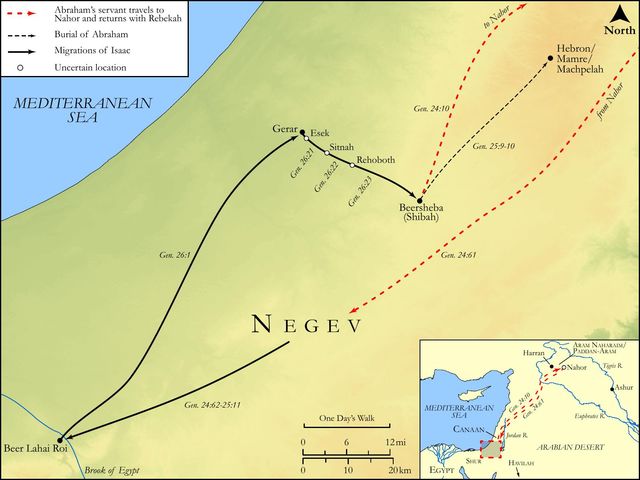
See on the biblical-era maps


Study this verse
Public-domain commentary
Matthew Henry
From his Commentary on the Whole Bible. Henry comments on passages, not single verses — this entry covers Genesis 24:29–53. His four-level outline is real structure in the source text, so it is rendered as structure.
We have here the making up of the marriage between Isaac and Rebekah. It is related very largely and particularly, even to the minute circumstances, which, we should think, might have been spared, while other things of great moment and mystery (as the story of Melchizedek) are related in few words. Thus God conceals that which is curious from the wise and prudent, reveals to babes that which is common and level to their capacity (Mat 11:25), and rules and saves the world by the foolishness of preaching, Co1 1:21. Thus also we are directed to take notice of God's providence in the little common occurrences of human life, and in them also to exercise our own prudence and other graces; for the scripture was not intended for the use of philosophers and statesmen only, but to make us all wise and virtuous in the conduct of ourselves and families. Here is,
I.The very kind reception given to Abraham's servant by Rebekah's relations.
Her brother Laban went to invite and conduct him in, but not till he saw the ear-rings and the bracelets upon his sister's hands, Gen 24:30. "O," thinks Laban, "here is a man that there is something to be got by, a man that is rich and generous; we will be sure to bid him welcome!" We know so much of Laban's character, by the following story, as to think that he would not have been so free of his entertainment if he had not hoped to be well paid for it, as he was, Gen 24:53. Note, A man's gift maketh room for him (Pro 18:16), which way soever it turneth, it prospereth, Pro 17:8.
1.The invitation was kind: Come in, thou blessed of the Lord, Gen 24:31. They saw he was rich, and therefore pronounced him blessed of the Lord; or, perhaps, because they heard from Rebekah (Gen 24:28) or the gracious words which proceeded out of his mouth, they concluded him a good man, and therefore blessed of the Lord. Note, Those that are blessed of God should be welcome to us. It is good owning those whom God owns.
2.The entertainment was kind, Gen 24:32, Gen 24:33. Both the house and stable were well furnished, and Abraham's servant was invited to the free use of both. Particular care was taken of the camels; for a good man regardeth the life of his beast, Pro 12:10. If the ox knows his owner to serve him, the owner should know his ox to provide for him that which is fitting for him.
II.The full account which he gave them of his errand, and the court he made to them for their consent respecting Rebekah. Observe,
1.How intent he was upon his business; though he had come off a journey, and come to a good house, he would not eat, till he had told his errand, Gen 24:33. Note, The doing of our work, and the fulfilling of our trusts, either for God or man, should be preferred by us before our necessary food: it was our Saviour's meat and drink, Joh 4:34.
2.How ingenious he was in the management of it; he approved himself, in this matter, both a prudent man and a man of integrity, faithful to his master by whom he was trusted, and just to those with whom he now treated.
(1.)He gives a short account of the state of his master's family, Joh 4:34-36. He was welcome before, but we may suppose him doubly welcome when he said, I am Abraham's servant. Abraham's name, no doubt, was well known among them and respected, and we might suppose them not altogether ignorant of his state, for Abraham knew theirs, Gen 22:20-24. Two things he suggests, to recommend his proposal: - [1.] That his master Abraham, through the blessing of God, had a very good estate; and, [2.] That he had settled it all upon Isaac, for whom he was now a suitor.
(2.)He tells them the charge his master had given him, to fetch a wife for his son from among his kindred, with the reason of it, Gen 24:37, Gen 24:38. Thus he insinuates a pleasing hint, that, though Abraham had removed to a country at so great a distance, yet he still retained the remembrance of his relations that he had left behind, and a respect for them. The highest degrees of divine affection must not divest us of natural affection. He likewise obviates an objection, That, if Isaac were deserving, he needed not send so far off for a wife: why did he not marry nearer home? "For a good reason," says he; "my master's son must not match with a Canaanite." He further recommends his proposal,
[1.]From the faith his master had that it would succeed, Gen 24:40. Abraham took encouragement from the testimony of his conscience that he walked before God in a regular course of holy living, and thence inferred that God would prosper him; probably he refers to that covenant which God had made with him (Gen 17:1), I am God, all-sufficient, walk before me. Therefore, says he the God before whom I walk will send his angel. Note, While we make conscience of our part of the covenant, we may take the comfort of God's part of it; and we should learn to apply general promises of particular cases, as there is occasion.
[2.]From the care he himself had taken to preserve their liberty of giving or refusing their consent, as they should see cause, without incurring the guilt of perjury (Gen 24:39-41), which showed him, in general, to be a cautious man, and particularly careful that their consent might not be forced, but be either free or not at all.
(3.)He relates to them the wonderful concurrence of providences, to countenance and further the proposal, plainly showing the finger of God in it.
[1.]He tells them how he had prayed for direction by a sign, Gen 24:42-44. Note, It is good dealing with those who be prayer take God along with them in their dealings.
[2.]How God had answered his prayer in the very letter of it. Though he did but speak in his heart (Gen 24:45), which perhaps he mentions, lest it should be suspected that Rebekah had overheard his prayer and designedly humoured it. "No," says he, "I spoke it in my heart, so that none heard it but God, to whom thought are word, and from him the answer came," Gen 24:46, Gen 24:47.
[3.]How he had immediately acknowledged God's goodness to him therein, leading him, as he here expresses it, in the right way. Note, God's way is always the right way (Psa 107:7), and those are well led whom he leads.
(4.)He fairly refers the matter to their consideration, and waits their decision (Gen 24:49): "If you will deal kindly and truly with my master, well and good: if you will be sincerely kind, you will accept the proposal, and I have what I came for; if not, do not hold me in suspense." Note, Those who deal fairly have reason to expect fair dealing.
(5.)They freely and cheerfully close with the proposal upon a very good principle (Gen 24:50): "The thing proceedeth from the Lord, Providence smiles upon it, and we have nothing to say against it." They do not object distance of place, Abraham's forsaking them, or his having no land in possession, but person estate only: they do not question the truth of what this man said; but,
[1.]They trust much to his integrity. It were well if honesty did so universally prevail among men that it might be as much an act of prudence as it is of good nature to take a man's word.
[2.]They trust more to God's providence, and therefore by silence give consent, because it appears to be directed and disposed by Infinite Wisdom. Note, A marriage is then likely to be comfortable when it appears to proceed from the Lord.
(6.)Abraham's servant makes a thankful acknowledgment of the good success he had met with,
[1.]To God: He worshipped the Lord, Gen 24:52. Observe, First, As his good success went on, he went on to bless God. Those that pray without ceasing should in every thing give thanks, and own God in every step of mercy. Secondly, God sent his angel before him, and so gave him success, Gen 24:7, Gen 24:40. But when he has the desired success, he worships God, not the angel. Whatever benefit we have by the ministration of angels, all the glory must be given to the Lord of the angels, Rev 22:9.
[2.]He pays his respects to the family also, and particularly to the bride, Gen 24:53. He presented her, and her mother, and brother, with many precious things, both to give a real proof of his master's riches and generosity and in gratitude for their civility to him, and further to ingratiate himself with them.
Historical interpretation
Historical reception
1 surviving comment on this verse from the historical church.
Then they called the young woman to learn from her [whether she would return with him or not]. Because she heard about the oath that Abraham had made him swear, and about the prayer that the servant had prayed at the well and about the sign for which he had asked and which had been granted to him, she feared to say “I will not go,” because she knew that it was the will of the Lord that she go. So she went and became Isaac’s [wife].
Continue studying Genesis 24:39 across the web’s major study libraries — every link below opens this exact verse, chapter, or book on the destination site.
Read & Compare
 BibleGatewayThis verse in more than 200 translations and 70 languages.
 Bible.comThe YouVersion reader — hundreds of translations, reading plans, and highlights.
 ESV.orgCrossway's official English Standard Version reader.
 NET BibleThe NET translation with 60,000+ translators' notes on every rendering decision.
 STEP BibleTyndale House's free study tool — original text, vocabulary, and scholarly resources.
 BibliaLogos Bible Software's free web reader.
 USCCBThe New American Bible (Revised Edition) with the U.S. bishops' study notes.
Commentaries
 BibleHub CommentariesDozens of classic commentaries on this verse, gathered on one page.
 StudyLightMore than 100 commentary sets — the largest collection on the web.
 BibleRefPlain-English commentary on what this verse means, verse by verse.
 Enduring WordDavid Guzik's free commentary on this chapter, widely used by Bible teachers.
 Bible Study ToolsVerse commentary alongside Greek and Hebrew study aids.
Original Language & Research
- BibleHub InterlinearThe verse word by word — original language, transliteration, and English.
- BibleHub LexiconEvery word's original-language definition and Strong's entry.
 Blue Letter BibleDeep-study tools — Strong's numbers, concordance, and word studies.
 SefariaThe Hebrew text with Rashi and centuries of Jewish commentary.
Sermons, Hymns & Audio


TrulyRandomVerse is not affiliated with these sites and doesn’t control their content. They’re linked because they’re genuinely useful.
Summary
Genesis 24:39 captures the chief servant Eliezer's candid and practical concern, voiced to Abraham, that the prospective bride for Isaac might not consent to leave her home and family to journey to a distant land. This pivotal verse highlights a deeply human apprehension regarding potential logistical and relational obstacles within a divinely commissioned mission, thereby setting the stage for God's profound demonstration of sovereign guidance and meticulous provision in orchestrating the search for Isaac's wife.
Context
ShowHideLiterary Context
This verse is deeply embedded within the expansive and highly detailed narrative of Genesis 24, which is entirely dedicated to the singular mission of finding a wife for Isaac. Following Abraham's solemn charge to Eliezer in Genesis 24:1-9, Eliezer recounts his initial conversation with Abraham to Rebekah's family, specifically in Genesis 24:34-48. Verse 39 is a direct quotation of Eliezer's earlier question to Abraham, demonstrating his consistent and realistic foresight regarding the challenges of his task. This repetition serves to underscore the significance of the potential obstacle and to highlight how God's providential hand later overcame this very concern, culminating in Rebekah's willing consent in Genesis 24:58.
Historical & Cultural Context
Among Nahor's kindred, while arranged marriages were the norm, the consent of the woman, or at least her family's, was often a crucial element, particularly when it involved a significant relocation. A woman leaving her paternal home (beth 'ab) was a momentous event, signifying a complete break from her familiar social and economic support system to join a new family. Eliezer's journey from Canaan to Mesopotamia (specifically, Nahor in Paddan Aram, as seen in Genesis 24:10) was a considerable distance, making the woman's willingness to undertake such a journey and adapt to an entirely new life a genuine and practical concern. This cultural reality grounds Eliezer's apprehension in the socio-historical context of the patriarchal period, illustrating that even divinely guided missions operated within human customs.
Key Themes
ShowHideGenesis 24, and verse 39 within it, contributes significantly to several overarching themes. Foremost is the theme of Divine Providence and Guidance, showcasing God's active involvement in the lives of His covenant people, even in seemingly personal matters like marriage, as powerfully demonstrated in Genesis 24:27. It also highlights Faith and Obedience, as Abraham's unwavering trust in God's promise (Genesis 24:7) contrasts with Eliezer's practical apprehension, yet both ultimately lead to faithful action. The narrative further develops the theme of Covenant Continuity, as finding a suitable wife for Isaac ensures the continuation of Abraham's lineage and the fulfillment of God's promises, a theme central to the entire book of Genesis. Finally, the verse subtly introduces the theme of Human Agency and Divine Sovereignty, where human choices and concerns intersect with God's overarching plan.
Exposition and Analysis
ShowHideKey Word Analysis
ShowHideThis primitive root (H559) is used with great latitude, meaning "to say," "to speak," "to tell," or "to declare." Here, it signifies Eliezer's direct verbal communication of his concern to his master, Abraham. It indicates a clear and explicit articulation of a potential difficulty, not merely an internal thought, underscoring the transparency of their master-servant relationship.
Derived from an unused root meaning "to rule," this word (H113) denotes a sovereign, controller, lord, or owner. In this context, it refers to Abraham, emphasizing Eliezer's subordinate position and his duty to report honestly to his authority figure. The use of "master" highlights the hierarchical structure of the household and Eliezer's respect for Abraham's command.
This primitive root (H3212) means "to walk" (literally or figuratively) or "to go." When combined with the preposition "me" (H310, ʼachar' meaning "after"), it forms the idiomatic expression "follow me," signifying to accompany, to go along with, or to obey. Here, it specifically refers to the woman's willingness to depart with Eliezer and journey to a new land, implying her consent and active participation in the divine plan.
Verse Breakdown
ShowHide"And I said unto my master"
This opening phrase identifies the speaker as Eliezer, Abraham's chief servant, and the recipient of his words as Abraham. It establishes the context of a direct, honest report from a trusted subordinate to his superior, recounting a crucial part of their earlier conversation regarding the mission to find Isaac a wife. This reiteration serves to emphasize Eliezer's faithful execution of his duties and his transparent communication.
"Peradventure the woman will not follow me"
This is Eliezer's expressed apprehension. The King James Version's "Peradventure" translates the Hebrew אולי ('ulay), which conveys a sense of "perhaps," "it may be," or "if it were possible." It reflects a realistic, culturally informed concern that the chosen woman might not be willing to leave her family and home to journey to a distant land with a stranger for marriage. This statement is not necessarily a sign of a lack of faith in God's ultimate ability, but rather a practical foresight of a significant human obstacle that would require divine intervention to overcome.
Literary Devices
ShowHideThe verse employs several literary devices. Dialogue is central, as it is a direct quote from Eliezer to Abraham, recounting a previous conversation. This use of dialogue makes the narrative immediate and personal, revealing the character's thoughts and concerns directly. The phrase "Peradventure the woman will not follow me" functions as Foreshadowing, setting up a potential obstacle that the subsequent narrative will triumphantly overcome, thereby highlighting God's miraculous intervention. There is also a subtle element of Irony in Eliezer's concern, as the very "peradventure" he voices is precisely what God will ensure is resolved, demonstrating divine sovereignty over human apprehension. The verse also utilizes Contrast between Eliezer's practical human concern and Abraham's unwavering faith in God's promise to send His angel, which is implicitly recalled by this recounting.
Theological and Thematic Connections
ShowHideEliezer's "peradventure" in Genesis 24:39 serves as a profound theological touchstone, illustrating the intersection of human apprehension and divine assurance. It underscores the reality that even those engaged in God's work may encounter practical doubts or foresee formidable obstacles. Yet, the subsequent unfolding of the narrative in Genesis 24 powerfully demonstrates that God's sovereign plan is not thwarted by human uncertainties but often works through them, transforming potential roadblocks into testimonies of His faithfulness. This narrative teaches us that while honest expression of concerns is healthy, ultimate trust must reside in God's ability to provide and guide, even when the path ahead seems uncertain or fraught with human challenges.
Reflection and Application
ShowHideEliezer's honest expression of doubt in Genesis 24:39 offers a timeless and deeply relatable lesson for believers navigating life's complexities. We often find ourselves in situations where we believe we are following God's leading, yet practical obstacles, uncertainties, or even our own fears surface. This verse reminds us that it is not a sign of weak faith to acknowledge potential difficulties or to voice our genuine concerns, whether to God in prayer or to trusted spiritual mentors. The beauty of this narrative lies in how God's sovereign hand utterly overcomes Eliezer's "peradventure," leading to Rebekah's willing consent and the successful fulfillment of the mission. Therefore, our call is to diligently pursue what we believe God has set before us, even when the path seems uncertain, trusting that His power is made perfect in our weakness and that His plan will ultimately prevail, transforming our "peradventures" into powerful testimonies of His faithfulness and provision.
Questions for Reflection
ShowHideFAQ
ShowHideWhy was Eliezer concerned about the woman not following him?
ShowHideEliezer's concern was a deeply practical and culturally informed one, as he articulated to Abraham in Genesis 24:5. Among the patriarchs, while arranged marriages were common, a woman's consent, or at least her family's, was often crucial, especially for a significant journey far from home. He anticipated the very real challenge of convincing a woman to leave her familiar surroundings, her family, and her entire social structure to marry a man she had never met in a distant land. This was a monumental request, and her willingness to comply was a genuine potential hurdle.
Does "peradventure" imply a lack of faith on Eliezer's part?
ShowHideNot necessarily. The Hebrew word אולי ('ulay), translated as "peradventure" in the KJV, means "perhaps," "it may be," or "if it were possible." It suggests a practical assessment of a potential difficulty or a contingency, rather than a fundamental doubt in God's power or Abraham's assurances. Eliezer faithfully carried out his mission despite this practical concern, demonstrating diligence and obedience alongside his realistic foresight. His question allowed Abraham to reiterate God's promise, reinforcing the divine nature of the mission and setting the stage for God's clear intervention. The narrative ultimately proves that Eliezer's concern was valid from a human perspective, but God's sovereignty transcended it.
Christ-Centered Fulfillment
ShowHideThe narrative of Abraham sending his trusted servant to secure a bride for Isaac, culminating in Rebekah's willing departure, serves as a profound and beautiful type of God the Father sending the Holy Spirit to gather a bride for His Son, Jesus Christ. Just as Eliezer journeyed to a distant land to find a bride, the Holy Spirit, the "other Helper" whom Jesus promised (John 14:16), is sent into the world to call out a people for Christ. Eliezer's initial concern in Genesis 24:39 about the woman's willingness to follow echoes the natural human reluctance or spiritual inability to respond to God's call to salvation (John 6:44). Yet, just as God sovereignly prepared Rebekah's heart to willingly follow Eliezer and embrace her new destiny with Isaac (Genesis 24:58), so the Holy Spirit works supernaturally to prepare the hearts of believers, enabling them to hear the gospel, respond in faith, and willingly become part of Christ's bride, the Church (Ephesians 5:25-27). This divine work ensures the eternal union of Christ with His redeemed people, fulfilling God's ultimate plan for redemptive love and communion.