


Genesis 24:41
Bible text: King James Version (1769 Blayney text) · Public domain
Bible text: Berean Standard Bible · Public domain
Bible text: American Standard Version (1901) · Public domain
Bible text: World English Bible, Messianic edition · Public domain
Bible text: Geneva Bible (1599) · Public domain
Bible text: Young's Literal Translation · Public domain
- אָז'azthenH227AdvAdverb
- תִּנָּקֶהti·na·Kehyou will be freeH5352V-Niphal-Imperf-2msVerb Niphal Imperfect 2nd Singular Masculine
- מֵאָלָתִיme·'A·la·Tifrom my oathH423Prep-m ¦ N-fsc ¦ 1csNoun Singular Feminine Constructמֵfromאָלָתִoathיmy
- כִּיkiforH3588PrtParticle Conditional
- תָבוֹאta·Vo'you will goH935V-Qal-Imperf-2msVerb Qal Imperfect 2nd Singular Masculine
- אֶל'eltoH413PrepPreposition
- מִשְׁפַּחְתִּיmish·pach·Timy familyH4940N-fsc ¦ 1csNoun Singular Feminine Constructמִשְׁפַּחְתִּfamilyיmy
- וְאִםve·'imand ifH518Conj-w ¦ PrtParticle Conditionalוְandאִםif
- לֹאlo'notH3808NegParticle Negative
- יִתְּנוּyi·te·Nuthey will give [her]H5414V-Qal-Imperf-3mpVerb Qal Imperfect 3rd Plural Masculine
- לָךְLakhto <the> youPrep-l ¦ 2msSuffix Personal 2nd Singular Masculineלָto <the>ךְyou
- וְהָיִיתָve·ha·Yi·taand you will beH1961Conj-w ¦ V-Qal-ConsecPerf-2msVerb Qal Consecutive Perfect 2nd Singular Masculineוְandהָיִיתָyou will be
- נָקִיna·KifreeH5355Adj-msAdjective Singular Masculine Absolute
- מֵאָלָתִיme·'a·la·Tifrom my oathH423Prep-m ¦ N-fsc ¦ 1csNoun Singular Feminine Constructמֵfromאָלָתִoathיmy
English is a literal word-by-word gloss of the Hebrew, not the KJV's wording. Why?
This is the original text the KJV's translators worked from — each Hebrew word with its own literal English meaning in this verse, prepared by scholars at Tyndale House, Cambridge. The KJV translates whole sentences, not word by word, so its wording differs: one Hebrew word can become several English words, and the KJV may choose “the LORD” where the gloss reads “Yahweh”. Both are faithful — they answer different questions. For the KJV's own rendering, switch to the KJV text.
Details
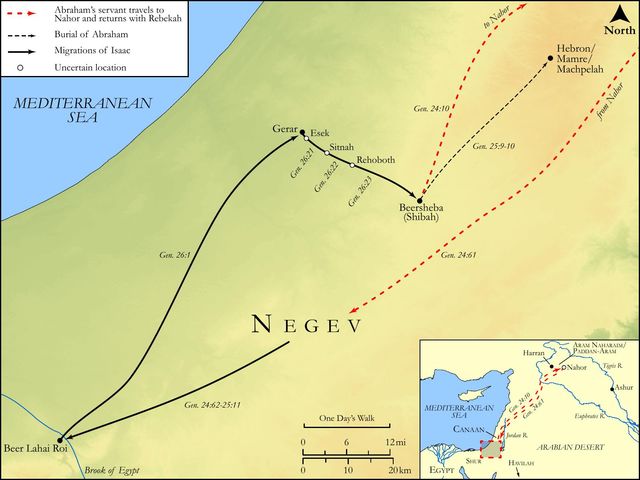
See on the biblical-era maps


Study this verse
Public-domain commentary
Matthew Henry
From his Commentary on the Whole Bible. Henry comments on passages, not single verses — this entry covers Genesis 24:29–53. His four-level outline is real structure in the source text, so it is rendered as structure.
We have here the making up of the marriage between Isaac and Rebekah. It is related very largely and particularly, even to the minute circumstances, which, we should think, might have been spared, while other things of great moment and mystery (as the story of Melchizedek) are related in few words. Thus God conceals that which is curious from the wise and prudent, reveals to babes that which is common and level to their capacity (Mat 11:25), and rules and saves the world by the foolishness of preaching, Co1 1:21. Thus also we are directed to take notice of God's providence in the little common occurrences of human life, and in them also to exercise our own prudence and other graces; for the scripture was not intended for the use of philosophers and statesmen only, but to make us all wise and virtuous in the conduct of ourselves and families. Here is,
I.The very kind reception given to Abraham's servant by Rebekah's relations.
Her brother Laban went to invite and conduct him in, but not till he saw the ear-rings and the bracelets upon his sister's hands, Gen 24:30. "O," thinks Laban, "here is a man that there is something to be got by, a man that is rich and generous; we will be sure to bid him welcome!" We know so much of Laban's character, by the following story, as to think that he would not have been so free of his entertainment if he had not hoped to be well paid for it, as he was, Gen 24:53. Note, A man's gift maketh room for him (Pro 18:16), which way soever it turneth, it prospereth, Pro 17:8.
1.The invitation was kind: Come in, thou blessed of the Lord, Gen 24:31. They saw he was rich, and therefore pronounced him blessed of the Lord; or, perhaps, because they heard from Rebekah (Gen 24:28) or the gracious words which proceeded out of his mouth, they concluded him a good man, and therefore blessed of the Lord. Note, Those that are blessed of God should be welcome to us. It is good owning those whom God owns.
2.The entertainment was kind, Gen 24:32, Gen 24:33. Both the house and stable were well furnished, and Abraham's servant was invited to the free use of both. Particular care was taken of the camels; for a good man regardeth the life of his beast, Pro 12:10. If the ox knows his owner to serve him, the owner should know his ox to provide for him that which is fitting for him.
II.The full account which he gave them of his errand, and the court he made to them for their consent respecting Rebekah. Observe,
1.How intent he was upon his business; though he had come off a journey, and come to a good house, he would not eat, till he had told his errand, Gen 24:33. Note, The doing of our work, and the fulfilling of our trusts, either for God or man, should be preferred by us before our necessary food: it was our Saviour's meat and drink, Joh 4:34.
2.How ingenious he was in the management of it; he approved himself, in this matter, both a prudent man and a man of integrity, faithful to his master by whom he was trusted, and just to those with whom he now treated.
(1.)He gives a short account of the state of his master's family, Joh 4:34-36. He was welcome before, but we may suppose him doubly welcome when he said, I am Abraham's servant. Abraham's name, no doubt, was well known among them and respected, and we might suppose them not altogether ignorant of his state, for Abraham knew theirs, Gen 22:20-24. Two things he suggests, to recommend his proposal: - [1.] That his master Abraham, through the blessing of God, had a very good estate; and, [2.] That he had settled it all upon Isaac, for whom he was now a suitor.
(2.)He tells them the charge his master had given him, to fetch a wife for his son from among his kindred, with the reason of it, Gen 24:37, Gen 24:38. Thus he insinuates a pleasing hint, that, though Abraham had removed to a country at so great a distance, yet he still retained the remembrance of his relations that he had left behind, and a respect for them. The highest degrees of divine affection must not divest us of natural affection. He likewise obviates an objection, That, if Isaac were deserving, he needed not send so far off for a wife: why did he not marry nearer home? "For a good reason," says he; "my master's son must not match with a Canaanite." He further recommends his proposal,
[1.]From the faith his master had that it would succeed, Gen 24:40. Abraham took encouragement from the testimony of his conscience that he walked before God in a regular course of holy living, and thence inferred that God would prosper him; probably he refers to that covenant which God had made with him (Gen 17:1), I am God, all-sufficient, walk before me. Therefore, says he the God before whom I walk will send his angel. Note, While we make conscience of our part of the covenant, we may take the comfort of God's part of it; and we should learn to apply general promises of particular cases, as there is occasion.
[2.]From the care he himself had taken to preserve their liberty of giving or refusing their consent, as they should see cause, without incurring the guilt of perjury (Gen 24:39-41), which showed him, in general, to be a cautious man, and particularly careful that their consent might not be forced, but be either free or not at all.
(3.)He relates to them the wonderful concurrence of providences, to countenance and further the proposal, plainly showing the finger of God in it.
[1.]He tells them how he had prayed for direction by a sign, Gen 24:42-44. Note, It is good dealing with those who be prayer take God along with them in their dealings.
[2.]How God had answered his prayer in the very letter of it. Though he did but speak in his heart (Gen 24:45), which perhaps he mentions, lest it should be suspected that Rebekah had overheard his prayer and designedly humoured it. "No," says he, "I spoke it in my heart, so that none heard it but God, to whom thought are word, and from him the answer came," Gen 24:46, Gen 24:47.
[3.]How he had immediately acknowledged God's goodness to him therein, leading him, as he here expresses it, in the right way. Note, God's way is always the right way (Psa 107:7), and those are well led whom he leads.
(4.)He fairly refers the matter to their consideration, and waits their decision (Gen 24:49): "If you will deal kindly and truly with my master, well and good: if you will be sincerely kind, you will accept the proposal, and I have what I came for; if not, do not hold me in suspense." Note, Those who deal fairly have reason to expect fair dealing.
(5.)They freely and cheerfully close with the proposal upon a very good principle (Gen 24:50): "The thing proceedeth from the Lord, Providence smiles upon it, and we have nothing to say against it." They do not object distance of place, Abraham's forsaking them, or his having no land in possession, but person estate only: they do not question the truth of what this man said; but,
[1.]They trust much to his integrity. It were well if honesty did so universally prevail among men that it might be as much an act of prudence as it is of good nature to take a man's word.
[2.]They trust more to God's providence, and therefore by silence give consent, because it appears to be directed and disposed by Infinite Wisdom. Note, A marriage is then likely to be comfortable when it appears to proceed from the Lord.
(6.)Abraham's servant makes a thankful acknowledgment of the good success he had met with,
[1.]To God: He worshipped the Lord, Gen 24:52. Observe, First, As his good success went on, he went on to bless God. Those that pray without ceasing should in every thing give thanks, and own God in every step of mercy. Secondly, God sent his angel before him, and so gave him success, Gen 24:7, Gen 24:40. But when he has the desired success, he worships God, not the angel. Whatever benefit we have by the ministration of angels, all the glory must be given to the Lord of the angels, Rev 22:9.
[2.]He pays his respects to the family also, and particularly to the bride, Gen 24:53. He presented her, and her mother, and brother, with many precious things, both to give a real proof of his master's riches and generosity and in gratitude for their civility to him, and further to ingratiate himself with them.
Continue studying Genesis 24:41 across the web’s major study libraries — every link below opens this exact verse, chapter, or book on the destination site.
Read & Compare
 BibleGatewayThis verse in more than 200 translations and 70 languages.
 Bible.comThe YouVersion reader — hundreds of translations, reading plans, and highlights.
 ESV.orgCrossway's official English Standard Version reader.
 NET BibleThe NET translation with 60,000+ translators' notes on every rendering decision.
 STEP BibleTyndale House's free study tool — original text, vocabulary, and scholarly resources.
 BibliaLogos Bible Software's free web reader.
 USCCBThe New American Bible (Revised Edition) with the U.S. bishops' study notes.
Commentaries
 BibleHub CommentariesDozens of classic commentaries on this verse, gathered on one page.
 StudyLightMore than 100 commentary sets — the largest collection on the web.
 BibleRefPlain-English commentary on what this verse means, verse by verse.
 Enduring WordDavid Guzik's free commentary on this chapter, widely used by Bible teachers.
 Bible Study ToolsVerse commentary alongside Greek and Hebrew study aids.
Original Language & Research
- BibleHub InterlinearThe verse word by word — original language, transliteration, and English.
- BibleHub LexiconEvery word's original-language definition and Strong's entry.
 Blue Letter BibleDeep-study tools — Strong's numbers, concordance, and word studies.
 SefariaThe Hebrew text with Rashi and centuries of Jewish commentary.
Sermons, Hymns & Audio


TrulyRandomVerse is not affiliated with these sites and doesn’t control their content. They’re linked because they’re genuinely useful.
Summary
Genesis 24:41 articulates the precise conditions under which Abraham's servant would be absolved of his solemn oath to secure a wife for Isaac from Abraham's kindred. This verse highlights Abraham's profound wisdom and foresight in establishing clear boundaries for responsibility, ensuring the servant's integrity and accountability were meticulously defined, even as the broader narrative underscores God's sovereign guidance in the mission's ultimate success.
Context
ShowHideLiterary Context
This verse is a pivotal clarification within the extensive narrative of Abraham's quest to find a suitable wife for his son, Isaac, as detailed in Genesis 24. Having reached a great age, Abraham, concerned about Isaac marrying a Canaanite woman, sends his most trusted servant on a crucial mission to Mesopotamia, to his own family, to find a bride. The servant had previously sworn a binding oath to Abraham, placing his hand under Abraham's thigh, as recorded in Genesis 24:9. Recognizing the arduous nature of the journey and the potential for his distant relatives to refuse the request, Abraham, with remarkable foresight, explicitly outlines the circumstances under which the servant's sworn obligation would be discharged. This demonstrates Abraham's deep understanding of the sanctity of vows and the practicalities of human agency.
Historical & Cultural Context
In that age, oaths were profoundly serious and legally binding commitments, often invoked with divine witnesses and carrying severe consequences for breach. The act of placing a hand under the thigh (as in Genesis 24:2) was a deeply solemn gesture, possibly related to procreative power or a symbolic connection to the covenant promises. Arranged marriages within one's extended family or tribe were common, serving to preserve lineage, property, and cultural identity. Abraham's insistence on a wife from his own "kindred" (family) was not merely a preference but a crucial step in maintaining the purity of the covenant line, distinguishing his descendants from the Canaanites and ensuring the fulfillment of God's promises made to him in passages like Genesis 12:1-3.
Key Themes
ShowHideThe overarching theme of Genesis 24 is Divine Providence working through Human Agency. While Abraham meticulously plans and the servant diligently executes, God's sovereign hand is evident in guiding the servant to Rebekah. This verse specifically contributes to themes of Integrity of Oaths and Covenants, highlighting the seriousness with which biblical figures regarded their sworn commitments and the conditions for their fulfillment or release. It also underscores Responsible Leadership through Abraham's wisdom in anticipating obstacles and providing clear parameters for his servant's success and potential absolution. Furthermore, the mission's ultimate goal reinforces the theme of Preservation of the Covenant Lineage, ensuring the continuation of God's promises through Isaac.
Exposition and Analysis
ShowHideGenesis 24:41 meticulously details Abraham's terms for absolving his servant from the weighty oath concerning Isaac's marriage. The KJV text states, "Then shalt thou be clear from [this] my oath, when thou comest to my kindred; and if they give not thee [one], thou shalt be clear from my oath." The repetition of "thou shalt be clear from my oath" underscores the absolute nature of the release under the specified conditions.
Key Word Analysis
ShowHideThe verb H5352 (nâqâh') means "to be (or make) clean (literally or figuratively); by implication (in an adverse sense) to be bare, i.e. extirpated; acquit... be blameless, cleanse, (be) clear(-ing), cut off, be desolate, be free, be (hold) guiltless, be (hold) innocent... be quit, be (leave) unpunished." The adjective H5355 (nâqîy') means "innocent; blameless, clean, clear, exempted, free, guiltless, innocent, quit." In this context, both forms convey a complete and legal absolution. The servant would be entirely free from any guilt, blame, or ongoing obligation concerning the oath, signifying a divinely recognized release from responsibility if external factors prevent the mission's full completion as originally intended.
H423 (ʼâlâh') derives from a root meaning "to swear" and refers to "an imprecation; curse, cursing, execration, oath, swearing." This word highlights the solemn, binding, and potentially self-cursing nature of the vow taken by the servant. It was not a casual promise but a sacred commitment, the breach of which could invoke divine displeasure. Abraham's careful delineation of conditions for release underscores the gravity of such a bond.
H4940 (mishpâchâh') refers to "a family, i.e. circle of relatives; figuratively, a class (of persons), a species (of animals) or sort (of things); by extension a tribe or people." Here, it specifically denotes Abraham's extended family or clan in Mesopotamia, emphasizing the importance of finding a wife from within his own genealogical and cultural background to maintain the purity of the covenant lineage.
Verse Breakdown
ShowHide"Then shalt thou be clear from [this] my oath"
This initial clause sets the stage for the servant's potential absolution. It immediately introduces the concept of release from a binding commitment, emphasizing Abraham's desire to ensure fairness and prevent an impossible burden on his servant. The phrase "my oath" underscores that this is Abraham's solemn charge, given under divine witness.
"when thou comest to my kindred"
This is the first, non-negotiable condition for release. It mandates that the servant must diligently fulfill his active part of the mission: undertaking the arduous journey and physically reaching Abraham's family in Mesopotamia. This demonstrates that mere difficulty or fear of failure on the way would not absolve him; his effort and faithfulness in reaching the destination are paramount.
"and if they give not thee [one], thou shalt be clear from my oath"
This is the secondary, and crucial, condition. It addresses the contingency beyond the servant's control: the refusal of Abraham's kindred to provide a daughter for Isaac. If, despite the servant's faithful journey and earnest request, the family declines, the servant is not held accountable for this external refusal. The repetition of "thou shalt be clear from my oath" powerfully reiterates the complete absolution under this specific, external circumstance, showcasing Abraham's practical wisdom in acknowledging the limits of human agency in a task dependent on the cooperation of others.
Literary Devices
ShowHideThe verse primarily employs Conditional Clauses ("when thou comest... and if they give not..."). This structure precisely delineates the terms of the servant's release, leaving no room for ambiguity. The Repetition of the phrase "thou shalt be clear from my oath" serves to emphasize the certainty and finality of the absolution once the conditions are met. This rhetorical device reinforces the gravity of the oath while simultaneously highlighting Abraham's meticulous Foresight and Prudence in anticipating potential obstacles and providing a just framework for his servant's responsibility.
Theological and Thematic Connections
ShowHideThis passage profoundly illustrates the biblical understanding of oaths and human responsibility within the framework of divine sovereignty. It teaches that while God's ultimate purposes will prevail, human agents are held accountable for their faithful effort and adherence to their commitments. Abraham's careful delineation of the conditions for release from the oath underscores the sanctity of vows in ancient Israelite thought, where a promise made was a promise to be kept, often before God Himself. However, it also reveals a compassionate and realistic understanding that human responsibility has limits, especially when outcomes depend on the free will of others. This balance between diligent human effort and reliance on divine providence is a recurring theme throughout Scripture.
Reflection and Application
ShowHideGenesis 24:41 offers profound lessons for believers today, emphasizing the critical importance of clarity, integrity, and wisdom in our commitments. It challenges us to be meticulous in defining expectations and responsibilities in all our agreements, whether personal, professional, or spiritual. Just as Abraham ensured his servant was not unfairly burdened, we are called to make our "yes" mean yes and our "no" mean no, as exhorted by Jesus in Matthew 5:37. Furthermore, this passage provides comfort and guidance regarding circumstances beyond our control. It reminds us that while we are called to diligent and faithful stewardship, God does not hold us accountable for outcomes that are genuinely impossible due to external refusal or divine redirection, provided we have faithfully fulfilled our part. This narrative encourages us to trust in God's overarching plan, knowing that He will ultimately guide our efforts and accomplish His purposes, even through potential obstacles, releasing us from burdens that are not ours to bear.
Questions for Reflection
ShowHideFAQ
ShowHideWhy was Abraham so specific about the conditions for the servant's release from the oath?
ShowHideAbraham's specificity demonstrates his remarkable practical wisdom, unwavering integrity, and deep understanding of the sanctity of an oath. He wanted to ensure his servant was not unfairly burdened by an impossible task or held accountable for circumstances entirely beyond his control. By clearly defining the conditions for release, Abraham protected his servant's conscience and ensured the oath's sanctity, while also acknowledging that the success of the mission ultimately depended on God's providence and the cooperation of his kindred. This foresight reflects a just and compassionate leadership style.
What does the Hebrew word naqah ("clear") imply in this context?
ShowHideThe Hebrew word naqah (נָקָה), and its adjectival form naqiy, means to be clean, innocent, acquitted, or absolved. In the context of Genesis 24:41, it signifies a complete and legal absolution from the binding nature of the oath. It's not merely a temporary suspension of duty but a full release from any guilt, blame, or ongoing obligation. This means that if the servant fulfilled his part by reaching the kindred and they refused to cooperate, he would be entirely free from his promise, as if he had never made it.
Does this verse suggest that God's plan could be thwarted by human refusal?
ShowHideNo, this verse does not suggest God's plan could be thwarted. Instead, it highlights Abraham's human foresight in planning for contingencies, even as the larger narrative of Genesis 24 powerfully demonstrates God's sovereign guidance. While Abraham provided for a scenario where his kindred might refuse, God supernaturally intervened to ensure the servant found Rebekah, Isaac's destined wife. This narrative beautifully illustrates that while human resistance or unforeseen obstacles may arise, divine providence ultimately overrides them, ensuring the fulfillment of God's purposes, often in ways that transcend human expectation or planning.
Christ-Centered Fulfillment
ShowHideGenesis 24:41, with its emphasis on the integrity of oaths and the fulfillment of a mission to secure a bride, finds profound Christ-centered fulfillment. The entire narrative of Abraham sending his trusted servant to secure a bride for Isaac serves as a beautiful foreshadowing of God the Father sending His Son, Jesus Christ, to secure a bride—the Church—for Himself. Unlike the servant's oath, which had conditions for release if the "kindred" refused, Christ's covenantal work is absolute and without contingency. He came not merely to journey to a distant land, but to enter human history, fulfilling every promise and requirement of the law. His perfect obedience and sacrificial death on the cross fully accomplished the Father's will, ensuring that His mission to gather His elect would not be thwarted by human refusal or any external obstacle. As the ultimate "seed" of Abraham (Galatians 3:16), Jesus is the one through whom all the promises of God's covenant are irrevocably fulfilled. He is the faithful Son who perfectly executed the Father's will, ensuring the eternal union of the heavenly Bridegroom with His redeemed Church (Ephesians 5:25-27), a union that is not conditional on human acceptance but secured by His finished work (John 6:37).