


Genesis 24:9
- וַיָּשֶׂםvai·Ya·semand he putH7760Conj-w ¦ V-Qal-ConsecImperf-3msVerb Qal Consecutive Imperfect 3rd Singular Masculineוַandיָּשֶׂםhe put
- הָעֶבֶדha·'E·vedthe servantH5650Art ¦ N-msNoun Singular Masculine Absoluteהָtheעֶבֶדservant
- אֶת'et<obj.>H853DirObjMParticle Object Indicator
- יָדוֹya·Dohis handH3027N-csc ¦ 3msNoun Singular common gender Constructיָדhandוֹhis
- תַּחַתTa·chatunderH8478N-mscNoun Singular Masculine Construct
- יֶרֶךְYe·rekh[the] thigh ofH3409N-fscNoun Singular Feminine Construct
- אַבְרָהָם'av·ra·HamAbrahamH85N-proper-mNoun Proper Masculine
- אֲדֹנָיו'a·do·Navhis master<s>H113N-mpc ¦ 3msNoun Plural Masculine Constructאֲדֹנָיmaster<s>וhis
- וַיִּשָּׁבַעvai·yi·Sha·va'and he swore an oathH7650Conj-w ¦ V-Niphal-ConsecImperf-3msVerb Niphal Consecutive Imperfect 3rd Singular Masculineוַandיִּשָּׁבַעhe swore an oath
- לוֹloto <the> himPrep-l ¦ 3msSuffix Personal 3rd Singular Masculineלto <the>וֹhim
- עַל'alonH5921PrepPreposition
- הַדָּבָרha·da·Varthe matterH1697Art ¦ N-msNoun Singular Masculine Absoluteהַtheדָּבָרmatter
- הַזֶּהha·Zeh<the> thisH2088Art ¦ PrtParticle Demonstrativeהַ<the>זֶּהthis
English is a literal word-by-word gloss of the Hebrew, not the KJV's wording. Why?
This is the original text the KJV's translators worked from — each Hebrew word with its own literal English meaning in this verse, prepared by scholars at Tyndale House, Cambridge. The KJV translates whole sentences, not word by word, so its wording differs: one Hebrew word can become several English words, and the KJV may choose “the LORD” where the gloss reads “Yahweh”. Both are faithful — they answer different questions. For the KJV's own rendering, switch to the KJV text.
Details
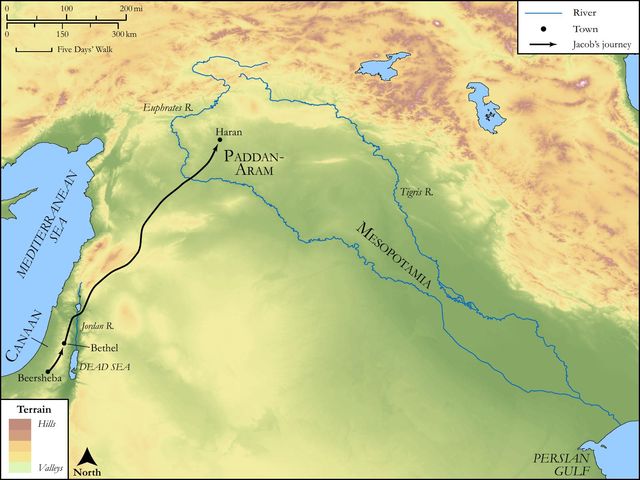
See on the biblical-era map


Study this verse
Public-domain commentary
Matthew Henry
From his Commentary on the Whole Bible. Henry comments on passages, not single verses — this entry covers Genesis 24:1–9. His two-level outline is real structure in the source text, so it is rendered as structure.
Three things we may observe here concerning Abraham: -
I.The care he took of a good son, to get him married, well married.
It was high time to think of it now, for Isaac was about forty years old, and it had been customary with his ancestors to marry at thirty, or sooner, Gen 11:14, Gen 11:18, Gen 11:22, Gen 11:24. Abraham believed the promise of the building up of his family, and therefore did not make haste; not more haste than good speed. Two considerations moved him to think of it now (Gen 24:1): - 1. That he himself was likely to leave the world quickly, for he was old, and well-stricken in age, and it would be a satisfaction to him to see his son settled before he died; and, 2. That he had a good estate to leave behind him, for the Lord had blessed him in all things; and the blessing of the Lord makes rich. See how much religion and piety befriend outward prosperity. Now Abraham's pious care concerning his son was, (1.) That he should not marry a daughter of Canaan, but one of his kindred. He saw that the Canaanites were degenerating into great wickedness, and knew by revelation that they were designed for ruin, and therefore he would not marry his son among them, lest they should be either a snare to his soul, or at least a blot to his name. (2.) That yet he should not leave the land of Canaan, to go himself among his kindred, not even for the purpose of choosing a wife, lest he should be tempted to settle there. This caution is given Gen 24:6, and repeated, Gen 24:8. "Bring not my son thither again, whatever comes of it. Let him rather want a wife than expose himself to that temptation." Note, Parents in disposing of their children, should carefully consult the welfare of their souls, and their furtherance in the way to heaven. Those who through grace have escaped the corruption that is in the world through lust, and have brought up their children accordingly, should take heed of doing any thing by which they may be again entangled therein and overcome, Pe2 2:20. Beware that you bring them not thither again, Heb 11:15.
II.The charge he gave to a good servant, probably Eliezer of Damascus, one of whose conduct, fidelity, and affection to him and his family, he had had long experience. He trusted him with this great affair, and not Isaac himself, because he would not have Isaac go at all into that country, but marry there by proxy; and no proxy so fit as this steward of his house. This matter is settled between the master and the servant with a great deal of care and solemnity.
1.The servant must be bound by an oath to do his utmost to get a wife for Isaac from among his relations, Gen 24:2-4. Abraham swears him to it, both for his own satisfaction and for the engagement of his servant to all possible care and diligence in this matter. Thus God swears his servants to their work, that, having sworn, they may perform it. Honour is here done to the eternal God; for he it is that is sworn by, to whom alone these appeals ought to be made. And some think honour is done to the covenant of circumcision by the ceremony here used of putting his hand under his thigh. Note, Swearing being an ordinance not peculiar to the church, but common to mankind, is to be performed by such signs as are the appointments and common usages of our country, for binding the person sworn.
2.He must be clear of this oath if, when he had done his utmost, he could not prevail. This proviso the servant prudently inserted (Gen 24:5), putting the case that the woman would not follow him; and Abraham allowed the exception, Gen 24:8. Note, Oaths are to be taken with great caution, and the matter sworn to should be rightly understood and limited, because it is a snare to devour that which is holy, and, after vows, to make the enquiry which should have been made before.
III.The confidence he put in a good God, who, he doubts not, will give his servant success in this undertaking, Gen 24:7.
He remembers that God had wonderfully brought him out of the land of his nativity, by the effectual call of his grace; and therefore doubts not but he will succeed him in his care not to bring his son thither again. He remembers also the promise God had made and confirmed to him that he would give Canaan to his seed, and thence infers that God would own him in his endeavours to match his son, not among those devoted nations, but to one that was fit to be the mother of such a seed. "Fear not therefore; he shall send his angel before thee to make thy way prosperous." Note,
1.Those that carefully keep in the way of duty, and govern themselves by the principles of their religion in their designs and undertakings, have good reason to expect prosperity and success in them. God will cause that to issue in our comfort in which we sincerely aim at his glory.
2.God's promises, and our own experiences, are sufficient to encourage our dependence upon God, and our expectations from him, in all the affairs of this life.
3.God's angels are ministering spirits, sent forth, not only for the protection, but for the guidance, of the heirs of promise, Heb 1:14. "He shall send his angel before thee, and then thou wilt speed well."
Historical interpretation
Historical reception
1 surviving comment on this verse from the historical church.
(Chapter 24, Verse 9) And the servant put his hand under the thigh of his master Abraham and swore to him concerning this matter. The Hebrews say that he swore at his consecration, that is, at his circumcision. But we say that he swore by the seed of Abraham, that is, by Christ, who was to be born from him, according to the Gospel of Matthew, which says: The book of the genealogy of Jesus Christ, the son of David, the son of Abraham (Matthew 1:1).
Continue studying Genesis 24:9 across the web’s major study libraries — every link below opens this exact verse, chapter, or book on the destination site.
Read & Compare
 BibleGatewayThis verse in more than 200 translations and 70 languages.
 Bible.comThe YouVersion reader — hundreds of translations, reading plans, and highlights.
 ESV.orgCrossway's official English Standard Version reader.
 NET BibleThe NET translation with 60,000+ translators' notes on every rendering decision.
 STEP BibleTyndale House's free study tool — original text, vocabulary, and scholarly resources.
 BibliaLogos Bible Software's free web reader.
 USCCBThe New American Bible (Revised Edition) with the U.S. bishops' study notes.
Commentaries
 BibleHub CommentariesDozens of classic commentaries on this verse, gathered on one page.
 StudyLightMore than 100 commentary sets — the largest collection on the web.
 BibleRefPlain-English commentary on what this verse means, verse by verse.
 Enduring WordDavid Guzik's free commentary on this chapter, widely used by Bible teachers.
 Bible Study ToolsVerse commentary alongside Greek and Hebrew study aids.
Original Language & Research
- BibleHub InterlinearThe verse word by word — original language, transliteration, and English.
- BibleHub LexiconEvery word's original-language definition and Strong's entry.
 Blue Letter BibleDeep-study tools — Strong's numbers, concordance, and word studies.
 SefariaThe Hebrew text with Rashi and centuries of Jewish commentary.
Sermons, Hymns & Audio


TrulyRandomVerse is not affiliated with these sites and doesn’t control their content. They’re linked because they’re genuinely useful.
Summary
Genesis 24:9 records a profoundly solemn and culturally significant oath taken by Abraham's most trusted servant. This pivotal act, involving the placement of the servant's hand under Abraham's thigh, underscores the immense gravity of the mission to secure a wife for Isaac from Abraham's kindred, thereby ensuring the continuation of the divinely promised covenant line and demonstrating the servant's unwavering commitment to his master's will.
Context
ShowHideLiterary Context
Genesis 24:9 is situated at the very beginning of the longest chapter in Genesis, which is entirely devoted to the search for a bride for Isaac. Following the death of Sarah in Genesis 23, Abraham, now advanced in years, recognizes the urgent need to secure Isaac's lineage to fulfill God's covenant promises. The preceding verses (Genesis 24:1-4) detail Abraham's explicit instructions to his chief servant: he must not take a wife for Isaac from the Canaanites among whom they dwell, but rather from Abraham's own country and kindred. This oath, therefore, is the formal, binding commencement of a mission critical to the unfolding narrative of God's redemptive plan through Abraham's descendants.
Historical & Cultural Context
The act of placing a hand under the thigh as an oath-taking ritual is rare, appearing only here and in Genesis 47:29. In the ancient Near East, oaths were incredibly serious, often involving divine witnesses and severe consequences for breach. The "thigh" (Hebrew: yârêkh) was a euphemism for the generative organs, symbolizing the source of life, lineage, and posterity. By swearing in this manner, the servant was not merely making a verbal promise but binding himself by the very future of Abraham's family, invoking the sanctity of the bloodline. This ritual underscored the absolute trust Abraham placed in his servant and the profound commitment expected of him, reflecting the cultural emphasis on family honor, lineage, and the solemnity of vows.
Key Themes
ShowHideThis verse powerfully contributes to several overarching themes within Genesis and the broader biblical narrative. Firstly, it highlights the preservation of the covenant lineage, emphasizing Abraham's dedication to ensuring Isaac's marriage aligns with God's promise of a distinct people, as outlined in Genesis 12:2-3. Secondly, it exemplifies faithful stewardship and obedience, as the servant willingly undertakes a challenging and sacred task, demonstrating exemplary loyalty to his master and, implicitly, to God's unfolding plan. Lastly, the solemnity of the oath underscores the binding nature of divine and human commitments, setting a precedent for the importance of vows and promises throughout the biblical narrative, from God's covenants with humanity to the laws governing oaths in the Mosaic Law.
Exposition and Analysis
ShowHideGenesis 24:9 describes a profoundly significant act: "And the servant put his hand under the thigh of Abraham his master, and sware to him concerning that matter." This seemingly simple action carries immense cultural and theological weight, revealing several layers of meaning.
Key Word Analysis
ShowHideThis term, while literally meaning the fleshy part of the leg, is used euphemistically in biblical contexts to refer to the generative organs, symbolizing the source of life, lineage, and descendants. By placing his hand under Abraham's thigh, the servant was effectively swearing by Abraham's future progeny and the covenant promises tied to that lineage, making the oath deeply personal and irrevocably binding upon his own posterity.
Derived from a root meaning "to seven oneself," this verb conveys the idea of completeness and solemnity. To "swear" in this context is to make a formal, binding declaration, often invoking a divine witness. The act of swearing by seven implies a full, perfect, and unbreakable commitment, elevating the promise beyond a mere word to a sacred vow that carries spiritual and potentially severe consequences for its violation.
This word is remarkably versatile, encompassing "word," "thing," "affair," "business," or "cause." In this context, it refers to the entire weighty commission Abraham has given his servant: the specific task of finding a wife for Isaac from Abraham's own family and not from the Canaanites. The servant's oath covers the entirety of this crucial "matter," signifying his comprehensive and undivided commitment to fulfilling every aspect of his master's directive.
Verse Breakdown
ShowHide"And the servant put his hand under the thigh of Abraham his master"
This describes the unique and highly symbolic physical action that initiated the oath. The servant, likely Eliezer of Damascus, Abraham's most trusted steward, performs this gesture as a sign of absolute submission and commitment. Placing the hand under the thigh, as discussed in the key word analysis, signifies an oath bound by the very essence of Abraham's lineage and the future of his descendants, emphasizing the gravity and sanctity of the promise.
"and sware to him concerning that matter"
This clause confirms the formalization of the oath. The servant's physical act is accompanied by a verbal declaration, making the commitment explicit and undeniable. The "matter" refers to the entire mission of finding a suitable bride for Isaac from Abraham's homeland, a task of immense theological importance for the continuation of the covenant line. The oath binds the servant to this specific, divinely-ordained purpose, ensuring his diligence and faithfulness.
Literary Devices
ShowHideThe verse employs Ritual and Symbolism to convey its profound meaning. The act of placing a hand under the thigh is a specific, ancient ritual, unique in its biblical appearance to Genesis and highlighting the exceptional solemnity of the oath. This ritual embodies powerful Symbolism: the "hand" represents power, agency, and commitment, while the "thigh" symbolizes lineage, procreation, and the future of Abraham's seed. The combination of these elements creates a visual and performative representation of an unbreakable vow, binding the servant not merely by his word but by his very being and the future of the covenant line. The gravity of this ritual also serves as a form of Foreshadowing, hinting at the importance of oaths and covenants throughout biblical history, ultimately pointing to God's own unwavering faithfulness to His covenant promises.
Theological and Thematic Connections
ShowHideThis passage profoundly underscores the sanctity of oaths and the binding nature of commitments, reflecting a theological principle that words spoken under oath are not mere utterances but sacred vows made before God. It illustrates the divine expectation of faithfulness in human relationships and responsibilities, particularly when those responsibilities intersect with God's overarching redemptive purposes. While Abraham and his servant act with diligence and human planning, the narrative implicitly highlights God's guiding hand and sovereign providence in orchestrating the fulfillment of His promises, even through the meticulous details of human actions. The emphasis on preserving a distinct, holy lineage through Isaac, avoiding intermarriage with the Canaanites, also foreshadows the later theological importance of Israel's separation and purity as God's chosen people, through whom the Messiah would ultimately come.
Reflection and Application
ShowHideGenesis 24:9 offers enduring lessons for contemporary believers, calling us to a deeper understanding of integrity and commitment. The profound solemnity of the servant's oath serves as a powerful reminder that our word should be our bond, reflecting the faithfulness of God Himself, who is true to His promises. This passage challenges us to consider the gravity with which we make commitments, whether to God, to others, or in our professional and personal lives. Abraham's meticulous approach to securing Isaac's spouse, guided by his understanding of God's covenant and a desire to align with divine will, encourages us to seek God's guidance diligently and prayerfully in all significant life decisions, especially those pertaining to marriage, family, and vocational callings, ensuring they align with biblical principles and God's broader purposes. Furthermore, the servant's unwavering loyalty, diligence, and dedication provide a sterling model for faithful service and stewardship, prompting us to approach our responsibilities with excellence and a recognition of their potential significance within God's overarching plan.
Questions for Reflection
ShowHideFAQ
ShowHideWhy was placing a hand under the thigh a sign of a solemn oath?
ShowHidePlacing a hand under the thigh was an ancient Near Eastern oath-taking ritual, unique in the Bible to Genesis 24:9 and Genesis 47:29. While its precise origins are debated, it is widely understood to symbolize a deep connection to lineage, procreation, and the source of life. The "thigh" (Hebrew: yârêkh) was a euphemism for the generative organs. By involving this part of the body, the oath-taker was binding himself by his very essence, his descendants, and his future posterity, making the vow incredibly solemn and implying severe consequences, potentially even to one's lineage, if the oath were broken. It likely invoked a divine witness over the covenant made, underscoring its sacred and unbreakable nature.
Christ-Centered Fulfillment
ShowHideGenesis 24:9, with its focus on securing a pure lineage for Isaac through a solemn oath, ultimately points forward to the ultimate fulfillment of God's covenant promises in Jesus Christ. Abraham's diligent effort to find a suitable bride for his son, essential for the continuation of the promised "seed," foreshadows God's meticulous plan to bring forth the Messiah through a specific, divinely preserved lineage, culminating in Christ, the true "seed" of Abraham through whom all nations would be blessed (Galatians 3:16). Furthermore, the faithful servant's successful mission to find a bride for Isaac can be seen as a profound type of the Holy Spirit's work in the new covenant era. Just as the servant was sent by Abraham to secure a bride for Isaac, the Holy Spirit is sent by the Father and the Son to gather and prepare the Church, the spiritual "bride" of Christ, from among all peoples and nations (Ephesians 5:25-27). This mission ensures the continuation of God's spiritual lineage, culminating in the joyous "marriage supper of the Lamb" (Revelation 19:7-9), where Christ and His redeemed people are eternally united.