


Ezra 10:6
- וַיָּקָםvai·Ya·komand he aroseH6965Conj-w ¦ V-Qal-ConsecImperf-3msVerb Qal Consecutive Imperfect 3rd Singular Masculineוַandיָּקָםhe arose
- עֶזְרָא'ez·Ra'EzraH5830N-proper-mNoun Proper Masculine
- מִלִּפְנֵיmi·lif·Neifrom to beforeH6440Prep-m ¦ Prep-l ¦ N-mpcNoun Plural Masculine Constructמִfromלִּtoפְנֵיbefore
- בֵּיתbeit[the] house ofH1004N-mscNoun Singular Masculine Construct
- הָאֱלֹהִיםha·'E·lo·Him<the> GodH430Art ¦ N-mpNoun Plural Masculine Absoluteהָ<the>אֱלֹהִיםGod
- וַיֵּלֶךְvai·Ye·lekhand he wentH1980Conj-w ¦ V-Qal-ConsecImperf-3msVerb Qal Consecutive Imperfect 3rd Singular Masculineוַandיֵּלֶךְhe went
- אֶל'elintoH413PrepPreposition
- לִשְׁכַּתlish·Kat[the] room ofH3957N-fscNoun Singular Feminine Construct
- יְהוֹחָנָןye·ho·cha·NanJehohananH3076N-proper-mNoun Proper Masculine
- בֶּןben[the] son ofH1121N-mscNoun Singular Masculine Construct
- אֶלְיָשִׁיב'el·ya·ShivEliashibH475N-proper-mNoun Proper Masculine
- וַיֵּלֶךְvai·Ye·lekhand he wentH1980Conj-w ¦ V-Qal-ConsecImperf-3msVerb Qal Consecutive Imperfect 3rd Singular Masculineוַandיֵּלֶךְhe went
- שָׁםShamthereH8033AdvAdverb
- לֶחֶםLe·chemfoodH3899N-msNoun Singular Masculine Absolute
- לֹאlo'notH3808NegParticle Negative
- אָכַל'a·Khalhe ateH398V-Qal-Perf-3msVerb Qal Perfect 3rd Singular Masculine
- וּמַיִםu·Ma·yimand waterH4325Conj-w ¦ N-mpNoun Plural Masculine Absoluteוּandמַיִםwater
- לֹאlo'notH3808NegParticle Negative
- שָׁתָהsha·Tahhe drankH8354V-Qal-Perf-3msVerb Qal Perfect 3rd Singular Masculine
- כִּיkiforH3588PrtParticle Conditional
- מִתְאַבֵּלmit·'a·Bel[he was] mourningH56V-Hithpael-Prtcpl-msVerb Hithpael Participle Singular Masculine Absolute
- עַל'alonH5921PrepPreposition
- מַעַלMa·'al[the] unfaithfulness ofH4604N-mscNoun Singular Masculine Construct
- הַגּוֹלָהha·go·Lahthe exile[s]H1473Art ¦ N-fsNoun Singular Feminine Absoluteהַtheגּוֹלָהexile[s]
English is a literal word-by-word gloss of the Hebrew, not the KJV's wording. Why?
This is the original text the KJV's translators worked from — each Hebrew word with its own literal English meaning in this verse, prepared by scholars at Tyndale House, Cambridge. The KJV translates whole sentences, not word by word, so its wording differs: one Hebrew word can become several English words, and the KJV may choose “the LORD” where the gloss reads “Yahweh”. Both are faithful — they answer different questions. For the KJV's own rendering, switch to the KJV text.
Details
See on the biblical-era map
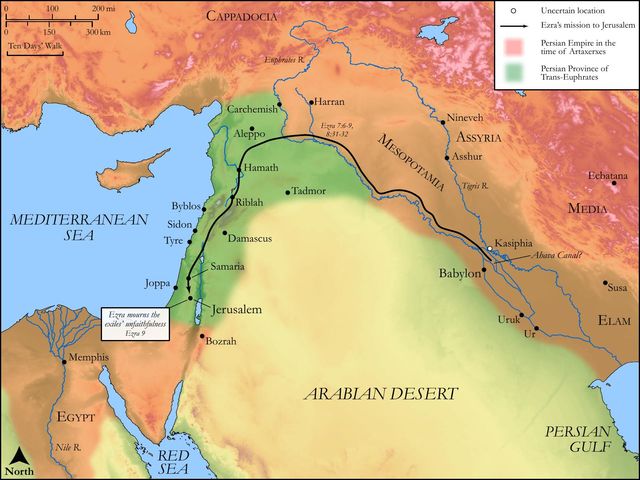
Study this verse
Public-domain commentary
Matthew Henry
From his Commentary on the Whole Bible. Henry comments on passages, not single verses — this entry covers Ezra 10:6–14.
We have here an account of the proceedings upon the resolutions lately taken up concerning the strange wives; no time was lost; they struck when the iron was hot, and soon set the wheels of reformation a-going. 1. Ezra went to the council-chamber where, it is probable, the priests used to meet upon public business; and till he came thither (so bishop Patrick thinks it should be read), till he saw something done, and more likely to be done, for the redress of this grievance, he did neither eat nor drink, but continued mourning. Sorrow for sin should be abiding sorrow; be sure to let it continue till the sin be put away. 2. He sent orders to all the children of the captivity to attend him at Jerusalem within three days (Ezr 10:7, Ezr 10:8); and, being authorized by the king to enforce his orders with penalties annexed (Ezr 7:26), he threatened that whosoever refused to obey the summons should forfeit his estate and be outlawed. The doom of him that would not attend on this religious occasion should be that his substance should, in his stead, be for ever after appropriated to the service of their religion, and he himself, for his contempt, should for ever after be excluded from the honours and privileges of their religion; he should be excommunicated. 3. Within the time limited the generality of the people met at Jerusalem and made their appearance in the street of the house of God, Ezr 10:9. Those that had no zeal for the work they were called to, nay, perhaps had a dislike to it, being themselves delinquents, yet paid such a deference to Ezra's authority, and were so awed by the penalty, that they durst not stay away. 4. God gave them a token of his displeasure in the great rain that happened at that time (Ezr 10:9 and again Ezr 10:13), which perhaps kept some away, and was very grievous to those that met in the open street. When they wept the heavens wept too, signifying that, though God was angry with them for their sin, yet he was well pleased with their repentance, and (as it is said, Jdg 10:16) his soul was grieved for the misery of Israel; it was also an indication of the good fruits of their repentance, for the rain makes the earth fruitful. 5. Ezra gave the charge at this great assize. He told them upon what account he called them together now, that it was because he found that since their return out of captivity they had increased the trespass of Israel by marrying strange wives, had added to their former sins this new transgression, which would certainly be a means of again introducing idolatry, the very sin they had smarted for and which he hoped they had been cured of in their captivity; and he called them together that they might confess their sin to God, and, having done that, might declare themselves ready and willing to do his pleasure, as it should be made known to them (which all those will do that truly repent of what they have done to incur his displeasure), and particularly that they might separate themselves from all idolaters, especially idolatrous wives, Ezr 10:10, Ezr 10:11. On these heads, we may suppose, he enlarged, and probably made such another confession of the sin now as he made Ezr 9:1-15, to which he required them to say Amen. 6. The people submitted not only to Ezra's jurisdiction in general, but to his inquisition and determination in this matter: "As thou hast said, so must we do, Ezr 10:12. We have sinned in mingling with the heathen, and have thereby been in danger, not only of being corrupted by them, for we are frail, but of being lost among them, for we are few; we are therefore convinced that there is an absolute necessity of our separating from them again." There is hope concerning people when they are convinced, not only that it is good to part with their sins, but that it is indispensably necessary: we must do it, or we are undone. 7. It was agreed that this affair should be carried on, not in a popular assembly, nor that they should think to go through with it all on a sudden, but that a court of delegates should be appointed to receive complaints and to hear and determine upon them. It could not be done at this time, for it was not put into a method, nor could the people stand out because of the rain. The delinquents were many, and it would require time to discover and examine them. Nice cases would arise, which could not be adjudged without debate and deliberation, Ezr 10:13. "And therefore let the crowd be dismissed, and the rulers stand to receive informations; let them proceed city by city, and let the offenders be convicted before them in the presence of the judges and elders of their own city; and let them be entrusted to see the orders executed. Thus take time and we shall have done the sooner; whereas, if we do it in a hurry, we shall do it by halves, Ezr 10:14. If, in this method, a thorough reformation be made, the fierce wrath of God will be turned from us, which, we are sensible, is ready to break forth against us for this transgression." Ezra was willing that his zeal should be guided by the people's prudence, and put the matter into this method; he was not ashamed to own that the advice came from them, any more than he was to comply with it.
Historical interpretation
Historical reception
1 surviving comment on this verse from the historical church.
He did not eat bread, etc. Here they will have an excellent example not only of weeping and praying, but also of fasting for those who have sinned; and since blessed are those who mourn, who weep for their own sins, because after receiving remission, they are comforted, how much more are they to be believed blessed, who also mourn for the errors of their brothers; and this to such an extent that they do not even want to touch bread and water, which is the nourishment of those who abstain, nor enter their house, or ascend to their bed, but rather prefer to pray throughout the night in the courtyards of the house of the Lord. For there was the house of the priest, which, as evening came, Ezra is reported to have entered. Finally, another Edition instead of Johanan's bedchamber, has Johanan's vestry, by which name Scripture often refers to the porticoes surrounding the temple on all sides, in which the ministers and guards of the same temple used to reside. They also mourn now for the transgression of those who came from captivity, who grieve for those who, having been recently rescued from sins through repentance, have again fallen into sin, by which they might be once more captured by the devil. Regarding whose seducers, as about parents of impure wives, the apostle Peter speaks: For, speaking arrogant words of vanity, they entice by lusts of the flesh, those who have barely escaped (II Peter II). And a little later he speaks about those who, as if ascending from captivity, are nonetheless captured by luxury: For if, he says, those who have escaped the defilements of the world through the knowledge of our Lord and Savior Jesus Christ, are again entangled in them and overcome, the last state has become worse for them than the first (Ibid.).
Continue studying Ezra 10:6 across the web’s major study libraries — every link below opens this exact verse, chapter, or book on the destination site.
Read & Compare
 BibleGatewayThis verse in more than 200 translations and 70 languages.
 Bible.comThe YouVersion reader — hundreds of translations, reading plans, and highlights.
 ESV.orgCrossway's official English Standard Version reader.
 NET BibleThe NET translation with 60,000+ translators' notes on every rendering decision.
 STEP BibleTyndale House's free study tool — original text, vocabulary, and scholarly resources.
 BibliaLogos Bible Software's free web reader.
 USCCBThe New American Bible (Revised Edition) with the U.S. bishops' study notes.
Commentaries
 BibleHub CommentariesDozens of classic commentaries on this verse, gathered on one page.
 StudyLightMore than 100 commentary sets — the largest collection on the web.
 BibleRefPlain-English commentary on what this verse means, verse by verse.
 Enduring WordDavid Guzik's free commentary on this chapter, widely used by Bible teachers.
 Bible Study ToolsVerse commentary alongside Greek and Hebrew study aids.
Original Language & Research
- BibleHub InterlinearThe verse word by word — original language, transliteration, and English.
- BibleHub LexiconEvery word's original-language definition and Strong's entry.
 Blue Letter BibleDeep-study tools — Strong's numbers, concordance, and word studies.
 SefariaThe Hebrew text with Rashi and centuries of Jewish commentary.
Sermons, Hymns & Audio


TrulyRandomVerse is not affiliated with these sites and doesn’t control their content. They’re linked because they’re genuinely useful.
Summary
Ezra 10:6 vividly portrays the profound personal anguish of Ezra, the scribe and priest, following the public confession of Israel's widespread sin of intermarriage with foreign women. After leading the people in a corporate lament before the Temple, Ezra withdraws to a private chamber, where he embarks on an extreme fast, abstaining from both food and water. This intense act of self-denial profoundly underscores the depth of his spiritual grief and his complete identification with the people's "transgression," demonstrating a leader who not only calls for repentance but embodies it with fervent devotion and sorrow over the egregious breach of God's covenant.
Context
ShowHideLiterary Context
Ezra 10:6 immediately follows the climactic scene of corporate repentance initiated by Ezra's powerful public prayer and lament detailed in Ezra 9. Overwhelmed by the news of widespread intermarriage, Ezra had torn his garments, pulled out his hair, and sat appalled, leading to a profound public display of grief that moved the entire assembly. The preceding verses, Ezra 10:1-5, describe how a great congregation gathered around Ezra, weeping bitterly, and how Shechaniah, representing the people, proposed a covenant to put away the foreign wives and children, urging Ezra to take decisive action. Verse 6 marks a pivotal transition from Ezra's public lament and the initial corporate response to his personal, sustained act of mourning, emphasizing the depth of his commitment and the gravity of the situation. It sets the somber and determined tone for the subsequent actions taken to address the sin of intermarriage and restore covenant fidelity.
Historical & Cultural Context
The events of Ezra 10:6 unfold during the critical post-exilic period, specifically after the first wave of returnees had re-established themselves in Judah under Zerubbabel and Joshua, and Ezra himself had arrived in Jerusalem with a second wave of exiles around 458 BC. The prohibition against intermarriage with foreign nations was not merely a social or racial concern but a foundational theological one, crucial for maintaining Israel's distinct identity and preventing syncretism, as explicitly commanded in laws like Deuteronomy 7:3-4 and Exodus 34:15-16. This was intended to safeguard their unique covenant relationship with Yahweh and prevent being led into idolatry. Fasting, as practiced by Ezra, was a well-established spiritual discipline in ancient Israel, employed to express deep sorrow, repentance, supplication, or intense mourning, often in times of national crisis or profound personal distress, as seen in 1 Samuel 7:6 or Joel 2:12. Ezra's extreme fast—abstaining from both food and water—signifies a level of distress comparable to that of Moses on Mount Sinai (Deuteronomy 9:9) or Esther's call for a national fast (Esther 4:16), indicating the profound spiritual crisis he perceived and his desperate plea to God.
Key Themes
ShowHideThis verse powerfully contributes to several overarching themes within the book of Ezra and the broader post-exilic narrative. Foremost is the theme of holiness and separation, highlighting the critical importance of maintaining Israel's distinct identity as God's chosen people, uncorrupted by pagan influences and their idolatrous practices. Ezra's profound grief underscores the seriousness of sin, particularly covenant unfaithfulness, demonstrating that disobedience is not a light matter but a deep offense against God that demands genuine contrition and repentance. The verse also powerfully exemplifies righteous and empathetic leadership, as Ezra embodies the very repentance he calls for, leading by personal example of spiritual anguish and fervent devotion. His actions reflect a deep commitment to covenant fidelity and the restoration of God's people to their rightful relationship with Him, emphasizing the ongoing need for purification and unwavering adherence to the Law even after their return from exile.
Exposition and Analysis
ShowHideKey Word Analysis
ShowHideThis primitive root denotes a deep, emotional sorrow, often accompanied by outward expressions of grief such as weeping, fasting, or wearing sackcloth. It implies a lamentation for a significant loss or tragedy, going beyond mere sadness to a profound state of anguish and distress. In Ezra's case, it signifies his personal identification with the corporate sin and its devastating implications for the covenant relationship with God, portraying a leader who felt the weight of his people's spiritual brokenness.
This noun specifically refers to an act of unfaithfulness, a breach of trust, or a trespass against God or sacred things. It is a stronger term than simply "sin" (חֵטְא, ḥēṭʾ), implying treachery, a violation of covenant obligations, or a betrayal of what is holy. The use of maʻal here emphasizes that the widespread intermarriage was not a minor oversight but a serious defilement and an act of disloyalty against Yahweh and His covenant, a profound breach of their relationship.
This term refers to the exiles themselves, specifically those who had been "carried away" into captivity and subsequently returned. It emphasizes their identity as a people who had experienced the consequences of past unfaithfulness (exile) and yet were now repeating similar patterns of "transgression." Ezra's mourning is for them—the very people who had been delivered from exile, yet were now compromising their restored identity and relationship with God.
Verse Breakdown
ShowHide"Then Ezra rose up from before the house of God"
This phrase marks a significant transition from the public scene described in Ezra 9:5 and Ezra 10:1 where Ezra had been prostrate in prayer and lament before the Temple. His rising signifies a shift in his physical posture and location, indicating a move from public lament to a more intense, private spiritual discipline, yet his spiritual burden remains undiminished.
"and went into the chamber of Johanan the son of Eliashib"
This specifies Ezra's destination for his continued mourning. Johanan (H3076), likely a prominent figure or perhaps a high priest (Eliashib, H475, was a high priest, though this Johanan is his son), provided a private space, possibly within the Temple complex or nearby. This withdrawal allowed Ezra to retreat from the public gaze and engage in a more personal and intense period of spiritual discipline without interruption, underscoring the deep respect and support Ezra received from the religious establishment.
"and [when] he came thither, he did eat no bread, nor drink water"
This describes Ezra's extreme act of fasting. Abstaining from both food (H3899) and water (H4325)—a complete fast—was the most severe form of fasting, typically reserved for moments of profound crisis, desperate supplication, or overwhelming grief. It demonstrates the depth of Ezra's personal anguish (H56) and his absolute commitment to identifying with the people's sin and seeking God's intervention.
"for he mourned because of the transgression of them that had been carried away"
This concluding clause provides the explicit and singular reason for Ezra's severe fasting and mourning. His grief was not for a personal loss or physical ailment, but for the "transgression" (H4604, maʻal) of the exiles (H1473, gôwlâh) who had returned to the land. This reveals a deep pastoral heart, one that felt the weighty burden of the community's sin as if it were his own, recognizing the severe spiritual danger and covenant breach that this widespread intermarriage represented.
Literary Devices
ShowHideEzra 10:6 employs several powerful literary devices to convey the depth of Ezra's spiritual anguish and the gravity of the situation. The most prominent is Hyperbole in the description of Ezra's fasting ("did eat no bread, nor drink water"). While literally true for a specific period, this extreme act emphasizes the overwhelming nature of his self-denial and the profound sorrow that drove it, underscoring the severity of the crisis. This extreme action also functions as Symbolism, where Ezra's physical deprivation and suffering symbolize the spiritual emptiness, brokenness, and defilement caused by the people's sin; his personal suffering mirrors the corporate spiritual decay and the dire need for divine intervention. The verse also uses Contrast, moving from the public spectacle of lament "before the house of God" to the private, intense mourning "in the chamber of Johanan," highlighting the personal, internal dimension of Ezra's grief that continued beyond the public display. Finally, the explicit statement of the reason for his mourning ("for he mourned because of the transgression of them that had been carried away") serves as direct Exposition, clearly informing the reader of Ezra's motivation and reinforcing the central theme of sin's seriousness and its devastating impact on the covenant community.
Theological and Thematic Connections
ShowHideEzra's profound grief and extreme fasting in response to the people's sin of intermarriage underscore a vital theological principle: genuine repentance begins with a deep, personal sorrow over sin, not merely its consequences. This verse portrays a leader who embodies intercessory lament, bearing the spiritual burden of his community's unfaithfulness as his own. It highlights the serious nature of covenant disobedience, particularly when it threatens the purity and distinct identity of God's people, and demonstrates that true spiritual revival is often preceded by such heartfelt contrition and self-abasement before God. Ezra's actions serve as a powerful model for all believers, reminding us that spiritual health is inextricably linked to our posture toward God's commands and our willingness to grieve over sin, both personal and corporate, recognizing that sin is fundamentally an offense against a holy God.
Reflection and Application
ShowHideEzra 10:6 offers a compelling portrait of spiritual leadership and personal devotion that transcends time, providing a profound challenge for contemporary believers. Ezra's willingness to enter into such profound and physically demanding mourning for the sins of others compels us to examine the depth of our own sorrow over sin, both individually and corporately. Do we truly grieve over the ways we, or the communities we belong to, fall short of God's holy standards and compromise His truth? This passage calls us to cultivate a heart that is not only aware of sin but deeply burdened by its offense against a holy God and its detrimental impact on His people. It reminds us that spiritual disciplines like fasting are not mere rituals or legalistic requirements but powerful, often desperate, expressions of earnestness, humility, and utter reliance on God in times of spiritual crisis. Ezra's example encourages us to embrace a posture of intercession, to bear the burdens of others, and to lead by embodying the very repentance and devotion we desire to see in those around us, recognizing that genuine spiritual transformation often flows from such costly and heartfelt engagement with God.
Questions for Reflection
ShowHideFAQ
ShowHideWhy did Ezra fast so severely, abstaining from both food and water?
ShowHideEzra's extreme fast was a profound, physical expression of his overwhelming spiritual grief and his complete identification with the people's "transgression" of intermarriage. In ancient Israel, abstaining from both food (H3899) and water (H4325) was the most severe form of fasting, typically reserved for moments of dire national crisis, desperate supplication, or intense personal sorrow. It signified a complete devotion to seeking God's face and demonstrating utter dependence on Him, reflecting the depth of the spiritual crisis he perceived due to the widespread covenant unfaithfulness. This level of fasting is seen in other biblical accounts during times of extreme distress, such as Esther's call for a three-day fast in Esther 4:16 or Moses' forty-day fast on Mount Sinai in Deuteronomy 9:9.
What was the "transgression" that Ezra mourned so deeply?
ShowHideThe "transgression" (H4604, maʻal) Ezra mourned was the widespread practice of intermarriage between the returning exiles (H1473, gôwlâh) and the foreign peoples of the land, specifically mentioned in Ezra 9:1-2. This was a direct and serious violation of God's commands given in the Law, particularly in Deuteronomy 7:3-4 and Exodus 34:15-16. The concern was not merely social or ethnic, but profoundly theological: intermarriage threatened to lead God's people into idolatry and compromise their distinct identity and covenant purity, which was crucial for their role as a holy nation set apart for Yahweh. Ezra understood this as a fundamental betrayal of their covenant with God, hence his profound grief.
How does Ezra's leadership in this verse serve as an example for spiritual leaders today?
ShowHideEzra's leadership in Ezra 10:6 provides a powerful and enduring example for spiritual leaders today in several ways. First, he demonstrates deep empathy and identification with the sins of his people, not merely condemning from a distance but bearing their burden as his own. Second, he models genuine contrition and humility, showing that true spiritual leadership involves personal brokenness before God over corporate sin. Third, his extreme fasting illustrates the importance of spiritual discipline and earnestness in seeking God's intervention and aligning with His will, demonstrating that spiritual battles require spiritual weapons. Finally, Ezra leads by example, not just by instruction, showing that a leader's personal devotion and authentic response to God's holiness can powerfully influence and inspire a community towards repentance and reform. This resonates deeply with the New Testament call for leaders to be examples to the flock, as seen in 1 Peter 5:3.
Christ-Centered Fulfillment
ShowHideEzra's profound mourning and extreme fasting over the "transgression" of God's people, particularly their covenant unfaithfulness through intermarriage, powerfully foreshadows the ultimate intercessor and sin-bearer, Jesus Christ. While Ezra grieved over the people's sin and identified with their brokenness, he, as a human, could not ultimately atone for it. His sorrow and self-abasement point to the perfect, sinless Son of God who would fully bear the crushing weight of humanity's transgressions, not merely mourning them but actively taking them upon Himself. Just as Ezra's fast was a physical expression of spiritual anguish, Christ's suffering and death on the cross were the ultimate, once-for-all sacrifice that truly "took away the sin of the world" (John 1:29). Ezra's intercession and self-abasement for the people's unfaithfulness find their perfect fulfillment in Jesus, who "made himself nothing, taking the very nature of a servant" (Philippians 2:7) and "became sin for us, so that in him we might become the righteousness of God" (2 Corinthians 5:21). Ezra's burden for the purity of God's people is ultimately realized in the new covenant, where Christ's shed blood cleanses and purifies His Church, making us a "holy nation, a people for his own possession" (1 Peter 2:9), perfectly fulfilling the covenant holiness Ezra so desperately sought.