


Nehemiah 12:22
Bible text: King James Version (1769 Blayney text) · Public domain
Bible text: King James Version with Strong's numbers · Public domain
Bible text: Berean Standard Bible · Public domain
Bible text: American Standard Version (1901) · Public domain
Bible text: World English Bible, Messianic edition · Public domain
Bible text: Geneva Bible (1599) · Public domain
Bible text: Young's Literal Translation · Public domain
- הַלְוִיִּםhal·vi·Yimthe LevitesH3881Art ¦ N-mpNoun Gentilic Plural Masculine AbsoluteהַtheלְוִיִּםLevites
- בִּימֵיbi·Meiin [the] days ofH3117Prep-b ¦ N-mpcNoun Plural Masculine Constructבִּinימֵי[the] days of
- אֶלְיָשִׁיב'el·ya·ShivEliashibH475N-proper-mNoun Proper Masculine
- יוֹיָדָעyo·ya·Da'JoiadaH3111N-proper-mNoun Proper Masculine
- וְיוֹחָנָןve·yo·cha·Nanand JohananH3110Conj-w ¦ N-proper-mNoun Proper MasculineוְandיוֹחָנָןJohanan
- וְיַדּוּעַve·ya·Du·a'and JadduaH3037Conj-w ¦ N-proper-mNoun Proper MasculineוְandיַדּוּעַJaddua
- כְּתוּבִיםke·tu·Vim[were] recordedH3789V-Qal-PassPrtcpl-mpVerb Qal Participle Passive Plural Masculine Absolute
- רָאשֵׁיra·Sheileaders ofH7218N-mpcNoun Plural Masculine Construct
- אָבוֹת'a·VotfathersH1N-fpNoun Plural Feminine Absolute
- וְהַכֹּהֲנִיםve·ha·Ko·ha·Nimand the priestsH3548Conj-w ¦ Art ¦ N-mpNoun Plural Masculine Absoluteוְandהַtheכֹּהֲנִיםpriests
- עַל'alonH5921PrepPreposition
- מַלְכוּתmal·Khut[the] reign ofH4438N-fscNoun Singular Feminine Construct
- דָּרְיָוֶשׁda·re·Ya·veshDariusH1867N-proper-mNoun Proper Masculine
- הַפָּרְסִיha·Pa·re·Sithe PersianH6542Art ¦ N-msNoun Gentilic Singular Masculine AbsoluteהַtheפָּרְסִיPersian
English is a literal word-by-word gloss of the Hebrew, not the KJV's wording. Why?
This is the original text the KJV's translators worked from — each Hebrew word with its own literal English meaning in this verse, prepared by scholars at Tyndale House, Cambridge. The KJV translates whole sentences, not word by word, so its wording differs: one Hebrew word can become several English words, and the KJV may choose “the LORD” where the gloss reads “Yahweh”. Both are faithful — they answer different questions. For the KJV's own rendering, switch to the KJV text.
Details
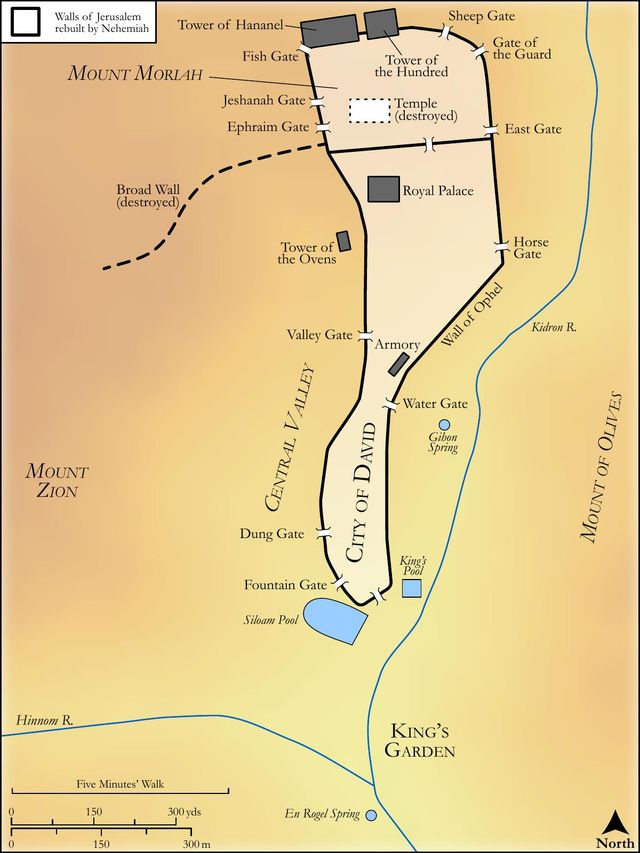
See on the biblical-era map
Study this verse
Public-domain commentary
Matthew Henry
From his Commentary on the Whole Bible. Henry comments on passages, not single verses — this entry covers Nehemiah 12:1–26.
We have here the names, and little more than the names, of a great many priests and Levites, that were eminent in their day among the returned Jews. Why this register should be here inserted by Nehemiah does not appear, perhaps to keep in remembrance those good men, that posterity might know to whom they were beholden, under God, for the happy revival and re-establishment of their religion among them. Thus must we contribute towards the performance of that promise, Psa 112:6, The righteous shall be in everlasting remembrance. Let the memory of the just be blessed, be perpetuated. It is a debt we still owe to faithful ministers to remember our guides, who have spoken to us the word of God, Heb 13:7. Perhaps it is intended to stir up their posterity, who succeeded them in the priest's office and inherited their dignities and preferments, to imitate their courage and fidelity. It is good to know what our godly ancestors and predecessors were, that we may learn thereby what we should be. We have here, 1. The names of the priests and Levites that came up with the first out of Babylon, when Jeshua was high priest. Jeremiah and Ezra are mentioned with the first (Neh 12:1), but, it is supposed, not Jeremiah the prophet nor Ezra the scribe; the fame of the one was long before and that of the other some time after, though both of them were priests. Of one of the Levites it is said (Neh 12:8) that he was over the thanksgiving, that is, he was entrusted to see that the psalms, the thanksgiving psalms, were constantly sung in the temple in due time and manner. The Levites kept their turns in their watches, reliving one another as becomes brethren, fellow-labourers, and fellow-soldiers. 2. The succession of high priests during the Persian monarchy, from Jeshua (or Jesus), who was high priest at the time of the restoration, to Jaddua (or Jaddus), who was high priest when Alexander the Great, after the conquest of Tyre, came to Jerusalem, and paid great respect to this Jaddus, who met him in his pontifical habit, and showed him the prophecy of Daniel, which foretold his conquests. 3. The next generation of priests, who were chief men, and active in the days of Joiakim, sons of the first set. Note, We have reason to acknowledge God's favour to his church, and care of it, in that, as one generation of ministers passes away, another comes. All those who are mentioned Neh 12:1, etc., as eminent in their generation, are again mentioned, though with some variation in several of the names, Neh 12:12, etc., except two, as having sons that were likewise eminent in their generation - a rare instance, that twenty good fathers should leave behind them twenty good sons (for so many here are) that filled up their places. 4. The next generation of Levites, or rather a latter generation; for those priests who are mentioned flourished in the days of Joiakim the high priest, these Levites in the days of Eliashib, Neh 12:22. Perhaps then the forementioned families of the priests began to degenerate, and the third generation of them came short of the first two; but the work of God shall never fail for want of instruments. Then a generation of Levites was raised up, who were recorded chief of the fathers (Neh 12:22), and were eminently serviceable to the interests of the church, and their service not the less acceptable either to God or to his people for their being Levites only, of the lower rank of ministers. Eliashib the high priest being allied to Tobiah (Neh 13:4), the other priests grew remiss; but then the Levites appeared the more zealous, as appears by this, that those who were now employed in expounding (Neh 8:7) and in praying (Neh 9:4, Neh 9:5) were all Levites, not priests, regard being had to their personal qualifications more than to their order. These Levites were some of them singers (Neh 12:24), to praise and give thanks, others of them porters (Neh 12:25), keeping the ward at the thresholds of the gates, and both according to the command of David.
Continue studying Nehemiah 12:22 across the web’s major study libraries — every link below opens this exact verse, chapter, or book on the destination site.
Read & Compare
 BibleGatewayThis verse in more than 200 translations and 70 languages.
 Bible.comThe YouVersion reader — hundreds of translations, reading plans, and highlights.
 ESV.orgCrossway's official English Standard Version reader.
 NET BibleThe NET translation with 60,000+ translators' notes on every rendering decision.
 STEP BibleTyndale House's free study tool — original text, vocabulary, and scholarly resources.
 BibliaLogos Bible Software's free web reader.
 USCCBThe New American Bible (Revised Edition) with the U.S. bishops' study notes.
Commentaries
 BibleHub CommentariesDozens of classic commentaries on this verse, gathered on one page.
 StudyLightMore than 100 commentary sets — the largest collection on the web.
 BibleRefPlain-English commentary on what this verse means, verse by verse.
 Enduring WordDavid Guzik's free commentary on this chapter, widely used by Bible teachers.
 Bible Study ToolsVerse commentary alongside Greek and Hebrew study aids.
Original Language & Research
- BibleHub InterlinearThe verse word by word — original language, transliteration, and English.
- BibleHub LexiconEvery word's original-language definition and Strong's entry.
 Blue Letter BibleDeep-study tools — Strong's numbers, concordance, and word studies.
 SefariaThe Hebrew text with Rashi and centuries of Jewish commentary.
Sermons, Hymns & Audio


TrulyRandomVerse is not affiliated with these sites and doesn’t control their content. They’re linked because they’re genuinely useful.
Summary
Nehemiah 12:22 functions as a crucial historical and administrative record, meticulously documenting the continuity of Levitical and priestly leadership within the post-exilic Jewish community. It traces the succession of chief Levites and priests from the era of Eliashib through Joiada, Johanan, and Jaddua, extending this lineage and service into the reign of Darius the Persian. This verse underscores the diligent commitment to maintaining an organized, legitimate, and divinely sanctioned structure for temple worship, highlighting the enduring faithfulness of God in preserving His people and their means of communion with Him during a critical period of restoration.
Context
ShowHideLiterary Context
Nehemiah 12 is primarily an extensive register of the priests and Levites who returned from Babylonian exile with Zerubbabel and Jeshua, and those who served in subsequent generations. The preceding verses Nehemiah 12:1-21 detail these genealogies, establishing the legitimate lineage of those responsible for temple service. Nehemiah 12:22 serves as a vital chronological bridge within these lists, extending the record of chief Levites and priests beyond the initial returnees to later high priestly successions, thereby demonstrating the long-term administrative diligence and the continuity of religious infrastructure in Jerusalem. This meticulous accounting culminates in the joyous dedication of Jerusalem's rebuilt wall and the re-establishment of organized temple worship, as described in Nehemiah 12:27-47.
Historical & Cultural Context
The period following the Babylonian exile was foundational for the Jewish community's re-establishment in Judah under the overarching authority of the Persian Empire. The restoration of the temple and its sacrificial system was paramount, requiring a clearly defined, legitimate, and organized priesthood and Levitical corps. Genealogical purity was not merely a cultural preference but a divine mandate, as seen in instances like Ezra 2:62, ensuring that only those of verified lineage could perform sacred duties. The succession of High Priests—Eliashib, Joiada, Johanan, and Jaddua—spans a significant historical period, likely from the mid-5th century BC into the late 4th century BC. The mention of "Darius the Persian" further anchors this historical record, most likely referring to Darius II (423-404 BC) or possibly Darius III (336-330 BC), signifying the enduring presence and stability of the Jewish religious leadership throughout a substantial portion of the Persian imperial era.
Key Themes
ShowHideThis verse significantly contributes to several overarching themes within the book of Nehemiah and the broader post-exilic narrative. Firstly, it powerfully illustrates the Continuity of Divine Institutions, emphasizing God's faithfulness in preserving the Levitical and priestly lines essential for the ongoing covenant relationship and worship. Secondly, the phrase "[were] recorded chief of the fathers" highlights the Importance of Meticulous Record-Keeping and Genealogical Purity, which was crucial for establishing legitimacy, order, and accountability within the religious community, ensuring adherence to Mosaic law and the proper functioning of temple service (Nehemiah 10:39). Thirdly, the verse implicitly speaks to Divine Providence, demonstrating how God actively worked through human diligence to maintain His people's identity and means of worship, even amidst the challenges of foreign domination. Finally, it underscores the Value of Organizational Structure and Good Administration in religious life, demonstrating that order and diligence are indispensable for the long-term health and stability of God's covenant people.
Exposition and Analysis
ShowHideKey Word Analysis
ShowHideA primitive root meaning "to grave," and by implication, "to write (describe, inscribe, prescribe, subscribe)." In this context, it signifies the official, systematic documentation of the chief Levites and priests. This act of recording was not merely administrative but carried significant legal and theological weight, ensuring legitimacy, accountability, and the proper functioning of the temple service according to divine mandates.
From an unused root meaning "to shake," referring to "the head (as most easily shaken)." Figuratively, it denotes the most prominent or leading position, indicating rank, authority, or the beginning. Here, it refers to the principal or leading figures within the Levitical and priestly families, highlighting their authoritative roles as heads of their ancestral houses.
A primitive word for "father," used in both literal and figurative senses. It can refer to a literal parent, an ancestor, or the head of a family or clan. In the phrase "chief of the fathers," it specifically denotes the ancestral heads or patriarchs of the Levitical and priestly families, emphasizing the lineage-based structure of their leadership and the importance of their ancestral heritage in qualifying for sacred service.
Verse Breakdown
ShowHide"The Levites in the days of Eliashib, Joiada, and Johanan, and Jaddua"
This clause establishes the primary subjects of the verse—the Levites—and anchors their recorded service within a specific historical timeline defined by the succession of High Priests. Eliashib was the High Priest during Nehemiah's initial work of rebuilding Jerusalem's walls (Nehemiah 3:1), followed by his son Joiada, grandson Johanan (also known as Jonathan in Ezra 10:6), and great-grandson Jaddua. This sequence covers a span of several generations, demonstrating the long-term continuity of the Levitical institution and the High Priesthood.
"[were] recorded chief of the fathers"
This phrase highlights the meticulous administrative practice of the post-exilic community. It indicates that the leading figures, or heads, of the Levitical ancestral families were officially documented. This systematic record-keeping was crucial for verifying their lineage, ensuring their eligibility for temple service, and maintaining order and accountability within the religious hierarchy, reflecting a deep commitment to the purity and proper functioning of worship.
"also the priests, to the reign of Darius the Persian"
This final clause extends the scope of the meticulous record-keeping to include the priests, confirming that both essential groups responsible for temple service were subject to this detailed documentation. The reference to "Darius the Persian" provides a significant chronological marker, indicating that the continuity and verification of religious personnel were maintained throughout a substantial portion of the Persian imperial period, underscoring the remarkable stability and enduring nature of the Jewish religious establishment in Jerusalem.
Literary Devices
ShowHideNehemiah 12:22 primarily functions as a Historical Record and a Genealogical List, reflecting a common literary feature in post-exilic biblical books like Ezra and Nehemiah. These records served to establish legitimacy, continuity, and divine faithfulness for the restored community. The verse employs precise Chronological Markers by naming successive high priests and a specific Persian king, thereby anchoring the historical narrative in a verifiable timeline. This precision underscores the meticulousness of the scribal tradition and the immense importance placed on accurate historical and administrative documentation, especially for the covenant people. The inclusion of these details emphasizes the enduring nature of the Levitical and priestly lines, serving as a powerful testament to the stability and order that characterized the post-exilic Jewish community's religious life and their commitment to God's covenant.
Theological and Thematic Connections
ShowHideNehemiah 12:22, though appearing as a mere administrative detail, carries profound theological weight, testifying to God's unwavering faithfulness in preserving His covenant people and their means of worship. The meticulous record-keeping and the continuity of the priesthood and Levites demonstrate God's commitment to order and His provision for His people to maintain their identity and relationship with Him, even under foreign rule. It illustrates that divine purposes unfold through human diligence and structured obedience, ensuring that the lamp of worship continued to burn in Jerusalem. This continuity was not merely administrative but foundational to the spiritual life of the nation, pointing to God's enduring covenant promises and His active presence in the midst of His people, upholding their sacred institutions.
Reflection and Application
ShowHideNehemiah 12:22 offers a powerful reminder of the enduring value of order, accountability, and faithful service across generations within the community of faith. Just as the post-exilic community meticulously maintained records to ensure the legitimacy and continuity of their spiritual leaders, so too are we called to value and uphold structures that promote integrity, spiritual health, and the effective functioning of God's work in the world. This verse encourages us to appreciate the often unsung work of those who ensure administrative diligence, recognizing that such efforts contribute significantly to the long-term stability and flourishing of the church. It also challenges us to consider our own spiritual lineage—the faith passed down through generations—and our responsibility to faithfully steward the heritage we have received, ensuring that the gospel continues to be proclaimed and lived out in an orderly and impactful way for future generations, thereby building a legacy of faithfulness for those who will follow.
Questions for Reflection
ShowHideFAQ
ShowHideWhy is such a detailed list of names important in the Bible?
ShowHideDetailed lists of names, genealogies, and administrative records, like those found in Nehemiah 12, serve several crucial purposes in the biblical narrative. Firstly, they establish legitimacy and continuity, particularly for the priesthood and Levites, ensuring that only those of verified lineage could perform sacred duties according to God's law. This was vital for maintaining the purity of worship and the covenant relationship. Secondly, they provide historical accuracy and anchor the narrative in real time and space, demonstrating the Bible's commitment to factual reporting and the historicity of God's interaction with humanity. Thirdly, these records underscore divine faithfulness in preserving a remnant and a chosen lineage, ultimately pointing towards the coming Messiah. The meticulous genealogies in Matthew 1:1 and Luke 3:23 are prime examples of how these detailed records culminate in the verification of Jesus' identity as the promised Christ. They show God's hand in history, meticulously working through generations to fulfill His redemptive plan.
Who was Darius the Persian, and why is he mentioned here?
ShowHide"Darius the Persian" in Nehemiah 12:22 serves as a vital chronological marker, indicating the span of time over which these Levitical and priestly records were maintained. While several Persian kings bore the name Darius, the context of the high priestly succession (Eliashib, Joiada, Johanan, Jaddua) strongly suggests that this refers to Darius II, who reigned from 423-404 BC. His mention signifies that the meticulous record-keeping and the continuity of the Jewish religious establishment extended well into the later period of the Persian Empire. This detail is crucial for historians and theologians alike, as it provides a fixed point in time, demonstrating the long-term stability and enduring presence of the Jewish community and its institutions in Jerusalem even under foreign imperial rule. It highlights the sustained commitment to order and religious practice that characterized the post-exilic era, showcasing God's preservation of His people even amidst geopolitical shifts.
Christ-Centered Fulfillment
ShowHideNehemiah 12:22, with its emphasis on the continuity and meticulous record-keeping of the earthly priesthood, profoundly foreshadows the perfect and eternal priesthood of Jesus Christ. The Levitical and Aaronic priesthoods, dependent on human lineage and succession, were inherently temporary and imperfect, requiring continuous records and successive priests because of death and sin, as powerfully highlighted in Hebrews 7:23-24. Jesus, however, is the ultimate High Priest, appointed not by human descent but by the power of an indestructible life (Hebrews 7:16). His priesthood is eternal and unchangeable, requiring no successor, for "He holds His priesthood permanently, because He continues forever" (Hebrews 7:24). The meticulous records in Nehemiah pointed to the need for a perfect order and legitimacy, a need fully met in Christ, who, through His single, perfect sacrifice, entered the true heavenly sanctuary, securing eternal redemption for all who believe (Hebrews 9:11-12). Furthermore, through Christ, believers are now made a "royal priesthood" (1 Peter 2:9), called to offer spiritual sacrifices and proclaim the excellencies of Him who called us out of darkness into His marvelous light, fulfilling the ultimate purpose of the Levitical service in a new and living way under the Headship of our eternal High Priest.