


Ezra 2:62
- אֵלֶּה'E·lehtheseH428PrtParticle Demonstrative
- בִּקְשׁוּbik·Shuthey searchedH1245V-Piel-Perf-3cpVerb Piel Perfect 3rd Plural common gender
- כְתָבָםkhe·ta·Vamtheir document[s]H3791N-msc ¦ 3mpNoun Singular Masculine Constructכְתָבָdocument[s]םtheir
- הַמִּתְיַחְשִׂיםha·mit·yach·Simthe [ones who] had had themselves enrolledH3187Art ¦ V-Hithpael-Prtcpl-mpVerb Hithpael Participle Plural Masculine Absoluteהַtheמִּתְיַחְשִׂים[ones who] had had themselves enrolled
- וְלֹאve·Lo'and notH3808Conj-w ¦ NegParticle Negativeוְandלֹאnot
- נִמְצָאוּnim·Tza·'uthey were foundH4672V-Niphal-Perf-3cpVerb Niphal Perfect 3rd Plural common gender
- וַיְגֹאֲלוּvay·go·'a·Luand they were defiledH1351Conj-w ¦ V-Pual-ConsecImperf-3mpVerb Pual Consecutive Imperfect 3rd Plural Masculineוַandיְגֹאֲלוּthey were defiled
- מִןminfromH4480PrepPreposition
- הַכְּהֻנָּהha·ke·hu·Nahthe priesthoodH3550Art ¦ N-fsNoun Singular Feminine Absoluteהַtheכְּהֻנָּהpriesthood
English is a literal word-by-word gloss of the Hebrew, not the KJV's wording. Why?
This is the original text the KJV's translators worked from — each Hebrew word with its own literal English meaning in this verse, prepared by scholars at Tyndale House, Cambridge. The KJV translates whole sentences, not word by word, so its wording differs: one Hebrew word can become several English words, and the KJV may choose “the LORD” where the gloss reads “Yahweh”. Both are faithful — they answer different questions. For the KJV's own rendering, switch to the KJV text.
Details
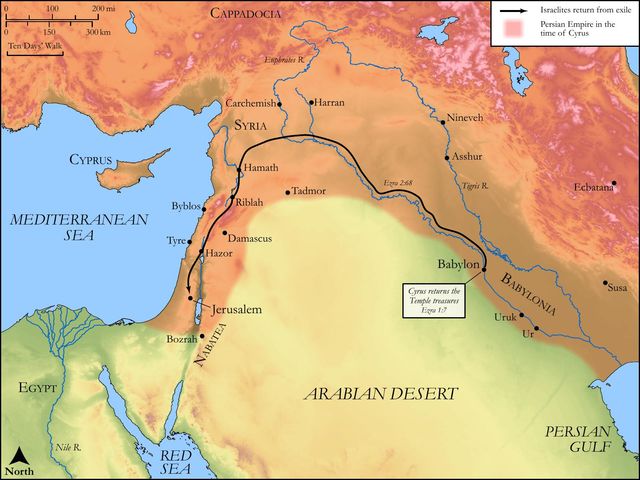
See on the biblical-era map
Study this verse
Public-domain commentary
Matthew Henry
From his Commentary on the Whole Bible. Henry comments on passages, not single verses — this entry covers Ezra 2:36–63. His three-level outline is real structure in the source text, so it is rendered as structure.
Here is an account, I. Of the priests that returned, and they were a considerable number, about a tenth part of the whole company: for the whole were above 42,000 (Ezr 2:64), and four families of priests made up above 4200 (Ezr 2:36-39); thus was the tenth God's part - a blessed decimation. Three of the fathers of the priests here named were heads of courses, Ch1 24:7, Ch1 24:8, Ch1 24:14. The fourth was Pashur, v. 38. If these were of the posterity of that Pashur that abused Jeremiah (Jer 20:1), it is strange that so bad a man should have so good a seed, and so numerous.
II.Of the Levites.
I cannot but wonder at the small number of them, for, taking in both the singers and the porters (Ezr 2:40-42), they did not make 350. Time was when the Levites were more forward to their duty than the priests (Ch2 29:34), but they were not so now. If one place, one family, has the reputation for pious zeal now, another may have it another time. The wind blows where it listeth, and shifts its points.
III.Of the Nethinim, who, it is supposed, were the Gibeonites, given (so their name signifies) by Joshua first (Jos 9:27), and again by David (Ezr 8:20), when Saul had expelled them, to be employed by the Levites in the work of God's house as hewers of wood and drawers of water; and, with them, of the children of Solomon's servants, whom he gave for the like use (whether they were Jews or Gentiles does not appear) and who were here taken notice of among the retainers of the temple and numbered with the Nethinim, Ezr 2:55, Ezr 2:58. Note, It is an honour to belong to God's house, though in the meanest office there.
IV.Of some that were looked upon as Israelites by birth, and others as priests, and yet could not make out a clear title to the honour.
1.There were some that could not prove themselves Israelites (Ezr 2:59, Ezr 2:60), a considerable number, who presumed they were of the seed of Jacob, but could not produce their pedigrees, and yet would go up to Jerusalem, having an affection to the house and people of God. These shamed those who were true-born Israelites, and yet were not called Israelites indeed, who came out of the waters of Judah (Isa 48:1), but had lost the relish of those waters.
2.There were others that could not prove themselves priests, and yet were supposed to be of the seed of Aaron. What is not preserved in black and white will, in all likelihood, be forgotten in a little time. Now we are here told,
(1.)How they lost their evidence. One of their ancestors married a daughter of Barzillai, that great man whom we read of in David's time; he gloried in an alliance to that honourable family, and, preferring that before the dignity of his priesthood, would have his children called after Barzillai's family, and their pedigree preserved in the registers of that house, not of the house of Aaron, and so they lost it. In Babylon there was nothing to be got by the priesthood, and therefore they cared not for being akin to it. Those who think their ministry, or their relation to ministers, a diminution or disparagement to them, forget who it was that said, I magnify my office.
(2.)What they lost with it. It could not be taken for granted that they were priests when they could not produce their proofs, but they were, as polluted, put from the priesthood. Now that the priests had recovered their rights, and had the altar to live upon again, they would gladly be looked upon as priests. But they had sold their birthright for the honour of being gentlemen, and therefore were justly degraded, and forbidden to eat of the most holy things. Note, Christ will be ashamed of those that are ashamed of him and his service. It was the tirshatha, or governor, that put them under this sequestration, which some understand of Zerubbabel the present governor, others of Nehemiah (who is so called, Neh 8:9, Neh 10:1, and who gave this order when he came some years after); but the prohibition was not absolute, it was only a suspension, till there should be a high priest with Urim and Thummin, by whom they might know God's mind in this matter. This, it seems, was expected and desired, but it does not appear that ever they were blessed with it under the second temple. They had the canon of the Old Testament complete, which was better than Urim; and, by the want of that oracle, they were taught to expect the Messiah the great Oracle, which the Urim and Thummim was but a type of. Nor does it appear that the second temple had the ark in it, either the old one or a new one. Those shadows by degrees vanished, as the substance approached; and God, by the prophet, intimates to his people that they should sustain no damage by the want of the ark, Jer 3:16, Jer 3:17. In those days, when they shall call Jerusalem the throne of the Lord, and all the nations shall be gathered to it, they shall say no more, The ark of the covenant of the Lord, neither shall it come to mind, for they shall do very well without it.
Continue studying Ezra 2:62 across the web’s major study libraries — every link below opens this exact verse, chapter, or book on the destination site.
Read & Compare
 BibleGatewayThis verse in more than 200 translations and 70 languages.
 Bible.comThe YouVersion reader — hundreds of translations, reading plans, and highlights.
 ESV.orgCrossway's official English Standard Version reader.
 NET BibleThe NET translation with 60,000+ translators' notes on every rendering decision.
 STEP BibleTyndale House's free study tool — original text, vocabulary, and scholarly resources.
 BibliaLogos Bible Software's free web reader.
 USCCBThe New American Bible (Revised Edition) with the U.S. bishops' study notes.
Commentaries
 BibleHub CommentariesDozens of classic commentaries on this verse, gathered on one page.
 StudyLightMore than 100 commentary sets — the largest collection on the web.
 BibleRefPlain-English commentary on what this verse means, verse by verse.
 Enduring WordDavid Guzik's free commentary on this chapter, widely used by Bible teachers.
 Bible Study ToolsVerse commentary alongside Greek and Hebrew study aids.
Original Language & Research
- BibleHub InterlinearThe verse word by word — original language, transliteration, and English.
- BibleHub LexiconEvery word's original-language definition and Strong's entry.
 Blue Letter BibleDeep-study tools — Strong's numbers, concordance, and word studies.
 SefariaThe Hebrew text with Rashi and centuries of Jewish commentary.
Sermons, Hymns & Audio


TrulyRandomVerse is not affiliated with these sites and doesn’t control their content. They’re linked because they’re genuinely useful.
Summary
Ezra 2:62 meticulously records the disqualification of a specific group of returning Jewish exiles who, despite claiming priestly heritage, were unable to substantiate their lineage with verifiable genealogical records. Because their names were definitively absent from the official registers, they were consequently deemed ritually "polluted" or ceremonially unfit, thereby permanently barring them from serving in the sacred office of the priesthood within the re-establishing community in Jerusalem.
Context
ShowHideLiterary Context
Ezra 2 functions as a meticulous census, detailing the first major wave of Jewish exiles who returned to Judah from Babylon following Cyrus's decree, as outlined in Ezra 1. This chapter provides an exhaustive list of families, individuals, and their numerical strength, which was absolutely critical for the systematic re-establishment of the community, the proper allocation of land, and, most significantly, the rebuilding of the Temple. The particular emphasis on the priestly and Levitical families, highlighted in passages like Ezra 2:36-42, underscores the paramount importance of verifiable lineage for sacred service. Verse 62, therefore, serves as a crucial addendum within this comprehensive census, emphasizing the rigorous and non-negotiable standards applied to those who aspired to perform duties in the newly restored Temple.
Historical & Cultural Context
The return from Babylonian exile marked a profoundly transformative period in Israelite history, signifying a phase of national and spiritual reconstruction. In ancient Israel, particularly under the Mosaic covenant, the priesthood was not merely a vocation but an inherited office, stringently reserved for the direct male descendants of Aaron, as explicitly commanded in Numbers 3:10. Consequently, genealogical records were not merely important but indispensable for proving one's legitimate claim to priestly service. The meticulous record-keeping reflected the deep cultural value placed on lineage, tribal identity, and, crucially, the preservation of ritual and religious purity. The term "polluted" in this context does not imply a moral failing, but rather a state of ritual impurity or disqualification due to the inability to prove the required lineage, rendering them unfit for the sanctity of Temple service. This adherence to strict genealogical proof was a cornerstone of their identity and religious practice.
Key Themes
ShowHideThis verse powerfully illustrates several foundational themes prevalent throughout the book of Ezra and the broader post-exilic period. Firstly, the Importance of Lineage and Genealogy is paramount, especially for the priesthood, as direct descent from Aaron was an absolute prerequisite for serving in the Temple. The genealogical records served as the authoritative and undisputed means of verification, a principle echoed in the parallel account in Nehemiah 7:64. Secondly, the theme of Qualification for Priesthood extends far beyond a mere personal claim, demanding documented proof and unwavering adherence to strict standards of ritual purity. Lacking such verifiable proof rendered one "polluted," effectively disqualified, irrespective of personal piety or sincere desire to serve. Thirdly, the Authority of Records is profoundly highlighted; the official registers held immense weight in determining identity, eligibility, and roles within the meticulously re-ordered community. Finally, the pervasive emphasis on Purity and Separation for sacred service is undeniably evident, echoing ancient laws in the Pentateuch that meticulously distinguish between the holy and the common, and the clean and the unclean, as found in Leviticus 10:10.
Exposition and Analysis
ShowHideKey Word Analysis
ShowHideThis primitive root (H1245) signifies "to search out," often with the implication of striving after something or making an earnest inquiry. In Ezra 2:62, it describes the active attempt by these individuals to find their names in the official genealogical registers. It implies a deliberate and perhaps anxious effort to secure their claim to priestly office, highlighting the critical nature of the documentation they were seeking.
Derived from the root for "to write," this noun (H3791) refers to "something written," specifically a "record" or "book." It denotes the official, authoritative written lists of families and their lineages. The term emphasizes the formal, documented, and legally binding nature of these records, which were meticulously maintained to verify claims of tribal affiliation, land rights, and, most importantly, qualification for the hereditary priesthood. The absence from this kâthâb was definitive proof of disqualification.
This primitive root (H1351) means "to soil" or "to desecrate," and figuratively, "to defile" or "to pollute." In this specific context, it signifies a state of ritual or ceremonial defilement, not necessarily moral sin. Their inability to prove their priestly lineage rendered them ritually unfit or disqualified for sacred service in the Temple, which demanded the highest standards of purity and legitimate descent. This disqualification was based on a lack of verifiable identity, rendering them "unclean" for the specific holy duties of the priesthood.
This noun (H3550) refers to the sacred office and function of the priests, who served as intermediaries between God and the people under the Old Covenant. Their divinely instituted duties included offering sacrifices, teaching the Law, and ministering in the Tabernacle and later the Temple. The office was strictly hereditary, passed down exclusively through the male line of Aaron. Being "put from the priesthood" meant a complete and permanent exclusion from these sacred duties and the privileges associated with them.
Verse Breakdown
ShowHide"These sought their register [among] those that were reckoned by genealogy"
This initial clause details the proactive step taken by the individuals in question. They initiated a search for their names within the established, authoritative genealogical records of the priestly families. This highlights the standard and expected procedure for validating any claim to priestly lineage, underscoring the community's reliance on documented proof for such a sacred office.
"but they were not found"
This brief but pivotal statement presents the critical outcome of their search. Despite their efforts, their names were definitively absent from the official registers. This lack of documentary evidence rendered their claim unsubstantiated and utterly invalid according to the strict legal and religious protocols governing the re-established community. It was an unassailable factual determination.
"therefore were they, as polluted, put from the priesthood"
This concluding clause articulates the direct, severe, and irreversible consequence of their unverified lineage. Because their claim could not be proven by the authoritative records, they were ritually considered "polluted" or ceremonially unclean for sacred service. This status led to their immediate and permanent exclusion from the hereditary office of the priesthood, underscoring the absolute necessity of legitimate, documented lineage for Temple ministry and the maintenance of ritual purity.
Literary Devices
ShowHideEzra 2:62 effectively employs several literary devices to convey its message with clarity, authority, and impact. The prominent use of Legal Language and Bureaucratic Language is evident, reflecting the meticulous record-keeping and the strict adherence to established protocols essential for the re-establishment of the post-exilic community. Phrases such as "sought their register" and "reckoned by genealogy" underscore the official, procedural, and administrative nature of the verification process. The consequence, "put from the priesthood," similarly reflects a formal, legal judgment rendered by the community's leadership. There is also an element of Irony in that these individuals claimed priestly status but were definitively denied it due to a lack of documented proof, highlighting the stark disparity between self-assertion and verifiable truth. Furthermore, the term "polluted" functions as a powerful form of Metonymy, where the state of ritual uncleanness stands in for the disqualification itself, emphasizing that the absence of a name in a record could render one ritually unfit for sacred duties. This meticulousness underscores the profound importance of purity, order, and legitimate succession within the Old Covenant priesthood.
Theological and Thematic Connections
ShowHideEzra 2:62 profoundly underscores the biblical emphasis on divine order, ritual purity, and proper qualification for sacred service within the Old Covenant. The meticulous attention to genealogical records for the priesthood reflects God's specific and unchangeable design for the Aaronic line to mediate between Himself and Israel, a system predicated on divine appointment and hereditary succession, not personal ambition or unverified claims. This strictness highlights the absolute holiness of God and the seriousness of drawing near to Him in service, demanding unwavering adherence to His prescribed ways. The concept of being "polluted" for lack of proper lineage demonstrates that ritual purity was not merely about moral conduct but also about adherence to divine statutes regarding identity, calling, and the proper boundaries for approaching the sacred.
Reflection and Application
ShowHideEzra 2:62 serves as a potent and enduring reminder that genuine spiritual authority and effective service in God's kingdom are not based on self-proclamation, mere desire, or personal feelings, but on divine qualification and alignment with God's established order. While the Old Testament priesthood was founded on physical lineage and strict ritual purity, the New Covenant introduces a "royal priesthood" for all believers, established not by human birth but through spiritual rebirth and adoption into God's family through Christ. This profound shift does not negate the principle of qualification but fundamentally transforms its basis: our spiritual standing and ability to serve God effectively now depend on our genuine, living connection to Jesus Christ, who is our true High Priest, and our commitment to living lives of purity, integrity, and obedience in Him. This verse challenges us to critically examine the basis of our own spiritual claims and service, ensuring they are deeply rooted in Christ and His truth, rather than relying on superficial appearances, unverified assumptions, or human merit.
Questions for Reflection
ShowHideFAQ
ShowHideWhy was genealogy so important for the priesthood in ancient Israel?
ShowHideGenealogy was critically important for the priesthood in ancient Israel because the office was divinely ordained to be hereditary, exclusively for the male descendants of Aaron. This was not a matter of human choice or merit, but of divine appointment, as explicitly detailed in passages like Exodus 29 and Numbers 3:10. Genealogical records served as the authoritative and irrefutable proof of this lineage, ensuring the purity, legitimacy, and continuity of those who ministered in the Tabernacle and later the Temple. Without verifiable lineage, an individual could not legitimately claim the sacred office, as it would directly violate God's specific and immutable instructions for the priesthood.
Does "polluted" in this verse imply moral sin on the part of those disqualified?
ShowHideNo, in the specific context of Ezra 2:62, "polluted" refers to a state of ritual or ceremonial uncleanness or disqualification, not necessarily moral sin. Their "pollution" stemmed directly from their inability to prove their legitimate priestly lineage, which rendered them ritually unfit for the sacred duties of the priesthood. The Old Testament carefully distinguished between moral defilement (sin against God's law) and ritual defilement (a state that made one temporarily or permanently unfit for sacred spaces or activities, often due to contact with something unclean or, in this case, a lack of proper qualification). Here, the absence of a verifiable genealogical record was the precise cause of their ritual disqualification, not a specific moral failing on their part.
What happened to these individuals after being disqualified from the priesthood?
ShowHideWhile Ezra 2:62 clearly states they were "put from the priesthood," it does not imply they were expelled from the community or suffered further punishment beyond losing the right to serve as priests. They would have remained an integral part of the returning Jewish community, likely taking on other roles or occupations within the re-established society. Their disqualification was specific and limited to the sacred office of the priesthood, which, as highlighted, required strict adherence to genealogical proof and ritual purity for its unique functions.
Christ-Centered Fulfillment
ShowHideEzra 2:62, with its stringent requirements for human lineage to qualify for the Old Covenant priesthood, profoundly foreshadows and illuminates the perfect and eternal priesthood of Jesus Christ. Unlike the priests of Aaron's line, whose qualification depended on an earthly genealogy that could be lost, questioned, or rendered "polluted," Christ's priesthood is not based on human descent or the Law, but "after the order of Melchizedek" (Hebrews 7:11). As Hebrews 7:3 powerfully declares, He is "without father or mother, without genealogy, having neither beginning of days nor end of life, but resembling the Son of God, He remains a priest forever." This highlights His divine, eternal qualification, which infinitely surpasses any earthly register or human pedigree. Furthermore, while the Old Testament priests could be "polluted" and thus disqualified from service, Jesus, our ultimate High Priest, is "holy, innocent, unstained, separated from sinners, and exalted above the heavens" (Hebrews 7:26). His perfect, once-for-all sacrifice on the cross cleanses us from all spiritual "pollution" and sin (Hebrews 9:14), granting us direct access to God that the old system could never provide. Through His finished work, believers are now made a "royal priesthood" (1 Peter 2:9), qualified not by an earthly register or human merit, but by being "washed... from our sins in His own blood" (Revelation 1:5-6), enabling us to draw near to God with confidence and boldness (Hebrews 4:16).