


Exodus 16:19
Bible text: King James Version (1769 Blayney text) · Public domain
Bible text: Berean Standard Bible · Public domain
Bible text: American Standard Version (1901) · Public domain
Bible text: World English Bible, Messianic edition · Public domain
Bible text: Geneva Bible (1599) · Public domain
Bible text: Young's Literal Translation · Public domain
- וַיֹּאמֶרvai·Yo·merand he saidH559Conj-w ¦ V-Qal-ConsecImperf-3msVerb Qal Consecutive Imperfect 3rd Singular Masculineוַandיֹּאמֶרhe said
- מֹשֶׁהmo·ShehMosesH4872N-proper-mNoun Proper Masculine
- אֲלֵהֶם'a·le·Hemto themH413Prep ¦ 3mpPreposition Definiteאֲלֵtoהֶםthem
- אִישׁ'isheveryoneH376N-msNoun Singular Masculine Absolute
- אַל'almay notH408NegParticle Negative
- יוֹתֵרyo·Terhim leave overH3498V-Hiphil-Imperf-3msVerb Hiphil Imperfect 3rd Singular Masculine
- מִמֶּנּוּmi·Me·nuany of itH4480Prep ¦ 3msPreposition Definiteמִמֶּany ofנּוּit
- עַד'aduntilH5704PrepPreposition
- בֹּקֶרBo·kermorningH1242N-msNoun Singular Masculine Absolute
English is a literal word-by-word gloss of the Hebrew, not the KJV's wording. Why?
This is the original text the KJV's translators worked from — each Hebrew word with its own literal English meaning in this verse, prepared by scholars at Tyndale House, Cambridge. The KJV translates whole sentences, not word by word, so its wording differs: one Hebrew word can become several English words, and the KJV may choose “the LORD” where the gloss reads “Yahweh”. Both are faithful — they answer different questions. For the KJV's own rendering, switch to the KJV text.
Details
See on the biblical-era maps

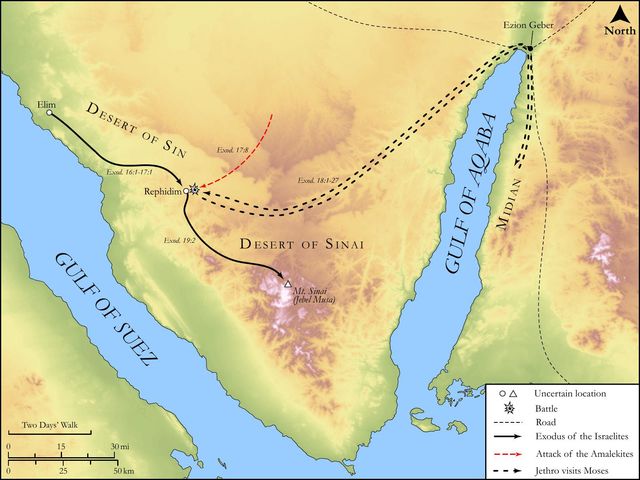
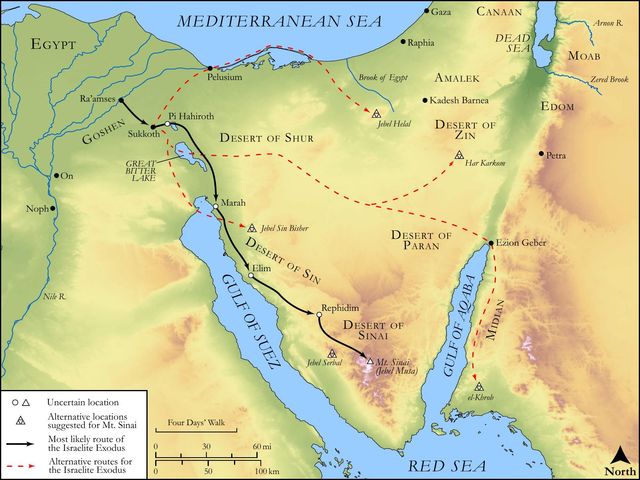
Study this verse
Public-domain commentary
Matthew Henry
From his Commentary on the Whole Bible. Henry comments on passages, not single verses — this entry covers Exodus 16:13–21. His four-level outline is real structure in the source text, so it is rendered as structure.
Now they begin to be provided for by the immediate hand of God.
I.He makes them a feast, at night, of delicate fowl, feathered fowl (Psa 78:27), therefore not locusts, as some think; quails, or pheasants, or some wild fowl, came up, and covered the camp, so tame that they might take up as many of them as they pleased. Note, God gives us of the good things of this life, not only for necessity, but for delight, that we may not only serve him, but serve him cheerfully.
II.Next morning he rained manna upon them, which was to be continued to them for their daily bread.
1.That which was provided for them was manna, which descended from the clouds, so that, in some sense, they might be said to live upon the air. It came down in dew that melted, and yet was itself of such a consistency as to serve for nourishing strengthening food, without any thing else. They called it manna, manhu, "What is this?" Either, "What a poor thing this is!" despising it: or, "What a strange thing this is!" admiring it: or, "It is a portion, no matter what it is; it is that which our God has allotted us, and we will take it and be thankful," Exo 16:14, Exo 16:15. It was pleasant food; the Jews say that it was palatable to all, however varied their tastes. It was wholesome food, light of digestion, and very necessary (Dr. Grew says) to cleanse them from disorders with which he thinks it probable that they were, in the time of their bondage, more or less infected, which disorders a luxurious diet would have made contagious. By this spare and plain diet we are all taught a lesson of temperance, and forbidden to desire dainties and varieties.
2.They were to gather it every morning (Exo 16:21), the portion of a day in his day, Exo 16:4. Thus they must live upon daily providence, as the fowls of the air, of which it is said, That which thou givest them they gather (Psa 104:28); not today for tomorrow: let the morrow take thought for the things of itself. To this daily raining and gathering of manna our Saviour seems to allude when he teaches us to pray, Give us this day our daily bread. We are hereby taught,
(1.)Prudence and diligence in providing food convenient for ourselves and our household. What God graciously gives we must industriously gather; with quietness working, and eating our own bread, not the bread either of idleness or deceit. God's bounty leaves room for man's duty; it did so even when manna was rained: they must not eat till they have gathered.
(2.)Contentment and satisfaction with a sufficiency. They must gather, every man according to his eating; enough is as good as a feast, and more than enough is as bad as a surfeit. Those that have most have, for themselves, but food, and raiment, and mirth; and those that have least generally have these: so that he who gathers much has nothing over, and he who gathers little has no lack. There is not so great a disproportion between one and another in the comforts and enjoyments of the things of this life as there is in the property and possession of the things themselves.
(3.)Dependence upon Providence: Let no man leave till morning (Exo 16:19), but let them learn to go to bed and sleep quietly, though they have not a bit of bread in their tent, nor in all their camp, trusting that God, with the following day, will bring them their daily bread." It was surer and safer in God's store-house than in their own, and would thence come to them sweeter and fresher. Read with this, Mat 6:25, Take no thought for your life, etc. See here the folly of hoarding. The manna that was laid up by some (who thought themselves wiser and better managers than their neighbours, and who would provide in case it should fail next day), putrefied, and bred worms, and became good for nothing. Note, That proves to be most wasted which is covetously and distrustfully spared. Those riches are corrupted, Jam 5:2, Jam 5:3. Let us set ourselves to think,
[1.]Of that great power of God which fed Israel in the wilderness, and made miracles their daily bread. What cannot this God do, who prepared a table in the wilderness, and furnished it richly even for those who questioned whether he could or no? Psa 78:19, Psa 78:20. Never was there such a market of provisions as this, where so many hundred thousand men were daily furnished, without money and without price. Never was there such an open house kept as God kept in the wilderness for forty years together, nor such free and plentiful entertainment given. The feast which Ahasuerus made, to show the riches of his kingdom, and the honour of his majesty, was nothing to this, Est 1:4. It is said (Exo 16:21), When the sun waxed hot, it melted; as if what was left were drawn up by the heat of the sun into the air to be the seed of the next day's harvest, and so from day to day.
[2.]Of that constant providence of God which gives food to all flesh, for his mercy endures for ever, Psa 136:25. He is a great house-keeper that provides for all the creatures. The same wisdom, power, and goodness that now brought food daily out of the clouds, are employed in the constant course of nature, bringing food yearly out of the earth, and giving us all things richly to enjoy.
Continue studying Exodus 16:19 across the web’s major study libraries — every link below opens this exact verse, chapter, or book on the destination site.
Read & Compare
 BibleGatewayThis verse in more than 200 translations and 70 languages.
 Bible.comThe YouVersion reader — hundreds of translations, reading plans, and highlights.
 ESV.orgCrossway's official English Standard Version reader.
 NET BibleThe NET translation with 60,000+ translators' notes on every rendering decision.
 STEP BibleTyndale House's free study tool — original text, vocabulary, and scholarly resources.
 BibliaLogos Bible Software's free web reader.
 USCCBThe New American Bible (Revised Edition) with the U.S. bishops' study notes.
Commentaries
 BibleHub CommentariesDozens of classic commentaries on this verse, gathered on one page.
 StudyLightMore than 100 commentary sets — the largest collection on the web.
 BibleRefPlain-English commentary on what this verse means, verse by verse.
 Enduring WordDavid Guzik's free commentary on this chapter, widely used by Bible teachers.
 Bible Study ToolsVerse commentary alongside Greek and Hebrew study aids.
Original Language & Research
- BibleHub InterlinearThe verse word by word — original language, transliteration, and English.
- BibleHub LexiconEvery word's original-language definition and Strong's entry.
 Blue Letter BibleDeep-study tools — Strong's numbers, concordance, and word studies.
 SefariaThe Hebrew text with Rashi and centuries of Jewish commentary.
Sermons, Hymns & Audio


TrulyRandomVerse is not affiliated with these sites and doesn’t control their content. They’re linked because they’re genuinely useful.
Summary
Exodus 16:19 records a pivotal divine instruction given to the Israelites in the wilderness concerning the daily collection and consumption of manna. Following God's miraculous provision of "bread from heaven," Moses commanded the people not to store any of this miraculous food overnight. This seemingly simple directive served as a profound and multifaceted lesson in cultivating daily dependence on God's fresh provision, discouraging the human tendency toward hoarding and anxiety, and demonstrating the immediate consequences of disobedience, thereby profoundly shaping Israel's understanding of God's unwavering faithfulness and their constant need for reliance upon Him.
Context
ShowHideLiterary Context
Exodus 16:19 is situated within the broader narrative of God's miraculous provision for the Israelites during their wilderness journey, specifically detailing the giving of manna and quail. The chapter opens with the Israelites' bitter complaints about hunger in the Desert of Sin, a mere month after their dramatic exodus from Egypt. In response to their murmuring, God graciously promises to "rain bread from heaven" (Exodus 16:4), establishing a daily rhythm of divine sustenance. Prior to verse 19, Moses has already outlined the general instructions for gathering: an omer per person (Exodus 16:16) and a double portion on the sixth day in preparation for the Sabbath (Exodus 16:5 and Exodus 16:22-26). Verse 19, therefore, functions as a specific, negative command, a prohibition designed to reinforce the principle of daily dependence and to test their obedience, immediately followed by the tangible consequences of disobedience detailed in Exodus 16:20.
Historical & Cultural Context
The Israelites, a vast multitude recently liberated from generations of brutal slavery in Egypt, found themselves in a harsh, barren wilderness. Their prior experience was one of forced labor and dependence on a human master, followed by a dramatic, supernatural liberation. Now, they faced the daunting challenge of sustaining millions in an environment utterly devoid of natural food sources. This precarious situation created a profound spiritual and existential crisis, leading to widespread murmuring and a nostalgic longing for the perceived security of Egypt, even if it meant slavery (Exodus 16:3). God's provision of manna was not merely an act of sustenance but a crucial pedagogical tool. It taught a nomadic people, accustomed to a settled agricultural or slave economy, to live by faith, to trust in an unseen God for their daily bread, and to understand that their true security lay not in stored provisions or human effort, but in divine faithfulness. This daily, perishable provision directly countered any natural human inclination to hoard or rely on self-sufficiency, a vital lesson for a people being shaped into a nation uniquely dependent on Yahweh for their very existence.
Key Themes
ShowHideThe command in Exodus 16:19 contributes significantly to several key themes woven throughout the book of Exodus and the broader Pentateuch. Central among these is the theme of Divine Provision and Faithfulness, demonstrating God's unwavering commitment to sustain His covenant people even in the most desolate circumstances. It underscores the theme of Obedience and Trust, as the command serves as a test of Israel's willingness to follow God's instructions precisely, even when they seem counter-intuitive to human wisdom. The perishable nature of the manna also highlights the theme of Daily Dependence, forcing the Israelites into a continuous posture of reliance on God, rather than on their own foresight or accumulated resources. This contrasts sharply with the human tendency towards Anxiety and Hoarding, a theme God actively works against throughout the wilderness narrative, teaching His people that true security is found in Him alone, not in material accumulation. Furthermore, the narrative of manna foreshadows the Sabbath Principle (as seen in Exodus 16:23-26), where God provides a double portion on the sixth day, reinforcing the importance of rest and trust in His provision for the seventh.
Exposition and Analysis
ShowHideKey Word Analysis
ShowHideThis term refers to an individual male person. In this context, "Let no man leave of it," it emphasizes that the prohibition applies universally to every single Israelite, underscoring the personal responsibility of each individual to adhere to the divine instruction. It highlights that the lesson of daily dependence was for the entire community, not just a select few.
This primitive root means "to jut over or exceed," "to remain or be left," or "to preserve." In this imperative, "Let no man leave of it," it carries the strong sense of allowing something to persist or remain beyond its intended time. The command is an absolute prohibition against any surplus of manna being kept overnight, directly challenging any inclination to hoard or store. It underscores the perishable nature of the manna and the immediate, daily cycle of God's provision, demanding a fresh act of faith each morning.
This word properly signifies "dawn" or "the break of day," generally referring to the early part of the day. Its inclusion specifies the precise temporal boundary for the manna's usability. This daily reset emphasized that each new day brought a fresh opportunity for God's provision and a renewed call for the people's trust. It was not merely about avoiding spoilage, but about establishing a rhythm of dependence that began anew with each sunrise, reinforcing the transient nature of the manna and the constancy of God's daily grace.
Verse Breakdown
ShowHide"And Moses said"
This opening phrase establishes Moses's authoritative role as God's chosen intermediary and messenger. It signifies that the following instruction is not a human suggestion or a practical guideline devised by Moses, but a direct, divinely ordained command from Yahweh Himself, communicated through His prophet to the people of Israel.
"Let no man leave of it"
This is a strong negative imperative, a direct and absolute prohibition. The phrase "leave of it" refers to allowing any portion of the collected manna to remain unconsumed or to be preserved beyond the designated time. This command directly challenges the natural human instinct to store provisions for future uncertainty, forcing a conscious and immediate reliance on God's consistent and immediate supply. It demands a posture of active trust over self-sufficiency.
"till the morning"
This temporal clause sets the precise and strict limit for the manna's viability and the duration of its permitted retention. It dictates that all collected manna must be consumed or disposed of before the next sunrise. This daily expiration date was critical for enforcing the lesson of daily dependence and preventing any attempt at hoarding, as any effort to save it would inevitably result in spoilage, as explicitly detailed in the subsequent verse (Exodus 16:20).
Literary Devices
ShowHideExodus 16:19 employs several potent literary devices to convey its profound theological and practical message. The primary device is Command, as Moses delivers a direct, unequivocal instruction from God, highlighting divine authority and the absolute necessity of immediate obedience. This command functions as a Test of Israel's faith, discipline, and trust, setting up a clear condition with immediate and tangible consequences for transgression, as revealed in the subsequent verses. The perishable nature of the manna, explicitly implied by the "till the morning" clause, acts as a powerful Symbol of God's daily, fresh provision and the fleeting nature of earthly sustenance when held onto outside of His will. It also serves as a Metaphor for spiritual sustenance, suggesting that just as physical manna must be consumed daily, so too must spiritual nourishment be sought continually and freshly from God. The inherent tension between the Israelites' natural human inclination to hoard and God's counter-intuitive command for daily reliance creates a subtle yet profound Irony, where true security and abundance are paradoxically found not in accumulation but in surrender, radical dependence, and immediate obedience to God's daily grace.
Theological and Thematic Connections
ShowHideExodus 16:19 is a foundational text for understanding God's character as a faithful, meticulous Provider and humanity's essential call to daily dependence. It teaches that God delights in sustaining His people, not just physically but also spiritually, and that His provision often comes in ways that directly challenge our deeply ingrained self-sufficiency, anxieties about the future, and desire for control. The perishable nature of the manna and the stringent command not to store it cultivated a daily rhythm of trust, compelling the Israelites to look to God anew each morning for their very sustenance. This divine pedagogy aimed to instill a deep-seated faith that God's grace is truly sufficient for each day, fostering contentment and actively discouraging the human tendency towards hoarding, worry, and a reliance on one's own accumulated resources. It underscores the truth that true life and security are found in living by every word that comes from the mouth of God.
Reflection and Application
ShowHideExodus 16:19 offers a timeless and profoundly relevant spiritual principle for believers today: the call to live in radical, moment-by-moment dependence on God. In a world that relentlessly champions self-reliance, accumulation of wealth, and meticulous future-proofing, this verse stands as a counter-cultural challenge, urging us to release our anxious grip on tomorrow and instead trust implicitly in God's consistent, moment-by-moment provision. It serves as a powerful reminder that true security is not ultimately found in our savings accounts, our career achievements, our comprehensive insurance policies, or our meticulously planned futures, but in the unwavering faithfulness and boundless grace of our Heavenly Father. Just as the Israelites learned to gather just enough for the day, we are invited to pray for "our daily bread," recognizing that God's grace is fresh each morning and utterly sufficient for every genuine need. This perspective liberates us from the crushing burdens of excessive worry, the relentless pursuit of more, and the illusion of self-sufficiency, enabling us to live with a posture of profound gratitude, deep contentment, and active faith, knowing that the God who miraculously fed millions in the barren wilderness is more than capable of sustaining us in our contemporary "deserts."
Questions for Reflection
ShowHideFAQ
ShowHideWhy did God command them not to leave manna till the morning?
ShowHideGod commanded the Israelites not to leave manna till the morning primarily to cultivate a profound and ongoing lesson in daily dependence and trust in His provision. The perishable nature of the manna, which would spoil and breed worms if kept overnight (Exodus 16:20), served as a constant, tangible reminder that their sustenance came directly from Him, fresh and new each day. This divine instruction prevented hoarding, discouraged anxiety about the future, and cultivated a spiritual rhythm of looking to God anew every morning for their needs. It reinforced the profound principle articulated later by Moses that "man does not live on bread alone but on every word that comes from the mouth of the Lord" (Deuteronomy 8:3). It was both a practical test of their obedience and a foundational pedagogical tool in shaping them into a nation uniquely reliant on Yahweh.
Christ-Centered Fulfillment
ShowHideThe manna in the wilderness, and the specific command in Exodus 16:19 not to store it, finds its ultimate Christ-centered fulfillment in Jesus, who is the true "bread of life." Just as the perishable manna required daily gathering, signifying a moment-by-moment reliance on God's fresh provision, so too does spiritual nourishment from Christ require ongoing, active engagement and dependence. Jesus Himself declared, "I am the bread of life; whoever comes to me shall not hunger, and whoever believes in me shall never thirst" (John 6:35). Unlike the manna, which sustained physical life but ultimately led to death for those who ate it (John 6:49), Jesus offers eternal life to those who "eat His flesh and drink His blood" in a spiritual sense, signifying complete identification with His sacrifice (John 6:53-54). The daily dependence taught by the manna powerfully foreshadows our continuous, moment-by-moment need for Christ's presence, His living Word, and the empowering work of His Spirit for our spiritual sustenance and growth. We are not to "store up" Christ's grace from yesterday as if it were a static commodity, but rather to draw from His inexhaustible supply afresh each day, trusting in His constant faithfulness and the ever-sufficient, atoning work of His cross, which is indeed "new every morning" (Lamentations 3:22-23). He is the ultimate, imperishable provision, satisfying our deepest hunger for eternity.