


Exodus 16:14
Bible text: King James Version (1769 Blayney text) · Public domain
Bible text: Berean Standard Bible · Public domain
Bible text: American Standard Version (1901) · Public domain
Bible text: World English Bible, Messianic edition · Public domain
Bible text: Geneva Bible (1599) · Public domain
Bible text: Young's Literal Translation · Public domain
- וַתַּעַלva·Ta·'aland it went upH5927Conj-w ¦ V-Qal-ConsecImperf-3fsVerb Qal Consecutive Imperfect 3rd Singular Feminineוַandתַּעַלit went up
- שִׁכְבַתshikh·Vat[the] layer ofH7902N-fscNoun Singular Feminine Construct
- הַטָּלha·Tal<the> dewH2919Art ¦ N-msNoun Singular Masculine Absoluteהַ<the>טָּלdew
- וְהִנֵּהve·hi·Nehand there!H2009Conj-w ¦ PrtParticle Interjectionוְandהִנֵּהthere!
- עַל'al[was] onH5921PrepPreposition
- פְּנֵיpe·Nei[the] surface ofH6440N-mpcNoun Plural Masculine Construct
- הַמִּדְבָּרha·mid·Barthe wildernessH4057Art ¦ N-msNoun Singular Masculine Absoluteהַtheמִּדְבָּרwilderness
- דַּקdakthin [stuff]H1851Adj-msAdjective Singular Masculine Absolute
- מְחֻסְפָּסme·chus·Pasflake-likeH2636V-Pual-PassPrtcpl-msVerb Pual Participle Passive Singular Masculine Absolute
- דַּקdakthin [stuff]H1851Adj-msAdjective Singular Masculine Absolute
- כַּכְּפֹרka·ke·Forlike <the> frostH3713Prep-k ¦ N-msNoun Singular Masculine Absoluteכַּlike <the>כְּפֹרfrost
- עַל'alonH5921PrepPreposition
- הָאָרֶץha·'A·retzthe groundH776Art ¦ N-fsNoun Singular Feminine Absoluteהָtheאָרֶץground
English is a literal word-by-word gloss of the Hebrew, not the KJV's wording. Why?
This is the original text the KJV's translators worked from — each Hebrew word with its own literal English meaning in this verse, prepared by scholars at Tyndale House, Cambridge. The KJV translates whole sentences, not word by word, so its wording differs: one Hebrew word can become several English words, and the KJV may choose “the LORD” where the gloss reads “Yahweh”. Both are faithful — they answer different questions. For the KJV's own rendering, switch to the KJV text.
Details
See on the biblical-era maps

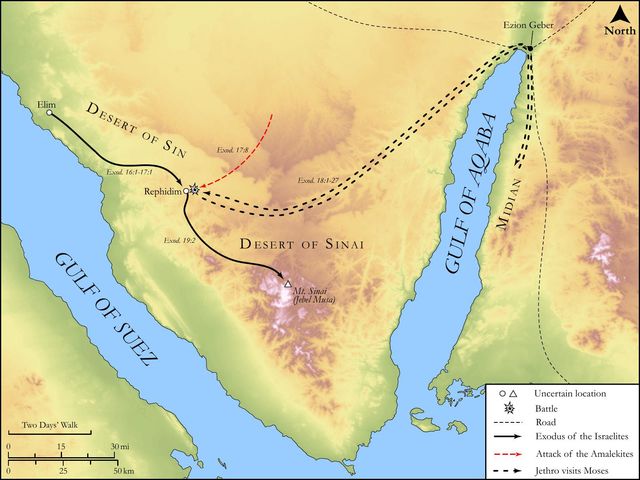
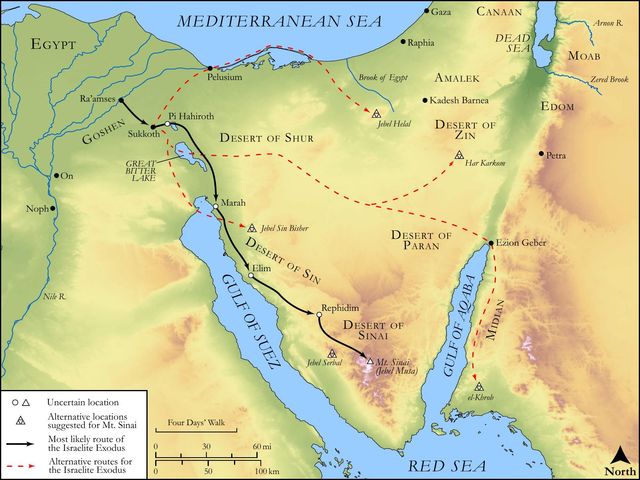
Study this verse
Public-domain commentary
Matthew Henry
From his Commentary on the Whole Bible. Henry comments on passages, not single verses — this entry covers Exodus 16:13–21. His four-level outline is real structure in the source text, so it is rendered as structure.
Now they begin to be provided for by the immediate hand of God.
I.He makes them a feast, at night, of delicate fowl, feathered fowl (Psa 78:27), therefore not locusts, as some think; quails, or pheasants, or some wild fowl, came up, and covered the camp, so tame that they might take up as many of them as they pleased. Note, God gives us of the good things of this life, not only for necessity, but for delight, that we may not only serve him, but serve him cheerfully.
II.Next morning he rained manna upon them, which was to be continued to them for their daily bread.
1.That which was provided for them was manna, which descended from the clouds, so that, in some sense, they might be said to live upon the air. It came down in dew that melted, and yet was itself of such a consistency as to serve for nourishing strengthening food, without any thing else. They called it manna, manhu, "What is this?" Either, "What a poor thing this is!" despising it: or, "What a strange thing this is!" admiring it: or, "It is a portion, no matter what it is; it is that which our God has allotted us, and we will take it and be thankful," Exo 16:14, Exo 16:15. It was pleasant food; the Jews say that it was palatable to all, however varied their tastes. It was wholesome food, light of digestion, and very necessary (Dr. Grew says) to cleanse them from disorders with which he thinks it probable that they were, in the time of their bondage, more or less infected, which disorders a luxurious diet would have made contagious. By this spare and plain diet we are all taught a lesson of temperance, and forbidden to desire dainties and varieties.
2.They were to gather it every morning (Exo 16:21), the portion of a day in his day, Exo 16:4. Thus they must live upon daily providence, as the fowls of the air, of which it is said, That which thou givest them they gather (Psa 104:28); not today for tomorrow: let the morrow take thought for the things of itself. To this daily raining and gathering of manna our Saviour seems to allude when he teaches us to pray, Give us this day our daily bread. We are hereby taught,
(1.)Prudence and diligence in providing food convenient for ourselves and our household. What God graciously gives we must industriously gather; with quietness working, and eating our own bread, not the bread either of idleness or deceit. God's bounty leaves room for man's duty; it did so even when manna was rained: they must not eat till they have gathered.
(2.)Contentment and satisfaction with a sufficiency. They must gather, every man according to his eating; enough is as good as a feast, and more than enough is as bad as a surfeit. Those that have most have, for themselves, but food, and raiment, and mirth; and those that have least generally have these: so that he who gathers much has nothing over, and he who gathers little has no lack. There is not so great a disproportion between one and another in the comforts and enjoyments of the things of this life as there is in the property and possession of the things themselves.
(3.)Dependence upon Providence: Let no man leave till morning (Exo 16:19), but let them learn to go to bed and sleep quietly, though they have not a bit of bread in their tent, nor in all their camp, trusting that God, with the following day, will bring them their daily bread." It was surer and safer in God's store-house than in their own, and would thence come to them sweeter and fresher. Read with this, Mat 6:25, Take no thought for your life, etc. See here the folly of hoarding. The manna that was laid up by some (who thought themselves wiser and better managers than their neighbours, and who would provide in case it should fail next day), putrefied, and bred worms, and became good for nothing. Note, That proves to be most wasted which is covetously and distrustfully spared. Those riches are corrupted, Jam 5:2, Jam 5:3. Let us set ourselves to think,
[1.]Of that great power of God which fed Israel in the wilderness, and made miracles their daily bread. What cannot this God do, who prepared a table in the wilderness, and furnished it richly even for those who questioned whether he could or no? Psa 78:19, Psa 78:20. Never was there such a market of provisions as this, where so many hundred thousand men were daily furnished, without money and without price. Never was there such an open house kept as God kept in the wilderness for forty years together, nor such free and plentiful entertainment given. The feast which Ahasuerus made, to show the riches of his kingdom, and the honour of his majesty, was nothing to this, Est 1:4. It is said (Exo 16:21), When the sun waxed hot, it melted; as if what was left were drawn up by the heat of the sun into the air to be the seed of the next day's harvest, and so from day to day.
[2.]Of that constant providence of God which gives food to all flesh, for his mercy endures for ever, Psa 136:25. He is a great house-keeper that provides for all the creatures. The same wisdom, power, and goodness that now brought food daily out of the clouds, are employed in the constant course of nature, bringing food yearly out of the earth, and giving us all things richly to enjoy.
Historical interpretation
Historical reception
1 surviving comment on this verse from the historical church.
But if there are some who have come out of Egypt and, following the pillar of fire and cloud, are entering the wilderness, then he comes down from heaven to them and offers them a small, thin food, like to the food of angels; so that “man eats the bread of angels.”
Continue studying Exodus 16:14 across the web’s major study libraries — every link below opens this exact verse, chapter, or book on the destination site.
Read & Compare
 BibleGatewayThis verse in more than 200 translations and 70 languages.
 Bible.comThe YouVersion reader — hundreds of translations, reading plans, and highlights.
 ESV.orgCrossway's official English Standard Version reader.
 NET BibleThe NET translation with 60,000+ translators' notes on every rendering decision.
 STEP BibleTyndale House's free study tool — original text, vocabulary, and scholarly resources.
 BibliaLogos Bible Software's free web reader.
 USCCBThe New American Bible (Revised Edition) with the U.S. bishops' study notes.
Commentaries
 BibleHub CommentariesDozens of classic commentaries on this verse, gathered on one page.
 StudyLightMore than 100 commentary sets — the largest collection on the web.
 BibleRefPlain-English commentary on what this verse means, verse by verse.
 Enduring WordDavid Guzik's free commentary on this chapter, widely used by Bible teachers.
 Bible Study ToolsVerse commentary alongside Greek and Hebrew study aids.
Original Language & Research
- BibleHub InterlinearThe verse word by word — original language, transliteration, and English.
- BibleHub LexiconEvery word's original-language definition and Strong's entry.
 Blue Letter BibleDeep-study tools — Strong's numbers, concordance, and word studies.
 SefariaThe Hebrew text with Rashi and centuries of Jewish commentary.
Sermons, Hymns & Audio


TrulyRandomVerse is not affiliated with these sites and doesn’t control their content. They’re linked because they’re genuinely useful.
Summary
Exodus 16:14 provides the initial, vivid description of manna, God's miraculous provision for the Israelites in the desolate Wilderness of Sin. This verse details the physical characteristics of the divine sustenance, presenting it as a delicate, finely textured substance, akin to hoarfrost, that covered the ground after the morning dew had evaporated. It marks a pivotal moment of divine intervention, demonstrating God's unwavering faithfulness and power to sustain His people in seemingly impossible circumstances, laying the groundwork for forty years of daily dependence on His supernatural care.
Context
ShowHideLiterary Context
Exodus 16:14 is strategically placed within the narrative of the Israelites' wilderness journey, specifically following their initial complaints about lack of food after their miraculous deliverance from Egypt. The preceding verses (Exodus 16:1-3) establish the critical setting in the "Wilderness of Sin" and chronicle the people's intense grumbling against Moses and Aaron, expressing a nostalgic, albeit misguided, longing for the perceived abundance of Egypt, even if it meant slavery. In response to their desperate cries, God promises to "rain bread from heaven" (Exodus 16:4), establishing conditions for its collection and use, including a double portion on the sixth day and none on the Sabbath. Verses 6-13 describe the appearance of quail in the evening, followed by the dew in the morning, meticulously setting the stage for the revelation of manna. Thus, verse 14 serves as the climactic fulfillment of God's promise, immediately preceding the Israelites' bewildered question, "What is it?" (Exodus 16:15), which gives the substance its enduring name, "manna." This precise timing underscores God's immediate and direct response to their need.
Historical & Cultural Context
The Israelites, a vast multitude estimated to be in the millions, had recently been delivered from centuries of slavery in Egypt through a series of unprecedented miracles, including the parting of the Red Sea (Exodus 14). Their subsequent journey into the vast, arid wilderness presented an immediate and existential challenge: how to feed such a large population in a barren land incapable of sustaining them naturally. This dire situation fostered a deep sense of vulnerability and, regrettably, a tendency towards murmuring and distrust, despite God's recent demonstrations of power. Among the kings of that day, a king's ability to provide for his people was a hallmark of his reign; God, as the divine King, demonstrates His unparalleled sovereignty and care by providing sustenance in a manner entirely outside human capability or expectation. The daily provision of manna, appearing with the dew, was a unique phenomenon, distinct from any known natural food source, emphasizing its supernatural origin and teaching the Israelites a profound lesson in daily dependence on their covenant God, rather than on their own efforts or the agricultural cycles they knew from Egypt. This miraculous provision underscored God's commitment to His covenant people, even when they displayed a lack of faith, setting a precedent for His continued faithfulness throughout their wilderness wanderings, as later reflected in passages like Deuteronomy 8:3.
Key Themes
ShowHideExodus 16:14 contributes significantly to several major theological and narrative themes within the book of Exodus and the broader Pentateuch. Foremost among these is Divine Provision and Faithfulness, showcasing God's unwavering commitment to His covenant people, even in their grumbling. The appearance of manna demonstrates His ability to sustain life in barren places, proving His sufficiency. Another crucial theme is Daily Dependence and Trust, as the Israelites were compelled to rely on God for their sustenance day by day, fostering a posture of continuous reliance rather than self-sufficiency or hoarding. This daily rhythm was designed to cultivate a deep trust in God's immediate and consistent care. Furthermore, the manna serves as a powerful illustration of God's Sovereignty over Nature, as He provides food in a way that defies natural explanation, highlighting His absolute control over creation. It also subtly introduces the theme of Obedience and Discipline, as specific instructions were given for gathering and not hoarding the manna, setting the stage for the detailed laws and commandments that would follow at Mount Sinai. The narrative of the manna, beginning here, lays foundational theological groundwork for understanding God's character as a caring, providing, and sovereign Lord, a theme that reverberates throughout Israel's history and finds its ultimate fulfillment in Christ, the true bread from heaven, as discussed in John 6.
Exposition and Analysis
ShowHideKey Word Analysis
ShowHideThe Hebrew word דַּק (daq), derived from a root meaning "crushed," signifies something "small" or "thin." In this context, it emphasizes the delicate, finely textured, and unassuming nature of the manna. Unlike a grand, overwhelming display, God's provision was subtle, requiring careful observation and collection. This "smallness" highlights the miraculous quality, as such a fine substance could not naturally sustain millions, underscoring its divine origin and the immense quantity in which it appeared across the vast wilderness.
The Hebrew word חַסְפַּס (chaçpaç), reduplicated from a root apparently meaning "to peel," refers to a "shred" or "scale," and by implication, a "round thing." This term describes the manna's physical form, suggesting it was distinct and discernible on the ground, yet not large or imposing. While the KJV adds "round," the underlying Hebrew implies a flake-like or scale-like quality, consistent with something delicate and easily gathered, further emphasizing its unique, non-natural origin.
The Hebrew word כְּפֹור (kᵉphôwr), meaning "a cover" or "white frost," is used here as a simile to describe the manna's appearance. This comparison suggests it was crystalline, delicate, and spread widely across the ground, mimicking the way frost covers a landscape. The resemblance to hoarfrost implies both its fragility and its pervasive presence, indicating that God's provision was abundant yet required careful gathering before it melted with the sun's heat (Exodus 16:21), thus teaching daily dependence.
Verse Breakdown
ShowHide"And when the dew that lay was gone up"
This clause precisely sets the temporal context for the manna's appearance. It indicates that the manna was revealed after the morning dew, which had settled during the night (Hebrew shᵉkâbâh H7902, "a lying down" of dew), had evaporated or "gone up" (Hebrew ʻâlâh H5927, "to ascend") with the rising sun. This detail is crucial, as it suggests the manna was either deposited with the dew and became visible only once the dew had dissipated, or it appeared immediately after the dew, preventing it from being confused with a natural phenomenon and highlighting its unique, supernatural formation.
"behold, upon the face of the wilderness [there lay] a small round thing"
The interjection "behold" (וְהִנֵּה, v'hinneh) draws immediate attention to the miraculous discovery, signaling something extraordinary. "Upon the face" (Hebrew pânîym H6440, "face" or "surface") "of the wilderness" (Hebrew midbâr H4057, "desert") emphasizes the barren, inhospitable environment where this provision appeared, underscoring the impossibility of its natural occurrence. The description "a small round thing" (Hebrew daq chaçpaç, "fine scale" or "thin shred") points to the physical form of the manna, indicating it was distinct and discernible on the ground, yet not large or imposing, requiring the Israelites to bend down and gather it.
"[as] small as the hoar frost on the ground."
This simile provides a vivid image of the manna's texture and distribution. Comparing it to "hoar frost" (Hebrew kᵉphôwr H3713) conveys its delicate, granular, or crystalline nature, and its widespread presence across the wilderness floor (Hebrew ʼerets H776, "ground" or "land"). This description reinforces the idea of a pervasive, yet unassuming, divine gift, available to all and covering the barren landscape, emphasizing both its abundance and its miraculous character.
Literary Devices
ShowHideExodus 16:14 employs several literary devices to convey its profound message and evoke a sense of wonder. The most prominent is Simile, evident in the phrase "[as] small as the hoar frost on the ground." This comparison vividly describes the manna's delicate texture, fine appearance, and widespread distribution, making an abstract supernatural phenomenon relatable by likening it to a common, observable natural occurrence. The use of "behold" (Hebrew: hinneh) functions as an Exclamatory Particle, drawing the reader's immediate attention and emphasizing the sudden, miraculous nature of the discovery, thereby creating a sense of awe and highlighting the divine intervention. Furthermore, the entire event is an act of Divine Intervention, showcasing God's active presence and direct involvement in the lives of His people, providing for their needs in a way that defies natural explanation. The manna itself serves as Symbolism, representing not only God's physical provision but also His constant faithfulness, His ability to sustain life in barren places, and later, as a powerful type pointing to Christ as the true spiritual sustenance.
Theological and Thematic Connections
ShowHideExodus 16:14 profoundly illustrates God's unwavering faithfulness and His sovereign power to provide for His people, even in the most desolate and seemingly impossible circumstances. The sudden appearance of manna, described in such delicate terms, underscores that God's provision is not limited by human resources or natural conditions. It teaches a foundational lesson in daily dependence, where the Israelites had to trust God for their sustenance day by day, fostering a posture of reliance rather than self-sufficiency. This miraculous food was a tangible sign of God's covenant loyalty, demonstrating that He hears the cries of His people and responds with grace, even in the face of their grumbling. The manna's unassuming appearance also highlights that God's greatest blessings often come in humble forms, requiring faith to recognize and receive.
Reflection and Application
ShowHideExodus 16:14 serves as a timeless testament to God's character as our faithful Provider. In our own "wilderness" moments—whether they be periods of financial hardship, emotional barrenness, spiritual dryness, or physical illness—this verse reminds us that God is actively at work, ready to supply our needs. Just as the Israelites learned daily dependence, we are called to cultivate a similar posture of trust, looking to God for our sustenance not just for the big crises, but for the daily provisions of grace, wisdom, and strength. This passage challenges us to recognize God's hand even in the "small" or "unassuming" ways He provides, fostering a spirit of gratitude and attentiveness to His consistent care. It encourages us to release our anxieties about tomorrow, trusting that the God who rained bread from heaven will meet us in our present need, inviting us into a deeper, moment-by-moment reliance on His unfailing love and boundless resources.
Questions for Reflection
ShowHideFAQ
ShowHideWhat exactly was the "small round thing" described in Exodus 16:14?
ShowHideThe "small round thing" is the miraculous substance later identified as "manna." While the KJV adds "round," the Hebrew describes it as "fine" or "thin" (דַּק, daq) and compares it to "hoar frost" (כְּפֹור, kᵉphôwr). It was a unique, edible substance provided by God, appearing each morning after the dew had evaporated, specifically designed to sustain the Israelites in the wilderness. It was unlike any natural food source, emphasizing its supernatural origin. Later verses, such as Numbers 11:7-8, describe its appearance further as being like coriander seed, white, and tasting like wafers made with honey.
Why did God provide manna in this specific way, appearing with the dew and needing to be gathered daily?
ShowHideGod provided manna daily to teach the Israelites profound lessons in faith, obedience, and dependence. The daily appearance ensured they would rely on Him day by day, rather than hoarding or trusting in their own provisions. The command to gather only what was needed for the day (with a double portion on the sixth day for the Sabbath) taught them discipline and trust in God's consistent faithfulness. This method prevented them from accumulating wealth from the manna and fostered a continuous, active relationship of reliance on their divine Provider, fulfilling the principle that "man does not live by bread alone" but by every word that comes from God (as later quoted in Deuteronomy 8:3).
How long did the manna provision last for the Israelites?
ShowHideThe manna provision lasted for the entire duration of the Israelites' forty-year wilderness journey. It ceased only when they had entered the Promised Land and eaten of its produce. Joshua 5:12 explicitly states, "And the manna ceased on the morrow after they had eaten of the old corn of the land; neither had the children of Israel manna any more; but they did eat of the fruit of the land that year." This marked the end of an era of supernatural provision and the beginning of their life in the land flowing with milk and honey.
Christ-Centered Fulfillment
ShowHideThe appearance of manna in Exodus 16:14 is a profound Old Testament type, powerfully foreshadowing Jesus Christ, the ultimate "Bread of Life." Just as the manna descended from heaven to sustain a physically starving people in a barren wilderness, Jesus, the eternal Son of God, "came down from heaven" (as He declares in John 6:38) to provide spiritual sustenance for a spiritually starving humanity lost in the wilderness of sin. The manna was a daily provision, teaching dependence; similarly, Jesus offers Himself as the continuous, indispensable source of life for those who believe, inviting us to "eat His flesh and drink His blood" (a metaphor for receiving Him by faith, as explained in John 6:53-58). While the manna sustained physical life for a time, those who ate it eventually died (John 6:49). In contrast, Jesus promises that whoever eats of the bread He gives "will live forever" (John 6:51). Thus, the delicate, unassuming "small round thing" of Exodus 16:14 ultimately points to the humble yet infinitely powerful incarnation of God in Christ, who provides eternal life and satisfies the deepest hunger of the human soul, being the true and living bread that gives life to the world.