


Exodus 12:22
Bible text: King James Version (1769 Blayney text) · Public domain
Bible text: King James Version with Strong's numbers · Public domain
Bible text: Berean Standard Bible · Public domain
Bible text: American Standard Version (1901) · Public domain
Bible text: World English Bible, Messianic edition · Public domain
Bible text: Geneva Bible (1599) · Public domain
Bible text: Young's Literal Translation · Public domain
- וּלְקַחְתֶּםu·le·kach·Temand you will takeH3947Conj-w ¦ V-Qal-ConsecPerf-2mpVerb Qal Consecutive Perfect 2nd Plural Masculineוּandלְקַחְתֶּםyou will take
- אֲגֻדַּת'a·gu·Data bunch ofH92N-fscNoun Singular Feminine Construct
- אֵזוֹב'e·ZovhyssopH231N-msNoun Singular Masculine Absolute
- וּטְבַלְתֶּםu·te·val·Temand you will dip [it]H2881Conj-w ¦ V-Qal-ConsecPerf-2mpVerb Qal Consecutive Perfect 2nd Plural Masculineוּandטְבַלְתֶּםyou will dip [it]
- בַּדָּםba·Damin the bloodH1818Prep-b ¦ N-msNoun Singular Masculine Absoluteבַּin theדָּםblood
- אֲשֶׁר'a·SherwhichH834RelParticle Relative
- בַּסַּףba·Saf[is] in the basinH5592Prep-b ¦ N-msNoun Singular Masculine Absoluteבַּ[is] in theסַּףbasin
- וְהִגַּעְתֶּםve·hi·ga'·Temand you will make touchH5060Conj-w ¦ V-Hiphil-ConsecPerf-2mpVerb Hiphil Consecutive Perfect 2nd Plural Masculineוְandהִגַּעְתֶּםyou will make touch
- אֶל'el<to>H413PrepPreposition
- הַמַּשְׁקוֹףha·mash·kOfthe lintelsH4947Art ¦ N-msNoun Singular Masculine Absoluteהַtheמַּשְׁקוֹףlintels
- וְאֶלve·'eland <to>H413Conj-w ¦ PrepPrepositionוְandאֶל<to>
- שְׁתֵּיshe·Tei[the] twoH8147Adj-fdcAdjective Numerical Dual Feminine Construct
- הַמְּזוּזֹתha·me·zu·Zotthe doorpostsH4201Art ¦ N-fpNoun Plural Feminine Absoluteהַtheמְּזוּזֹתdoorposts
- מִןminsome ofH4480PrepPreposition
- הַדָּםha·Damthe bloodH1818Art ¦ N-msNoun Singular Masculine Absoluteהַtheדָּםblood
- אֲשֶׁר'a·SherwhichH834RelParticle Relative
- בַּסָּףba·Saf[is] in the basinH5592Prep-b ¦ N-msNoun Singular Masculine Absoluteבַּ[is] in theסָּףbasin
- וְאַתֶּםve·'a·Temand youH859Conj-w ¦ Pro-2mpPronoun Personal 2nd Plural Masculineוְandאַתֶּםyou
- לֹאlo'notH3808NegParticle Negative
- תֵצְאוּte·tze·'Uyou will go outH3318V-Qal-Imperf-2mpVerb Qal Imperfect 2nd Plural Masculine
- אִישׁ'ishanyoneH376N-msNoun Singular Masculine Absolute
- מִפֶּתַחmi·pe·tachfrom [the] door ofH6607Prep-m ¦ N-mscNoun Singular Masculine Constructמִfromפֶּתַח[the] door of
- בֵּיתוֹbei·Tohis houseH1004N-msc ¦ 3msNoun Singular Masculine Constructבֵּיתhouseוֹhis
- עַד'aduntilH5704PrepPreposition
- בֹּקֶרBo·kermorningH1242N-msNoun Singular Masculine Absolute
English is a literal word-by-word gloss of the Hebrew, not the KJV's wording. Why?
This is the original text the KJV's translators worked from — each Hebrew word with its own literal English meaning in this verse, prepared by scholars at Tyndale House, Cambridge. The KJV translates whole sentences, not word by word, so its wording differs: one Hebrew word can become several English words, and the KJV may choose “the LORD” where the gloss reads “Yahweh”. Both are faithful — they answer different questions. For the KJV's own rendering, switch to the KJV text.
Details
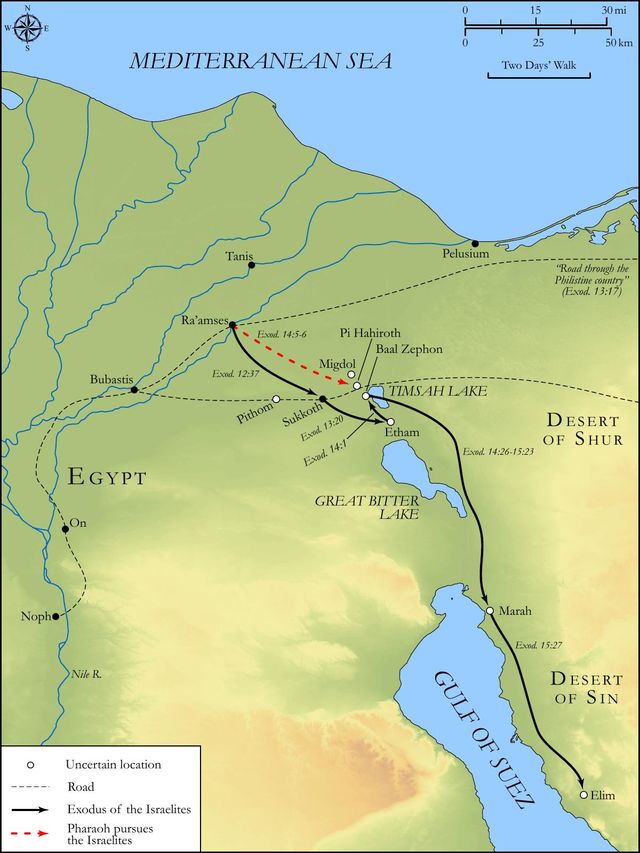
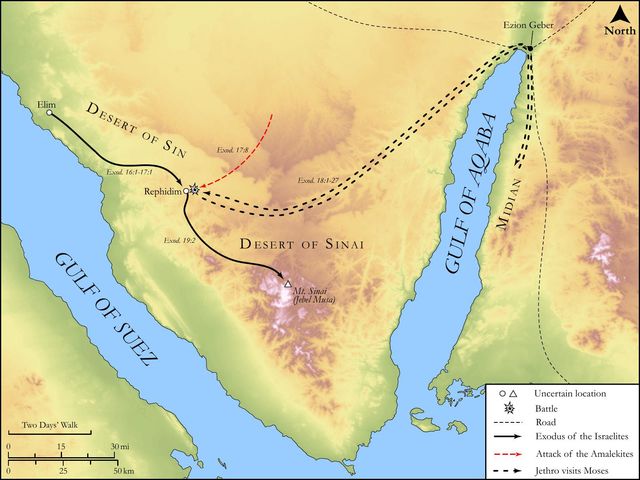
See on the biblical-era maps

Study this verse
Public-domain commentary
Matthew Henry
From his Commentary on the Whole Bible. Henry comments on passages, not single verses — this entry covers Exodus 12:21–28. His four-level outline is real structure in the source text, so it is rendered as structure.
I.Moses is here, as a faithful steward in God's house, teaching the children of Israel to observe all things which God had commanded him; and no doubt he gave the instructions as largely as he received them, though they are not so largely recorded. It is here added,
1.That this night, when the first-born were to be destroyed, no Israelite must stir out of doors till morning, that is, till towards morning, when they would be called to march out of Egypt, Exo 12:22. Not but that the destroying angel could have known an Israelite from an Egyptian in the street; but God would intimate to them that their safety was owing to the blood of sprinkling; if they put themselves from under the protection of that, it was at their peril. Those whom God has marked for himself must not mingle with evil doers: see Isa 26:20, Isa 26:21. They must not go out of the doors, lest they should straggle and be out of the way when they should be summoned to depart: they must stay within, to wait for the salvation of the Lord, and it is good to do so.
2.That hereafter they should carefully teach their children the meaning of this service, Exo 12:26, Exo 12:27. Observe,
(1.)The question which the children would ask concerning this solemnity (which they would soon take notice of in the family): "What mean you by this service? What is he meaning of all this care and exactness about eating this lamb, and this unleavened bread, more than about common food? Why such a difference between this meal and other meals?" Note,
[1.]It is a good thing to see children inquisitive about the things of God; it is to be hoped that those who are careful to ask for the way will find it. Christ himself, when a child, heard and asked questions, Luk 2:46.
[2.]It concerns us all rightly to understand the meaning of those holy ordinances wherein we worship God, what is the nature and what the end of them, what is signified and what intended, what is the duty expected from us in them and what are the advantages to be expected by us. Every ordinance has a meaning; some ordinances, as sacraments, have not their meaning so plain and obvious as others have; therefore we are concerned to search, that we may not offer the blind for sacrifice, but may do a reasonable service. If either we are ignorant of, or mistake about, the meaning of holy ordinances, we can neither please God nor profit ourselves.
(2.)The answer which the parents were to return to this question (Exo 12:27): You shall say, It is the sacrifice of the Lord's passover, that is, "By the killing and sacrificing of this lamb, we keep in remembrance the work of wonder and grace which God did for our fathers, when," [1.] "To make way for our deliverance out of bondage, he slew the firstborn of the Egyptians, so compelling them to sign our discharge;" and, [2.] "Though there were with us, even with us, sins against the Lord our God, for which the destroying angel, when he was abroad doing execution, might justly have destroyed our first-born too, yet God graciously appointed and accepted the family-sacrifice of a lamb, instead of the first-born, as, of old, the ram instead of Isaac, and in every house where the lamb was slain the first-born were saved." The repetition of this solemnity in the return of every year was designed, First, To look backward as a memorial, that in it they might remember what great things God had done for them and their fathers. The word pesach signifies a leap, or transition; it is a passing over; for the destroying angel passed over the houses of the Israelites, and did not destroy their first-born. When God brings utter ruin upon his people he says, I will not pass by them any more (Amo 7:8; Amo 8:2), intimating how often he had passed by them, as now when the destroying angel passed over their houses. Note, 1. Distinguishing mercies lay under peculiar obligations. When a thousand fall at our side, and ten thousand at our right hand, and yet we are preserved, and have our lives given us for a prey, this should greatly affect us, Psa 91:7. In war or pestilence, if the arrow of death have passed by us, passed over us, hit the next to us and just missed us, we must not say it was by chance that we were preserved but by the special providence of our God. 2. Old mercies to ourselves, or to our fathers, must not be forgotten, but be had in everlasting remembrance, that God may be praised, our faith in him encouraged, and our hearts enlarged in his service. Secondly, It was designed to look forward as an earnest of the great sacrifice of the Lamb of God in the fulness of time, instead of us and our first-born. We were obnoxious to the sword of the destroying angel, but Christ our passover was sacrificed for us, his death was our life, and thus he was the Lamb slain from the foundation of the world, from the foundation of the Jewish church: Moses kept the passover by faith in Christ, for Christ was the end of the law for righteousness.
II.The people received these instructions with reverence and ready obedience.
1.They bowed the head and worshipped (Exo 12:27): they hereby signified their submission to this institution as a law, and their thankfulness for it as a favour and privilege. Note, When God gives law to us, we must give honour to him; when he speaks, we must bow our heads and worship.
2.They went away and did as they were commanded, Exo 12:23. Here was none of that discontent and murmuring among them which we read of, Exo 5:20, Exo 5:21. The plagues of Egypt had done them good, and raised their expectations of a glorious deliverance, which before they despaired of; and now they went forth to meet it in the way appointed. Note, The perfecting of God's mercies to us must be waited for in a humble observance of his institutions.
Historical interpretation
Fourteen Centuries of Reception
4 surviving comments on this verse. Each one is dated, so this reads as a timeline rather than a list.
Select a marker to jump to its quote. Markers stagger vertically where authors wrote within a few decades of each other.
Be it so, some will say, in the case of those who ask for baptism; what have you to say about those who are still children and conscious neither of the loss nor of the grace? Are we to baptize them too? Certainly, if any danger presses. For it is better that they should be unconsciously sanctified than that they should depart unsealed and uninitiated.A proof of this is found in the circumcision on the eighth day, which was a sort of typical seal. It was conferred on children before they had use of reason. And so is the anointing of the doorposts, which preserved the firstborn, though applied to things which had no consciousness.
For he who is baptized is seen to be purified both according to the law and according to the gospel. According to the law, because Moses sprinkled the blood of the lamb with a bunch of hyssop. According to the gospel, because Christ’s garments were white as snow, when in the gospel he showed forth the glory of his resurrection.
They are to bear in mind that those who celebrated the Passover at the time through figures and shadows, when they were commanded to mark their doorpost with the blood of the lamb, marked them with hyssop. This is a mild and humble plant, but it has very strong and penetrating roots. So, “being rooted and grounded in love,” we may be able “to comprehend with all the saints what is the breadth and length and height and depth,” that is, the cross of the Lord.
Sprinkle: This sprinkling the doors of the Israelites with the blood of the paschal lamb, in order to their being delivered from the sword of the destroying angel, was a lively figure of our redemption by the blood of Christ.
Continue studying Exodus 12:22 across the web’s major study libraries — every link below opens this exact verse, chapter, or book on the destination site.
Read & Compare
 BibleGatewayThis verse in more than 200 translations and 70 languages.
 Bible.comThe YouVersion reader — hundreds of translations, reading plans, and highlights.
 ESV.orgCrossway's official English Standard Version reader.
 NET BibleThe NET translation with 60,000+ translators' notes on every rendering decision.
 STEP BibleTyndale House's free study tool — original text, vocabulary, and scholarly resources.
 BibliaLogos Bible Software's free web reader.
 USCCBThe New American Bible (Revised Edition) with the U.S. bishops' study notes.
Commentaries
 BibleHub CommentariesDozens of classic commentaries on this verse, gathered on one page.
 StudyLightMore than 100 commentary sets — the largest collection on the web.
 BibleRefPlain-English commentary on what this verse means, verse by verse.
 Enduring WordDavid Guzik's free commentary on this chapter, widely used by Bible teachers.
 Bible Study ToolsVerse commentary alongside Greek and Hebrew study aids.
Original Language & Research
- BibleHub InterlinearThe verse word by word — original language, transliteration, and English.
- BibleHub LexiconEvery word's original-language definition and Strong's entry.
 Blue Letter BibleDeep-study tools — Strong's numbers, concordance, and word studies.
 SefariaThe Hebrew text with Rashi and centuries of Jewish commentary.
Sermons, Hymns & Audio


TrulyRandomVerse is not affiliated with these sites and doesn’t control their content. They’re linked because they’re genuinely useful.
Summary
Exodus 12:22 delivers precise, life-preserving instructions for the inaugural Passover, mandating that each Israelite household apply the blood of a sacrificed lamb to their doorframes using hyssop and remain securely indoors until morning. This act of meticulous obedience, rooted in divine command, served as the visual sign for God to "pass over" their homes, sparing their firstborn from the climactic tenth plague against Egypt. It powerfully demonstrated God's sovereign power to protect and redeem His people through a marked sign of faith, establishing a foundational covenant ritual.
Context
ShowHideLiterary Context
This verse is an indispensable part of God's detailed directives to Moses and Aaron concerning the institution of the first Passover, meticulously outlined in Exodus 12:1-28. Prior to this specific command, God had already specified the selection of an unblemished lamb, its sacrifice, and the collection of its blood, as detailed in Exodus 12:3-7. Exodus 12:22 provides the crucial action of applying this blood. Immediately following, Exodus 12:23 articulates God's solemn promise of protection for those under the blood, alongside the dire consequence for those without this mark. The entire narrative arc of Exodus 12 culminates in the devastating execution of the tenth plague and the subsequent exodus of Israel from Egypt in Exodus 12:29-42.
Historical & Cultural Context
The events of Exodus 12 are set against the oppressive backdrop of Israel's brutal enslavement in ancient Egypt. God, through Moses, had already demonstrated His unparalleled power through nine escalating plagues, each designed to dismantle the authority of Pharaoh and expose the impotence of Egypt's pantheon of gods. The tenth plague, the death of the firstborn, represented the ultimate, decisive judgment. While blood rituals were present among the nations, often for purification, covenant sealing, or appeasement, the Passover ritual was uniquely commanded by Yahweh, directly linking a specific blood application to salvation from an imminent, divine judgment. The act of applying blood to the doorframe was not merely a private act but a visible, public declaration of allegiance to Yahweh, distinguishing Israelite households from the Egyptians. Remaining inside the house underscored the absolute necessity of divine protection and the peril of being exposed to God's judgment outside His prescribed covering. This pivotal event laid the theological and historical foundation for the annual Passover feast, a perpetual reminder of God's mighty deliverance and covenant faithfulness.
Key Themes
ShowHideExodus 12 is rich with foundational theological themes that resonate throughout the biblical narrative. Divine Sovereignty and Judgment are paramount, as God meticulously orchestrates the plagues and the Passover, demonstrating His absolute control over life and death. The theme of Redemption and Deliverance is central, with the Passover serving as the quintessential act of God freeing His people from bondage. Substitutionary Atonement is powerfully introduced, as the life of an unblemished lamb is sacrificed in place of the firstborn, foreshadowing greater realities. The necessity of Obedience and Faith is highlighted, as the Israelites' salvation is contingent upon their meticulous adherence to God's specific commands, not their own merit. Finally, the establishment of a Covenant Relationship is reinforced, as the Passover becomes a perpetual ordinance, binding God and His people in a sacred bond, marking them as distinct and chosen, as seen in the broader narrative of Exodus.
Exposition and Analysis
ShowHideExodus 12:22 meticulously details the precise actions required for the Israelites to secure divine protection during the final, devastating plague. Each element carries profound meaning, emphasizing the ritual's sacred nature and the necessity of obedience.
Key Word Analysis
ShowHideThis common plant, likely a variety of marjoram or oregano, was chosen for its small, brush-like leaves, making it an ideal tool for sprinkling liquids. Its significance extends beyond practicality, as hyssop was frequently employed in ancient Israelite purification rituals, often in conjunction with blood or water, to cleanse from defilement, such as leprosy (Leviticus 14:4) or sin (Psalm 51:7). Its inclusion here underscores the ritualistic, cleansing, and sanctifying nature of the act, preparing the household for divine protection.
In the Old Testament, blood is intrinsically linked to life (Leviticus 17:11). It is the primary means by which atonement is made for sin and reconciliation with God is achieved. Here, the blood of an unblemished lamb, sacrificed in place of the firstborn, serves as a substitute—a life for a life. The basin collected this precious, life-giving fluid, ready for its application, signifying the gravity of the impending judgment and the sanctity of the means of escape.
This word implies a deliberate, forceful, and active application, rather than a mere passive anointing or gentle touch. It suggests a decisive act of obedience and a public declaration. The act of "striking" the blood onto the doorframe was a powerful, visible sign, indicating that the household within was definitively set apart and under the protective covering of the blood, a clear signal for the "destroyer" to pass over.
Verse Breakdown
ShowHide"And ye shall take a bunch of hyssop, and dip [it] in the blood that [is] in the bason"
The instruction begins with the specific instrument—a bunch of hyssop—and the substance—the collected blood of the sacrificed lamb. The act of "dipping" signifies the saturation of the hyssop with the life-giving, atoning blood, preparing it for application. This highlights the intentionality and precision required in the ritual.
"and strike the lintel and the two side posts with the blood that [is] in the bason"
This is the core command for applying the blood. The "lintel" (the horizontal beam above the door) and the "two side posts" (the vertical doorframes) together form the complete entrance. Applying the blood to these three points effectively "sealed" the doorway, signifying that the entire household within was under the blood's protective covering. This created a visible, unmistakable sign for the "destroyer" to pass over, emphasizing that salvation was tied to God's specific, visible mark.
"and none of you shall go out at the door of his house until the morning"
This final, crucial instruction underscores the necessity of remaining under the blood's protection. To step outside the marked doorway would be to forfeit the divine covering and expose oneself to the judgment sweeping through Egypt. This command highlights the principle of abiding within God's appointed place of safety and obedience, emphasizing that the protection was conditional upon remaining within the bounds of God's covenant provision.
Literary Devices
ShowHideExodus 12:22 is rich with symbolism, where various elements represent deeper theological truths. The lamb itself is a potent symbol of substitutionary sacrifice, its innocent life given to spare another. The blood is the ultimate symbol of atonement, life, and protection, marking the boundary between judgment and salvation. The doorframe serves as a symbolic threshold, a visible boundary separating those under God's grace from those exposed to His wrath. The entire Passover ritual functions as a powerful type or foreshadowing, pointing forward to greater spiritual realities, particularly the ultimate redemptive work of Jesus Christ, the true Passover Lamb, whose blood provides eternal deliverance. The detailed instructions also convey divine precision, emphasizing that God's plan for salvation is not arbitrary but meticulously designed.
Theological and Thematic Connections
ShowHideExodus 12:22 unveils profound theological truths about God's character, His justice, and His gracious provision for humanity's salvation. It underscores God's absolute sovereignty over life and death, demonstrating His power to execute righteous judgment against sin and injustice, while simultaneously providing a divinely appointed way of escape for His chosen people. The Israelites were not saved by their own merit or works, but by God's gracious provision of a means of escape. Their part was to respond in faith through precise obedience to His command. The blood itself was the sign, but the act of applying it was the required response of faith, highlighting the efficacy of God's prescribed atonement. The central role of blood emphasizes its sacred nature in biblical theology: it is the life-giving essence, and its shedding in sacrifice is the means by which atonement is made and protection is secured. This points forward to the ultimate, perfect sacrifice. Furthermore, the blood on the doorposts marked a clear distinction between those under God's protection and those exposed to His judgment, signifying a divine act of setting apart, consecrating, and preserving His people.
This theme of salvation through a blood sacrifice and obedient faith resonates throughout the biblical narrative:
Reflection and Application
ShowHideExodus 12:22 offers profound spiritual lessons for believers today, transcending its historical context to speak to our universal need for salvation and security in God. Just as the Israelites' physical lives were preserved by the blood of the lamb and their meticulous obedience to God's specific instructions, our spiritual lives are eternally secured by the precious blood of Jesus Christ, our ultimate Passover Lamb. This verse serves as a powerful reminder that salvation is not a reward earned by our own merits or good works, but is a sovereign gift, freely offered by God's grace and received through faith in His divinely prescribed method of atonement. Our vital part is to trust fully in that provision and to abide in its protective embrace. Furthermore, the command for the Israelites to remain indoors until morning profoundly underscores the necessity of continually abiding "in Christ" for spiritual protection, sustenance, and identity. To step outside of His covering, to rely on our own strength or wisdom, is to expose ourselves to spiritual danger and the ongoing consequences of sin in a fallen world. This passage calls us to a deep, abiding trust in the finished work of Christ and a faithful adherence to His commands, recognizing that true safety and life are found only within Him.
Questions for Reflection
ShowHideFAQ
ShowHideWhy was hyssop specifically chosen for this ritual?
ShowHideHyssop was chosen for both practical and symbolic reasons. Practically, it was a common plant with small, brush-like branches, making it an ideal tool for sprinkling liquids, ensuring the blood could be effectively applied to the doorframe. Symbolically, hyssop held significant ritualistic associations in ancient Israel, frequently used in purification ceremonies, such as cleansing from leprosy (Leviticus 14:4) and for spiritual cleansing, as seen in the plea for purification in Psalm 51:7. Its inclusion in the Passover ritual underscored the sacred, cleansing, and sanctifying nature of the act, emphasizing that the blood was not merely a physical barrier but a divine agent of purification and separation from judgment.
Was the act of applying the blood a magical charm, or something else?
ShowHideThe application of the blood was emphatically not a magical charm or a superstitious act. It was a direct, obedient response of faith to God's explicit command. The power to save was not inherent in the blood itself, nor in the physical act, but solely in God's sovereign promise to "pass over" those houses marked precisely according to His instructions. It served as a visible sign of an invisible covenant relationship and trust in God's word, distinguishing those who believed and obeyed from those who did not. The efficacy lay in God's faithfulness to His word, not in any intrinsic power of the ritual apart from Him.
What would have happened if an Israelite household did not follow these instructions precisely?
ShowHideThe biblical text strongly implies that precise obedience was critical for protection. Exodus 12:23 states, "For the Lord will pass through to smite the Egyptians; and when he seeth the blood upon the lintel, and on the two side posts, the Lord will pass over the door, and will not suffer the destroyer to come in unto your houses to smite you." Without the blood applied as commanded, there would have been no distinguishing mark for the "destroyer" to "pass over." The consequence would have been the death of the firstborn in that household, just as with the Egyptians, because salvation and protection were contingent on following God's prescribed method and abiding within His covenant provision.
Christ-Centered Fulfillment
ShowHideExodus 12:22, with its vivid imagery of the Passover lamb's blood providing protection from death, serves as a profound Old Testament type pointing directly and powerfully to the person and redemptive work of Jesus Christ. The unblemished Passover lamb, whose blood was shed to save the firstborn, perfectly foreshadows Jesus, the "Lamb of God, which taketh away the sin of the world" (John 1:29). Just as the blood of the lamb was shed and applied to the doorposts to avert physical death and judgment, so Jesus's precious and sinless blood was shed on the cross, not merely to avert physical death, but to provide eternal deliverance from the penalty, power, and ultimately the presence of sin and spiritual death. The act of "striking" the doorframe with hyssop and blood finds its ultimate fulfillment in our active faith in Christ's atoning sacrifice. We are called to "apply" His blood, not physically, but spiritually, by believing in His finished work on the cross, confessing Him as Lord, and yielding our lives to Him (Romans 10:9-10). The command to remain inside the house until morning prefigures the New Testament call to "abide in Christ" (John 15:4), finding our security, identity, and eternal salvation solely within His divine covering and union with Him. Through Jesus, the ultimate Passover Lamb, the righteous judgment of God "passes over" all who are "in Him" (Romans 8:1), marked by His atoning blood, granting them eternal life, freedom from spiritual slavery, and adoption into God's family (Galatians 4:4-7).