


Esther 7:1
Bible text: King James Version (1769 Blayney text) · Public domain
Bible text: Berean Standard Bible · Public domain
Bible text: American Standard Version (1901) · Public domain
Bible text: World English Bible, Messianic edition · Public domain
Bible text: Geneva Bible (1599) · Public domain
Bible text: Young's Literal Translation · Public domain
- וַיָּבֹאvai·ya·Vo'and he wentH935Conj-w ¦ V-Qal-ConsecImperf-3msVerb Qal Consecutive Imperfect 3rd Singular Masculineוַandיָּבֹאhe went
- הַמֶּלֶךְha·Me·lekhthe kingH4428Art ¦ N-msNoun Singular Masculine Absoluteהַtheמֶּלֶךְking
- וְהָמָןve·ha·Manand HamanH2001Conj-w ¦ N-proper-mNoun Proper MasculineוְandהָמָןHaman
- לִשְׁתּוֹתlish·Totto drinkH8354Prep-l ¦ V-Qal-InfVerb Qal Infinitive Constructלִtoשְׁתּוֹתdrink
- עִם'imwithH5973PrepPreposition
- אֶסְתֵּר'es·TerEstherH635N-proper-fNoun Proper Feminine
- הַמַּלְכָּהha·mal·Kahthe queenH4436Art ¦ N-fsNoun Singular Feminine Absoluteהַtheמַּלְכָּהqueen
English is a literal word-by-word gloss of the Hebrew, not the KJV's wording. Why?
This is the original text the KJV's translators worked from — each Hebrew word with its own literal English meaning in this verse, prepared by scholars at Tyndale House, Cambridge. The KJV translates whole sentences, not word by word, so its wording differs: one Hebrew word can become several English words, and the KJV may choose “the LORD” where the gloss reads “Yahweh”. Both are faithful — they answer different questions. For the KJV's own rendering, switch to the KJV text.
Details
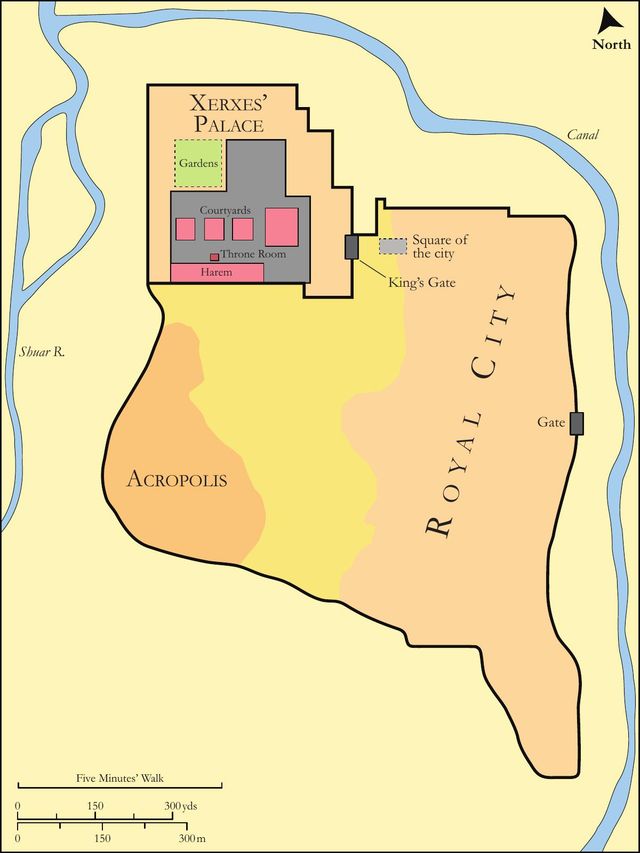
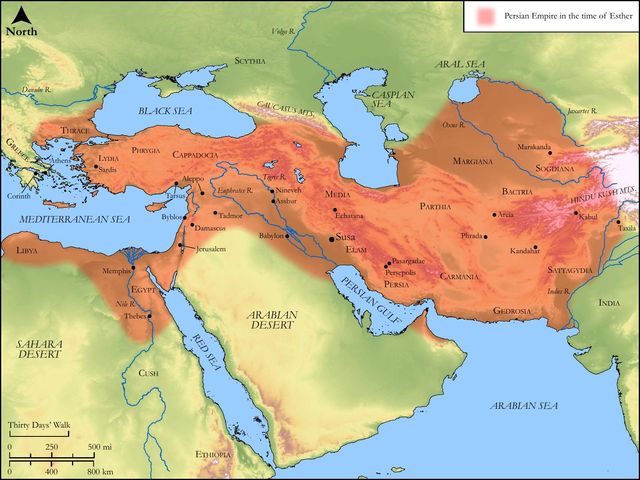
See on the biblical-era maps
Study this verse
Public-domain commentary
Matthew Henry
From his Commentary on the Whole Bible. Henry comments on passages, not single verses — this entry covers Esther 7:1–6. His three-level outline is real structure in the source text, so it is rendered as structure.
The king in humour, and Haman out of humour, meet at Esther's table. Now,
I.The king urged Esther, a third time, to tell him what her request was, for he longed to know, and repeated his promise that it should be granted, Est 7:2. If the king had now forgotten that Esther had an errand to him, and had not again asked what it was, she could scarcely have known how to renew it herself; but he was mindful of it, and now was bound with the threefold cord of a promise thrice made to favour her.
II.Esther, at length, surprises the king with a petition, not for wealth or honour, or the preferment of some of her friends to some high post, which the king expected, but for the preservation of herself and her countrymen from death and destruction, Est 7:3, Est 7:4.
1.Even a stranger, a criminal, shall be permitted to petition for his life; but that a friend, a wife, should have occasion to present such a petition was very affecting: Let my life be given me at my petition, and my people at my request. Two things bespeak lives to be very precious, and fit to be saved, if innocent, at any expense: - (1.) Majesty. If it be a crowned head that is struck at, it is time to stir. Esther's was such: "Let my life be given me. If thou hast any affection for the wife of thy bosom, now is the time to show it; for that is the life that lies at stake." (2.) Multitude. If they be many lives, very many, and those no way forfeited, that are aimed at, no time should be lost nor pains spared to prevent the mischief. "It is not a friend or two, but my people, a whole nation, and a nation dear to me, for the saving of which I now intercede."
2.To move the king the more she suggests,
(1.)That she and her people were bought and sold. They had not sold themselves by any offence against the government, but were sold to gratify the pride and revenge of one man.
(2.)That it was not their liberty only, but their lives that were sold. "Had we been sold" (she says) "into slavery, I would not have complained; for in time we might have recovered our liberty, thought eh king would have made but a bad bargain of it, and not have increased his wealth by our price. Whatever had been paid for us, the loss of so many industrious hands out of his kingdom would have been more damage to the treasury than the price would countervail." To persecute good people is as impolitic as it is impious, and a manifest wrong to the interests of princes and states; they are weakened and impoverished by it. But this was not the case. We are sold (says she) to be destroyed, to be slain, and to perish; and then it is time to speak. She refers to the words of the decree (Est 3:13), which aimed at nothing short of their destruction; this would touch in a tender part if there were any such in the king's heart, and would bring him to relent.
III.The king stands amazed at the remonstrance, and asks (Est 7:5) "Who is he, and where is he, that durst presume in his heart to do so? What! contrive the murder of the queen and all her friends? Is there such a man, such a monster rather, in nature? Who is he, and where is he, whose heart has filled him to do so?" Or, Who hath filled his heart. He wonders,
1.That any one should be so bad as to think such a thing; Satan certainly filled his heart.
2.That any one should be so bold as to do such a thing, should have his heart so fully set in him to do wickedly, should be so very daring. Note,
(1.)It is hard to imagine that there should be such horrid wickedness committed in the world as really there is. Who, where is he, that dares, presumes, to question the being of God and his providence, to banter his oracles, profane his name, persecute his people, and yet bid defiance to his wrath? Such there are, to think of whom is enough to make horror take hold of us, Psa 119:53.
(2.)We sometimes startle at the mention of that evil which yet we ourselves are chargeable with. Ahasuerus is amazed at that wickedness which he himself is guilty of; for he consented to that bloody edict against the Jews. Thou art the man, might Esther too truly have said.
IV.Esther plainly charged Haman with it before his face:
"Here he is, let him speak for himself, for therefore he is invited: The adversary and enemy is this wicked Haman (Est 7:6); it is he that has designed our murder, and, which is worse, has basely drawn the king in to be particeps criminisa partaker of his crime, ignorantly agreeing to it."
V.Haman is soon apprehensive of his danger:
He was afraid before the king and queen; and it was time for him to fear when the queen was his prosecutor, the king his judge, and his own conscience a witness against him; and the surprising operations of Providence against him that same morning could not but increase his fear. Now he has little joy of his being invited to the banquet of wine, but finds himself in straits when he thought himself in the fulness of his sufficiency. He is cast into a net by his own feet.
Historical interpretation
Historical reception
2 surviving comments on this verse. Each one is dated, so this reads as a timeline rather than a list.
Now, notice that Haman is now attending the second day just as he had come before when he was summoned; and yet once Esther lays out her request, he is condemned and goes off to his punishment. This explains the fact that in one place in the Gospels is mentioned a lunch made by a person, and elsewhere a dinner; since the lunch symbolizes the present Church, and the dinner the eternal and final feast. Hence once the sinners have been removed, only the good may rejoice in the sight of their creator.
Because Haman—who was of course the spiritual enemy of the people of God—was not wearing the garment of charity which would have made him worthy of the king’s feast, he realized that the king was angry; and when the king rushed into the garden—that is, when he invited his chosen ones to the delights of paradise—he tried to plead with the queen for his own safety but in vain, since he could not find an opportune moment for this. For once the penalty of vengeance is imminent, it is too late to look for a means of salvation.
So too in the Gospel parable, the foolish virgins ask for oil to refill their lamps when the groom is on his way, but do not receive it. So after the Groom has entered the wedding with the wise virgins, and the door has been closed, the others remain locked out and must look for a point of entry; but there is no way they can be worthy of this, since they no longer find the opportunity for absolution which they had earlier failed to seek out by doing the appropriate deeds.
One may no longer deserve there what he asks from the Lord, if he did not listen here to what he was ordered to do; once he has lost the chance to do the appropriate penance, in vain does he come with his prayers before the door of the kingdom. This is, in fact, the reason why the Lord says through Solomon: “I called and you refused; I stretched out my hand and no one paid attention; you despised all my counsel, and you ignored my reproaches. I too will laugh at your destruction, and I will mock you when that which you fear comes to pass; when sudden disaster overwhelms you, and destruction assails you like a storm. Then they will call on me but I will not listen; they will arise in the morning but will not find me” (Proverbs 1).
The second day of the banquet arrives to which Haman is invited like before. However, after Esther reveals her petition, he is condemned and brought to his place of execution. The gospel mentions this as a noonday meal in one passage and as an evening meal in another. For it designates the noonday meal of the present church but also the eternal supper and final banquet where only the righteous will rejoice before their creator after sinners have been separated out. Therefore Haman, the spiritual enemy of the people of God, realized that the king was angry because he did not have the robe of charity that would make him worthy of the royal banquet. And while he was hurrying to the palace gardens, that is, while he invited his elect to the delights of paradise, he tried to entreat the queen for his salvation. It was to no avail, however, because he was not able to find the right time for this. It is already too late to ask for the remedies of salvation when revenge and punishment are near.In the parable of the gospel concerning the coming bridegroom, the foolish virgins also ask the wise for oil to fill their lamps, but do not receive any. And after the bridegroom has entered the wedding banquet with the wise virgins, the door is closed. And because they are left outside, they ask to be admitted. They are no longer able to incur this favor, however, because the time for mercy which they neglected to ask for previously with their good works is now past.
One who has no desire to hear what the Lord has commanded cannot receive from him what he asks for. And one who has neglected the time for appropriate repentance comes in vain to the door of the kingdom with his prayers. And indeed the Lord says through Solomon, “I called you and you refused. I stretched out my arms and no one heeded. And because you ignored all my counsel and would have none of my reproof, I also will laugh at your calamity; I will mock when panic strikes you like a storm, and your calamity comes like a whirlwind, when distress and anguish come upon you. Then they will call upon me, but I will not answer; they will seek me diligently, but will not find me.”
Continue studying Esther 7:1 across the web’s major study libraries — every link below opens this exact verse, chapter, or book on the destination site.
Read & Compare
 BibleGatewayThis verse in more than 200 translations and 70 languages.
 Bible.comThe YouVersion reader — hundreds of translations, reading plans, and highlights.
 ESV.orgCrossway's official English Standard Version reader.
 NET BibleThe NET translation with 60,000+ translators' notes on every rendering decision.
 STEP BibleTyndale House's free study tool — original text, vocabulary, and scholarly resources.
 BibliaLogos Bible Software's free web reader.
 USCCBThe New American Bible (Revised Edition) with the U.S. bishops' study notes.
Commentaries
 BibleHub CommentariesDozens of classic commentaries on this verse, gathered on one page.
 StudyLightMore than 100 commentary sets — the largest collection on the web.
 BibleRefPlain-English commentary on what this verse means, verse by verse.
 Enduring WordDavid Guzik's free commentary on this chapter, widely used by Bible teachers.
 Bible Study ToolsVerse commentary alongside Greek and Hebrew study aids.
Original Language & Research
- BibleHub InterlinearThe verse word by word — original language, transliteration, and English.
- BibleHub LexiconEvery word's original-language definition and Strong's entry.
 Blue Letter BibleDeep-study tools — Strong's numbers, concordance, and word studies.
 SefariaThe Hebrew text with Rashi and centuries of Jewish commentary.
Sermons, Hymns & Audio


TrulyRandomVerse is not affiliated with these sites and doesn’t control their content. They’re linked because they’re genuinely useful.
Summary
Esther 7:1 marks the dramatic culmination of Queen Esther's strategic planning, initiating the second, decisive banquet with King Ahasuerus and Haman. This seemingly straightforward statement of arrival is charged with profound dramatic irony and escalating tension, meticulously setting the stage for the queen's courageous revelation and the swift, irreversible downfall of Haman, thereby foreshadowing the dramatic reversal of fortunes that is about to unfold for the Jewish people.
Context
ShowHideLiterary Context
This verse immediately follows a meticulously orchestrated sequence of events initiated by Queen Esther. In Esther 5:4, Esther first invited the king and Haman to a banquet. Rather than presenting her petition to save her people from Haman's genocidal decree at that initial gathering, she strategically postponed her request, inviting them to a second, more intimate banquet the following day, as recorded in Esther 5:8. The intervening night proved critical: King Ahasuerus suffered from insomnia, leading him to review the royal chronicles. This review uncovered Mordecai's past loyalty, which had gone unrewarded, resulting in Haman being compelled to publicly honor Mordecai, the very man he despised and planned to hang, as detailed in Esther 6:11. Thus, Haman arrives at this second banquet humiliated and deeply troubled, yet utterly oblivious to the fact that he is walking into the trap that will seal his ultimate demise, a stark contrast to his earlier arrogance.
Historical & Cultural Context
The Persian court was renowned for its lavish banquets, which served not merely as social gatherings but as crucial arenas for political maneuvering, the forging or breaking of alliances, and the issuance of royal decrees. These feasts were often characterized by extensive drinking, as implied by the Hebrew term for "banquet" (often associated with drinking feasts, mishteh). The presence of only the king, queen, and Haman at this particular banquet underscores its extraordinary intimacy and gravity. This exclusivity heightens the tension and signifies that what is about to transpire is a deeply personal and consequential confrontation, far removed from the public spectacle of most royal gatherings. Haman, as the highest-ranking official, would have perceived his repeated invitation as a sign of unparalleled favor, reinforcing his inflated sense of importance and privilege just before his catastrophic fall.
Key Themes
ShowHideThe narrative leading up to Esther 7 and the events of this verse powerfully illustrate several key themes. First, Divine Providence is unmistakably evident; though God is never explicitly mentioned in the book of Esther, His unseen hand is consistently at work, orchestrating seemingly coincidental events—like the king's sleepless night in Esther 6:1 and Esther's perfectly timed actions—to bring about the deliverance of His people. Second, Dramatic Irony permeates the scene; Haman enters the banquet hall believing he is the most favored man in the kingdom, invited again by the queen, yet he is unknowingly walking into a trap set by the very woman he intends to destroy, a classic illustration of pride preceding a fall, as seen in Proverbs 16:18. Third, Esther's Courage and Wisdom are central to the unfolding drama; her strategic decision to host a second banquet, rather than making her plea at the first, allowed divine events to unfold that further weakened Haman's position and strengthened hers, demonstrating remarkable patience and discernment in the face of immense pressure.
Exposition and Analysis
ShowHideKey Word Analysis
ShowHideThis primitive root signifies "to go or come" in a wide variety of applications, including entering, arriving, or bringing to pass. In this context, it denotes the physical arrival of the king and Haman, but also carries the weight of their entering into the pre-ordained moment of truth. Their "coming" signifies the culmination of Esther's patient strategy and the divine orchestration of events.
Of foreign derivation, Haman is identified as the Persian vizier and the primary antagonist in the book of Esther. His presence at this intimate banquet is laden with dramatic irony, as he is unknowingly walking into the very trap set by the woman whose people he seeks to annihilate. His name, at this point, becomes synonymous with impending doom and the ultimate reversal of fortune.
This primitive root means "to imbibe" or "to drink," often referring to a drinking feast. In the context of the Persian court, a "banquet" was not merely a social gathering but a significant political event. The use of this term here highlights that the gathering is not just a meal but a formal, consequential occasion where significant matters are addressed, underscoring the gravity of the impending revelation.
Verse Breakdown
ShowHide"¶ So the king and Haman came"
This clause establishes the arrival of the two key male figures at the queen's second banquet. The introductory "So" (KJV "¶ So") indicates a direct continuation and consequence of the preceding events, particularly the king's sleepless night and Haman's public humiliation. Their arrival signifies the culmination of Esther's strategic delay and the perfect timing for her revelation. Haman, despite his recent public disgrace, still holds his position of power and believes he is entering a place of honor, utterly unaware of the impending catastrophe that awaits him.
"to banquet with Esther the queen."
This phrase specifies the purpose and the host of the gathering. The intimacy conveyed by "with Esther the queen" underscores the personal and private nature of this confrontation. Unlike the larger, more public feasts, this exclusive setting allows for a direct, unmediated appeal, highlighting Esther's agency and courage in bringing her petition before the king in a controlled environment where Haman cannot easily escape or deflect. It is a setting designed for a decisive, personal confrontation.
Literary Devices
ShowHideEsther 7:1 is rich with Dramatic Irony, as Haman, still reeling from his forced public honor of Mordecai, enters the queen's private banquet believing he is a favored guest, completely oblivious that this very gathering is the setting for his downfall. This creates intense Suspense for the reader, who is aware of Esther's true intentions and the king's recent discovery, contrasting sharply with Haman's profound ignorance. The verse also employs Foreshadowing, as the very act of the king and Haman arriving at Esther's second banquet signals that the carefully laid plans are about to culminate, hinting at the dramatic climax and the swift reversal of fortune that will immediately follow. The Juxtaposition of Haman's perceived status and his imminent doom amplifies the narrative's tension and underscores the swiftness of divine justice.
Theological and Thematic Connections
ShowHideEsther 7:1, though simple in its phrasing, is a profound testament to divine sovereignty working through human agency and timing. It underscores the biblical principle that pride precedes destruction, and a haughty spirit before a fall, as seen in Haman's dramatic reversal. The verse also highlights the importance of strategic patience and courage in the face of overwhelming evil, demonstrating how God can use seemingly ordinary individuals and events to accomplish His extraordinary purposes. The unseen hand of God is orchestrating every detail, bringing the oppressor into the very presence of his victim, setting the stage for justice and deliverance in a way that magnifies His providential care for His people.
Reflection and Application
ShowHideEsther 7:1 serves as a powerful reminder that God often works behind the scenes, orchestrating seemingly coincidental events and human decisions to bring about His perfect will. For believers, this verse encourages a posture of patient trust, even when circumstances seem dire or when facing formidable adversaries. Esther's strategic delay and her courage in confronting injustice, even at personal risk, offer a compelling model. It prompts us to consider how we might discern God's timing in our own lives, to exercise wisdom in our actions, and to find the courage to rebuke the powerful, trusting that God is sovereign over all events, even those where His name is not explicitly invoked. Our role is to be faithful and obedient, even when the path is unclear, knowing that His purposes will ultimately prevail and that He is able to turn the tables on those who oppress.
Questions for Reflection
ShowHideFAQ
ShowHideWhy did Esther host a second banquet instead of making her petition at the first one?
ShowHideEsther's decision to host a second banquet, as hinted at in Esther 5:8, was a brilliant strategic move rooted in wisdom and divine timing. It allowed for several critical developments to unfold, primarily the king's sleepless night and his subsequent discovery of Mordecai's unrewarded loyalty in Esther 6:1. This sequence of events resulted in Haman's public humiliation (see Esther 6:11) and a significant shift in the king's disposition, making him more receptive to Esther's plea and more inclined to punish Haman. It also heightened the dramatic tension and isolated Haman, making his downfall all the more impactful and inescapable.
What is the significance of Haman's presence at this intimate banquet?
ShowHideHaman's presence at this exclusive banquet, alongside only the king and queen, is laden with dramatic irony and serves as a powerful setup for his impending downfall. From his perspective, it solidified his status as the king's most favored official, invited to the queen's most intimate gathering, a perceived pinnacle of his power. However, for the reader, it represents Haman walking directly into the trap set by Esther. His presence ensures that he is a direct witness to his own condemnation and the reversal of fortunes, making his humiliation and execution a personal and inescapable consequence of his own wickedness, fulfilling the principle of reaping what one sows. It underscores the profound justice about to be meted out.
Christ-Centered Fulfillment
ShowHideThe dramatic reversal of fortune depicted in Esther 7:1, where Haman, the oppressor, is brought into the very presence of the queen for his ultimate downfall, powerfully foreshadows the ultimate deliverance achieved through Christ. Just as Esther strategically positioned herself and courageously exposed the enemy, Jesus, the true King and ultimate deliverer, entered human history to confront the spiritual enemy, Satan, and the power of sin and death. The seemingly mundane act of "coming to banquet" in Esther 7:1 points to the ultimate "banquet" of salvation and the triumph of God's people. Christ, through His sacrificial death on the cross and glorious resurrection, disarmed the powers and authorities, triumphing over them by His cross (Colossians 2:15). He is the true Lamb of God who takes away the sin of the world (John 1:29), delivering His people from the decree of spiritual death and ushering them into an eternal kingdom. Ultimately, He will host a great wedding feast (Revelation 19:9) for His redeemed, where no enemy will be present to threaten their eternal joy and peace.