


Daniel 6:11
Bible text: King James Version (1769 Blayney text) · Public domain
Bible text: Berean Standard Bible · Public domain
Bible text: American Standard Version (1901) · Public domain
Bible text: World English Bible, Messianic edition · Public domain
Bible text: Geneva Bible (1599) · Public domain
Bible text: Young's Literal Translation · Public domain
- אֱדַיִן'E·da·yinthenH116AdvAdverb
- גֻּבְרַיָּאguv·rai·Ya'men theH1400N-mp ¦ ArtNoun Plural Masculine Definiteגֻּבְרַיָּmenאthe
- אִלֵּךְ'i·leKhtheseH479PrtParticle Demonstrative
- הַרְגִּשׁוּhar·Gi·shuthey came as a crowdH7284V-Haphel-Perf-3mpVerb Haphel Perfect 3rd Plural Masculine
- וְהַשְׁכַּחוּve·hash·Ka·chuand they foundH7912Conj-w ¦ V-Haphel-Perf-3mpVerb Haphel Perfect 3rd Plural Masculineוְandהַשְׁכַּחוּthey found
- לְדָנִיֵּאלle·da·ni·Yel<obj.> DanielH1841Prep-l ¦ N-proper-mNoun Proper Masculineלְ<obj.>דָנִיֵּאלDaniel
- בָּעֵאba·'E'askingH1156V-Peal-Prtcpl-msVerb Peal Participle Singular Masculine Absolute
- וּמִתְחַנַּןu·mit·cha·Nanand imploring favorH2604Conj-w ¦ V-Hitpaal-Prtcpl-msVerb Hitpaal Participle Singular Masculine Absoluteוּandמִתְחַנַּןimploring favor
- קֳדָםko·DambeforeH6925N-cscNoun Singular common gender Construct
- אֱלָהֵהּ'e·la·Hehhis GodH426N-csc ¦ 3msNoun Singular common gender ConstructאֱלָהֵGodהּhis
English is a literal word-by-word gloss of the Hebrew, not the KJV's wording. Why?
This is the original text the KJV's translators worked from — each Hebrew word with its own literal English meaning in this verse, prepared by scholars at Tyndale House, Cambridge. The KJV translates whole sentences, not word by word, so its wording differs: one Hebrew word can become several English words, and the KJV may choose “the LORD” where the gloss reads “Yahweh”. Both are faithful — they answer different questions. For the KJV's own rendering, switch to the KJV text.
Details
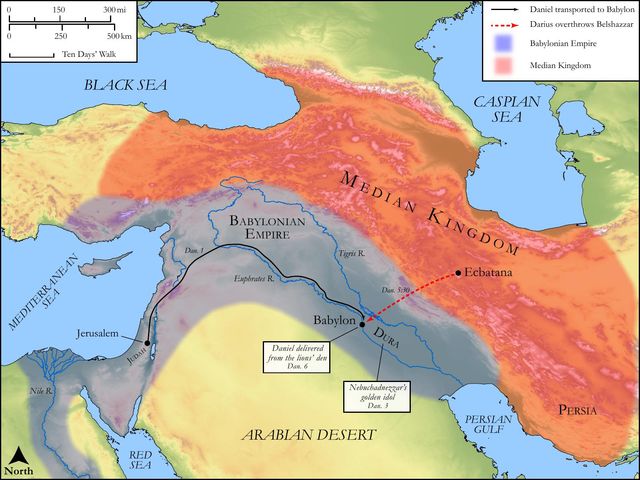
See on the biblical-era map
Study this verse
Public-domain commentary
Matthew Henry
From his Commentary on the Whole Bible. Henry comments on passages, not single verses — this entry covers Daniel 6:11–17.
Here is 1. Proof made of Daniel's praying to his God, notwithstanding the late edict to the contrary (Dan 6:11): These men assembled; the came tumultuously together, so the word is, the same that was used Dan 6:6, borrowed from Psa 2:1, Why do the heathen rage? They came together to visit Daniel, perhaps under pretence of business, at that time which they knew to be his usual hour of devotion; and, if they had not found him so engaged, they would have upbraided him with his faint-heartedness and distrust of his God, but (which they rather wished to do) they found him on his knees praying and making supplication before his God. For his love they are his adversaries; but, like his father David, he gives himself unto prayer, Psa 109:4. 2. Complaint made of it to the king. When they had found occasion against Daniel concerning the law of his God they lost no time, but applied to the king (Dan 6:12), and having appealed to his whether there was not such a law made, and gained from him a recognition of it, and that it was so ratified that it might not be altered, they proceeded to accuse Daniel, Dan 6:13. They so describe him, in the information they give, as to exasperate the king and incense him the more against him: "He is of the children of the captivity of Judah; he is of Judah, that despicable people, and now a captive in a despicable state, that can call nothing his own but what he has by the king's favour, and yet he regards not thee, O king! nor the decree that thou hast signed." Note, It is no new thing for that which is done faithfully, in the conscience towards God, to be misrepresented as done obstinately and in contempt of the civil powers, that is, for the best saints to be reproached as the worst men. Daniel regarded God, and therefore prayed, and we have reason to think prayed for the king and his government, yet this is construed as not regarding the king. That excellent spirit which Daniel was endued with, and that established reputation which he had gained, could not protect him from these poisonous darts. They do not say, He makes his petition to his God, lest Darius should take notice of that to his praise, but only, He makes his petition, which is the thing the law forbids. 3. The great concern the king was in hereupon. He now perceived that, whatever they pretended, it was not to honour him, but in spite to Daniel, that they had proposed that law, and now he is sorely displeased with himself for gratifying them in it, Dan 6:14. Note, When men indulge a proud vain-glorious humour, and please themselves with that which feeds it, they know not what vexations they are preparing for themselves; their flatterers may prove their tormentors, and are but spreading a net for their feet. Now, the king sets his heart to deliver Daniel; both by argument and by authority he labours till the going down of the sun to deliver him, that is, to persuade his accusers not to insist upon his prosecution. Note, We often do that, through inconsideration, which afterwards we see cause a thousand times to wish undone again, which is a good reason why we should ponder the path of our feet, for then all our ways will be established. 4. The violence with which the prosecutors demanded judgment, Dan 6:15. We are not told what Daniel said; the king himself is his advocate, he needs not plead his own cause, but silently commits himself and it to him that judges righteously. But the prosecutors insist upon it that the law must have its course; it is a fundamental maxim in the constitution of the government of the Medes and Persians, which had now become the universal monarchy, that no decree or statute which the king establishes may be changed. The same we find Est 1:19; Est 8:8. The Chaldeans magnified the will of their king, by giving him a power to make and unmake laws at his pleasure, to slay and keep alive whom he would. The Persians magnified the wisdom of their king, by supposing that whatever law he solemnly ratified it was so well made that there could be no occasion to alter it, or dispense with it, as if any human foresight could, in framing a law, guard against all inconveniences. But, if this maxim be duly applied to Daniel's case (as I am apt to think it is not, but perverted), while it honours the king's legislative power it hampers his executive power, and incapacitates him to show that mercy which upholds the throne, and to pass acts of indemnity, which are the glories of a reign. Those who allow not the sovereign's power to dispense with a disabling statute, yet never question his power to pardon an offence against a penal statute. But Darius is denied this power. See what need we have to pray for princes that God would give them wisdom, for they are often embarrassed with great difficulties, even the wisest and best are. 5. The executing of the law upon Daniel. The king himself, with the utmost reluctance, and against his conscience, signs the warrant for his execution; and Daniel, that venerable grave man, who carried such a mixture of majesty and sweetness in his countenance, who had so often looked great upon the bench, and at the council-board, and greater upon his knees, who had power with God and man, and had prevailed, is brought, purely for worshipping his God, as if he had been one of the vilest of malefactors, and thrown into the den of lions, to be devoured by them, Dan 6:16. One cannot think of it without the utmost compassion to the gracious sufferer and the utmost indignation at the malicious prosecutors. To make sure work, the stone laid upon the mouth of the den is sealed, and the king (an over-easy man) is persuaded to seal it with his own signet (Dan 6:17), that unhappy signet with which he had confirmed the law that Daniel falls by. But his lords cannot trust him, unless they add their signets too. Thus, when Christ was buried, his adversaries sealed the stone that was rolled to the door of his sepulchre. 6. The encouragement which Darius gave to Daniel to trust in God: Thy God whom thou servest continually, he will deliver thee, Dan 6:16. Here (1.) He justifies Daniel from guilt, owning all his crime to be serving his God continually, and continuing to do so even when it was made a crime. (2.) He leaves it to God to free him from punishment, since he could not prevail to do it: He will deliver thee. He is sure that his God can deliver him, for he believes him to be an almighty God, and he has reason to think he will do it, having heard of his delivering Daniel's companions in a like case from the fiery furnace, and concluding him to be always faithful to those who approve themselves faithful to him. Note, Those who serve God continually he will continually preserve, and will bear them out in his service.
Historical interpretation
Historical reception
1 surviving comment on this verse from the historical church.
Verse 11. "Those men, therefore, conducted an inquisitive search and discovered Daniel in prayer and making supplication unto his God." From this passage we learn that we are not to expose ourselves rashly to danger, but so far as it lies in our power, we are to avoid the plots of our enemies. And so in Daniel's case, he did not contravene the king's authority in a public square or out in the street, but rather in a private place, in order that he might not neglect the commands of the one true God Almighty.
Continue studying Daniel 6:11 across the web’s major study libraries — every link below opens this exact verse, chapter, or book on the destination site.
Read & Compare
 BibleGatewayThis verse in more than 200 translations and 70 languages.
 Bible.comThe YouVersion reader — hundreds of translations, reading plans, and highlights.
 ESV.orgCrossway's official English Standard Version reader.
 NET BibleThe NET translation with 60,000+ translators' notes on every rendering decision.
 STEP BibleTyndale House's free study tool — original text, vocabulary, and scholarly resources.
 BibliaLogos Bible Software's free web reader.
 USCCBThe New American Bible (Revised Edition) with the U.S. bishops' study notes.
Commentaries
 BibleHub CommentariesDozens of classic commentaries on this verse, gathered on one page.
 StudyLightMore than 100 commentary sets — the largest collection on the web.
 BibleRefPlain-English commentary on what this verse means, verse by verse.
 Enduring WordDavid Guzik's free commentary on this chapter, widely used by Bible teachers.
 Bible Study ToolsVerse commentary alongside Greek and Hebrew study aids.
Original Language & Research
- BibleHub InterlinearThe verse word by word — original language, transliteration, and English.
- BibleHub LexiconEvery word's original-language definition and Strong's entry.
 Blue Letter BibleDeep-study tools — Strong's numbers, concordance, and word studies.
 SefariaThe Hebrew text with Rashi and centuries of Jewish commentary.
Sermons, Hymns & Audio


TrulyRandomVerse is not affiliated with these sites and doesn’t control their content. They’re linked because they’re genuinely useful.
Summary
Daniel 6:11 captures a critical moment in the narrative, revealing the success of the conspirators' treacherous plot against Daniel. This verse vividly portrays how these men, driven by jealousy and malice, discovered Daniel engaged in his habitual practice of prayer and supplication before God, an act in direct defiance of the recently enacted royal decree. This scene sets the immediate stage for Daniel's accusation and subsequent miraculous deliverance, powerfully underscoring his unwavering integrity and profound loyalty to God, which transcended any earthly command or threat.
Context
ShowHideLiterary Context
This verse serves as the climax of the conspirators' scheme, immediately following Daniel's conscious decision to continue his devotion despite the king's decree. Daniel 6:7 outlines the severe penalty of the lions' den for anyone petitioning a god or man other than King Darius for thirty days. Daniel 6:10 explicitly details Daniel's steadfast response: knowing the decree was signed, he still went to his house, opened his windows toward Jerusalem, and knelt three times a day to pray and give thanks, just as he had always done. Daniel 6:11 then describes the conspirators' successful ambush, confirming their trap. This discovery leads directly to Daniel's accusation before the king in Daniel 6:12, setting in motion the events leading to the lions' den.
Historical & Cultural Context
The events of Daniel 6 are set during the reign of Darius the Mede, a period marking the transition of power from the Babylonian Empire to the Persian Empire. A crucial aspect of Persian law was its immutability; once a decree was signed by the king and sealed, it could not be altered or revoked, even by the king himself (Daniel 6:8). This legal rigidity was exploited by Daniel's jealous adversaries, likely high-ranking satraps and presidents, who resented his elevation to a position of supreme authority (Daniel 6:1-3). For Daniel, a devout Jewish exile, the practice of praying toward Jerusalem was deeply significant, symbolizing his enduring hope for Israel's restoration and his unwavering allegiance to the God of Israel, even while far from the Temple and his homeland. This act was not merely religious ritual but a profound statement of identity and loyalty in a foreign land.
Key Themes
ShowHideDaniel 6:11 powerfully illustrates several foundational themes within the book of Daniel and broader biblical theology. Firstly, it highlights unwavering faithfulness to God, demonstrating Daniel's absolute trust in divine providence over human power, even when facing mortal danger. Secondly, the verse underscores the consistency of prayer as an indispensable spiritual discipline, revealing that Daniel's devotion was not circumstantial but a deeply ingrained, daily habit that sustained him. Thirdly, it exemplifies integrity under pressure, as Daniel steadfastly refused to compromise his spiritual convictions despite the severe consequences, serving as a powerful testimony against his adversaries. Finally, Daniel's act of prayer functions as a profound act of spiritual resistance, asserting God's ultimate sovereignty above any earthly authority that attempts to usurp His rightful place, echoing the timeless principle of obeying God rather than men, as later articulated in Acts 5:29.
Exposition and Analysis
ShowHideKey Word Analysis
ShowHideThis Aramaic term (H7284) signifies "to gather tumultuously" or "to assemble together." It conveys more than a casual meeting; it suggests a concerted, perhaps eager, agitated, or even mob-like gathering of the conspirators. Their assembly was not by chance but a deliberate, malicious congregation with the specific intent of catching Daniel in an act of perceived disobedience, highlighting the calculated nature of their plot.
The Aramaic word (H1156), corresponding to the Hebrew ba'ah, means "to seek or ask." In this context, it refers to Daniel's general act of communicating with God, seeking His presence, His will, and perhaps His intervention. It encompasses the broader act of devotion and communion, a regular practice for Daniel as described in Daniel 6:10. This word indicates an active engagement with the divine, a seeking of God's face.
This Aramaic term (H2604), related to the concept of grace or favor, means "to favor or (causatively) to entreat." When used reflexively, as here, it signifies "to make supplication," implying a humble, earnest, and specific request for divine favor, mercy, or help. This word adds a layer of intensity and urgency to Daniel's prayer, suggesting he was not merely generally praying but specifically pleading with God, perhaps for strength, wisdom, or protection in his perilous situation.
Verse Breakdown
ShowHide"Then these men assembled,"
This opening clause immediately follows Daniel's consistent prayer life described in Daniel 6:10. The "men" are the jealous satraps and presidents who had meticulously devised the decree to ensnare Daniel. Their "assembling" denotes their deliberate, collective action and their eager anticipation of witnessing Daniel's transgression, thus securing his downfall. It underscores the calculated and premeditated nature of their plot and their active surveillance of Daniel.
"and found Daniel"
This phrase marks the successful culmination of the conspirators' scheme. They actively sought to catch Daniel in the act, and their efforts bore fruit. The word "found" (H7912, shᵉkach) implies a discovery of something previously sought or hidden, emphasizing that Daniel's act was not accidental but a deliberate and visible continuation of his spiritual discipline, despite the royal decree. It highlights the direct confrontation between human law and divine loyalty.
"praying and making supplication"
This is the core of Daniel's "offense" and the very act the decree sought to prohibit. He was engaged in direct, intimate communication with his God. The dual expression, "praying" (general communion) and "making supplication" (earnest entreaty for favor/mercy), underscores the profound depth and earnestness of Daniel's devotion. It was not a casual or perfunctory act but a heartfelt, profound engagement with the divine, demonstrating his unwavering commitment.
"before his God."
This final phrase is profoundly significant. It unequivocally clarifies the object of Daniel's devotion and the true nature of his "crime." He was not praying to the king, nor to any other deity, but specifically "before his God"—the one true God of Israel. This emphasizes Daniel's singular allegiance and the direct, irreconcilable conflict between the king's decree and Daniel's unyielding loyalty to the Almighty. It highlights the deeply personal and intimate nature of his relationship with God, placing divine authority above all human mandates.
Literary Devices
ShowHideThe verse employs several impactful literary devices that deepen its meaning. Irony is profoundly present, as the very act intended to condemn Daniel—his unwavering prayer—becomes the catalyst for God's miraculous intervention and Daniel's ultimate vindication. The conspirators' "finding" of Daniel in prayer, meant to expose his disobedience, instead exposes their malice and Daniel's profound faithfulness. There is also a strong element of Contrast between the seemingly absolute earthly power and immutable law of King Darius and the spiritual power and unyielding devotion of Daniel to his God. Daniel's quiet, consistent act of prayer stands in stark opposition to the tumultuous assembly of his adversaries and the oppressive nature of the decree. Furthermore, Daniel's prayer itself serves as Symbolism, representing not just personal piety but also an act of courageous spiritual resistance against a totalitarian regime attempting to usurp God's rightful place and demand ultimate allegiance.
Theological and Thematic Connections
ShowHideDaniel 6:11 profoundly speaks to the nature of authentic faith and the sovereignty of God in the face of human opposition. Daniel's unyielding commitment to prayer, despite the threat of death, illustrates that true worship is not contingent upon favorable circumstances but flows from a deep, abiding relationship with the Divine. His actions underscore the theological truth that there are times when obedience to God necessitates civil disobedience to human authority, especially when human laws directly contradict divine commands. This verse serves as a powerful reminder that God honors faithfulness and that His power is often most clearly displayed when His servants are most vulnerable, demonstrating His ability to deliver and vindicate those who prioritize His will above all else.
Reflection and Application
ShowHideDaniel 6:11 offers a profound challenge and encouragement for believers today, compelling us to examine the depth and consistency of our own spiritual disciplines, particularly prayer, in a world that often pressures us to conform or compromise. Daniel's example teaches us that genuine faith is not merely a private belief but a public commitment, expressed through consistent acts of devotion, even when inconvenient or dangerous. Are we willing to prioritize our communion with God above all earthly fears or societal pressures? Daniel's integrity under pressure reminds us that our true allegiance is to God, and that standing firm in our convictions, even when it costs us, can become a powerful testimony to His sustaining grace and sovereign power. His story inspires us to cultivate a prayer life so deeply ingrained that it becomes an unbreakable habit, a source of strength and defiance against any force that seeks to separate us from our God.
Questions for Reflection
ShowHideFAQ
ShowHideWhy did Daniel pray openly when he knew it would lead to his arrest?
ShowHideDaniel's decision to pray openly, as described in Daniel 6:10, was not an act of recklessness but a profound demonstration of his unwavering integrity and faith. He refused to compromise his devotion to God, even under threat of death. For Daniel, ceasing his regular prayer practice would have been a concession to human authority over divine command, a betrayal of his lifelong commitment to the one true God. His open prayer was a conscious act of obedience to God, an affirmation that his ultimate allegiance lay with the Almighty, not with an earthly king or an unjust law. It also reflected his deep trust that God was sovereign and would sustain him, regardless of the outcome, believing that God's power was greater than any human decree or threat.
What is the significance of Daniel "praying and making supplication" rather than just "praying"?
ShowHideThe use of two distinct Aramaic terms, "praying" (bᵉʻâʼ) and "making supplication" (chănan), emphasizes the comprehensive and earnest nature of Daniel's communication with God. "Praying" (H1156) refers to the general act of seeking or asking, encompassing broad communion and worship, a regular conversation with God. "Making supplication" (H2604) implies a more specific, humble, and earnest plea for divine favor, mercy, or help, often in a time of need or distress. This combination suggests that Daniel was not merely going through the motions; he was deeply engaged in a heartfelt pouring out of his needs, desires, and perhaps even his fears before God, seeking His grace and intervention in a time of extreme crisis. It highlights the depth and intimacy of his relationship with God, characterized by both regular communion and fervent petition.
Christ-Centered Fulfillment
ShowHideDaniel 6:11, while a powerful testament to human faithfulness, ultimately points beyond Daniel to the ultimate faithful one, Jesus Christ. Daniel's consistent prayer life, even under the threat of death, foreshadows the perfect and unwavering devotion of Jesus, who frequently withdrew to pray (Luke 5:16) and consistently sought His Father's will, even to the point of agony in Gethsemane (Matthew 26:39). Daniel's refusal to compromise his allegiance to God in the face of an unjust decree prefigures Christ's perfect obedience to the Father, even unto death on a cross (Philippians 2:8), an obedience that ultimately triumphed over all earthly and spiritual powers. Just as Daniel's prayer was a defiant act against a worldly kingdom, Christ's life and death were the ultimate act of spiritual resistance, establishing a kingdom not of this world (John 18:36). Furthermore, Daniel's deliverance from the lions' den, a direct result of his faithfulness, serves as a powerful type of Christ's victory over death and the grave, offering ultimate deliverance and eternal life to all who trust in Him. Christ is the true intercessor, who ever lives to make supplication for us (Hebrews 7:25), fulfilling the earnest "supplication" seen in Daniel's prayer with perfect efficacy and providing access to the Father.