


Daniel 6:13
Bible text: King James Version (1769 Blayney text) · Public domain
Bible text: King James Version with Strong's numbers · Public domain
Bible text: Berean Standard Bible · Public domain
Bible text: American Standard Version (1901) · Public domain
Bible text: World English Bible, Messianic edition · Public domain
Bible text: Geneva Bible (1599) · Public domain
Bible text: Young's Literal Translation · Public domain
- בֵּאדַיִןBe·da·yin<in> thenH116Prep-b ¦ AdvAdverbבֵּ<in>אדַיִןthen
- עֲנוֹa·Nothey repliedH6032V-Peal-Perf-3mpVerb Peal Perfect 3rd Plural Masculine
- וְאָמְרִיןve·'a·me·Rinand [were] sayingH560Conj-w ¦ V-Qal-Prtcpl-mpVerb Qal Participle Plural Masculine Absoluteוְandאָמְרִין[were] saying
- קֳדָםko·DambeforeH6925N-cscNoun Singular common gender Construct
- מַלְכָּאmal·Ka'king theH4430N-cs ¦ ArtNoun Singular common gender Definiteמַלְכָּkingאthe
- דִּיdithatH1768ConjConjunction
- דָנִיֵּאלda·ni·YelDanielH1841N-proper-mNoun Proper Masculine
- דִּיdiwhoH1768ConjConjunction
- מִןmin[is] one ofH4481PrepPreposition
- בְּנֵיbe·Nei[the] sons ofH1247N-mpcNoun Plural Masculine Construct
- גָלוּתָאga·lu·Ta'exile theH1547N-fs ¦ ArtNoun Singular Feminine Definiteגָלוּתָexileאthe
- דִּיdiofH1768ConjConjunction
- יְהוּדye·HudJudahH3061N-properNoun Proper Location
- לָאla'notH3809NegParticle Negative
- שָׂםsamhe has setH7761V-Peal-Perf-3msVerb Peal Perfect 3rd Singular Masculine
- עֲלָךְa·la·yikhto youH5922Prep ¦ 2msPreposition Definiteעֲלָtoךְyou
- מַלְכָּאmal·Ka'king OH4430N-cs ¦ ArtNoun Singular common gender DefiniteמַלְכָּkingאO
- טְעֵםte·'EmdiscretionH2942N-csNoun Singular common gender Absolute
- וְעַלve·'aland toH5922Conj-w ¦ PrepPrepositionוְandעַלto
- אֱסָרָא'e·sa·Ra'prohibition theH633N-cs ¦ ArtNoun Singular common gender Definiteאֱסָרָprohibitionאthe
- דִּיdiwhichH1768ConjConjunction
- רְשַׁמְתָּre·Sham·tayou signedH7560V-Peal-Perf-2msVerb Peal Perfect 2nd Singular Masculine
- וְזִמְנִיןve·zim·Ninand timesH2166Conj-w ¦ N-mpNoun Plural Masculine Absoluteוְandזִמְנִיןtimes
- תְּלָתָהte·la·TahthreeH8532Adj-csAdjective Numerical Singular common gender Absolute
- בְּיוֹמָאbe·yo·Ma'in day theH3118Prep-b ¦ N-cs ¦ ArtNoun Singular common gender Definiteבְּinיוֹמָdayאthe
- בָּעֵאba·'E'[he is] askingH1156V-Peal-Prtcpl-msVerb Peal Participle Singular Masculine Absolute
- בָּעוּתֵהּba·'u·Tehhis petitionH1159N-fsc ¦ 3msNoun Singular Feminine Constructבָּעוּתֵpetitionהּhis
English is a literal word-by-word gloss of the Hebrew, not the KJV's wording. Why?
This is the original text the KJV's translators worked from — each Hebrew word with its own literal English meaning in this verse, prepared by scholars at Tyndale House, Cambridge. The KJV translates whole sentences, not word by word, so its wording differs: one Hebrew word can become several English words, and the KJV may choose “the LORD” where the gloss reads “Yahweh”. Both are faithful — they answer different questions. For the KJV's own rendering, switch to the KJV text.
Details
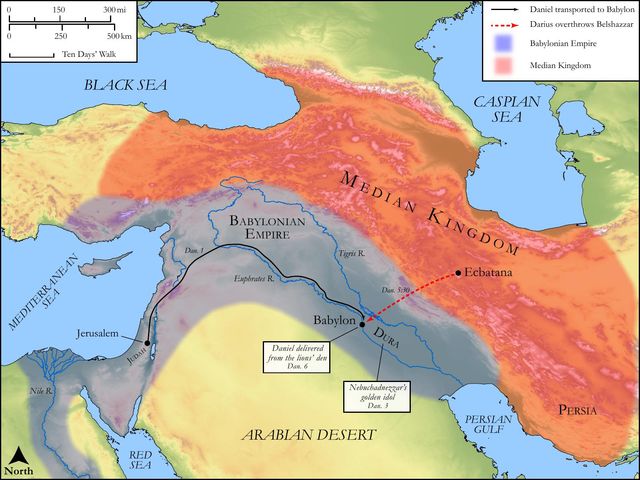
See on the biblical-era map
Study this verse
Public-domain commentary
Matthew Henry
From his Commentary on the Whole Bible. Henry comments on passages, not single verses — this entry covers Daniel 6:11–17.
Here is 1. Proof made of Daniel's praying to his God, notwithstanding the late edict to the contrary (Dan 6:11): These men assembled; the came tumultuously together, so the word is, the same that was used Dan 6:6, borrowed from Psa 2:1, Why do the heathen rage? They came together to visit Daniel, perhaps under pretence of business, at that time which they knew to be his usual hour of devotion; and, if they had not found him so engaged, they would have upbraided him with his faint-heartedness and distrust of his God, but (which they rather wished to do) they found him on his knees praying and making supplication before his God. For his love they are his adversaries; but, like his father David, he gives himself unto prayer, Psa 109:4. 2. Complaint made of it to the king. When they had found occasion against Daniel concerning the law of his God they lost no time, but applied to the king (Dan 6:12), and having appealed to his whether there was not such a law made, and gained from him a recognition of it, and that it was so ratified that it might not be altered, they proceeded to accuse Daniel, Dan 6:13. They so describe him, in the information they give, as to exasperate the king and incense him the more against him: "He is of the children of the captivity of Judah; he is of Judah, that despicable people, and now a captive in a despicable state, that can call nothing his own but what he has by the king's favour, and yet he regards not thee, O king! nor the decree that thou hast signed." Note, It is no new thing for that which is done faithfully, in the conscience towards God, to be misrepresented as done obstinately and in contempt of the civil powers, that is, for the best saints to be reproached as the worst men. Daniel regarded God, and therefore prayed, and we have reason to think prayed for the king and his government, yet this is construed as not regarding the king. That excellent spirit which Daniel was endued with, and that established reputation which he had gained, could not protect him from these poisonous darts. They do not say, He makes his petition to his God, lest Darius should take notice of that to his praise, but only, He makes his petition, which is the thing the law forbids. 3. The great concern the king was in hereupon. He now perceived that, whatever they pretended, it was not to honour him, but in spite to Daniel, that they had proposed that law, and now he is sorely displeased with himself for gratifying them in it, Dan 6:14. Note, When men indulge a proud vain-glorious humour, and please themselves with that which feeds it, they know not what vexations they are preparing for themselves; their flatterers may prove their tormentors, and are but spreading a net for their feet. Now, the king sets his heart to deliver Daniel; both by argument and by authority he labours till the going down of the sun to deliver him, that is, to persuade his accusers not to insist upon his prosecution. Note, We often do that, through inconsideration, which afterwards we see cause a thousand times to wish undone again, which is a good reason why we should ponder the path of our feet, for then all our ways will be established. 4. The violence with which the prosecutors demanded judgment, Dan 6:15. We are not told what Daniel said; the king himself is his advocate, he needs not plead his own cause, but silently commits himself and it to him that judges righteously. But the prosecutors insist upon it that the law must have its course; it is a fundamental maxim in the constitution of the government of the Medes and Persians, which had now become the universal monarchy, that no decree or statute which the king establishes may be changed. The same we find Est 1:19; Est 8:8. The Chaldeans magnified the will of their king, by giving him a power to make and unmake laws at his pleasure, to slay and keep alive whom he would. The Persians magnified the wisdom of their king, by supposing that whatever law he solemnly ratified it was so well made that there could be no occasion to alter it, or dispense with it, as if any human foresight could, in framing a law, guard against all inconveniences. But, if this maxim be duly applied to Daniel's case (as I am apt to think it is not, but perverted), while it honours the king's legislative power it hampers his executive power, and incapacitates him to show that mercy which upholds the throne, and to pass acts of indemnity, which are the glories of a reign. Those who allow not the sovereign's power to dispense with a disabling statute, yet never question his power to pardon an offence against a penal statute. But Darius is denied this power. See what need we have to pray for princes that God would give them wisdom, for they are often embarrassed with great difficulties, even the wisest and best are. 5. The executing of the law upon Daniel. The king himself, with the utmost reluctance, and against his conscience, signs the warrant for his execution; and Daniel, that venerable grave man, who carried such a mixture of majesty and sweetness in his countenance, who had so often looked great upon the bench, and at the council-board, and greater upon his knees, who had power with God and man, and had prevailed, is brought, purely for worshipping his God, as if he had been one of the vilest of malefactors, and thrown into the den of lions, to be devoured by them, Dan 6:16. One cannot think of it without the utmost compassion to the gracious sufferer and the utmost indignation at the malicious prosecutors. To make sure work, the stone laid upon the mouth of the den is sealed, and the king (an over-easy man) is persuaded to seal it with his own signet (Dan 6:17), that unhappy signet with which he had confirmed the law that Daniel falls by. But his lords cannot trust him, unless they add their signets too. Thus, when Christ was buried, his adversaries sealed the stone that was rolled to the door of his sepulchre. 6. The encouragement which Darius gave to Daniel to trust in God: Thy God whom thou servest continually, he will deliver thee, Dan 6:16. Here (1.) He justifies Daniel from guilt, owning all his crime to be serving his God continually, and continuing to do so even when it was made a crime. (2.) He leaves it to God to free him from punishment, since he could not prevail to do it: He will deliver thee. He is sure that his God can deliver him, for he believes him to be an almighty God, and he has reason to think he will do it, having heard of his delivering Daniel's companions in a like case from the fiery furnace, and concluding him to be always faithful to those who approve themselves faithful to him. Note, Those who serve God continually he will continually preserve, and will bear them out in his service.
Historical interpretation
Two Centuries of Reception
2 surviving comments on this verse. Each one is dated, so this reads as a timeline rather than a list.
Select a marker to jump to its quote. Markers stagger vertically where authors wrote within a few decades of each other.
And he prays “constantly” (deeds of virtue or fulfilling the commandments are included as part of prayer) who unites prayer with the deeds required and right deeds with prayer. For the only way we can accept the command to “pray constantly” as referring to a real possibility is by saying that the entire life of the saint taken as a whole is a single great prayer. What is customarily called prayer is, then, a part of this prayer. Now prayer in the ordinary sense ought to be made no less than three times each day. This is evident in the story of Daniel, who prayed three times each day when such great peril had been devised for him.
Verse 13. "Then they answered before the king and said, 'Daniel, who is of the captivity of Judah, has paid no heed to thy law...'" In order to magnify the dishonor involved in this contempt, they speak of the man who showed this contempt for the king's commands as a mere captive.
Continue studying Daniel 6:13 across the web’s major study libraries — every link below opens this exact verse, chapter, or book on the destination site.
Read & Compare
 BibleGatewayThis verse in more than 200 translations and 70 languages.
 Bible.comThe YouVersion reader — hundreds of translations, reading plans, and highlights.
 ESV.orgCrossway's official English Standard Version reader.
 NET BibleThe NET translation with 60,000+ translators' notes on every rendering decision.
 STEP BibleTyndale House's free study tool — original text, vocabulary, and scholarly resources.
 BibliaLogos Bible Software's free web reader.
 USCCBThe New American Bible (Revised Edition) with the U.S. bishops' study notes.
Commentaries
 BibleHub CommentariesDozens of classic commentaries on this verse, gathered on one page.
 StudyLightMore than 100 commentary sets — the largest collection on the web.
 BibleRefPlain-English commentary on what this verse means, verse by verse.
 Enduring WordDavid Guzik's free commentary on this chapter, widely used by Bible teachers.
 Bible Study ToolsVerse commentary alongside Greek and Hebrew study aids.
Original Language & Research
- BibleHub InterlinearThe verse word by word — original language, transliteration, and English.
- BibleHub LexiconEvery word's original-language definition and Strong's entry.
 Blue Letter BibleDeep-study tools — Strong's numbers, concordance, and word studies.
 SefariaThe Hebrew text with Rashi and centuries of Jewish commentary.
Sermons, Hymns & Audio


TrulyRandomVerse is not affiliated with these sites and doesn’t control their content. They’re linked because they’re genuinely useful.
Summary
Daniel 6:13 captures the pivotal moment when Daniel's jealous adversaries present their formal accusation to King Darius, meticulously detailing Daniel's unwavering prayer practice in direct violation of the recently enacted royal decree. This verse serves as the immediate report of Daniel's perceived transgression, revealing the deep-seated malice of his accusers and setting the stage for Daniel's miraculous deliverance, which ultimately serves as a profound demonstration of God's sovereignty and faithfulness. It powerfully underscores Daniel's unyielding commitment to his God, even in the face of certain death, highlighting the perennial tension between human authority and divine allegiance.
Context
ShowHideLiterary Context
Daniel 6:13 is strategically placed at the dramatic climax of the narrative involving Daniel in the lions' den. Immediately preceding this verse, the king, manipulated by the cunning machinations of jealous satraps and administrators, has unwillingly signed an irrevocable decree. This decree, a trap meticulously designed to ensnare Daniel, forbade any petition to god or man, save the king, for thirty days. Daniel's exceptional character and administrative prowess had earned him a position of unparalleled favor with the king, second only to Darius himself, as detailed in Daniel 6:1-3. The conspirators, fully aware of Daniel's consistent and public prayer life, knew he would not compromise his devotion to God. Thus, Daniel 6:13 is their triumphant report to the king, confirming Daniel's "violation" and initiating the legal process that would lead to his condemnation to the lion's den.
Historical & Cultural Context
The events of Daniel 6 unfold during the reign of Darius the Mede, likely a satrap or co-regent under Cyrus the Great, following the fall of Babylon to the Medo-Persian Empire around 539 BC. The Persian administrative system was renowned for its efficiency, strict adherence to law, and the immutability of royal decrees. Once signed by the king, a law was considered irrevocable, a principle explicitly stated in Daniel 6:8. Daniel's identity as one of the "children of the captivity of Judah" is a crucial detail emphasized by his accusers; it highlights his status as a foreign exile, a detail they likely exploited to portray him as disloyal or an outsider, despite his exemplary service. His public and consistent prayer practice, facing Jerusalem, was a distinctive and well-known mark of Jewish piety, standing in stark contrast to the polytheistic practices prevalent in the Persian court and directly challenging the decree's intent.
Key Themes
ShowHideThis verse powerfully contributes to several overarching themes within the book of Daniel and broader biblical theology. Foremost is the theme of Unwavering Faithfulness and Obedience to God, demonstrating Daniel's supreme commitment to his covenant God above all earthly authority, even when facing severe consequences. This narrative directly challenges the notion of absolute human rule and underscores the biblical principle that God's commands supersede human decrees, as famously articulated in Acts 5:29. The account also highlights the theme of Divine Sovereignty and Miraculous Deliverance, as Daniel's steadfastness ultimately leads to God's intervention, showcasing His power to protect His faithful servants. Furthermore, the Conflict Between Righteousness and Malice is vividly portrayed, as the jealousy and malicious intent of Daniel's accusers stand in stark contrast to Daniel's integrity and devotion, revealing the spiritual battle at play. Finally, the theme of Perseverance in Prayer is central, as Daniel's consistent practice of "maketh his petition three times a day" exemplifies the importance of a disciplined and unwavering prayer life, regardless of external pressures, echoing the psalmist's commitment in Psalm 55:17.
Exposition and Analysis
ShowHideKey Word Analysis
ShowHideThis Aramaic term, corresponding to the Hebrew bēn, signifies "a son (as a builder of the family name), in the widest sense," encompassing children or young ones. In Daniel 6:13, when Daniel is identified as being "of the children of the captivity of Judah," it emphasizes his lineage and his belonging to the exiled community of Judah. This highlights his identity not merely as an individual, but as a representative of a specific people, whose historical and religious identity was deeply tied to their God and their homeland, even in exile.
Derived from a root meaning "flavor," this Aramaic word figuratively denotes "judgment" (both subjective and objective), and by extension, "account" or "command." In this context, to "regard" means to pay attention to, to consider, or to obey a command or decree. The accusers' claim that Daniel "regardeth not thee, O king, nor the decree" implies a deliberate disregard for the king's authority and a conscious refusal to acknowledge or obey his signed command, effectively accusing him of insubordination and disrespect.
This Aramaic noun, derived from the verb bᵉʻâʼ ("to seek or ask"), specifically refers to "a request" or "supplication." It denotes the formal and earnest nature of Daniel's communication with God. The use of this word underscores the precise nature of his "transgression" in the eyes of his accusers: he was making a direct and formal request to a deity other than the king, which was precisely what the decree forbade. This highlights the deliberate and public nature of Daniel's devotional act.
Verse Breakdown
ShowHide"Then answered they and said before the king,"
This opening clause establishes the formal and public nature of the accusation. The "they" refers to the jealous satraps and administrators who had conspired against Daniel, and their "answering" implies a direct response to the king's earlier inquiry or perhaps their pre-arranged presentation of evidence. The setting "before the king" emphasizes the gravity and official status of their report, underscoring the legal and political weight of their words.
"That Daniel, which is of the children of the captivity of Judah,"
This clause identifies the accused and immediately highlights his background. By specifying Daniel's identity as an exile from Judah, the accusers sought to frame his actions not just as a violation of the decree, but perhaps also as an act of disloyalty from a foreign subject. This detail underscores the cultural and religious tension inherent in Daniel's position, subtly implying that his foreign allegiance might supersede his loyalty to the Persian crown.
"regardeth not thee, O king, nor the decree that thou hast signed,"
This is the core of the accusation, directly stating Daniel's perceived defiance. The accusers claim Daniel shows no "regard" or respect for King Darius or the specific law he personally "signed." This phrasing is meticulously designed to provoke the king's anger and sense of betrayal, making Daniel's actions appear as a direct affront to the monarch's supreme authority and personal decree, thereby demanding the harshest penalty.
"but maketh his petition three times a day."
This final clause provides the specific and undeniable evidence of Daniel's "transgression." It details his consistent practice of prayer—"three times a day"—which was a well-known aspect of his spiritual discipline. This precise detail confirms that Daniel's actions were deliberate, habitual, and public, leaving no room for doubt about his intentional non-compliance with the royal edict and emphasizing his steadfast devotion to God above all else.
Literary Devices
ShowHideThe verse employs several powerful Literary Devices. Irony is profoundly evident in the accusers' meticulous report, as their attempt to condemn Daniel inadvertently highlights his unwavering faithfulness and sets the stage for God's glorious intervention. Their scheme, intended for Daniel's destruction, ultimately leads to the king's decree acknowledging and exalting the God of Daniel (Daniel 6:26-27). Contrast is central to the verse's dramatic tension, pitting Daniel's steadfast obedience to God against the king's unchangeable but flawed human law. This stark opposition underscores the ultimate supremacy of divine authority over temporal power. Furthermore, the accusers' specific mention of Daniel being "of the children of the captivity of Judah" serves as a form of Characterization, emphasizing Daniel's distinct identity and unwavering loyalty to his heritage and God, even in a foreign land. This detail also subtly foreshadows the broader theme of God's faithfulness to His exiled people and their unique covenant relationship with Him.
Theological and Thematic Connections
ShowHideDaniel 6:13 is a powerful testament to the principle of prioritizing divine law over human decree when the two conflict. Daniel's refusal to compromise his prayer life, despite the life-threatening consequences, exemplifies a profound theological conviction: ultimate allegiance belongs to God alone. This act of civil disobedience, rooted in unwavering faith, highlights God's sovereignty over earthly rulers and laws. It demonstrates that true reverence for God sometimes necessitates a courageous stand against societal norms or governmental mandates that contradict divine principles. Daniel's steadfastness serves as a model for believers throughout history, encouraging them to maintain their spiritual disciplines and convictions even under duress, trusting that God will vindicate His faithful servants and that His kingdom is eternal.
Reflection and Application
ShowHideDaniel 6:13 offers a potent challenge and profound encouragement for contemporary believers. In a world where personal convictions are increasingly tested, Daniel's unwavering commitment to his daily prayer routine, even when it meant facing the lions' den, reminds us of the non-negotiable priority of our relationship with God. His example calls us to examine our own spiritual disciplines: do we prioritize our communion with God above comfort, convenience, or even personal safety? This verse compels us to consider what we truly "regard" as the ultimate authority in our lives. When societal pressures, cultural trends, or legal frameworks clash with biblical principles, Daniel's story provides a divine mandate for faithful resistance, not out of rebellion, but out of supreme loyalty to the King of kings. It teaches us that true courage is found in quiet, consistent obedience to God, regardless of the cost, trusting that His power is made perfect in our weakness and His deliverance is always timely and perfect.
Questions for Reflection
ShowHideFAQ
ShowHideWas Daniel's act of prayer a deliberate act of defiance against the king?
ShowHideFrom the perspective of Daniel's accusers and the king's decree, Daniel's continued practice of "maketh his petition three times a day" was indeed a deliberate act of defiance. The decree explicitly forbade such petitions to any god or man other than the king for thirty days, as clearly outlined in Daniel 6:7. However, from Daniel's perspective, it was not defiance for defiance's sake, but an unwavering act of obedience to God, prioritizing his divine allegiance over an unjust human law. His open window and consistent devotional practice demonstrated his profound conviction that obeying God was paramount, even if it meant violating an earthly edict and facing severe consequences. It was a conscious choice to honor God's command above all else.
Christ-Centered Fulfillment
ShowHideDaniel 6:13, with its depiction of Daniel's unwavering obedience in the face of death, powerfully foreshadows the ultimate obedience of Jesus Christ. Daniel's resolute commitment to prayer, even under the threat of the lions' den, mirrors Christ's perfect submission to the Father's will, culminating in His agonizing prayer in Gethsemane, where He prayed, "Nevertheless, not my will, but yours, be done" (Luke 22:42). Just as Daniel was accused and condemned by jealous adversaries despite his blameless character and faithful service, so too was Jesus, "who committed no sin, nor was any deceit found in his mouth" (1 Peter 2:22), unjustly condemned by those who envied His divine authority and saving power. Daniel's miraculous deliverance from the lions' den, a testament to God's power to save His faithful servant, finds its ultimate and most profound fulfillment in Christ's triumph over death and the grave. Through His resurrection, Jesus, the true Lamb of God, delivered humanity from the jaws of spiritual death and eternal condemnation, offering eternal life and true freedom to all who believe in Him (John 11:25-26). Daniel's steadfastness is a timeless call for believers to imitate Christ's perfect obedience, trusting that our ultimate vindication and deliverance come through Him, who has indeed overcome the world (John 16:33).