


Daniel 1:6
Bible text: King James Version (1769 Blayney text) · Public domain
Bible text: Berean Standard Bible · Public domain
Bible text: American Standard Version (1901) · Public domain
Bible text: World English Bible, Messianic edition · Public domain
Bible text: Geneva Bible (1599) · Public domain
Bible text: Young's Literal Translation · Public domain
- וַיְהִיvay·Hiand he wasH1961Conj-w ¦ V-Qal-ConsecImperf-3msVerb Qal Consecutive Imperfect 3rd Singular Masculineוַandיְהִיhe was
- בָהֶםva·Hemamong <the> themPrep-b ¦ 3mpSuffix Personal 3rd Plural Masculineבָamong <the>הֶםthem
- מִבְּנֵיmi·be·Neifrom [the] people ofH1121Prep-m ¦ N-mpcNoun Plural Masculine Constructמִfromבְּנֵי[the] people of
- יְהוּדָהye·hu·DahJudahH3063N-properNoun Proper Location
- דָּנִיֵּאלda·ni·YelDanielH1840N-proper-mNoun Proper Masculine
- חֲנַנְיָהcha·nan·YahHananiahH2608N-proper-mNoun Proper Masculine
- מִישָׁאֵלmi·sha·'ElMishaelH4332N-proper-mNoun Proper Masculine
- וַעֲזַרְיָהva·'a·zar·Yahand AzariahH5838Conj-w ¦ N-proper-mNoun Proper MasculineוַandעֲזַרְיָהAzariah
English is a literal word-by-word gloss of the Hebrew, not the KJV's wording. Why?
This is the original text the KJV's translators worked from — each Hebrew word with its own literal English meaning in this verse, prepared by scholars at Tyndale House, Cambridge. The KJV translates whole sentences, not word by word, so its wording differs: one Hebrew word can become several English words, and the KJV may choose “the LORD” where the gloss reads “Yahweh”. Both are faithful — they answer different questions. For the KJV's own rendering, switch to the KJV text.
Details
See on the biblical-era map
Study this verse
Public-domain commentary
Matthew Henry
From his Commentary on the Whole Bible. Henry comments on passages, not single verses — this entry covers Daniel 1:1–7. His four-level outline is real structure in the source text, so it is rendered as structure.
We have in these verses an account,
I.Of the first descent which Nebuchadnezzar, king of Babylon, in the first year of his reign, made upon Judah and Jerusalem, in the third year of the reign of Jehoiakim, and his success in that expedition (Dan 1:1, Dan 1:2.): He besieged Jerusalem, soon made himself master of it, seized the king, took whom he pleased and what he pleased away with him, and then left Jehoiakim to reign as tributary to him, which he did about eight years longer, but then rebelled, and it was his ruin. Now from this first captivity most interpreters think the seventy years are to be dated, though Jerusalem was not destroyed, nor the captivity completed, till about nineteen years after, In that first year Daniel was carried to Babylon, and there continued the whole seventy years (see Dan 1:21), during which time all nations shall serve Nebuchadnezzar, and his son, and his son's son, Jer 25:11. This one prophet therefore saw within the compass of his own time the rise, reign, and ruin of that monarchy; so that it was res unius aetatis - the affair of a single age, such short-lived things are the kingdoms of the earth; but the kingdom of heaven is everlasting. The righteous, that see them taking root, shall see their fall, Job 5:3; Pro 29:16. Mr. Broughton observes the proportion of times in God's government since the coming out of Egypt: thence to their entering Canaan forty years, thence seven years to the dividing of the land, thence seven Jubilees to the first year of Samuel, in whom prophecy began, thence to this first year of the captivity seven seventies of years, 490 (ten Jubilees), thence to the return one seventy, thence to the death of Christ seven seventies more, thence to the destruction of Jerusalem forty years.
II.The improvement he made of this success.
He did not destroy the city or kingdom, but did that which just accomplished the first threatening of mischief by Babylon. It was denounced against Hezekiah, for showing his treasures to the king of Babylon's ambassadors (Isa 39:6, Isa 39:7), that the treasures and the children should be carried away, and, if they had been humbled and reformed by this, hitherto the king of Babylon's power and success should have gone, but no further. If less judgments do the work, God will not send greater; but, if not, he will heat the furnace seven times hotter. Let us see what was now done.
1.The vessels of the sanctuary were carried away, part of them, Dan 1:2. They fondly trusted to the temple to defend them, though they went on in their iniquity. And now, to show them the vanity of that confidence, the temple is first plundered. Many of the holy vessels which used to be employed in the service of God were taken away by the king of Babylon, those of them, it is likely, which were most valuable, and he brought them as trophies of victory to the house of his god, to whom, with a blind devotion, he gave praise of his success; and having appropriated these vessels, in token of gratitude, to his god, he put them in the treasury of his temple. See the righteousness of God; his people had brought the images of other gods into his temple, and now he suffers the vessels of the temple to be carried into the treasuries of those other gods. Note, When men profane the vessels of the sanctuary with their sins it is just with God to profane them by his judgments. It is probable that the treasures of the king's house were rifled, as was foretold, but particular mention is made of the taking away of the vessels of the sanctuary because we shall find afterwards that the profanation of them was that which filled up the measure of the Chaldeans' iniquity, Dan 5:3. But observe, It was only part of them that went now; some were left them yet upon trial, to see if they would take the right course to prevent the carrying away of the remainder. See Jer 27:18.
2.The children and young men, especially such as were of noble or royal extraction, that were sightly and promising, and of good natural parts, were carried away. Thus was the iniquity of the fathers visited upon the children. These were taken away by Nebuchadnezzar,
(1.)As trophies, to be made a show of for the evidencing and magnifying of his success.
(2.)As hostages for the fidelity of their parents in their own land, who would be concerned to conduct themselves well that their children might have the better treatment.
(3.)As a seed to serve him. He took them away to train them up for employments and preferments under him, either out of an unaccountable affectation, which great men often have, to be attended by foreigners, though they be blacks, rather than by those of their own nation, or because he knew that there were no such witty, sprightly, ingenious young men to be found among his Chaldeans as abounded among the youth of Israel; and, if that were so, it was much for the honour of the Jewish nation, as of an uncommon genius above other people, and a fruit of the blessing. But it was a shame that a people who had so much wit should have so little wisdom and grace. Now observe,
[1.]The directions which the king of Babylon gave for the choice of these youths, Dan 1:4. They must not choose such as were deformed in body, but comely and well-favoured, whose countenances were indexes of ingenuity and good humour. But that is not enough; they must be skilful in all wisdom, and cunning, or well-seen in knowledge, and understanding science, such as were quick and sharp, and could give a ready and intelligent account of their own country and of the learning they had hitherto been brought up in. He chose such as were young, because they would be pliable and tractable, would forget their own people and incorporate with the Chaldeans. He had an eye to what he designed them for; they must be such as had ability in them to stand in the king's palace, not only to attend his royal person, but to preside in his affairs. This is an instance of the policy of this rising monarch, now in the beginning of his reign, and was a good omen of his prosperity, that he was in care to raise up a succession of persons fit for public business. He did not, like Ahasuerus, appoint them to choose him out young women for the service of his government. It is the interest of princes to have wise men employed under them; it is therefore their wisdom to take care for the finding out and training up of such. It is the misery of this world that so many who are fit for public stations are buried in obscurity, and so many who are unfit for them are preferred to them.
[2.]The care which he took concerning them. First, For their education. He ordered that they should be taught the learning and tongue of the Chaldeans. They are supposed to be wise and knowing young men, and yet they must be further taught. Give instructions to a wise man and he will increase in learning. Note, Those that would do good in the world when they grow up must learn when they are young. That is the learning age; if that time be lost, it will hardly be redeemed. It does not appear that Nebuchadnezzar designed they should learn the unlawful arts that were used among the Chaldeans, magic and divination; if he did, Daniel and his fellows would not defile themselves with them. Nay, we do not find that he ordered them to be taught the religion of the Chaldeans, by which it appears That he was at this time no bigot; if men were skilful and faithful, and fit for his business, it was not material to him what religion they were of, provided they had but some religion. They must be trained up in the language and laws of the country, in history, philosophy, and mathematics, in the arts of husbandry, war, and navigation, in such learning as might qualify them to serve their generation. Note, It is real service to the public to provide for the good education of the youth. Secondly, For their maintenance. He provided for them three years, not only necessaries, but dainties for their encouragement in their studies. They had daily provision of the king's meat, and of the wine which he drank, Dan 1:5. This was an instance of his generosity and humanity; though they were captives, he considered their birth and quality, their spirit and genius, and treated them honourably, and studied to make their captivity easy to them. There is a respect due to those who are well-born and bred when they have fallen into distress. With a liberal education there should be a liberal maintenance.
III.A particular account of Daniel and his fellows.
They were of the children of Judah, the royal tribe, and probably of the house of David, which had grown a numerous family; and God told Hezekiah that of the children that should issue from him some should be taken and made eunuchs, or chamberlains, in the palace of the king of Babylon. The prince of the eunuchs changed the names of Daniel and his fellows, partly to show his authority over them and their subjection to him, and partly in token of their being naturalized and made Chaldeans. Their Hebrew names, which they received at their circumcision, had something of God, or Jah, in them: Daniel - God is my Judge; Hananiah - The grace of the Lord; Mishael - He that is the strong God; Azariah - The Lord is a help. To make them forget the God of their fathers, the guide of their youth, they give them names that savour of the Chaldean idolatry. Belteshazzar signifies the keeper of the hidden treasures of Bel; Shadrach - The inspiration of the sun, which the Chaldeans worshipped; Meshach - Of the goddess Shach, under which name Venus was worshipped; Abed-nego, The servant of the shining fire, which they worshipped also. Thus, though they would not force them from the religion of their fathers to that of their conquerors, yet they did what they could by fair means insensibly to wean them from the former and instil the latter into them. Yet see how comfortably they were provided for; though they suffered for their fathers' sins they were preferred for their own merits, and the land of their captivity was made more comfortable to them than the land of their nativity at this time would have been.
Historical interpretation
Historical reception
1 surviving comment on this verse from the historical church.
So here he informs us of the king’s generosity in providing them with nourishment that was not of an ordinary kind fit for captives and slaves; instead, he gave orders for them to share in the king’s table. Shortly afterward he mentions their self-control and sound values, not indulging in self-glorification but proposing a beneficial lesson to those prepared to accept benefit. It is possible to see also the moderation in his thinking: after mentioning above that the king ordered young men of royal birth to be chosen, fair to behold and of becoming stature, and citing at this point the persons’ names, he simply referred to the tribe of Judah and concealed their royal connections.
Continue studying Daniel 1:6 across the web’s major study libraries — every link below opens this exact verse, chapter, or book on the destination site.
Read & Compare
 BibleGatewayThis verse in more than 200 translations and 70 languages.
 Bible.comThe YouVersion reader — hundreds of translations, reading plans, and highlights.
 ESV.orgCrossway's official English Standard Version reader.
 NET BibleThe NET translation with 60,000+ translators' notes on every rendering decision.
 STEP BibleTyndale House's free study tool — original text, vocabulary, and scholarly resources.
 BibliaLogos Bible Software's free web reader.
 USCCBThe New American Bible (Revised Edition) with the U.S. bishops' study notes.
Commentaries
 BibleHub CommentariesDozens of classic commentaries on this verse, gathered on one page.
 StudyLightMore than 100 commentary sets — the largest collection on the web.
 BibleRefPlain-English commentary on what this verse means, verse by verse.
 Enduring WordDavid Guzik's free commentary on this chapter, widely used by Bible teachers.
 Bible Study ToolsVerse commentary alongside Greek and Hebrew study aids.
Original Language & Research
- BibleHub InterlinearThe verse word by word — original language, transliteration, and English.
- BibleHub LexiconEvery word's original-language definition and Strong's entry.
 Blue Letter BibleDeep-study tools — Strong's numbers, concordance, and word studies.
 SefariaThe Hebrew text with Rashi and centuries of Jewish commentary.
Sermons, Hymns & Audio


TrulyRandomVerse is not affiliated with these sites and doesn’t control their content. They’re linked because they’re genuinely useful.
Summary
Daniel 1:6 introduces four distinguished young men—Daniel, Hananiah, Mishael, and Azariah—from the royal or noble lineage of the tribe of Judah, who were among the initial wave of captives deported to Babylon by King Nebuchadnezzar. This verse serves as a foundational introduction, setting the stage for their extraordinary narratives of unwavering faithfulness, divine empowerment, and prophetic revelation within the formidable and often hostile environment of the Babylonian empire, thereby highlighting God's sovereign preservation of a faithful remnant for His unfolding purposes.
Context
ShowHideLiterary Context
This verse immediately follows the dramatic account of Nebuchadnezzar's successful siege of Jerusalem and his subsequent desecration of the temple by plundering its sacred vessels, which he then transported to the treasury of his own deity in Babylon, as detailed in Daniel 1:1-2. The narrative then transitions to Nebuchadnezzar's strategic command to Ashpenaz, his chief eunuch, to select a specific group of young men from the Israelite nobility. These chosen individuals were to be "without blemish, handsome, skillful in all wisdom, endowed with knowledge, understanding learning, and competent to stand in the king's palace," destined for a rigorous three-year training program in the language and literature of the Chaldeans (Daniel 1:3-5). Daniel 1:6 then precisely identifies four pivotal individuals within this elite cadre—Daniel, Hananiah, Mishael, and Azariah—establishing them as the central protagonists whose steadfastness in the face of immense cultural and religious assimilation pressures will drive much of the book's early narrative.
Historical & Cultural Context
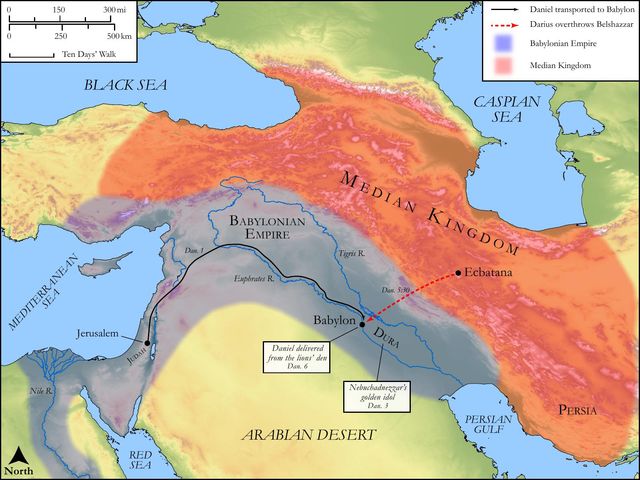
The historical backdrop for Daniel 1:6 is the initial phase of the Babylonian exile, specifically around 605 BC. This period marked Nebuchadnezzar's first deportation of Judeans following his victory over Judah. It was a standard imperial policy for powerful empires like Babylon to integrate conquered populations, especially their most intelligent and influential youth, into their own administrative and cultural structures. This practice served multiple strategic objectives: it effectively neutralized potential future leadership within the subjugated nation, bolstered the empire's own bureaucracy with skilled personnel, and systematically indoctrinated future leaders into Babylonian ideology and its polytheistic religious system. The explicit mention of these young men being "of the children of Judah" signifies their connection to the royal or aristocratic families of the Southern Kingdom, making them prime candidates for this assimilation policy. Their forced relocation and subsequent rigorous training were not merely educational but a deliberate, calculated attempt to erode their distinct Israelite identity and fully integrate them into Babylonian society, a challenge they would famously and faithfully resist.
Key Themes
ShowHideDaniel 1:6 is foundational for several profound themes that permeate the book of Daniel. Firstly, it powerfully underscores the theme of Divine Sovereignty Amidst Captivity. Even in a moment of profound national catastrophe, loss of independence, and forced exile, God's providential hand is unmistakably evident in the specific selection and preservation of these individuals. Their presence in Babylon is not a random outcome of war but a purposeful part of God's larger divine plan, demonstrating that His sovereignty extends even over pagan kings and formidable empires, preparing instruments for His purposes in unexpected and challenging environments. Secondly, the emphasis on their origin as "of the children of Judah" highlights their Distinguished Identity and covenant heritage. This lineage sets the stage for their unwavering commitment to the God of Israel and their deep-rooted adherence to their Israelite traditions, even when immersed in a polytheistic culture. This identity becomes an essential anchor for their subsequent acts of courageous faithfulness. Lastly, their selection for training in the Babylonian court, while intended by Nebuchadnezzar for his imperial administration, simultaneously functions as Preparation for Service in God's kingdom. This rigorous education equipped them with knowledge and skills that would later be divinely employed for revelation and intercession, profoundly impacting both Babylonian and Israelite history, as exemplified by Daniel's interpretation of Nebuchadnezzar's dream in Daniel 2 and the miraculous deliverance of his friends from the fiery furnace in Daniel 3.
Exposition and Analysis
ShowHideKey Word Analysis
ShowHideFrom בָּנָה; a son (as a builder of the family name), in the widest sense (of literal and figurative relationship, including grandson, subject, nation, quality or condition, etc., (like father or brother), etc.). In this context, "children" transcends mere youthfulness to denote their lineage and esteemed status as descendants, emphasizing their noble or royal connection within the tribe of Judah. This highlights their identity as part of the covenant people, even in the crucible of exile.
From יָדָה; celebrated; Jehudah (or Judah), the name of five Israelites; also of the tribe descended from the first, and of its territory; Judah. This term precisely specifies their tribal affiliation, linking them directly to the Southern Kingdom, the Davidic line, and the profound covenant promises associated with Judah, most notably the messianic lineage. Their origin from Judah underscores their unique significance in God's ongoing redemptive plan for His chosen people.
From דָּן and אֵל; judge of God; Daniel or Danijel, the name of two Israelites; Daniel. The very meaning of Daniel's name, "God is my judge," proves profoundly prophetic. It foreshadows his pivotal role throughout the book as an interpreter of divine judgments and revelations, standing fearlessly before powerful kings and proclaiming God's immutable truth. It also implicitly highlights the inherent tension between human judgment (as exercised by Nebuchadnezzar) and the ultimate, sovereign divine judgment.
Verse Breakdown
ShowHide"Now among these were"
This introductory phrase seamlessly connects the verse to the preceding narrative, specifically referring to the elite group of young men meticulously selected by Ashpenaz based on their exceptional qualities and noble background. It signifies that Daniel and his companions were integral members of this hand-picked contingent, earmarked for direct service to the Babylonian king.
"of the children of Judah"
This clause is profoundly significant, unequivocally establishing the specific tribal and national identity of these young men. It declares their direct descent from the royal tribe of Judah, thereby linking them to the esteemed lineage of King David and the enduring covenant promises uniquely associated with the Southern Kingdom. This rich heritage would prove to be a foundational anchor for their steadfastness and faithfulness in a foreign and hostile land.
"Daniel, Hananiah, Mishael, and Azariah"
This segment explicitly names the four central figures who will become the primary protagonists of the book's early and most compelling narratives. Their individual Hebrew names, each imbued with deep theological meaning, immediately introduce a profound spiritual layer to the text, setting up a stark contrast with the pagan Babylonian names they are about to receive and powerfully foreshadowing their future character, experiences, and divine interventions.
Literary Devices
ShowHideThe primary literary device prominently featured in Daniel 1:6 is the Significance of Names, which functions simultaneously as both Symbolism and Foreshadowing. The original Hebrew names of Daniel, Hananiah, Mishael, and Azariah are far from arbitrary; they are deeply meaningful theological statements that profoundly reflect the character of these young men and powerfully foreshadow their future experiences and God's miraculous interaction with them. "Daniel," meaning "God is my judge," points directly to his future prophetic role and his unwavering resolve in upholding God's law even under duress. "Hananiah," meaning "Yahweh has been gracious," speaks to the remarkable grace and divine favor they would consistently experience despite their dire circumstances as exiles. "Mishael," meaning "Who is what God is?" or "Who is like God?", serves as an implicit, yet potent, challenge to Babylonian idolatry and emphatically affirms the incomparable nature of the one true God, a theme powerfully demonstrated in their miraculous preservation in the fiery furnace. "Azariah," meaning "Yahweh has helped," directly anticipates the divine assistance and miraculous deliverance they would receive throughout their trials. This rich symbolism embedded within their original names creates a stark and intentional contrast with the pagan names they are subsequently given in the following verse, thereby highlighting the profound tension between their God-given identity and the concerted attempts by a foreign power to assimilate and erase it, ultimately emphasizing the overarching theme of unwavering faithfulness in exile.
Theological and Thematic Connections
ShowHideDaniel 1:6 powerfully illustrates God's sovereign hand in meticulously preserving a faithful remnant even amidst national catastrophe and the relentless pressures of forced assimilation. The deliberate selection of these specific individuals from the tribe of Judah, a tribe renowned for its royal and messianic lineage, profoundly underscores God's unwavering commitment to His covenant people and His meticulously orchestrated plan for their future. Their strategic placement within the Babylonian court, initially intended for their indoctrination into pagan culture, is transformed by divine providence into a strategic outpost, allowing God's truth to be revealed and His incomparable power to be displayed within the very heart of a formidable pagan empire. Their steadfastness in maintaining their distinct identity and their unwavering devotion to God, despite immense cultural and political pressure, serves as a powerful and enduring testament to the transformative power of faith and the profound possibility of living righteously and influentially even in a hostile spiritual environment.
Reflection and Application
ShowHideThe introduction of Daniel and his three faithful friends in Daniel 1:6 offers profound and timeless lessons for believers navigating the complexities of contemporary life. Their story serves as a powerful reminder that even when life takes unexpected, profoundly difficult, and seemingly God-forsaken turns—such as being forcibly uprooted from one's homeland and thrust into a foreign, culturally hostile environment—God remains immutably sovereign and always has a redemptive purpose. Their distinguished identity as "children of Judah" was not merely a biological birthright but a profound call to live distinctly, set apart for God's purposes. For us today, our identity in Christ is paramount; it is the unshakeable anchor that grounds us, regardless of our shifting circumstances or the intense cultural pressures we face. We are unequivocally called to be "in the world but not of it," to shine as radiant lights in dark places, demonstrating unwavering faithfulness, integrity, and moral courage within our respective spheres of influence, much like Daniel and his friends exemplified in Babylon. Their proactive commitment to God's ways, even before facing overt persecution or direct challenges to their faith, meticulously prepared them for the greater trials and opportunities ahead, enabling them to become powerful instruments of God's glory and truth.
Questions for Reflection
ShowHideFAQ
ShowHideWhy were these specific young men, Daniel, Hananiah, Mishael, and Azariah, chosen by King Nebuchadnezzar for his court?
ShowHideKing Nebuchadnezzar's stringent criteria for selecting these young men, meticulously outlined in Daniel 1:3-4, were quite specific and demanding. They had to be from the royal family or nobility of Israel, "without blemish, handsome, skillful in all wisdom, endowed with knowledge, understanding learning, and competent to stand in the king's palace." Daniel and his friends evidently met these exacting requirements, indicating they were among the brightest, most capable, and physically impressive young men in all of Judah. Their selection was a calculated part of Nebuchadnezzar's broader strategy to assimilate the best and brightest from conquered nations into his own imperial administration, thereby simultaneously strengthening his burgeoning empire and strategically weakening the leadership potential of the defeated people. From a profound divine perspective, however, their selection was also an integral part of God's sovereign plan to strategically place His faithful servants in positions of significant influence within the very heart of the Babylonian court, enabling His purposes to unfold.
Christ-Centered Fulfillment
ShowHideDaniel 1:6, by introducing Daniel and his companions as "children of Judah" in the crucible of exile, subtly yet powerfully foreshadows the ultimate "Son of Judah," Jesus Christ, who would perfectly embody faithfulness, righteousness, and bring true, eternal deliverance. Just as these young men were divinely chosen and set apart to bear witness to God's sovereignty and truth within a pagan empire, so too was Jesus chosen and sent to enter a world inherently hostile to God, not as a captive, but as the conquering King of kings. Their unwavering steadfastness in maintaining their distinct identity and their profound devotion to God in Babylon, despite the constant threat of cultural and religious assimilation, profoundly points to Christ's perfect obedience and His unyielding commitment to His Father's will, even unto the ultimate sacrifice of death on a cross (Philippians 2:8). Furthermore, their strategic placement in the king's palace, which enabled God's truth to be revealed through their lives and prophetic insights, prefigures Christ's ultimate and supreme role as the revealer of God's profound mysteries (Colossians 2:2-3) and the one to whom all authority in heaven and on earth has been irrevocably given (Matthew 28:18). Their remarkable story of being preserved, empowered, and strategically used by God in a foreign land ultimately finds its glorious fulfillment in Christ, who establishes His eternal and unshakeable kingdom, gathering His redeemed people from every nation, tribe, and tongue into His glorious and everlasting presence (Revelation 7:9-10).