


Amos 2:2
- וְשִׁלַּחְתִּיve·shi·lach·tiand I will send forthH7971Conj-w ¦ V-Piel-ConsecPerf-1csVerb Piel Consecutive Perfect 1st Singular common genderוְandשִׁלַּחְתִּיI will send forth
- אֵשׁ'esha fireH784N-csNoun Singular common gender Absolute
- בְּמוֹאָבbe·mo·'Avon MoabH4124Prep-b ¦ N-properNoun Proper LocationבְּonמוֹאָבMoab
- וְאָכְלָהve·'a·khe·Lahand it will consumeH398Conj-w ¦ V-Qal-ConsecPerf-3fsVerb Qal Consecutive Perfect 3rd Singular Feminineוְandאָכְלָהit will consume
- אַרְמְנוֹת'ar·me·Not[the] fortresses ofH759N-fpcNoun Plural Feminine Construct
- הַקְּרִיּוֹתha·ke·ri·Yot<the> KeriothH7152Art ¦ N-properNoun Proper Locationהַ<the>קְּרִיּוֹתKerioth
- וּמֵתu·Metand it will dieH4191Conj-w ¦ V-Qal-ConsecPerf-3msVerb Qal Consecutive Perfect 3rd Singular Masculineוּandמֵתit will die
- בְּשָׁאוֹןbe·sha·'Onin uproarH7588Prep-b ¦ N-msNoun Singular Masculine Absoluteבְּinשָׁאוֹןuproar
- מוֹאָבmo·'AvMoabH4124N-properNoun Proper Location
- בִּתְרוּעָהbit·ru·'Ahwith a shout of alarmH8643Prep-b ¦ N-fsNoun Singular Feminine Absoluteבִּwithתְרוּעָהa shout of alarm
- בְּקוֹלbe·Kolwith [the] sound ofH6963Prep-b ¦ N-mscNoun Singular Masculine Constructבְּwithקוֹל[the] sound of
- שׁוֹפָרsho·Fara trumpetH7782N-msNoun Singular Masculine Absolute
English is a literal word-by-word gloss of the Hebrew, not the KJV's wording. Why?
This is the original text the KJV's translators worked from — each Hebrew word with its own literal English meaning in this verse, prepared by scholars at Tyndale House, Cambridge. The KJV translates whole sentences, not word by word, so its wording differs: one Hebrew word can become several English words, and the KJV may choose “the LORD” where the gloss reads “Yahweh”. Both are faithful — they answer different questions. For the KJV's own rendering, switch to the KJV text.
Details
See on the biblical-era map
Study this verse
Public-domain commentary
Matthew Henry
From his Commentary on the Whole Bible. Henry comments on passages, not single verses — this entry covers Amos 2:1–8. His three-level outline is real structure in the source text, so it is rendered as structure.
Here is, I. The judgment of Moab, another of the nations that bordered upon Israel. They are reckoned with and shall be punished for three transgressions and for four, as those before. Now, 1. Moab's fourth transgression, as theirs who were before set to the bar, was cruelty. The instance given refers not to the people of God, but to a heathen like themselves: The king of Moab burnt the bones of the king of Edom into lime. We find there was war between the Edomites and the Moabites, in which the king of Moab, in distress and rage, offered his own son for a burnt-offering, to appease his deity, Kg2 3:26, Kg2 3:27. And it should seem that afterwards he, or some of his successors, in revenge upon the Edomites for bringing him to that extremity, having an advantage against the king of Edom, seized him alive and burnt him to ashes, or slew him and burnt his body, or dug up the bones of their dead king, of that particularly who had so straitened him, and, in token of his rage and fury, burnt them to lime. and perhaps made use of the powder of his bones for the white-washing of the walls and ceilings of his palace, that he might please himself with the sight of that monument of his revenge. Est vindicta bonum vita jucundius ipsa - Revenge is sweeter than life itself. It is barbarous to abuse human bodies, for we ourselves also are in the body; it is senseless to abuse dead bodies, nay, it is impious, for we believe and look for their resurrection; and to abuse the dead bodies of kings (whose persons and names ought to be in a particular manner respected and had in veneration) is an affront to majesty; it is an argument of a base spirit for those to trample upon a dead lion who, were he alive, would tremble before him. 2. Moab's doom for this transgression is, (1.) A judgment of death. Those that deal cruelly shall be cruelly dealt with (Amo 2:2): Moab shall die; the Moabites shall be cut off with the sword of war, which kills with tumult, with shouting, and with sound of trumpet, circumstances that make it so much the more terrible, as the lion's roaring aggravates his tearing. Every battle of the warrior is with confused noise, Isa 9:5. (2.) It is a judgment upon their judge, who had passed the sentence upon the bones of the king of Edom that they should be burnt to lime: I will cut him off, says God (Amo 2:3); he shall know there is a judge that is higher than he. The king, the chief judge, and all the inferior judges and princes, shall be cut off together. If the people sometimes suffer for the sin of their princes, yet the princes themselves shall not escape, Jer 48:47. Thus far is the judgment of Moab.
II.Judah also is a near neighbour to Israel, and therefore, now that justice is riding the circuit, that shall not be passed by; that nation has made itself like the heathen and mingled with them, and therefore the indictment here runs against them in the same form in which it had run against all the rest: For these transgressions of Judah, and for four, I will not turn away the punishment thereof; their sins are as many as the sins of other nations, and we find them huddled up with them in the same character, Jer 9:26, "As for Egypt, and Judah, and Edom, jumble them together; they are all alike;" the sentence here also is the same (Amo 2:5): "I will send a fire upon Judah, though it is the land where God is known, and it shall devour the palaces of Jerusalem, though it is the holy city, and God has formerly been known in its palaces for a refuge," Psa 48:3. But the sin here charged upon Judah is different from all the rest. The other nations were reckoned with for injuries done to men, but Judah is reckoned with for indignities done to God, Amo 2:4.
1.They put contempt upon his statutes and persisted in disobedience to them: They have despised the law of the Lord, as if it were not worth taking notice of, nor had any thing in it valuable; and herein they despised the wisdom, justice, and goodness, as well as the authority and sovereignty, of the Lawmaker; this they did, in effect, when they kept not his commandments, made no conscience of them, took no care about them.
2.They put honour upon his rivals, their idols, here called their lies which caused them to err; for an image is a teacher of lies, Hab 2:18. And those that are led away into the error of idolatry are by that led into a multitude of other errors, Uno dato absurdo mille sequuntur - One absurdity draws after it a thousand. God is an infinite eternal Spirit; but, when the truth of God is by idolatry changed into a lie, all his other truths are in danger of being so changed likewise; thus their idols caused them to err, and God justly gave them up to strong delusions; nor was it any excuse for their sin that they were lies after which their father walked, for they should rather have taken warning than taken pattern by those that perished with these lies in their right hand.
III.We now at length come to the words which Amos saw concerning Israel.
The reproofs and threatenings having walked the round, here they centre, here they settle. He begins with them as with the rest: For three transgressions of Israel, and for four, I will not turn away the punishment thereof; it all these nations must be punished for their iniquities, shall Israel go unpunished? Observe here what their sins were, for which God would reckon with them.
1.Perverting justice. This was the sin of those who were entrusted with the administration of justice, the judges and magistrates, and all parties concerned. They made nothing of selling a righteous man, and his righteous cause when it came to be tried before them, for a piece of silver; sentence was passed, not according to the merits of the cause, but the bribe always turned the scale, and judgment was set to sale by auction to the highest bidder. They would sell the life and livelihood of a poor man for a pair of shoes, for the least advantage to themselves that could be proposed to them; give them but a pair of shoes, and the cause of a poor man, who could not give them as much as that, should be betrayed, and left at the mercy of those that will have no mercy. They will rather play at small game that sit out. For a piece of bread such a man will transgress. Note, Those who will wrong their consciences for any thing will come at length to do it for next to nothing; those who begin to sell justice for silver will in time be so sordid as to see it for a pair of shoes, for a pair of old shoes.
2.Oppressing the poor, and seeking to benefit themselves by doing them a mischief: They pant after the dust of the earth on the head of the poor; they swallow up the poor with the utmost greediness, and make a prey of those that are in sorrow with dust on their heads, poor orphans that are in mourning for their parents; they catch at them to get their estates into their hands; they never rest till they have got the heads of the poor in the dust, to be trodden on. Or, They pant after the dust of the earth, that is, silver and gold, white and yellow dust; they covet it earnestly, and levy it upon the head of the poor by their unjust exactions. Note, Men's seeking to enrich themselves by the impoverishing of others is a transgression which God will not long turn away the punishment of. This is turning aside the way of the meek, contriving to do injury to those who, they know, are mild and patient and will bear injury. They invade their rights, break their measures, and obstruct the course of justice in favour of them, not suffering them to go on with their righteous cause; this is turning aside their way. Note, The more patiently men bear injuries that are done them the greater is the sin of those that injure them, and the more occasion they have to expect that God will give them redress, and take vengeance for them. I, as a deaf man, heard not, and then thou wilt hear.
3.Abominable uncleanness, even incest itself, such as it not named among the Gentiles, that a man should have his father's wife (Co1 5:1), his father's concubine: A man and his father will go in unto the same young woman, as black an instance as any other of an unbounded promiscuous lust; and yet where the former iniquities of oppression and extortion are this also is found; for laws of modesty seldom hold those that have broken the bands of justice and cast away its cords from them. This wickedness is such a scandal to religion, and the profession of it, that those who are guilty of it are looked upon as designing thereby to profane God's holy name, and to render it odious among the heathen, as if he countenanced the villainies which those who pretend relation to him allow themselves in, and were altogether such a one as they.
4.Regaling themselves and yet pretending to honour their God with that which they had got by oppression and extortion, Amo 2:8. They add idolatry to their injustice, and then think to atone for their injustice with their idolatry.
(1.)They make merry with that which they have unjustly squeezed from the poor. They lay themselves down at ease, and in state, and stretch themselves upon clothes laid to pledge, which they ought to have restored the same night, according to the law, Deu 24:12, Deu 24:13. And they drink the wine of the condemned, of such as they have fined and laid heavy mulcts upon, spending that in sensuality which they have got by injustice.
(2.)They think to make atonement for this by feasting on the gains of oppression before their altars, and drinking this wine in the house of their God, in the temples where they worshipped their calves, as if they would make God a partner in their crimes by making him a partner of the profits of them - service good enough for false gods; but the true God will not thus be mocked; he has declared that he hates robbery for burnt-offerings, and cannot be served acceptably but with that which is got honestly.
Historical interpretation
Historical reception
1 surviving comment on this verse from the historical church.
(Chapter 2, Verse 1 and following) Thus says the Lord: Concerning the three sins of Moab, and concerning four, I will not revoke my punishment, because he burned the bones of the king of Edom to ashes. And I will send fire upon Moab, and it shall devour the palaces of Kerioth, and Moab shall die with tumult, with shouting, and with the sound of the trumpet. And I will cut off the judge from the midst of her, and will slay all her princes with him, says the Lord. LXX: Thus says the Lord: Concerning the three impious acts of Moab, and concerning four, I will not turn away from them, because he burned the bones of the king of Edom to ashes. And I will send fire upon Moab, and it shall devour the foundations of its cities, and Moab shall die with affliction, with shouting, and with the sound of the trumpet. And I will cut off the judge from her, and will slay all her princes with him, says the Lord. Not only the sons of Ammon, but also Moab, was descended from Lot, who was the son of Abraham's brother. And in order to demonstrate that He is the Lord of all and that all souls belong to Him, who is their creator, He avenges the injustice of the king of Edom, indeed the crime that was perpetrated against him by the Moabites, that they burned his bones to ashes, and their cruelty and rage did not end even in death. The Hebrews tell that the bones of the king of Edom, who had gone up with the king of Israel, Joram, and the king of Judah, Jehoshaphat, against Moab in revenge for a grievance, were later torn apart and burned by the Moabites (2 Kings 3). Therefore, they say, God declares that he will send fire upon Moab, or the capital city of the Moabites, from which the whole province is named, or the entire province, to devour the city of Carioth, which is the name of the city. Although the Seventy translated it as 'the cities of Moab', that is, Moab: and it will perish in the sound and wailing of the conquering army, of which one is called Saon in Hebrew, the other Therua; and in the blast of the trumpet or horn, for this is what Sophar means. And when Moab shall perish, the counsel of the princes and judges shall be in vain, with the cities and leaders being overthrown. However, it is necessary to transfer the perfect captivity, or Solomon's, and conclude it in Edom, so that it may make them humble and earthly from the high and heavenly, as Gaza and Tyre are said to have done. Thus, we should not burn the bones of the king of Edom and dissolve them into ash and dust. The Jews transfer spiritual understanding into Edomite flesh, and weaken and diminish the royal sense, which is found in scripture and is most solid and firm, with certain genealogies and unnecessary traditions, reducing it to dust. And it is not only they who do this, but all heretics who want to sit God on a high and elevated throne in a human likeness, and to place feet on the ground so that they do not hang; to have a nose to smell the fragrance of good scent, eyes to see, hands to work, feet to walk, ears to hear, a mouth to speak, teeth to chew food. He who reads that Judah went in to Thamar the harlot and from her begot two sons (Gen. XXXVIII): if he follows the disgraceful letter and does not ascend to the beauty of spiritual understanding, he will burn the bones of the king of Edom. He who thinks that Hosea took a harlot as a wife (Hosea I), and understands nothing more in the statement than what is contained in simple words, he will burn the bones of the king of Edom. And therefore the Lord will send fire into Moab, which is interpreted 'from the father,' because although he was indeed born from God, yet he has forsaken him. And it shall devour cities, or towns, because it is interpreted as Carioth. Hence Cariathiarim is translated into our language as the village of the woods. And Moab shall not die in any other way except in a clamor, and a noise, and a wailing, and the blast of the trumpet, so that they may be overwhelmed in their high senses, which are compared in holy books to the blasts of the trumpet. Then the judges and princes, and all those who are in charge of earthly works, are destroyed by the divine word, and the Church commands to the teachers: \"Climb up to a high mountain, you who preach Zion, lift up your voice, you who proclaim Jerusalem\" (Isaiah XL, 9).
Continue studying Amos 2:2 across the web’s major study libraries — every link below opens this exact verse, chapter, or book on the destination site.
Read & Compare
 BibleGatewayThis verse in more than 200 translations and 70 languages.
 Bible.comThe YouVersion reader — hundreds of translations, reading plans, and highlights.
 ESV.orgCrossway's official English Standard Version reader.
 NET BibleThe NET translation with 60,000+ translators' notes on every rendering decision.
 STEP BibleTyndale House's free study tool — original text, vocabulary, and scholarly resources.
 BibliaLogos Bible Software's free web reader.
 USCCBThe New American Bible (Revised Edition) with the U.S. bishops' study notes.
Commentaries
 BibleHub CommentariesDozens of classic commentaries on this verse, gathered on one page.
 StudyLightMore than 100 commentary sets — the largest collection on the web.
 BibleRefPlain-English commentary on what this verse means, verse by verse.
 Enduring WordDavid Guzik's free commentary on this chapter, widely used by Bible teachers.
 Bible Study ToolsVerse commentary alongside Greek and Hebrew study aids.
Original Language & Research
- BibleHub InterlinearThe verse word by word — original language, transliteration, and English.
- BibleHub LexiconEvery word's original-language definition and Strong's entry.
 Blue Letter BibleDeep-study tools — Strong's numbers, concordance, and word studies.
 SefariaThe Hebrew text with Rashi and centuries of Jewish commentary.
Sermons, Hymns & Audio


TrulyRandomVerse is not affiliated with these sites and doesn’t control their content. They’re linked because they’re genuinely useful.
Summary
Amos 2:2 pronounces God's certain and devastating judgment upon Moab, declaring that divine fire will consume the fortified palaces of Kerioth, a significant Moabite city. This destruction will be accompanied by the chaotic sounds of battle—tumult, shouting, and the blare of the trumpet—signifying a complete and violent overthrow. The verse underscores God's universal sovereignty and unwavering justice, demonstrating His accountability for all nations, even those outside His direct covenant, particularly for acts of extreme cruelty and desecration.
Context
ShowHideLiterary Context
This verse is a pivotal part of the "Oracles Against the Nations" found in Amos 1:3-15 and Amos 2:1-16, a meticulously structured series of pronouncements where God declares judgment upon Israel's neighbors before turning His attention to Judah and then Israel itself. Following specific condemnations of Damascus, Gaza, Tyre, Edom, and Ammon, the oracle against Moab in Amos 2:1-3 serves to reinforce God's universal jurisdiction. The immediate preceding verse, Amos 2:1, specifies Moab's egregious sin: the burning of the bones of the king of Edom into lime, an act of extreme desecration that violated common ancient Near Eastern burial customs and demonstrated profound cruelty. This sequence of judgments establishes a theological foundation for the subsequent, even more severe, judgments against God's covenant people, emphasizing that if Gentile nations are held accountable for general moral transgressions, Israel's covenant unfaithfulness will incur even greater wrath.
Historical & Cultural Context
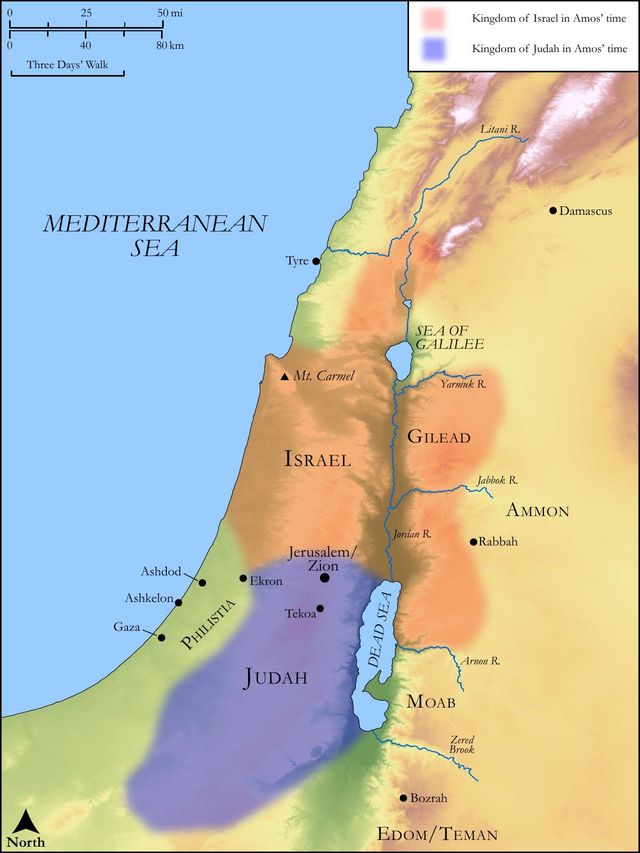
Moab was a long-standing neighbor and often an adversary of Israel, located east of the Dead Sea. Their relationship was complex, marked by periods of conflict (e.g., 2 Kings 3) and occasional interaction (e.g., Ruth, a Moabite, became an ancestor of David). The specific act condemned in Amos 2:1—burning the bones of the king of Edom—was an unparalleled affront to ancient sensibilities regarding the dead. In the ancient Near East, proper burial was crucial for a person's honor and perceived well-being in the afterlife. To desecrate a corpse, especially that of a king, was an act of ultimate contempt and an attempt to deny the deceased any peace or honor, reflecting a deep-seated hatred that went beyond conventional warfare. This act was not merely a military tactic but a profound violation of universal human dignity, making it a fitting target for divine judgment, even for a nation not under the Mosaic Covenant. Kerioth (or Kirioth) was a prominent city in Moab, possibly a royal or administrative center, making its destruction a symbol of the nation's complete downfall.
Key Themes
ShowHideThis verse powerfully contributes to several overarching themes in Amos and the broader prophetic literature. Firstly, it underscores the theme of Divine Judgment and Sovereignty, asserting God's absolute authority over all nations and His impartiality in judging sin, whether committed by covenant people or Gentiles. The detailed nature of the prophecy, including the specific city of Kerioth and the sounds of battle, highlights the Certainty and Precision of Prophecy, demonstrating that God's word is not vague but will be fulfilled with exactitude. Furthermore, the judgment against Moab for an act of extreme cruelty emphasizes the theme of Consequences of Inhumanity and Desecration. God holds all humanity accountable for basic moral laws, even those not explicitly outlined in the Mosaic Law. The imagery of fire and chaotic sounds points to the theme of Complete Devastation, signifying that God's judgment, once enacted, will bring about a thorough and irreversible destruction upon the targeted nation, echoing similar prophecies against other nations in the book, such as the fire sent upon Damascus in Amos 1:4.
Exposition and Analysis
ShowHideKey Word Analysis
ShowHideA primitive root meaning "to eat" literally or figuratively. In this context, it signifies the complete consumption or destruction by fire, indicating the thoroughness of the divine judgment. The fire will not merely damage but utterly consume the palaces, leaving nothing behind.
A primitive root meaning "to die" literally or figuratively; causatively, "to kill." Here, it denotes the literal perishing of the Moabite people, emphasizing the finality and severity of the judgment that will result in widespread death, not just defeat.
From a root meaning "uproar (as of rushing)"; by implication, "destruction." This word vividly describes the chaotic, confused noise of battle, the clamor of war, and the general disorder that accompanies a nation's collapse. It paints a picture of disarray and panic rather than an orderly retreat.
Verse Breakdown
ShowHide"But I will send a fire upon Moab,"
This opening declaration establishes the divine origin and nature of the impending judgment. The "fire" (Hebrew: 'esh', H784) is a common biblical metaphor for God's wrath and destructive power, signifying a judgment that is both purifying and consuming. It is God Himself who initiates this action, underscoring His sovereignty over nations.
"and it shall devour the palaces of Kerioth:"
The fire's target is specific: "the palaces (Hebrew: 'armôwn', H759) of Kerioth (Hebrew: Qᵉrîyôwth', H7152)." Kerioth was a significant city in Moab, likely a royal or administrative center. The mention of "palaces" indicates that the judgment will affect the highest echelons of Moabite society and infrastructure, symbolizing the complete collapse of their power and prestige, not just a minor skirmish.
"and Moab shall die with tumult,"
This clause specifies the fate of the nation itself: "Moab shall die." The death is not merely a cessation of national identity but a literal perishing of its people. This death is accompanied "with tumult" (Hebrew: shâʼôwn', H7588), depicting the chaotic noise and confusion of a nation under siege and being destroyed, filled with the sounds of war and disarray.
"with shouting, [and] with the sound of the trumpet:"
These phrases further amplify the imagery of violent destruction. "Shouting" (Hebrew: tᵉrûwʻâh', H8643) refers to a battle cry, an alarm, or a shout of distress, intensifying the sense of a nation in panic and defeat. The "sound of the trumpet" (Hebrew: qôwl' H6963 of the shôwphâr' H7782) refers to the ram's horn, typically used for signaling war, alarm, or assembly. Here, it signifies the signals of impending doom and the sounds of a nation being utterly routed in battle, reinforcing the picture of a military overthrow leading to their demise.
Literary Devices
ShowHideAmos 2:2 is rich in Imagery, painting a vivid picture of destruction through sensory details. The "fire" is a powerful visual and metaphorical image of divine wrath and total consumption. The mention of "palaces" evokes images of grandeur and power, which are then contrasted with their imminent destruction, highlighting the futility of human strength against divine judgment. Auditory Imagery is particularly strong with the triple repetition of sounds: "tumult," "shouting," and "the sound of the trumpet." This crescendo of chaotic noises immerses the reader in the scene of battle and national collapse, emphasizing the overwhelming nature of the devastation. The phrase "Moab shall die" employs Personification, treating the nation as a living entity that will perish, underscoring the completeness of its demise. The overall structure of the oracle, with its clear cause-and-effect relationship between Moab's sin and God's judgment, also demonstrates a form of Poetic Justice, where the punishment directly addresses the nature of the transgression.
Theological and Thematic Connections
ShowHideAmos 2:2 serves as a profound theological statement on God's universal justice and sovereignty. It unequivocally declares that God's moral standards extend beyond His covenant people, Israel, to encompass all nations. Moab's judgment for an act of extreme cruelty—burning the bones of the Edomite king—demonstrates that God holds all humanity accountable for basic moral principles and the sanctity of human dignity, even in death. This passage underscores that sin, particularly that which violates fundamental human decency, incurs divine wrath, irrespective of one's religious or national affiliation. It highlights that God is not merely the God of Israel but the just ruler of all the earth, who will bring every deed into judgment.
Reflection and Application
ShowHideAmos 2:2 stands as a timeless reminder of God's unwavering justice and the inevitable consequences of sin. For believers today, this passage calls us to a profound understanding of God's character: He is not only merciful and loving but also perfectly righteous and just. No act of cruelty, injustice, or desecration escapes His notice, whether committed by individuals or nations. This should inspire a deep commitment to living righteously, pursuing justice, and extending compassion, even to those we consider adversaries, because God's standards transcend human distinctions. It also reinforces the reliability of God's word; what He declares, He will bring to pass, giving us confidence in His promises and warnings. Ultimately, this passage challenges us to examine our own hearts and societies, asking if our actions align with the universal moral principles upheld by a holy God who will ultimately judge all works.
Questions for Reflection
ShowHideFAQ
ShowHideWhat was the specific sin of Moab that led to this severe judgment?
ShowHideThe specific sin of Moab, detailed in Amos 2:1, was the burning of the bones of the king of Edom into lime. This was an act of extreme desecration and cruelty, violating common ancient Near Eastern customs that respected the dead. It went beyond the normal brutality of warfare, demonstrating profound contempt and hatred, which God deemed worthy of severe judgment.
What is the significance of "Kerioth" in this prophecy?
ShowHideKerioth (Hebrew: Qᵉrîyôwth' H7152) was a prominent city in Moab, likely a royal or administrative center, making it a symbol of Moab's power and national identity. The prophecy that "fire upon Moab" would "devour the palaces of Kerioth" signifies that God's judgment would not be superficial but would strike at the very heart of Moabite strength and leadership, leading to a complete and devastating downfall of the nation. Its destruction represents the comprehensive nature of God's wrath against their sin.
Christ-Centered Fulfillment
ShowHideWhile Amos 2:2 speaks directly of God's judgment upon a Gentile nation for its sin, it points forward to the ultimate fulfillment of God's justice and the resolution of sin through Jesus Christ. The "fire" of divine wrath, so vividly depicted here, foreshadows the consuming holiness of God that must confront all unrighteousness. Yet, in the New Testament, we see this wrath not primarily poured out on nations in a general sense, but uniquely absorbed by the Lamb of God, who takes away the sin of the world. Jesus, through His atoning sacrifice on the cross, endured the full "tumult" and "shouting" of God's judgment against humanity's sin, becoming the ultimate sacrifice so that those who believe might escape the condemnation and "die" no longer in their sins but to them (Romans 6:11). Thus, the judgment on Moab, while historical, serves as a stark reminder of the gravity of sin and the certainty of God's justice, ultimately leading us to appreciate the profound grace found in Christ, who bore the full weight of divine judgment so that we might have life and peace (Romans 5:1). He is the one who ultimately conquers the chaos of sin and death, ushering in an era of true peace and righteousness (Colossians 1:20).