


1 Kings 8:12
Bible text: King James Version (1769 Blayney text) · Public domain
Bible text: Berean Standard Bible · Public domain
Bible text: American Standard Version (1901) · Public domain
Bible text: World English Bible, Messianic edition · Public domain
Bible text: Geneva Bible (1599) · Public domain
Bible text: Young's Literal Translation · Public domain
- אָז'azthenH227AdvAdverb
- אָמַר'a·Marhe saidH559V-Qal-Perf-3msVerb Qal Perfect 3rd Singular Masculine
- שְׁלֹמֹהshe·lo·MohSolomonH8010N-proper-mNoun Proper Masculine
- יְהוָהYah·wehYahwehH3068N-properNoun Proper Title
- אָמַר'a·Marhe has saidH559V-Qal-Perf-3msVerb Qal Perfect 3rd Singular Masculine
- לִשְׁכֹּןlish·Konto dwellH7931Prep-l ¦ V-Qal-InfVerb Qal Infinitive Constructלִtoשְׁכֹּןdwell
- בָּעֲרָפֶלba·'a·ra·Felin <the> thick darknessH6205Prep-b ¦ N-msNoun Singular Masculine Absoluteבָּin <the>עֲרָפֶלthick darkness
English is a literal word-by-word gloss of the Hebrew, not the KJV's wording. Why?
This is the original text the KJV's translators worked from — each Hebrew word with its own literal English meaning in this verse, prepared by scholars at Tyndale House, Cambridge. The KJV translates whole sentences, not word by word, so its wording differs: one Hebrew word can become several English words, and the KJV may choose “the LORD” where the gloss reads “Yahweh”. Both are faithful — they answer different questions. For the KJV's own rendering, switch to the KJV text.
Details
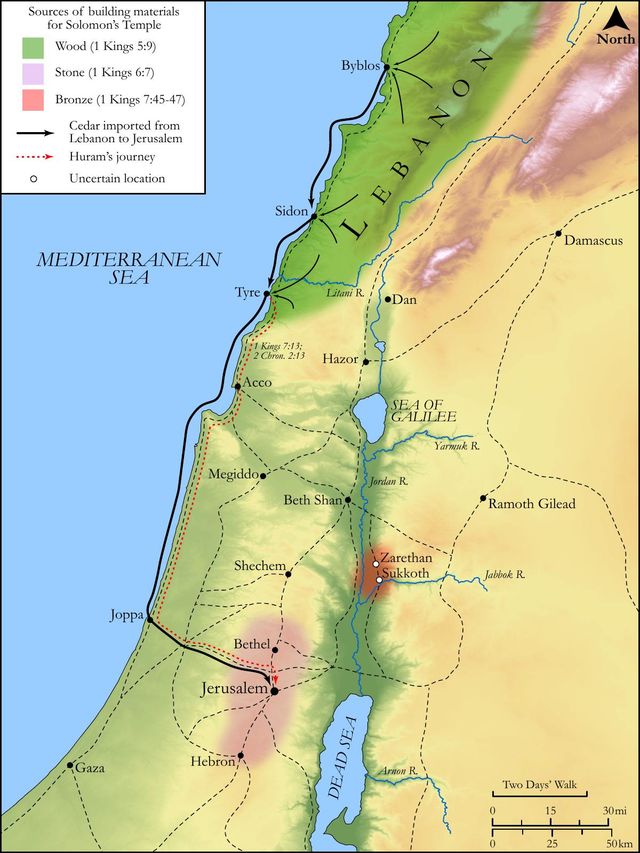
See on the biblical-era maps

Study this verse
Public-domain commentary
Matthew Henry
From his Commentary on the Whole Bible. Henry comments on passages, not single verses — this entry covers 1 Kings 8:12–21. His four-level outline is real structure in the source text, so it is rendered as structure.
Here, I. Solomon encourages the priests, who came out of the temple from their ministration, much astonished at the dark cloud that overshadowed them. The disciples of Christ feared when they entered into the cloud, though it was a bright cloud (Luk 9:34), so did the priests when they found themselves wrapped in a thick cloud. To silence their fears, 1. He reminds them of that which they could not but know, that this was a token of God's presence (Kg1 8:12): The Lord said he would dwell in the thick darkness. It is so far from being a token of his displeasure that it is an indication of his favour; for he had said, I will appear in a cloud, Lev 16:2. Note, Nothing is more effectual to reconcile us to dark dispensations than to consider what God hath said, and to compare his word and works together; as Lev 10:3, This is that which the Lord hath said. God is light (Jo1 1:5), and he dwells in light (Ti1 6:16), but he dwells with men in the thick darkness, makes that his pavilion, because they could not bear the dazzling brightness of his glory. Verily thou art a God that hidest thyself. Thus our holy faith is exercised and our holy fear is increased. Where God dwells in light faith is swallowed up in vision and fear in love. 2. He himself bids it welcome, as worthy of all acceptation; and since God, by this cloud, came down to take possession, he does, in a few words, solemnly give him possession (Kg1 8:13): "Surely I come," says God. "Amen," says Solomon, "Even so, come, Lord,. The house is thy own, entirely thy own, I have surely built it for thee, and furnished it for thee; it is for ever thy own, a settled place for thee to abide in for ever; it shall never be alienated nor converted to any other use; the ark shall never be removed from it, never unsettled again." It is Solomon's joy that God has taken possession; and it is his desire that he would keep possession. Let not the priests therefore dread that in which Solomon so much triumphs.
II.He instructs the people, and gives them a plain account concerning this house, which they now saw God take possession of.
He spoke briefly to the priests, to satisfy them (a word to the wise), but turned his face about (Kg1 8:14) from them to the congregation that stood in the outer court, and addressed himself to them largely.
1.He blessed them. When they saw the dark cloud enter the temple they blessed themselves, being astonished at it and afraid lest the thick darkness should be utter darkness to them. The amazing sight, such as they had never seen in their days, we may suppose, drove every man to his prayers, and the vainest minds were made serious by it. Solomon therefore set in with their prayers, and blessed them all, as one having authority (for the less is blessed of the better); in God's name, he spoke peace to them, and a blessing, like that with which the angel blessed Gideon when he was in a fright, upon a similar occasion. Jdg 6:22, Jdg 6:23, Peace be unto thee. Fear not; thou shalt not die. Solomon blessed them, that is, he pacified them, and freed them from the consternation they were in. To receive this blessing, they all stood up, in token of reverence and readiness to hear and accept it. It is a proper posture to be in when the blessing is pronounced.
2.He informed them concerning this house which he had built and was now dedicating.
(1.)He began his account with a thankful acknowledgment of the good hand of his God upon him hitherto: Blessed be the Lord God of Israel, Kg1 8:15. What we have the pleasure of God must have the praise of. He thus engaged the congregation to lift up their hearts in thanksgivings to God, which would help to still the tumult of spirit which, probably, they were in. "Come," says he, "let God's awful appearances not drive us from him, but draw us to him; let us bless the Lord God of Israel." Thus Job, under a dark scene, blessed the name of the Lord. Solomon here blessed God,
[1.]For his promise which he spoke with his mouth to David.
[2.]For the performance, that he had now fulfilled it with his hand. We have then the best sense of God's mercies, and most grateful both to ourselves and to our God, when we run up those streams to the fountain of the covenant, and compare what God does with what he has said.
(2.)Solomon is now making a solemn surrender or dedication of this house unto God, delivering it to God by his own act and deed. Grants and conveyances commonly begin with recitals of what has been before done, leading to what is now done: accordingly, here is a recital of the special causes and considerations moving Solomon to build this house.
[1.]He recites the want of such a place. It was necessary that this should be premised; for, according to the dispensation they were under, there must be but one place in which they must expect God to record his name. If, therefore, there were any other chosen, this would be a usurpation. But he shows, from what God himself had said, that there was no other (Kg1 8:16): I chose no city to build a house in for my name; therefore there is occasion for the building of this.
[2.]He recites David's purpose to build such a place. God chose the person first that should rule his people (I chose David, Kg1 8:16) and then put it into his heart to build a house for God's name, Kg1 8:17. It was not a project of his own, for the magnifying of himself; but his good father, of blessed memory, laid the first design of it, though he lived not to lay the first stone.
[3.]He recites God's promise concerning himself. God approved his father's purpose (Kg1 8:18): Thou didst well, that it was in thy heart. Note, Sincere intentions to do good shall be graciously approved and accepted of God, though Providence prevent our putting them in execution. The desire of a man is his kindness. See Co2 8:12. God accepted David's good will, yet would not permit him to do the good work, but reserved the honour of it for his son (Kg1 8:19): He shall build the house to my name; so that what he had done was not of his own head, nor for his own glory, but the work itself was according to his father's design and his doing it was according to God's designation.
[4.]He recites what he himself had done, and with what intention: I have built a house, not for my own name, but for the name of the Lord God of Israel (Kg1 8:20), and set there a place for the ark, Kg1 8:21. Thus all the right, title, interest, claim, and demand, whatsoever, which he or his had or might have in or to this house, or any of its appurtenances, he resigns, surrenders, and gives up, to God for ever. It is for his name, and his ark. In this, says he, the Lord hath performed his word that he spoke. Note, Whatever good we do, we must look upon it as the performance of God's promise to us, rather than the performance of our promises to him. The more we do for God the more we are indebted to him; for our sufficiency is of him, and not of ourselves.
Continue studying 1 Kings 8:12 across the web’s major study libraries — every link below opens this exact verse, chapter, or book on the destination site.
Read & Compare
 BibleGatewayThis verse in more than 200 translations and 70 languages.
 Bible.comThe YouVersion reader — hundreds of translations, reading plans, and highlights.
 ESV.orgCrossway's official English Standard Version reader.
 NET BibleThe NET translation with 60,000+ translators' notes on every rendering decision.
 STEP BibleTyndale House's free study tool — original text, vocabulary, and scholarly resources.
 BibliaLogos Bible Software's free web reader.
 USCCBThe New American Bible (Revised Edition) with the U.S. bishops' study notes.
Commentaries
 BibleHub CommentariesDozens of classic commentaries on this verse, gathered on one page.
 StudyLightMore than 100 commentary sets — the largest collection on the web.
 BibleRefPlain-English commentary on what this verse means, verse by verse.
 Enduring WordDavid Guzik's free commentary on this chapter, widely used by Bible teachers.
 Bible Study ToolsVerse commentary alongside Greek and Hebrew study aids.
Original Language & Research
- BibleHub InterlinearThe verse word by word — original language, transliteration, and English.
- BibleHub LexiconEvery word's original-language definition and Strong's entry.
 Blue Letter BibleDeep-study tools — Strong's numbers, concordance, and word studies.
 SefariaThe Hebrew text with Rashi and centuries of Jewish commentary.
Sermons, Hymns & Audio


TrulyRandomVerse is not affiliated with these sites and doesn’t control their content. They’re linked because they’re genuinely useful.
Summary
In the climactic moment of the Temple's dedication, King Solomon articulates a profound theological truth, declaring that the LORD had previously stated His intention to reside "in the thick darkness." This pronouncement immediately follows the overwhelming manifestation of God's glory, which filled the newly consecrated Temple with a dense cloud, preventing the priests from continuing their service. Solomon's words serve as a crucial interpretive key to this awe-inspiring event, affirming God's mysterious, transcendent, yet immanent presence among His people, veiled in an unapproachable and majestic obscurity.
Context
ShowHideLiterary Context
This verse serves as Solomon's immediate theological interpretation of the dramatic events preceding it. The narrative in 1 Kings 8:6-9 describes the priests bringing the Ark of the Covenant into the Most Holy Place, followed by the spectacular filling of the Temple with the glory of the LORD, manifested as a cloud so dense that the priests could not stand to minister (1 Kings 8:10-11). Solomon's declaration in 1 Kings 8:12 directly explains this divine manifestation, setting the stage for his subsequent blessing of the assembly (1 Kings 8:14) and his extensive dedicatory prayer, which spans from 1 Kings 8:22-53. The phrase "thick darkness" thus links the Temple's dedication back to earlier divine encounters, particularly at Sinai, establishing continuity in God's mode of revelation.
Historical & Cultural Context
The construction and dedication of the Temple by Solomon marked a significant milestone in Israelite history, symbolizing the establishment of a permanent, central dwelling place for Yahweh in Jerusalem. This monumental event fulfilled long-standing promises, particularly those made to David concerning a lasting dynasty and a house for God's name (2 Samuel 7:12-13). The manifestation of God's glory as a cloud (often referred to as the Shekinah) was a familiar motif from Israel's wilderness wanderings, where a cloud led them by day and filled the Tabernacle (Exodus 40:34-35), and from the giving of the Law at Mount Sinai, where God appeared in "thick darkness" (Exodus 20:21). The Temple served as the focal point of Israelite worship, national identity, and covenant relationship with God, solidifying Jerusalem's role as the spiritual capital and the center of Israel's theocratic government.
Key Themes
ShowHideThis verse contributes significantly to several key themes within 1 Kings and the broader biblical narrative. Foremost is the theme of Divine Presence and Dwelling, emphasizing God's commitment to be among His people, yet on His own terms. This presence is paradoxically both immanent (dwelling in the Temple) and transcendent (veiled in "thick darkness"), highlighting God's Mystery and Ineffability. The manifestation underscores God's Holiness and Otherness, requiring a reverent distance and acknowledging that His full glory cannot be directly perceived by humans. It also reinforces the theme of Covenant Fulfillment, as the Temple's completion and God's indwelling signify the ongoing faithfulness of Yahweh to His promises to Israel. Finally, the dramatic scene and Solomon's interpretation contribute to the theme of Worship and Awe, indicating the appropriate human response to encountering the living God.
Exposition and Analysis
ShowHideKey Word Analysis
ShowHideFrom the root hayah (to be), this is the self-existent or eternal God, the Jewish national name of God, Jehovah. It signifies the covenant-keeping God of Israel, whose very being is independent and everlasting. Solomon's use of this name emphasizes that the divine presence filling the Temple is none other than the sovereign, personal God who has revealed Himself throughout Israel's history.
A primitive root meaning to reside or permanently stay, literally or figuratively. It conveys the idea of abiding, continuing, or having a habitation. In this context, it signifies God's deliberate and chosen act of taking up residence among His people, establishing a settled, enduring presence. This verb highlights God's immanence – His nearness and active presence within the created order and specifically within the Temple, fulfilling His promise to be with Israel.
Probably from the root ʻâraph (to drop, distil), this term refers to a dense, thick cloud or gloom, often associated with divine manifestation. It is not a negative concept of evil or absence of light, but rather a profound, impenetrable veil that conceals God's presence. It emphasizes His holiness, majesty, and transcendence, signifying the unapproachable nature of God's glory, which is too overwhelming for human sight, as seen in the context of Mount Sinai (Exodus 20:21 and Deuteronomy 4:11).
Verse Breakdown
ShowHide"Then spake Solomon"
This phrase highlights Solomon's pivotal role as the divinely appointed king and the primary speaker at this monumental event. His words are not merely a personal reflection but a public, authoritative declaration interpreting the profound divine manifestation that has just occurred. It signifies his understanding of the theological implications of God's presence in the Temple, acting as a prophet-king.
"The LORD said"
This clause is crucial as it grounds Solomon's statement in divine revelation, not human speculation. Solomon is not inventing a new theological concept but recalling a previously revealed truth about God's nature and His chosen mode of appearing. While the exact quote is not found verbatim in earlier texts, the concept of God dwelling in thick darkness is deeply embedded in the Sinai narratives, indicating Solomon's grasp of Israel's covenant history and divine encounters.
"that he would dwell"
This expresses God's sovereign choice and commitment to establish a presence among His people. The verb "dwell" signifies a settled, enduring presence. It speaks to God's faithfulness to His covenant promises, particularly the promise to be Israel's God and to reside among them. This dwelling is the very purpose of the Tabernacle and now the Temple – to provide a unique place where God's presence can be experienced by His people in a special way.
"in the thick darkness"
This is the central theological assertion of the verse. It describes the specific manner of God's dwelling. The "thick darkness" (ʻărâphel) is a veil of mystery, not an absence of God, but a sign of His overwhelming holiness, transcendence, and unapproachable glory. It communicates that while God is present, He remains distinct, incomprehensible in His fullness, and utterly beyond human manipulation or complete understanding. It evokes awe and reverence, reminding humanity of the infinite gap between the Creator and creation.
Literary Devices
ShowHideThe verse employs several significant literary devices that enrich its meaning. Theophany is central, as the preceding verses describe a visible manifestation of God's glory in the cloud, which Solomon interprets. The "thick darkness" itself functions as potent Symbolism, representing God's unapproachable holiness, transcendence, and the mysterious nature of His presence. It is a veil that both conceals and reveals, indicating that while God is present, He is not fully comprehensible to human senses. There is also a strong element of Allusion to earlier biblical narratives, particularly the giving of the Law at Mount Sinai, where God appeared in a similar "thick darkness" (Exodus 20:21). This allusion connects the Temple dedication to the foundational covenant event, establishing continuity in God's character and His interaction with Israel. The concise nature of Solomon's declaration also gives it the quality of a Proverbial Statement, distilling profound theological truth into a memorable phrase.
Theological and Thematic Connections
ShowHideThis verse profoundly shapes our understanding of God's nature and His relationship with humanity. It presents a paradox: God is both immanent, choosing to dwell among His people in a physical structure, and transcendent, veiled in "thick darkness" to signify His incomprehensible majesty and holiness. This balance prevents a reductionist view of God, affirming His nearness without diminishing His otherness. The "thick darkness" is not an absence of light, but the overwhelming intensity of divine glory that is too brilliant for human eyes, thus appearing as darkness. It teaches that true intimacy with God involves profound reverence and an acknowledgment of His infinite mystery, inviting awe rather than complete intellectual mastery.
Reflection and Application
ShowHideSolomon's declaration in 1 Kings 8:12 offers a powerful reminder of the dual nature of God's presence: He is intimately near, yet infinitely transcendent. For believers today, this means that while we experience God's presence through the Holy Spirit and in community, we must never lose our sense of awe and reverence. The "thick darkness" signifies that God is not fully graspable by human intellect or fully containable by our experiences. This should cultivate humility in our worship and study, recognizing that our understanding of God will always be partial. It encourages us to lean into the mystery, trusting in His revealed character even when His ways are beyond our full comprehension. Our approach to God should be marked by both confident intimacy and profound respect for His unapproachable holiness, knowing that He desires to dwell with us even as He remains utterly distinct.
Questions for Reflection
ShowHideFAQ
ShowHideWhy would God choose to dwell in "thick darkness" instead of light, given that He is often associated with light?
ShowHideThe "thick darkness" (ʻărâphel) in this context is not the absence of light or an evil darkness, but rather the overwhelming, impenetrable glory of God. It signifies a light so intense that it appears as darkness to human perception, an unapproachable light as described in 1 Timothy 6:16. This concept highlights God's transcendence, holiness, and the fact that His full being is beyond human comprehension or direct observation. It serves as a protective veil, preventing human annihilation in the face of His infinite glory, and emphasizing His majestic otherness. The association with Sinai (Exodus 20:21) reinforces that this "darkness" is a sign of divine presence, not absence.
Christ-Centered Fulfillment
ShowHideThe declaration that God would dwell "in the thick darkness" finds its ultimate fulfillment and redefinition in Jesus Christ. While the Old Testament Temple represented God's veiled presence, foreshadowing a greater revelation, Jesus is the very embodiment of God's presence, the true dwelling place of God among humanity. John 1:14 declares, "And the Word was made flesh, and dwelt among us, (and we beheld his glory, the glory as of the only begotten of the Father,) full of grace and truth." The Greek word for "dwelt" here (skenoo) means to "tabernacle," directly linking Jesus to the Old Testament dwelling places of God. No longer veiled in "thick darkness" or confined to a physical Temple, God's glory is now seen in the person of Christ, who is the "radiance of God's glory and the exact representation of his being" (Hebrews 1:3). Through Christ's atoning sacrifice, the veil of the Temple was dramatically torn from top to bottom (Matthew 27:51), signifying direct and unhindered access to God's holy presence. Furthermore, through the indwelling Holy Spirit, believers themselves become a "temple of God" (1 Corinthians 3:16), meaning God now dwells not in physical darkness, but intimately within His people, fully revealed in the light of Christ.