


1 Kings 6:2
Bible text: King James Version (1769 Blayney text) · Public domain
Bible text: King James Version with Strong's numbers · Public domain
Bible text: Berean Standard Bible · Public domain
Bible text: American Standard Version (1901) · Public domain
Bible text: World English Bible, Messianic edition · Public domain
Bible text: Geneva Bible (1599) · Public domain
Bible text: Young's Literal Translation · Public domain
- וְהַבַּיִתve·ha·Ba·yitand the houseH1004Conj-w ¦ Art ¦ N-msNoun Singular Masculine Absoluteוְandהַtheבַּיִתhouse
- אֲשֶׁר'a·SherwhichH834RelParticle Relative
- בָּנָהba·Nahhe builtH1129V-Qal-Perf-3msVerb Qal Perfect 3rd Singular Masculine
- הַמֶּלֶךְha·Me·lekhthe kingH4428Art ¦ N-msNoun Singular Masculine Absoluteהַtheמֶּלֶךְking
- שְׁלֹמֹהshe·lo·MohSolomonH8010N-proper-mNoun Proper Masculine
- לַיהוָהla·Yah·wehfor YahwehH3068Prep-l ¦ N-properNoun Proper TitleלַforיהוָהYahweh
- שִׁשִּׁיםshi·shim[was] sixtyH8346N-mpNoun Plural Masculine Absolute
- אַמָּה'a·Mahcubit[s]H520N-fsNoun Singular Feminine Absolute
- אָרְכּוֹ'a·re·Koits lengthH753N-msc ¦ 3msNoun Singular Masculine Constructאָרְכּlengthוֹits
- וְעֶשְׂרִיםve·'es·Rimand [was] twentyH6242Conj-w ¦ N-mpNoun Plural Masculine Absoluteוְandעֶשְׂרִים[was] twenty
- רָחְבּוֹra·che·Boits breadthH7341N-msc ¦ 3msNoun Singular Masculine Constructרָחְבּbreadthוֹits
- וּשְׁלֹשִׁיםu·she·lo·Shimand [was] thirtyH7970Conj-w ¦ N-mpNoun Plural Masculine Absoluteוּandשְׁלֹשִׁים[was] thirty
- אַמָּה'a·Mahcubit[s]H520N-fsNoun Singular Feminine Absolute
- קוֹמָתוֹko·ma·Toits heightH6967N-fsc ¦ 3msNoun Singular Feminine Constructקוֹמָתheightוֹits
English is a literal word-by-word gloss of the Hebrew, not the KJV's wording. Why?
This is the original text the KJV's translators worked from — each Hebrew word with its own literal English meaning in this verse, prepared by scholars at Tyndale House, Cambridge. The KJV translates whole sentences, not word by word, so its wording differs: one Hebrew word can become several English words, and the KJV may choose “the LORD” where the gloss reads “Yahweh”. Both are faithful — they answer different questions. For the KJV's own rendering, switch to the KJV text.
Details
See on the biblical-era maps

Study this verse
Public-domain commentary
Matthew Henry
From his Commentary on the Whole Bible. Henry comments on passages, not single verses — this entry covers 1 Kings 6:1–10. His two-level outline is real structure in the source text, so it is rendered as structure.
Here, I. The temple is called the house of the Lord (Kg1 6:1), because it was, 1. Directed and modelled by him. Infinite Wisdom was the architect, and gave David the plan or pattern by the Spirit, not by word of mouth only, but, for the greater certainty and exactness, in writing (Ch1 28:11, Ch1 28:12), as he had given to Moses in the mouth a draught of the tabernacle. 2. Dedicated and devoted to him and to his honour, to be employed in his service, so his as never any other house was, for he manifested his glory in it (so as never in any other) in a way agreeable to that dispensation; for, when there were carnal ordinances, there was a worldly sanctuary, Heb 9:1, Heb 9:10. This gave it its beauty of holiness, that it was the house of the Lord, which far transcended all its other beauties.
II.The time when it began to be built is exactly set down.
1.It was just 480 years after the bringing of the children of Israel out of Egypt. Allowing forty years to Moses, seventeen to Joshua, 299 to the Judges, forty to Eli, forty to Samuel and Saul, forty to David, and four to Solomon before he began the work, we have just the sum of 480. So long it was after that holy state was founded before that holy house was built, which, in less than 430 years, was burnt by Nebuchadnezzar. It was thus deferred because Israel had, by their sins, rendered themselves unworthy of this honour, and because God would show how little he values external pomp and splendour in his service: he was in no haste for a temple. David's tent, which was clean and convenient, though it was neither stately nor rich, nor, for aught that appears, ever consecrated, is called the house of the Lord (Sa2 12:20), and served as well as Solomon's temple; yet, when God gave Solomon great wealth, he put it into his heart thus to employ it, and graciously accepted him, chiefly because it was to be a shadow of good things to come, Heb 9:9.
2.It was in the fourth year of Solomon's reign, the first three years being taken up in settling the affairs of his kingdom, that he might not find any embarrassment from them in this work. It is not time lost which is spent in composing ourselves for the work of God, and disentangling ourselves from every thing which might distract or divert us. During this time he was adding to the preparations which his father had made (Ch1 22:14), hewing the stone, squaring the timber, and getting every thing ready, so that he is not to be blamed for slackness in deferring it so long. We are truly serving God when we are preparing for his service and furnishing ourselves for it.
III.The materials are brought in, ready for their place (Kg1 6:7), so ready that there was neither hammer nor ax heard in the house while it was in building. In all building Solomon prescribes it as a rule of prudence to prepare the work in the field, and afterwards build, Pro 24:27. But here, it seems, the preparation was more than ordinarily full and exact, to such a degree that, when the several parts came to be put together, there was nothing defective to be added, nothing amiss to be amended. It was to be the temple of God of peace, and therefore no iron tool must be heard in it. Quietness and silence both become and befriend religious exercises: God's work should be done with as much care and as little noise as may be. The temple was thrown down with axes and hammers, and those that threw it down roared in the midst of the congregation (Psa 74:4, Psa 74:6); but it was built up in silence. Clamour and violence often hinder the work of God, but never further it.
IV.The dimensions are laid down (Kg1 6:2, Kg1 6:3) according to the rules of proportion.
Some observe that the length and breadth were just double to that of the tabernacle. Now that Israel had grown more numerous the place of their meeting needed to be enlarged (Isa 54:1, Isa 54:2), and now that they had grown richer they were the better able to enlarge it. Where God sows plentifully he expects to reap so.
V.An account of the windows (Kg1 6:4):
They were broad within, and narrow without, Marg. Such should the eyes of our mind be, reflecting nearer on ourselves than on other people, looking much within, to judge ourselves, but little without, to censure our brethren. The narrowness of the lights intimated the darkness of that dispensation, in comparison with the gospel day.
VI.The chambers are described (Kg1 6:5, Kg1 6:6), which served as vestries, in which the utensils of the tabernacle were carefully laid up, and where the priests dressed and undressed themselves and left the clothes in which they ministered: probably in some of these chambers they feasted upon the holy things. Solomon was not so intent upon the magnificence of the house as to neglect the conveniences that were requisite for the offices thereof, that every thing might be done decently and in order. Care was taken that the beams should not be fastened in the walls to weaken them, Kg1 6:6. Let not the church's strength be impaired under pretence of adding to its beauty or convenience.
Historical interpretation
Historical reception
3 surviving comments on this verse. Each one is dated, so this reads as a timeline rather than a list.
Select a marker to jump to its quote. Markers stagger vertically where authors wrote within a few decades of each other.
The temple was built of Parian marble, a white stone, to represent the brilliance of chastity in the church, concerning which the Lord says in the canticle of love: “Like a lily among thorns, so is my love among maidens.” [The temple] “was sixty cubits long, twenty cubits wide and thirty cubits high.” The length of the temple designates the faith of the holy church, through which it bears with long-suffering patience, in the midst of its good works, the adversities brought against it by the wicked. The width designates the charity by which [the church] expands inwardly through the essential working of piety. The height designates the hope with which it awaits the rewards of the heavenly life, [which it will receive] as a result of the good deeds it performs through charity.
Why is it said in the book of Kings [1 Kings 6:2] that the temple had a height of 30 cubits, while in the book of Chronicles [2 Chronicles 3:4] it is stated as 120 cubits? What is said regarding the construction of the temple in the book of Kings, that it had a height of 30 cubits, while in the books of Chronicles it is written: "Moreover, the height was 120 cubits" [2 Chronicles 3:4], is by no means contradictory, but both are to be understood as true. For, as Josephus narrates in his History: there were 30 cubits from the floor to the middle chamber, another 30 from the middle to the third, up to where the height of the porticos, which were attached to the temple on the southern, western, and northern sides, extended—that is, together 60; then another 60 up to the roof of the house: thus, the total height of the temple was completed at 120 cubits (Antiquities of the Jews, Book VIII, chapter 3).
The house that Solomon built for the [Lord] was sixty cubits long,” that is, the double of the tabernacle. It is extremely likely that it included two rooms, an interior and an exterior. The interior was twenty cubits long, while the exterior was forty cubits. [The house] was built on the threshing floor of Ornan the Jebusite, which David had bought together with the garden. David had prepared the materials for the construction of the house, as the book of Chronicles reports.
Continue studying 1 Kings 6:2 across the web’s major study libraries — every link below opens this exact verse, chapter, or book on the destination site.
Read & Compare
 BibleGatewayThis verse in more than 200 translations and 70 languages.
 Bible.comThe YouVersion reader — hundreds of translations, reading plans, and highlights.
 ESV.orgCrossway's official English Standard Version reader.
 NET BibleThe NET translation with 60,000+ translators' notes on every rendering decision.
 STEP BibleTyndale House's free study tool — original text, vocabulary, and scholarly resources.
 BibliaLogos Bible Software's free web reader.
 USCCBThe New American Bible (Revised Edition) with the U.S. bishops' study notes.
Commentaries
 BibleHub CommentariesDozens of classic commentaries on this verse, gathered on one page.
 StudyLightMore than 100 commentary sets — the largest collection on the web.
 BibleRefPlain-English commentary on what this verse means, verse by verse.
 Enduring WordDavid Guzik's free commentary on this chapter, widely used by Bible teachers.
 Bible Study ToolsVerse commentary alongside Greek and Hebrew study aids.
Original Language & Research
- BibleHub InterlinearThe verse word by word — original language, transliteration, and English.
- BibleHub LexiconEvery word's original-language definition and Strong's entry.
 Blue Letter BibleDeep-study tools — Strong's numbers, concordance, and word studies.
 SefariaThe Hebrew text with Rashi and centuries of Jewish commentary.
Sermons, Hymns & Audio


TrulyRandomVerse is not affiliated with these sites and doesn’t control their content. They’re linked because they’re genuinely useful.
Summary
1 Kings 6:2 provides the foundational architectural specifications for the main sanctuary of Solomon's Temple, detailing its length as sixty cubits, its breadth as twenty cubits, and its height as thirty cubits. This verse immediately follows the commencement of the Temple's construction, establishing the precise dimensions for the physical dwelling place dedicated to the LORD in Jerusalem. These meticulous measurements underscore the sacredness and divine inspiration behind the structure, reflecting God's nature of order and the profound significance of the house built for His name and presence.
Context
ShowHideLiterary Context
This verse is strategically placed at the very outset of the detailed account of Solomon's Temple construction, directly following the statement in 1 Kings 6:1 that the work commenced in the fourth year of Solomon's reign. It serves as the essential architectural baseline upon which all subsequent descriptions—including the side chambers, windows, and intricate internal furnishings—are built. The precise numerical specifications here set a tone of meticulousness and divine guidance for the entire building project, which unfolds throughout the remainder of 1 Kings chapter 6 and extends into chapter 7 with details of the Temple's bronze furnishings and Solomon's palace. This grand undertaking is presented not merely as a human architectural feat but as the fulfillment of God's covenant promise to David that his son would construct a permanent house for the LORD, a promise foundational to the Davidic covenant elaborated in 2 Samuel 7:13.
Historical & Cultural Context
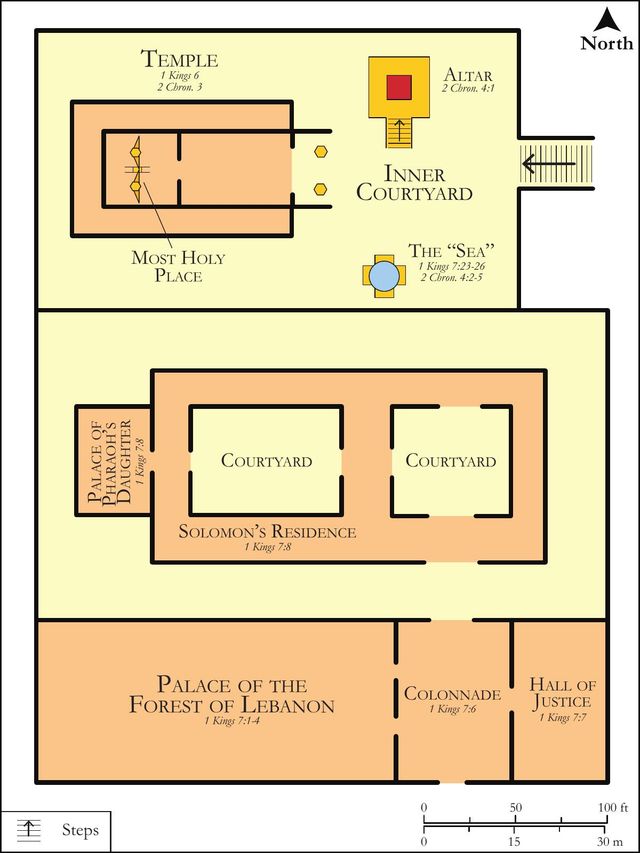
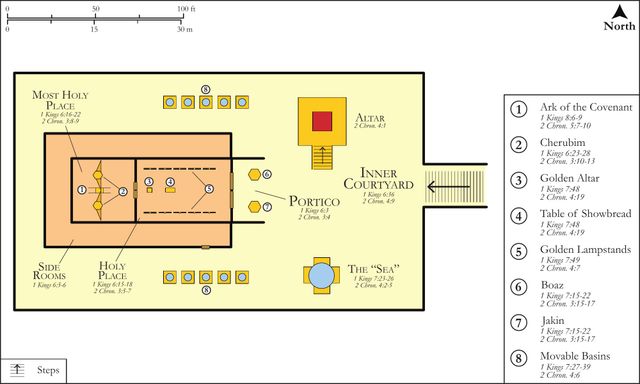
The construction of the Temple was a highly significant undertaking for the king, built after the pattern that David had given his son. Solomon's Temple was marked by its exclusive dedication to YHWH, the one true God, and its unparalleled role as the singular, central place of worship for the entire nation of Israel. The "cubit" (Hebrew: ʾammah) was a universally recognized unit of measurement in that day, conventionally approximating the distance from the elbow to the tip of the middle finger, typically ranging from 18 to 22 inches (approximately 45-56 cm). The dimensions provided in this verse—60 cubits long, 20 cubits wide, and 30 cubits high—describe the main sanctuary, which was internally divided into the Holy Place (the larger outer chamber) and the Most Holy Place (the inner sanctum, or Holy of Holies, which occupied the innermost 20 cubits of the length). This meticulously designed structure was intended to be the preeminent physical manifestation of God's holy presence among His covenant people in Jerusalem.
Key Themes
ShowHideThe precise dimensions detailed in 1 Kings 6:2 contribute profoundly to several overarching theological and narrative themes within the book of Kings and the broader biblical metanarrative. Firstly, they powerfully underscore the theme of Divine Precision and Order. The meticulous measurements suggest that the Temple was not constructed arbitrarily but according to a specific, sacred, and divinely ordained design, reflecting God's inherent character as a God of order, perfection, and intentionality. Secondly, the sheer scale implied by these dimensions highlights the Grandeur and Majesty of God. The Temple was conceived as an impressive and awe-inspiring structure, befitting the dwelling place of the Almighty, a truth echoed in passages like Psalm 29:2 which calls for worship in the splendor of holiness. Thirdly, the verse firmly establishes the Centrality of Worship in Israelite national life. By providing the foundational measurements of this sacred edifice, the text emphasizes the Temple's pivotal role as the physical and spiritual core of national religious life, where the covenant God would uniquely manifest His presence, receive the worship of His people, and hear their prayers, as magnificently articulated in Solomon's dedication prayer in 1 Kings chapter 8.
Exposition and Analysis
ShowHideKey Word Analysis
ShowHideWhile literally meaning "house" or "building," in this sacred context, bayith transcends a mere physical structure. It denotes a dwelling place, a sacred abode, or specifically, a temple dedicated to a deity. Here, it is explicitly "the house which king Solomon built for the LORD," emphasizing its consecrated purpose as the dwelling place for God's presence, rather than merely a royal edifice. This term carries profound theological weight, linking back to God's ancient desire to "dwell among" His people, as seen in the instructions for the Tabernacle (e.g., Exodus 25:8).
This primitive root signifies the act of construction, both literally and figuratively. In this verse, it highlights Solomon's active role as the divinely appointed builder, fulfilling the promise made to his father David. The verb emphasizes the deliberate and intentional creation of a physical structure, but also implicitly points to the establishment of a lasting legacy and a place for God's name to dwell. The act of "building" here is not just an architectural endeavor but a theological one, establishing a tangible center for Israel's worship and national identity.
This is the sacred, covenantal name of God, often rendered as "LORD" in English translations, signifying the self-existent, eternal God of Israel. The explicit statement that the house was built "for the LORD" is paramount. It defines the Temple's ultimate purpose, ownership, and consecration. It was not built for Solomon's glory, nor for the nation's pride, but as a dedicated space for the worship and manifest presence of the sovereign God who had chosen Israel as His people and promised to dwell among them. This emphasizes the Temple's unique status as a divine initiative, not a human one.
Verse Breakdown
ShowHide"And the house which king Solomon built for the LORD"
This opening clause immediately establishes the subject of the detailed description: not just any building, but the specific, sacred structure commissioned and dedicated to YHWH. It highlights Solomon's divinely appointed role as the builder, fulfilling the promise made to his father David. The crucial phrase "for the LORD" emphasizes the Temple's exclusive and consecrated purpose, distinguishing it profoundly from any secular or royal edifice. It underscores that the Temple's existence and function were entirely centered on God.
"the length thereof [was] threescore cubits"
This specifies the primary longitudinal dimension of the main sanctuary, which comprised both the Holy Place and the Most Holy Place. "Threescore" means sixty (60) cubits. At an approximate cubit length of 18-22 inches, this translates to roughly 90-110 feet (27-33 meters). This substantial length would have created an imposing and reverent space, guiding worshippers from the outer courts into the increasingly sacred interior.
"and the breadth thereof twenty [cubits]"
This provides the width of the main sanctuary, twenty (20) cubits, which is approximately 30-37 feet (9-11 meters). The ratio of length to breadth (3:1) is significant and commonly found in ancient sacred architecture, contributing to the sense of proportion, balance, and divine harmony within the overall blueprint. This dimension ensured the interior was spacious yet contained, fostering an atmosphere of reverence.
"and the height thereof thirty cubits."
This specifies the vertical dimension of the main sanctuary, thirty (30) cubits, approximately 45-55 feet (13.5-17 meters). This considerable height would have contributed significantly to the grandeur and spaciousness of the interior, elevating the structure both physically and symbolically as a place set apart for the Most High God. These foundational dimensions set the stage for the detailed descriptions of the Temple's internal divisions, materials, and furnishings that follow in subsequent verses.
Literary Devices
ShowHideThe primary literary device at play in 1 Kings 6:2 is Precision and Detailing. The text provides exact numerical measurements for the Temple's foundational dimensions, which serves to emphasize the meticulous care, divine blueprint, and sacred order involved in its construction. This level of detail is not merely architectural; it conveys a profound theological message about God's inherent orderliness, His specific and holy requirements for worship, and the sacredness of the space dedicated to Him. The precise numbers also lend an air of Verisimilitude, making the account feel historically grounded and authentic, inviting the reader to visualize the structure with clarity. Furthermore, the description of these grand and exact dimensions contributes to the overall Symbolism of the Temple itself. The structure, by its very size, precise design, and dedication "for the LORD," symbolizes the majesty, holiness, and dwelling presence of God among His people, serving as a tangible representation of His covenant faithfulness and His desire to be known and worshipped in a specific, consecrated manner.
Theological and Thematic Connections
ShowHideThe precise dimensions of Solomon's Temple, as meticulously laid out in 1 Kings 6:2, are far more than mere architectural specifications; they carry profound theological weight and convey deep spiritual truths. They underscore God's nature as a God of order, precision, and absolute holiness, who desires a specific, consecrated space for His dwelling and worship among His people. This divine attention to detail reflects a continuity with the meticulous divine blueprint given for the Tabernacle (e.g., Exodus 25), indicating a consistent pattern in God's desire for a structured, reverent, and intentional approach to His presence. The grandeur implied by these dimensions also speaks powerfully to the majesty, glory, and transcendence of the God whom the Temple was built to honor, establishing it as the preeminent center of worship and a tangible sign of the enduring covenant relationship between YHWH and Israel.
Reflection and Application
ShowHideWhile believers today no longer build physical temples for God to dwell in, the meticulous care and precise dimensions described in 1 Kings 6:2 offer profound and enduring lessons for our spiritual lives. This verse serves as a powerful reminder that God is a God of order, intention, and holiness, and He calls us to approach Him with similar reverence, thoughtfulness, and intentionality. The Temple's grandeur was designed to reflect the majesty of God; similarly, our lives, as spiritual temples, should reflect His glory through intentional worship, unwavering obedience, and a commitment to personal holiness in every sphere. The detailed blueprint for the Temple suggests that God's plan for our individual lives, though not always as numerically precise, is equally intentional, purposeful, and divinely designed. We are called to build our lives on the solid foundation of His Word, ensuring that our spiritual structures—our character, our relationships, our ministries—are sound, robust, and aligned with His divine design, rather than being haphazardly constructed. This calls for a deliberate, disciplined, and consecrated faith, recognizing that every aspect of our being can and should be consecrated to the LORD.
Questions for Reflection
ShowHideFAQ
ShowHideWhat is a cubit in modern measurements, and how large was Solomon's Temple in contemporary terms?
ShowHideA cubit (Hebrew: ʾammah) was an ancient unit of length, typically based on the distance from the elbow to the tip of the middle finger. While its exact length varied slightly by region and period, it is generally estimated to be between 18 and 22 inches (approximately 45-56 centimeters). For the main sanctuary described in 1 Kings 6:2, this means:
These dimensions describe a substantial and impressive building for its time, though it was not as large as some of the massive pagan temples found in contemporary empires like Egypt or Mesopotamia. Its significance lay not in its sheer size but in its sacred purpose and its dedication to the one true God.
Why are the dimensions of the Temple described with such precision in the biblical text?
ShowHideThe precise dimensions in 1 Kings 6:2 serve several important purposes. Firstly, they underscore the divine origin and sacred nature of the Temple's design. Just as the Tabernacle was built according to specific divine instructions (e.g., Exodus 25:9), the Temple's exact measurements imply a heavenly blueprint, reflecting God's order, perfection, and specific requirements for worship. Secondly, this precision emphasizes the meticulous care and reverence with which the Temple was to be constructed, befitting a dwelling place for the Almighty. It highlights human obedience to divine commands and the seriousness of approaching God. Thirdly, the detailed description provides a concrete understanding of the structure's grandeur and functional layout for the ancient reader, making the sacred space tangible and real. Finally, in Hebrew thought, sacred numbers and proportions often conveyed theological meaning, suggesting completeness, stability, and divine presence.
Does Solomon's Temple still exist today, and what happened to it?
ShowHideNo, Solomon's Temple, often referred to as the First Temple, no longer exists. It was tragically destroyed by the Babylonian army under King Nebuchadnezzar II in 586 BC, as vividly recounted in 2 Kings 25. The Temple was plundered, burned, and its walls torn down, marking a devastating period in Israelite history known as the Babylonian Exile. A Second Temple was later built on the same site after the return from exile, completed around 516 BC (see Ezra 6:15), which was then extensively renovated and expanded by Herod the Great. Herod's Temple was in turn destroyed by the Romans in 70 AD, leaving only the Western Wall (or "Wailing Wall") as its most prominent remnant today.
Christ-Centered Fulfillment
ShowHideThe precise and grand dimensions of Solomon's Temple, as meticulously detailed in 1 Kings 6:2, find their ultimate Christ-centered fulfillment in several profound and transformative ways. The Temple, as the preeminent dwelling place of God among His people, served as a powerful type and shadow of Jesus Christ. While the physical structure was magnificent and divinely ordained, it was ultimately a temporary, earthly representation of God's presence. Jesus, however, is the true and perfect "Temple" in whom the fullness of God dwells in bodily form, making Him the ultimate locus of divine presence and revelation (Colossians 2:9). He boldly declared, "Destroy this temple, and in three days I will raise it up," speaking not of the stone edifice but of the temple of His own body, foreshadowing His death and resurrection (John 2:19-21). Through His incarnation, God truly came to "tabernacle" or "dwell" among humanity, full of grace and truth, making His glory visible to all (John 1:14). Furthermore, through Christ's atoning work on the cross and His resurrection, believers are now individually and corporately made temples of the Holy Spirit, fulfilling God's ancient desire to dwell among His people in a new, intimate, and indwelling way (1 Corinthians 6:19-20; 2 Corinthians 6:16). Ultimately, the glorious vision of the New Jerusalem in Revelation 21 reveals that in the eternal state, there will be no need for a physical temple, "for the Lord God Almighty and the Lamb are its temple" (Revelation 21:22), signifying the complete, unmediated, and perfect presence of God with His redeemed people through Christ for all eternity.