


Ezekiel 41:15
Bible text: King James Version (1769 Blayney text) · Public domain
Bible text: King James Version with Strong's numbers · Public domain
Bible text: Berean Standard Bible · Public domain
Bible text: American Standard Version (1901) · Public domain
Bible text: World English Bible, Messianic edition · Public domain
Bible text: Geneva Bible (1599) · Public domain
Bible text: Young's Literal Translation · Public domain
- וּמָדַדu·ma·Dadand he measuredH4058Conj-w ¦ V-Qal-ConsecPerf-3msVerb Qal Consecutive Perfect 3rd Singular Masculineוּandמָדַדhe measured
- אֹרֶךְ'o·rekh[the] length ofH753N-mscNoun Singular Masculine Construct
- הַבִּנְיָןHa·bin·yonthe structureH1146Art ¦ N-msNoun Singular Masculine Absoluteהַtheבִּנְיָןstructure
- אֶל'eltoH413PrepPreposition
- פְּנֵיpe·Nei[the] face ofH6440N-mpcNoun Plural Masculine Construct
- הַגִּזְרָהha·giz·Rahthe separate placeH1508Art ¦ N-fsNoun Singular Feminine Absoluteהַtheגִּזְרָהseparate place
- אֲשֶׁר'a·SherwhichH834RelParticle Relative
- עַל'al[was] atH5921PrepPreposition
- אַחֲרֶיהָ'a·cha·Rei·habehind itH310Adj-mpc ¦ 3fsAdjective Numerical Plural Masculine Constructאַחֲרֶיbehindהָit
- וְאַתִּיקֶיהָאve·'a·tu·kei·ha'and its galleriesH862Conj-w ¦ N-mpc ¦ 3fsNoun Plural Masculine Constructוְandאַתִּיקֶיgalleriesהָאits
- מִפּוֹmi·Pofrom hereH6311Prep-m ¦ AdvAdverbמִfromפּוֹhere
- וּמִפּוֹu·mi·Poand from hereH6311Conj-w ¦ Prep-m ¦ AdvAdverbוּandמִfromפּוֹhere
- מֵאָהme·'Aha hundredH3967Adj-fsAdjective Numerical Singular Feminine Absolute
- אַמָּה'a·Mahcubit[s]H520N-fsNoun Singular Feminine Absolute
- וְהַהֵיכָלve·ha·hei·Khaland the templeH1964Conj-w ¦ Art ¦ N-msNoun Singular Masculine Absoluteוְandהַtheהֵיכָלtemple
- הַפְּנִימִיha·pe·ni·Mi<the> innerH6442Art ¦ Adj-msAdjective Singular Masculine Absoluteהַ<the>פְּנִימִיinner
- וְאֻלַמֵּיve·'u·la·Meiand [the] porches ofH197Conj-w ¦ N-mpcNoun Plural Masculine Constructוְandאֻלַמֵּי[the] porches of
- הֶחָצֵרhe·cha·Tzerthe courtyardH2691Art ¦ N-csNoun Singular common gender Absoluteהֶtheחָצֵרcourtyard
English is a literal word-by-word gloss of the Hebrew, not the KJV's wording. Why?
This is the original text the KJV's translators worked from — each Hebrew word with its own literal English meaning in this verse, prepared by scholars at Tyndale House, Cambridge. The KJV translates whole sentences, not word by word, so its wording differs: one Hebrew word can become several English words, and the KJV may choose “the LORD” where the gloss reads “Yahweh”. Both are faithful — they answer different questions. For the KJV's own rendering, switch to the KJV text.
Details
See on the biblical-era map
Study this verse
Public-domain commentary
Matthew Henry
From his Commentary on the Whole Bible. Henry comments on passages, not single verses — this entry covers Ezekiel 41:12–26.
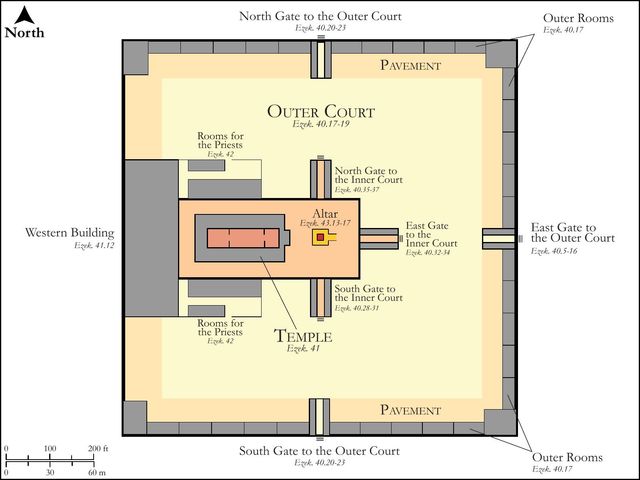
Here is, 1. An account of a building that was before the separate place (that is, before the temple), at the end towards the west (Eze 41:12), which is here measured, and compared (Eze 41:13) with the measure of the house, and appears to be of equal dimensions with it. This stood in a court by itself, which is measured (Eze 41:15) and its galleries, or chambers belonging to it, its posts and windows, and the ornaments of them, Eze 41:15-17. But what use was to be made of this other building we are not told; perhaps, in this vision, it signified the setting up of a church among the Gentiles not inferior to the Jewish temple, but of quite another nature, and which should soon supersede it. 2. A description of the ornaments of the temple, and the other building. The walls on the inside from top to bottom were adorned with cherubim and palm-trees, placed alternately, as in Solomon's temple, Kg1 6:29. Each cherub is here said to have two faces, the face of a man towards the palm tree on one side and the face of a young lion towards the palm-tree on the other side, Eze 41:19. These seem to represent the angels, who have more than the wisdom of a man and the courage of a lion; and in both they have an eye to the palms of victory and triumph which are set before them, and which they are sure of in all their conflicts with the powers of darkness. And in the assemblies of the saints angels are in a special manner present, Co1 11:10. 3. A description of the posts of the doors both of the temple and of the sanctuary; they were squared (Eze 41:21), not round like pillars; and the appearance of the one was as the appearance of the other. In the tabernacle, and in Solomon's temple, the door of the sanctuary, or most holy, was narrower than that of the temple, but here it was fully as broad; for in gospel-times the way into the holiest of all is made more manifest than it was under the Old Testament (Heb 9:8) and therefore the door is wider. These doors are described, Eze 41:23, Eze 41:24. The temple and the sanctuary had each of them its door, and they were two-leaved, folding doors. 4. We have here the description of the altar of incense, here said to be an altar of wood, Eze 41:22. No mention is made of its being over-laid with gold; but surely it was intended to be so, else it would not bear the fire with which the incense was to be burned, unless we will suppose that it served only to put the censers upon. Or else it intimates that the incense to be offered in the gospel-temple shall be purely spiritual, and the fire spiritual, which will not consume an altar of wood. Therefore this altar is called a table. This is the table that is before the Lord. Here, as before, we find the altar turned into a table; for, the great sacrifice being now offered, that which we have to do is to feast upon the sacrifice at the Lord's table. 5. Here is the adorning of the doors and windows with palm-trees, that they might be of a piece with the walls of the house, Eze 41:25, Eze 41:26. Thus the living temples are adorned, not with gold, or silver, or costly array, but with the hidden man of the heart, in that which is not corruptible.
Historical interpretation
Historical reception
1 surviving comment on this verse from the historical church.
(Versed. 8 seqq.) 'And I saw in the house a height all around, with foundations of reed measuring six cubits, and the width along the outer wall of the side chamber, five cubits. And the inner part of the house and the space between the storehouses, twenty cubits wide all around the house. And there were doors in the side chambers toward the outer court, one door toward the north, and another door toward the south. And the width of the place for worship, five cubits all around.' And the building, which was separate and facing the road towards the sea, was seventy cubits wide. The wall of the building was five cubits wide all around, and its length was ninety cubits. After he reached the Holy of Holies, of which we spoke earlier, that venerable man measured the wall of the Holy of Holies. It had a height of six cubits because of the structure of the world and all visible creation, which was created in six days, and a width of one side of four cubits, not on one side only, but all around. But the width of the house, measured around, was four cubits, to represent the four elements from which all things are composed, especially human bodies. Against these, the holy ones fight and subject themselves to the power of the soul, so that they may deserve to enter the inner regions and know the secrets of the Lord. The sides of the house, which were around it and were separated from the walls of the temple by a space of four cubits, were joined together. So that one side touched another side, and it had a length not of thirty-three cubits, but of sixty-six, that is, sixty-six. In the book of Leviticus, it is said that after one week in the birth of a male child, the mother and the child must wait for thirty-three days in order to undergo purification (Lev. XII). However, if the child is female, the waiting period is doubled to sixty-six days. And because, in order to enter the holy of holies, we need not only the first birth, but also the second, to be born in the flesh and be reborn in the spirit: therefore, the number is not sixty-six, but twice thirty and three, so that both births are owed to God the creator and his mercy, and the two sides of the house that support the structure of the temple are enclosed by a double wall. And what follows according to the Hebrew: 'And there were certain heights that would go out through the wall of the house on the sides all around, to contain, and not touch the wall of the temple,' signifies this: that holy men, amidst the multitude of believers, burst forth through the wall of the temple, through all the sides all around, and uphold the foundations of the Church, and yet do not touch the wall of the temple: content with having seen only, and from afar, worship the indescribable mysteries. Now we see through a glass, darkly; but then face to face: now I know in part; but then shall I know even as also I am known. And now abideth faith, hope, charity, these three; but the greatest of these is charity. (1 Corinthians 13:12-13) But through the circular and spiral ascent we reach the upper room of the temple, which, among all shapes, is also approved by philosophers of this age as the most beautiful: for both the sky, the sun, the moon, and the other stars, and the earth, in human bodies as well, the eyes are like other stars, and the shape of the head, which is the receptacle of all the senses, and the rounded fingers, and women, and arms, exhibit this roundness. Moreover, I think that the upper room of the temple, which we ascend from the lower to the higher, is the same one that Elijah and Elisha had, as mentioned in the book of Kings, and also Tabitha had it in the Acts of the Apostles, which means 'the gazelle' in Greek, and our damsel who had reached the highest through good works (3 Kings 17; 4 Kings 4; Acts 9; Acts 10). But the Apostle Peter, on whom the Lord established the foundations of the Church, surpasses the upper room and comes to the roof, which is more significantly called 'dorma' in Greek, that is, the solarium of the roof, and he came to know the mysteries of the Church, previously unknown to the world. The Savior also made the Pasch in the upper room, and in a large and wide upper room, and after all impurity had been cleansed and the bed prepared, and the spiritual feast prepared, where he delivered the mystery of his body and blood to his disciples, and left to us the eternal celebration of the immaculate Lamb. And he added: And from the middle to the saddest, that is, the third upper room and Thrael, it seems to me that it should be marked with a note. For why do we need to discuss doubtful and unwritten things when we should devote ourselves to the books held by the Hebrews? It follows: 'And I saw in the house a height encompassed by sides, measured by a reed, a space of six cubits; and a width by the outer wall of the side of five cubits; and between the treasuries' (which Symmachus calls 'exedrae') 'a width of twenty cubits around the house.' By these measurements it is shown that we are deserving of ascending not only into the Holy of Holies, but also into their upper room, and that we should always remember that through the six days of our earthly condition, and through the five senses, and through the twenty cubits of width, we ascend to the upper room of the temple, leaving behind earthly humility and the sense of the letter, and we pass over to the summit of the Church, and rejoice in the fellowship of the Holy Spirit.' And the entrance, he says, of the side toward the north (Jer. 1:14), from which evil spreads over all the earth, and which the Lord promises to drive away from us, saying: 'And I will drive away from you him who is from the north' (Joel 2:20). And it is a beautiful place for prayer at the entrance opposite the north, so that, according to the Apostle, we may pray without ceasing (1 Thess. 5), and say with Jeremiah: 'Let not the apple of my eye be silent' (Lam. 2:18), whether we desire to avoid present evils or give thanks for the past. For as long as we are in the tent of this body, we groan and say: Wretched me, who will set me free from this body of death? (Rom. VII, 24). But there was also a door to the South, which had a place of prayer nearby according to the Hebrew custom, and it extended five cubits around. For after the cold of the North, we pass through the heat of the South, and yet we still seek a place for prayer, in the door of the North, in order to escape dangers; in the South, to give thanks for the past and to have a secure possession of victory. But five cubits, and in this place they indicate divine senses, through which we ascend from earthly things to higher things. And the building, he says, which was separated and turned toward the road facing the sea, was seventy cubits wide: so that after labors and dangers, and the waves and shipwrecks of this world, and seventy years, of which Jeremiah, Daniel, and Zechariah write (Jer. 25 and 29; Dan. 9, Zech. 9); but also the legitimate sabbath of seven decades we may attain: so that we may have eternal rest, and through the width of five cubits we may come to a length of ninety cubits: in which age Sarah gave birth to a son according to the promise, who, at the age of ninety, that is, at the end of nine decades, was born to Abraham, who was one hundred years old (Gen. 21), that is, having the mystery of ten decades. The following Scripture will show what the number signifies.
(Verses 13 and following) And the house was measured in length a hundred cubits. And the separate building, and its walls, were also a hundred cubits in length. The width before the face of the house, and that which was separate against the East, was a hundred cubits. And the length of the building over against the face thereof, which was separated at the back, was also a hundred cubits. And there were chambers exceeding in height on either side a hundred cubits; and the inner temple, and the porches of the court. Doorways and slanted windows were set outward, in a perimeter on three sides against the threshold of each, and a wooden floor went all the way around. And the earth was up to the windows: and the windows were closed. Above the doors, and up to the inner house; and on the outside, through every wall on the inside; and on the outside, to the measurement. And cherubs and palm trees were carved: and a palm tree was between cherub and cherub: and each cherub had two faces: the face of a man next to the palm tree on one side, and the face of a lion next to the palm tree on the other side; carved throughout the whole house on the inside. From the ground up to the upper gates, there were carved cherubim and palm trees on the wall of the temple. The threshold was square. The sanctuary faced the shape of the wooden altar, its height being three cubits. Its length was two cubits. Its corners, length, and walls were all made of wood. Seventy: It measured against the length of the house, one hundred cubits. And the remaining and separating walls, in the length of one hundred cubits. And the width against the face of the temple, and the remaining opposite one hundred cubits. And he measured the length of the separating wall facing the back of the house, and the remaining width of one hundred cubits. And the temple and the corners, and the outer Aelam covered with wood, and three windows made like a net, for light to shine through, that one could look through them. And the house and the adjacent structures, all covered with wood around. And the floor, and from the floor to the windows. And the windows were opened threefold, so that one could look through them: both into the inner and outer house, and through every wall around inside and outside the measurement, and carved cherubim, and palm trees between cherub and cherub. Two faces of cherub: the face of a man towards the palm tree on one side, and the face of a lion towards the palm tree on the other side: the entire wall was carved all around from the floor to the rafters with cherubim and carved palm trees. And the sanctuary and the temple were opened on four corners towards the face of the saints: a vision as if the appearance of a wooden altar: its height being three cubits, and its length two cubits: and its width two cubits: and it had horns, and its bases and walls were wooden.» The word 'contra', which the LXX translated at the beginning of the testimony, where it is written: 'And he measured against the house', is not found in Hebrew, and therefore it must be marked with an obelus, in order for it to be correct and true, and he measured the house with a length of one hundred cubits, and so on. The Holy of Holies and the inner sanctuary are described, which is said to have a perfect number of ten decades, after ninety cubits, with three sides having one hundred cubits each: so that we may serve the Lord with our mind, speech, and deeds, remembering that Apostolic example in which it is said: 'That we may know the breadth, and length, and depth, and height' (Ephesians 3:18). But what is said in Hebrew, the separate structure and its walls, the Septuagint translates as separating and not clinging to the walls of the temple, but having their own nearby walls. The temple itself, as well as its corners and the porch or entrance hall (propylon), were covered with wood, a symbol of wisdom, as the Scripture records the tree of life being located in paradise (Gen. II). The windows were made in the form of a net, similar to lattice screens, so that they were not covered with stone or glass, but with wooden lattices woven with twists and turns. In Hebrew, they have diagonal windows, which were only present in three parts of the temple: on the right, on the left, and at the back, that is, to the South, North, and West. The eastern part, however, did not have windows because the entrance itself let in bright light from within, and all the interior of the temple was filled with the light of the doors, so that someone could look inside through each window and opening. And not only were the exterior areas covered with wood, but there was such an abundance of wood all around that the floor and everything up to the windows were connected with wood. The windows were opened in three ways according to the Seventy, so that when they were opened, a triple understanding of God's temple would be revealed, according to what is said elsewhere: 'But you, write down these things in three ways' (Prov. 22:20). And through them, both the interior and the exterior are seen: so that we may know the invisible things that are within, and the visible things that are without; so that one thing may show the mind, another the flesh, another the spiritual understanding, and another the simple historical account; and through all the surrounding walls, internally and externally, their measurements were consistent. For nothing is done in the temple of God without reason and measure, especially in the holy of holies made by God. The Cherubim were also carved, no doubt in wood, extending from the floor to the windows, and the carvings were so finely made that they appeared not sculpted, but applied. Cherubim are interpreted as a multitude of knowledge. Therefore, within the innermost part of the temple, after the multitude of knowledge, there are carvings and palm trees, in which the sign of victory is, as the Apostle says: But I press on to the goal for the prize of the heavenly call of God, in Christ Jesus (Philippians 3:14). Which palms were between the Cherub and the Cherub, so that one Cherub was surrounded on both sides by two palms: which Cherub did not, as we read at the beginning of this prophet, have four faces, namely, of a man, a lion, a calf, and an eagle; but only two, that is, of a man and a lion, of which the first pertains to reason, and the second to fury, which is more significantly called θυμὸς in Greek. By fury, however, we mean not that which is close to disturbance and vice, but that which consolidates the softness of the mind and makes the soul of the combatant stronger. For in the beginning, we are subject to concupiscence, which pertains to the earthly works; and some are carnal, others are spiritual, of which the ultimate is attributed to eagles. But when we enter the innermost sanctuary, and possess the inner parts of the temple, we have no need for anything else except reason and strength, of which one pertains to perception and prudence, the other to the perseverance of the soul. Therefore, every wall around the temple, from the floor to the ceiling, had Cherubim and palms skillfully carved: after which the sanctuary and the temple were opened from the four corners opposite the faces of the holy ones. First, we have a multitude of knowledge, through which we achieve victory over the enemy, and then a sanctuary and temple are opened to us, which has four angles, and a very strong position, and which is inclined in no direction. For it has the nature of a square measure, so that it may stand on a stable base, and it possesses, in a mystical number that is clear to the wise reader, four elements from which all things consist, solid and everlasting. And they looked at everything opposite the face of the sanctuary: before which was the sanctuary, or in which was the image of the wooden altar three cubits high, and two cubits long, and two cubits wide, which together make seven cubits. This altar had horns; and both its bases and its walls, that is, its sides, were made of wood, in which the holy Scriptures mysteries, human speech cannot explain: how the altar, in which the fire was to be kindled, namely the incense offering, should suffer nothing from the fire, but, so to speak, becomes more pure through the fire. For just as the works of the saints, of which the Apostle writes, 'The work of each will be made manifest; for the Day will disclose it' (1 Corinthians 3:13), do not perish, but are made even more pure through fire, so too the wood of the altar, which is from the trees of paradise, is not consumed by nearby fire, but is made even more pure. It is not surprising to believe this about the sanctuary and the inner parts of the temple and the altar of incense, since even linen, which is a type of flax, or something with a similar appearance to linen, is found to be cleaner the more it is burned. Forgive, reader, the difficulty, and grant pardon to the impoverished understanding. For through slanted and net-like windows, which are always closed, we can barely allow our eye to enter into the inner chamber of our heart, so that all that we see, we see in shadow and in image, and with the Apostle, we cry out: O the depth of the riches of the wisdom and knowledge of God! How inscrutable are his judgments, and how unsearchable his ways (Rom. XI, 13)! And: Who has known the mind of God (Isaiah XL, 13), except the one who is the angel of great counsel, and who has the power to reveal worthy mysteries? And in Rome, they call the projections on the walls of dining rooms 'solaria,' or 'Meniana' from the one who first invented them, which some Greeks call 'exōstras.'
Continue studying Ezekiel 41:15 across the web’s major study libraries — every link below opens this exact verse, chapter, or book on the destination site.
Read & Compare
 BibleGatewayThis verse in more than 200 translations and 70 languages.
 Bible.comThe YouVersion reader — hundreds of translations, reading plans, and highlights.
 ESV.orgCrossway's official English Standard Version reader.
 NET BibleThe NET translation with 60,000+ translators' notes on every rendering decision.
 STEP BibleTyndale House's free study tool — original text, vocabulary, and scholarly resources.
 BibliaLogos Bible Software's free web reader.
 USCCBThe New American Bible (Revised Edition) with the U.S. bishops' study notes.
Commentaries
 BibleHub CommentariesDozens of classic commentaries on this verse, gathered on one page.
 StudyLightMore than 100 commentary sets — the largest collection on the web.
 BibleRefPlain-English commentary on what this verse means, verse by verse.
 Enduring WordDavid Guzik's free commentary on this chapter, widely used by Bible teachers.
 Bible Study ToolsVerse commentary alongside Greek and Hebrew study aids.
Original Language & Research
- BibleHub InterlinearThe verse word by word — original language, transliteration, and English.
- BibleHub LexiconEvery word's original-language definition and Strong's entry.
 Blue Letter BibleDeep-study tools — Strong's numbers, concordance, and word studies.
 SefariaThe Hebrew text with Rashi and centuries of Jewish commentary.
Sermons, Hymns & Audio


TrulyRandomVerse is not affiliated with these sites and doesn’t control their content. They’re linked because they’re genuinely useful.
Summary
Ezekiel 41:15 offers a precise and detailed measurement of specific architectural components within the visionary temple complex revealed to the prophet. It meticulously describes the length of the main building, its relationship to the "separate place" behind it, the dimensions of its galleries on both sides, and its integration with the inner temple and the court's porches, all specified at a length of one hundred cubits. This verse, consistent with the broader vision in Ezekiel 40-42, underscores the divine precision, grandeur, and holiness of God's future dwelling place, serving as a profound message of hope, restoration, and the enduring reality of God's presence for a people in exile.
Context
ShowHideLiterary Context
Ezekiel 41:15 is deeply embedded within a comprehensive and highly detailed prophetic vision of a new temple and its surrounding complex, a vision that spans from Ezekiel 40 through Ezekiel 48. Specifically, Ezekiel 41 is dedicated to the interior and exterior measurements of the temple building itself, meticulously detailing its walls, chambers, and various architectural features. This particular verse, with its focus on the length of the main edifice, immediately precedes descriptions of the temple's decorative elements and the outer sanctuary, maintaining a consistent narrative of precise architectural specification. The cumulative effect of these exhaustive measurements is to convey an overwhelming sense of divine order, absolute holiness, and the tangible reality of God's future restoration.
Historical & Cultural Context
The profound vision of this new temple was granted to Ezekiel in the twenty-fifth year of his exile, approximately 573 BC, while he was among the Jewish captives in Babylon. At this time, Jerusalem and the magnificent Temple of Solomon had been utterly destroyed by the Babylonians in 586 BC, leaving the Israelites in profound despair, questioning God's presence, power, and covenant faithfulness. In this context of national desolation and spiritual crisis, the detailed blueprint of a new, glorious temple served as a powerful counter-narrative to their present reality. Culturally, temples were universally regarded as the dwelling places of deities, and their destruction implied the defeat or departure of the associated god. God's revelation of a new, perfect temple to Ezekiel was, therefore, a profound statement of His enduring sovereignty, His unwavering covenant faithfulness, and His promise to dwell among His people once more, transcending the physical destruction they had experienced and offering a concrete vision of future hope.
Key Themes
ShowHideThe meticulous measurements presented in Ezekiel 41, including those in Ezekiel 41:15, contribute significantly to several overarching themes woven throughout the book of Ezekiel. First, they powerfully emphasize Divine Precision and Order, demonstrating God's absolute control, meticulous planning, and the perfection inherent in His design, even down to the smallest cubit. This precision signifies the profound holiness and perfection required for God's dwelling place. Second, the entire temple vision, including its detailed architectural specifications, powerfully conveys the Promise of God's Restored Presence. For a people who had witnessed the departure of God's glory from the first temple (Ezekiel 10), this vision offered the profound assurance that the glory of the Lord would indeed return and fill His house (Ezekiel 43:4). Finally, the vision provides a profound Hope for Future Restoration for Israel, encompassing not merely a physical structure but a renewed relationship with God, a restored land, and a re-established covenant, culminating in the triumphant declaration, "The Lord Is There" (Ezekiel 48:35).
Exposition and Analysis
ShowHideKey Word Analysis
ShowHideDerived from the root banah (to build), this term refers to an edifice or structure, specifically highlighting the constructed and divinely engineered nature of the temple. In Ezekiel's visionary context, it underscores the tangible, meticulously designed architectural reality of the future temple, standing in stark contrast to the destroyed temple of his present. It signifies a divinely established and permanent structure.
This word denotes an enclosure or something that has been "cut out" and set apart. In the context of the temple, it refers to a distinct, specially designated area, likely a sacred or restricted space within the complex. Its designation as "separate" emphasizes the holiness and exclusive nature of different zones within the temple, reinforcing the divine order and the boundaries required for God's holy presence.
This term refers to a large public building, specifically a palace or a temple, often implying a grand and significant structure. In this verse, it specifically refers to the "inner temple," which is the main sanctuary building itself—the Holy Place and the Most Holy Place—distinct from the surrounding courts or other auxiliary structures. Its mention signifies the central dwelling place of God's presence within the entire complex, the very heart of the sacred architecture.
Verse Breakdown
ShowHide"And he measured the length of the building over against the separate place which [was] behind it"
This clause initiates the precise measurement, focusing on the main temple structure ("the building"). It specifies its length in relation to a distinct, set-apart area ("the separate place") located directly behind it. This indicates a meticulously planned spatial relationship and an integrated design within the larger temple complex, where every component is precisely positioned.
"and the galleries thereof on the one side and on the other side"
This specifies that the measurement of the building's length includes its "galleries," which were likely elevated walkways, ledges, or perhaps rows of chambers, extending along both sides of the main structure. This detail highlights the architectural complexity and grandeur, indicating that the overall length encompasses these integral extensions.
"an hundred cubits"
This provides the exact dimension for the combined length of the building, encompassing its galleries and its relationship to the separate place. A cubit was an ancient unit of measure, typically around 18-21 inches (approximately 45-53 cm), making 100 cubits a substantial length (approximately 150-175 feet or 45-53 meters). This emphasizes the vast scale and impressive dimensions of the visionary temple, underscoring its divine origin and significance.
"with the inner temple"
This clarifies that the "building" being measured at 100 cubits encompasses the "inner temple" (the hêykâl), which is the main sanctuary or holy place. This confirms that the 100-cubit measurement applies to the core sacred structure, the very heart of the temple where God's presence would dwell.
"and the porches of the court"
This final phrase indicates that the total 100-cubit length also accounts for the porches (vestibules or porticoes) that were part of the court area. This suggests an integrated measurement that spans from the main temple building through its associated entryways and connecting structures within the court, emphasizing the holistic and interconnected nature of the entire divinely designed complex.
Literary Devices
ShowHideThe predominant literary device at play in Ezekiel 41:15, and indeed throughout the detailed architectural vision in Ezekiel 40-42, is Meticulous Description or Hyper-detail. The prophet provides an exhaustive inventory of measurements and architectural features, far exceeding what would be necessary for a mere symbolic or abstract vision. This extreme precision serves to convey the Divine Order and absolute Holiness of the temple. Every cubit, every dimension, and every architectural component is divinely ordained and precisely specified, leaving no room for human improvisation or error. This level of detail also functions as a form of Verisimilitude, lending an air of absolute reality and certainty to the vision, assuring the exiled Israelites that God's promises of restoration are concrete, tangible, and utterly reliable, not mere abstract hopes. The repetition of measurements and architectural terms throughout these chapters creates a sense of Rhythm and Emphasis, reinforcing the grand scale, sacred nature, and divine origin of the structure.
Theological and Thematic Connections
ShowHideEzekiel's visionary temple, with its precise measurements and sacred spaces, is a profound theological statement about God's nature and His unwavering desire for communion with His people. It emphatically underscores God's absolute holiness, His demand for ordered and reverent worship, and His covenant faithfulness to dwell among humanity. The meticulous detail points to a divine blueprint for a perfect dwelling, foreshadowing not only a future physical restoration for Israel but also deeper spiritual realities concerning God's presence. This vision underscores that God is a God of order, beauty, and intentional design, and His presence demands a consecrated space, whether that space is physical, spiritual, or ultimately, personal.
Reflection and Application
ShowHideEzekiel 41:15, with its seemingly mundane measurements, invites us to ponder the profound significance of God's meticulous attention to detail and His unyielding desire for intimate communion with His people. For the exiled Israelites, this vision was far more than an architectural blueprint; it was a tangible promise of hope and restoration, a powerful reminder that God had not forgotten them and would indeed return to dwell among them in glory. For us today, it serves as a powerful reminder that God is a God of order, who designs everything with ultimate purpose and divine precision. It challenges us to consider the "measurements" of our own lives—the intentionality, holiness, and order with which we live, particularly in how we prepare our hearts as dwelling places for God's Spirit. Just as every cubit in the visionary temple had its divinely appointed place and purpose, so too does every aspect of our lives, when surrendered to God, contribute to the building of His spiritual temple. This verse encourages us to trust in God's perfect and sovereign plan, even when our circumstances seem chaotic, broken, or desolate, knowing that His ultimate design for our redemption and fellowship is grander, more precise, and more glorious than we can possibly imagine.
Questions for Reflection
ShowHideFAQ
ShowHideWhat is the significance of the "hundred cubits" measurement in Ezekiel 41:15?
ShowHideThe "hundred cubits" (approximately 150-175 feet or 45-53 meters) signifies the immense scale, grandeur, and divine perfection of the visionary temple. Throughout Ezekiel 40-42, precise and often large measurements are given for every part of the temple complex. This emphasis on exact, substantial dimensions serves several profound purposes: it underscores the divine origin and perfection of the blueprint, demonstrating God's meticulous planning and absolute control; it contrasts sharply with the destroyed and desecrated temple of Ezekiel's time, offering a vision of unparalleled glory and holiness; and it powerfully conveys the vastness and sacredness required for God's restored and unhindered presence among His people. It is not merely a large building, but a divinely proportioned and consecrated space, reflecting the infinite majesty of the God who dwells within it.
Christ-Centered Fulfillment
ShowHideEzekiel 41:15, with its detailed measurements of a future temple, finds its ultimate and profound fulfillment in the person and work of Jesus Christ. While the Old Testament temple, including the visionary one in Ezekiel, served as a physical dwelling place for God's presence and a locus for atonement, it was always a shadow, a type pointing to a greater, spiritual reality. Jesus Himself declared, "Destroy this temple, and in three days I will raise it up," referring not to the physical structure in Jerusalem but to the temple of his body (John 2:19-21). In Christ, the fullness of God's presence fully and perfectly dwells among humanity (Colossians 2:9), making Him the true meeting place, the ultimate sanctuary, between God and man. Furthermore, the New Testament reveals that through Christ's atoning work, believers are incorporated into a spiritual temple, "being built together into a dwelling place for God by the Spirit" (Ephesians 2:21-22). The meticulous measurements in Ezekiel thus foreshadow the divine perfection, holiness, and precise design of this new spiritual reality—the church as God's dwelling—culminating in the glorious vision of the New Jerusalem where the Lord God Almighty and the Lamb are its temple, and God will dwell directly with His people for all eternity (Revelation 21:3 and Revelation 21:22). Therefore, the visionary temple's precise dimensions ultimately speak to the perfect, immeasurable reality of God's dwelling in and through Christ, His church, and the eternal city.