


Ezekiel 41:1
Bible text: King James Version (1769 Blayney text) · Public domain
Bible text: King James Version with Strong's numbers · Public domain
Bible text: Berean Standard Bible · Public domain
Bible text: American Standard Version (1901) · Public domain
Bible text: World English Bible, Messianic edition · Public domain
Bible text: Geneva Bible (1599) · Public domain
Bible text: Young's Literal Translation · Public domain
- וַיְבִיאֵנִיvay·vi·'E·niand he brought meH935Conj-w ¦ V-Hiphil-ConsecImperf-3ms ¦ 1csVerb Hiphil Consecutive Imperfect 3rd Singular Masculineוַandיְבִיאֵhe broughtנִיme
- אֶל'eltoH413PrepPreposition
- הַהֵיכָלha·hei·Khalthe templeH1964Art ¦ N-msNoun Singular Masculine Absoluteהַtheהֵיכָלtemple
- וַיָּמָדvai·Ya·modand he measuredH4058Conj-w ¦ V-Qal-ConsecImperf-3msVerb Qal Consecutive Imperfect 3rd Singular Masculineוַandיָּמָדhe measured
- אֶת'et<obj.>H853DirObjMParticle Object Indicator
- הָאֵילִיםha·'ei·Limthe pillarsH352Art ¦ N-mpNoun Plural Masculine Absoluteהָtheאֵילִיםpillars
- שֵׁשׁshesh[was] sixH8337Adj-csAdjective Numerical Singular common gender Absolute
- אַמּוֹת'a·MotcubitsH520N-fpNoun Plural Feminine Absolute
- רֹחַבRo·chav[the] breadthH7341N-msNoun Singular Masculine Absolute
- מִפּוֹmi·Pofrom hereH6311Prep-m ¦ AdvAdverbמִfromפּוֹhere
- וְשֵׁשׁve·sheshand [was] sixH8337Conj-w ¦ Adj-csAdjective Numerical Singular common gender Absoluteוְandשֵׁשׁ[was] six
- אַמּוֹת'a·motcubitsH520N-fpNoun Plural Feminine Absolute
- רֹחַבRo·chav[the] breadthH7341N-msNoun Singular Masculine Absolute
- מִפּוֹmi·Pofrom hereH6311Prep-m ¦ AdvAdverbמִfromפּוֹhere
- רֹחַבRo·chav[the] breadth ofH7341N-mscNoun Singular Masculine Construct
- הָאֹהֶלha·'O·helthe tentH168Art ¦ N-msNoun Singular Masculine Absoluteהָtheאֹהֶלtent
English is a literal word-by-word gloss of the Hebrew, not the KJV's wording. Why?
This is the original text the KJV's translators worked from — each Hebrew word with its own literal English meaning in this verse, prepared by scholars at Tyndale House, Cambridge. The KJV translates whole sentences, not word by word, so its wording differs: one Hebrew word can become several English words, and the KJV may choose “the LORD” where the gloss reads “Yahweh”. Both are faithful — they answer different questions. For the KJV's own rendering, switch to the KJV text.
Details
See on the biblical-era map
Study this verse
Public-domain commentary
Matthew Henry
From his Commentary on the Whole Bible. Henry comments on passages, not single verses — this entry covers Ezekiel 41:1–11.
We are still attending a prophet that is under the guidance of an angel, and therefore attend with reverence, though we are often at a loss to know both what this is and what it is to us. Observe here, 1. After the prophet had observed the courts he was at length brought to the temple, Eze 41:1. If we diligently attend to the instructions given us in the plainer parts of religion, and profit by them, we shall be led further into an acquaintance with the mysteries of the kingdom of heaven. Those that are willing to dwell in God's courts shall at length be brought into his temple. Ezekiel was himself a priest, but by the iniquity and calamity of the times was cut short of his birthright privilege of ministering in the temple; but God makes up the loss to him by introducing him into this prophetical, evangelical, celestial temple, and employing him to transmit a description of it to the church, in which he was dignified above all the rest of his order. 2. When our Lord Jesus spoke of the destroying of this temple, which his hearers understood of this second temple of Jerusalem, he spoke of the temple of his body (Joh 2:19, Joh 2:21); and with good reason might he speak so ambiguously when Ezekiel's vision had a joint respect to them both together, including also his mystical body the church, which is called the house of God (Ti1 3:15), and all the members of that body, which are living temples, in which the Spirit dwells. 3. The very posts of this temple, the door-posts, were as far one from the other, and consequently the door was as wide, as the whole breadth of the tabernacle of Moses (Eze 41:1), namely, twelve cubits, Exo 26:16, Exo 26:22, Exo 26:25. In comparison with what had been under the law we may say, Wide is the gate which leads into the church, the ceremonial law, that wall of partition which had so much straitened the gate, being taken down. 4. The most holy place was an exact square, twenty cubits each way, Eze 41:4. For the new Jerusalem is exactly square (Rev 21:16), denoting its stability; for we look for a city that cannot be moved. 5. The upper stories were larger than the lower, Eze 41:7. The walls of the temple were six cubits thick at the bottom, five in the middle story, and four in the highest, which gave room to enlarge the chambers the higher they went; but care was taken that the timber might have fast hold (though God builds high, he builds firmly), yet so as not to weaken one part for the strengthening of another; they had hold, but not in the wall of the house. By this spreading gradually, the side-chambers that were on the height of the house (in the uppermost story of all) were six cubits, whereas the lowest were but four; they gained a cubit every story. The higher we build up ourselves in our most holy faith the more should our hearts, those living temples, be enlarged.
Historical interpretation
Historical reception
1 surviving comment on this verse from the historical church.
(Chapter 41, Verse 1 and following) 'And he brought me into the temple, and measured the fronts, six cubits in width here and six cubits in width there, the width of the tabernacle. And the width of the gate was ten cubits, and the sides (or shoulders) of the gate were five cubits here and five cubits there. And he measured its length, forty cubits, and its width, twenty cubits.' After many mysteries and various entrances, and the peculiarities of each place, at last finally a man comes, whose string of masons and measuring rod was in his hand, and he brings Ezekiel the prophet into the temple, and he measured the front of the temple: for which atelam, the Septuagint; and aelim Theodotius; and around Symmachus translated. And on both sides the width of the tabernacle was six cubits, containing the mystery of all creatures: for in six days the world was finished. Through the knowledge of these and the causes and conditions and the order of creation, we enter into the temple of God, and through the order and stability of created things we come to know the Creator. But the width of the gate of the temple was ten cubits, which is a sacred and perfect number, and in which, on the seventh month, on the tenth day of the month, there is fasting and propitiation. But on the tenth day of the first month, which is called Nisan, the lamb is taken for sacrifice and preparation for the Passover. Therefore, in the seventh month, the tithes are offered in the storehouses of God, or, as the Scripture has accustomed to call them, the wine presses. Hence the Apostle says: Be ye enlarged also (2 Corinthians 6); so that after entering the temple through the ten cubit gates, on both sides of the gate itself, the sides, or as it is properly said in Hebrew, the shoulders are measured, which are always referred to as works. And Issachar desired good (Gen. XLIX), resting among the clergy, seeing the rest, because it is good, and the land, because it is fertile, he put his shoulder to work, and he became a man of agriculture. And in the vestment of the high priest, the ephod with the breastplate is fastened, so that the works of reason are joined, and the man can say: I have understood from your commandments (Ps. CXVIII, 104). The gatekeepers on both sides of the gate had five porches, so that through earthly and divine senses, about which we have often written their differences, we may enter the inner sanctuary of the temple, which was measured by that man, who was the prophet's guide, with a length of forty cubits, and a width of twenty cubits, or rather, the gate's length and width: because he had spoken only of the width and shoulders above. But that the number which is next to eight hundred forty makes is no doubt. Hence it is commanded in Ecclesiastes: Give portions to seven, and also to eight (Eccl. XI, 2). I am aware that there is frequent debate about the mystery of this number, whether it is because through tribulations and distresses of this world we enter into the sanctuary of the Lord: therefore the length of the gate had forty cubits, which number is always associated with labor. And so, Moses and Elijah did not eat bread or drink water for forty days (Deut. 9, 3 Kings 19, Deut. 29). And for forty years, the people of Israel are troubled and tested in the wilderness and enter the promised land through many struggles. And the Lord and Savior, according to the weakness of the assumed body, is tested for forty days in the wilderness, so that after the victory, angels approach and minister to him (Matt. 4). But when we can say in the midst of tribulations and distress, the words of the Apostle: In all things we are troubled, but not crushed (2 Cor. 4, 8), and the prophetic words: In tribulation, you have enlarged me (Psalm 4, 1), then the widest entrance is opened to us, which has a width of twenty cubits, so that having overcome the struggles and earthly things, which themselves represent duality, we may enter the inner sanctuary of the temple and hear the Lord commanding his disciples: Have confidence, I have overcome the world (John 16, 34).
Continue studying Ezekiel 41:1 across the web’s major study libraries — every link below opens this exact verse, chapter, or book on the destination site.
Read & Compare
 BibleGatewayThis verse in more than 200 translations and 70 languages.
 Bible.comThe YouVersion reader — hundreds of translations, reading plans, and highlights.
 ESV.orgCrossway's official English Standard Version reader.
 NET BibleThe NET translation with 60,000+ translators' notes on every rendering decision.
 STEP BibleTyndale House's free study tool — original text, vocabulary, and scholarly resources.
 BibliaLogos Bible Software's free web reader.
 USCCBThe New American Bible (Revised Edition) with the U.S. bishops' study notes.
Commentaries
 BibleHub CommentariesDozens of classic commentaries on this verse, gathered on one page.
 StudyLightMore than 100 commentary sets — the largest collection on the web.
 BibleRefPlain-English commentary on what this verse means, verse by verse.
 Enduring WordDavid Guzik's free commentary on this chapter, widely used by Bible teachers.
 Bible Study ToolsVerse commentary alongside Greek and Hebrew study aids.
Original Language & Research
- BibleHub InterlinearThe verse word by word — original language, transliteration, and English.
- BibleHub LexiconEvery word's original-language definition and Strong's entry.
 Blue Letter BibleDeep-study tools — Strong's numbers, concordance, and word studies.
 SefariaThe Hebrew text with Rashi and centuries of Jewish commentary.
Sermons, Hymns & Audio


TrulyRandomVerse is not affiliated with these sites and doesn’t control their content. They’re linked because they’re genuinely useful.
Summary
Ezekiel 41:1 marks a pivotal transition in Ezekiel's visionary tour, shifting the focus from the outer and inner courts to the sacred core of the temple building itself. This verse meticulously records the initial measurements of the temple's entrance, specifically noting the substantial breadth of its doorposts. It underscores the divine precision inherent in God's architectural blueprint and establishes a profound theological connection by explicitly linking a dimension of this future, glorious temple to the ancient wilderness tabernacle, thereby emphasizing continuity in God's enduring desire to dwell among His people.
Context
ShowHideLiterary Context
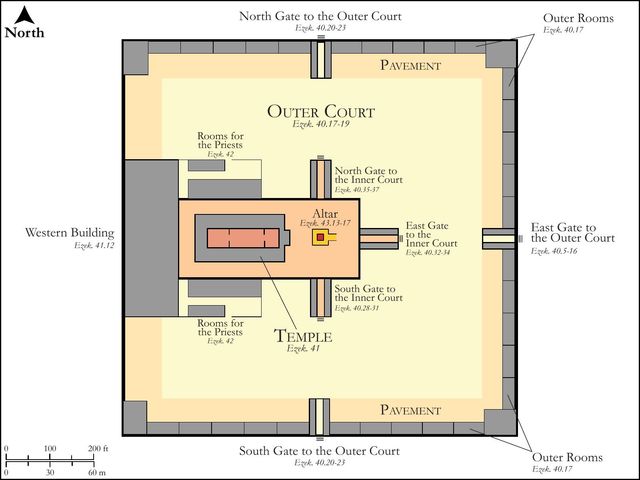
This verse is deeply embedded within the climactic section of Ezekiel's prophecy, specifically chapters 40-48, which present an elaborate and highly detailed vision of a new, idealized temple and the reordering of the land of Israel. Having meticulously described the outer court in Ezekiel 40:1-27 and the inner court in Ezekiel 40:28-47, the angelic guide now leads Ezekiel to the very threshold of the temple building itself. The precise measurements introduced in Ezekiel 41:1 set the tone for the entire chapter, which proceeds to meticulously detail the temple's main hall (the Holy Place), its side chambers, and the surrounding structures, building a comprehensive and awe-inspiring picture of the sanctuary's interior. This progression signifies a movement from the peripheral to the sacred core, emphasizing the escalating holiness and importance of the divine dwelling.
Historical & Cultural Context
Ezekiel received this elaborate vision while in exile in Babylon, far removed from Jerusalem, which had been utterly destroyed along with its temple in 586 BC. This catastrophic event was a profound trauma for the Jewish people, leading to despair, questioning of God's covenant faithfulness, and a sense of abandonment. Against this backdrop of national devastation and displacement, Ezekiel's vision of a restored temple served as an incredibly powerful message of hope, divine presence, and future restoration. While the exact architectural plan may not have been intended for literal construction in the post-exilic period, it provided a tangible blueprint for a renewed covenant relationship and the re-establishment of God's dwelling among His people. The use of the "cubit" as a unit of measurement was standard in the architecture of Israel, reflecting a practical and universally understood system for construction, lending an air of realism and authority to the divine blueprint.
Key Themes
ShowHideEzekiel 41:1 contributes significantly to several overarching themes in the book of Ezekiel. First, the theme of Divine Presence and Glory is paramount, as the entire vision anticipates the glorious return of God's presence to a purified sanctuary, a stark contrast to its departure described earlier in Ezekiel 10. Second, Holiness and Separation are profoundly emphasized through the meticulous measurements and the distinct zones of the temple, highlighting the sacredness required for God's dwelling and the imperative for Israel to be set apart. Third, the explicit reference to the "tabernacle" introduces the theme of Continuity and Typology, linking this future, idealized temple to Israel's earliest portable sanctuary. This connection underscores God's unchanging desire to dwell with His people, demonstrating His faithfulness across generations and covenant dispensations, even as the forms of that dwelling evolve.
Exposition and Analysis
ShowHideKey Word Analysis
ShowHideThis term (H1964) refers to a large public building, specifically a palace or temple. In the context of Ezekiel's vision, it denotes the central sanctuary building, the dwelling place of God. Its use here signifies a grand, magnificent structure, emphasizing the ultimate glory and majesty of God's renewed presence, a stark contrast to the destroyed temple.
Derived from a root meaning "strength," this word (H352) properly refers to anything strong, specifically a pilaster (as a strong support). In the architectural context of this verse, it denotes the substantial doorposts or pillars that frame an entrance. Their measurement of "six cubits broad" indicates their massive and foundational nature, emphasizing the strength, stability, and permanence of this divinely designed structure.
From a root meaning "to be clearly conspicuous from a distance," this word (H168) primarily means "tent" or "dwelling place." It specifically refers to the portable sanctuary used by Israel in the wilderness, commanded by God in Exodus 25:8. The explicit comparison of the temple's breadth to that of the tabernacle creates a direct theological link, suggesting a profound continuity of God's dwelling with His people from the wilderness wanderings to this future, glorious temple.
Verse Breakdown
ShowHide"Afterward he brought me to the temple"
This phrase signals a significant transition in Ezekiel's guided tour of the visionary sanctuary. "He" refers to the angelic guide who has been accompanying Ezekiel and meticulously providing the detailed measurements of the outer and inner courts. The movement "to the temple" indicates that the focus is now shifting from the peripheral areas to the sacred core building itself, the very dwelling place of God's glory, signifying an escalation in the revelation of divine holiness.
"and measured the posts, six cubits broad on the one side, and six cubits broad on the other side"
Here, the guide commences the precise architectural survey of the temple's main entrance. The "posts" are the substantial doorframes or pilasters that flank the entryway. The repeated measurement of "six cubits broad" for both sides emphasizes the symmetrical, robust, and imposing nature of this gateway. This meticulous detail underscores the divine precision and order inherent in the blueprint, signifying the importance, grandeur, and sacred boundaries of the entrance to God's holy dwelling.
"which was the breadth of the tabernacle"
This is a critical theological statement that connects the visionary temple to Israel's sacred history. It explicitly links the dimensions of these massive entrance posts to the breadth of the ancient wilderness tabernacle. While the overall scale of Ezekiel's temple is much grander and more elaborate, this specific dimension—the breadth of the entrance—echoes the dimensions of the original portable sanctuary. This connection highlights a profound continuity in God's plan for dwelling with His people, bridging the past covenant faithfulness with the future hope of restoration and renewed divine presence.
Literary Devices
ShowHideEzekiel 41:1 employs several significant literary devices that enrich its meaning and impact. The most prominent is Precision and Detail, evident in the meticulous recording of measurements ("six cubits broad on the one side, and six cubits broad on the other side"). This device serves to underscore the divine origin and authority of the vision, implying that every aspect of God's plan is exact, ordered, and purposeful, leaving no room for human error or improvisation in the construction of His dwelling. Another key device is Symbolism, where the physical dimensions and structures of the temple symbolize deeper spiritual realities. The massive "posts" represent the strength, stability, and sacred boundaries of God's presence, indicating an unshakeable foundation. Furthermore, the explicit comparison to the "tabernacle" functions as both Typology and Continuity, establishing a direct and intentional link between God's past dwelling among His people and His future, restored presence. This connection served to assure the exiles that God's covenant faithfulness endures, and His desire to dwell with them remains constant, even if the form of that dwelling evolves from a portable tent to a grand, fixed sanctuary.
Theological and Thematic Connections
ShowHideEzekiel 41:1, with its precise measurements and explicit link to the tabernacle, profoundly reinforces the overarching theme of God's enduring desire to dwell among His people. The meticulous detail suggests that God's presence is not haphazard but ordered, holy, and accessible only on His terms, emphasizing the reverence and sacredness required for interaction with the divine. This vision served as a powerful reminder to the exiled Israelites that despite the destruction of their physical temple, God's covenant promises remained, and a future restoration of His dwelling place among them was assured. It speaks to the sanctity of divine space and the reverence due to God's presence, echoing the careful construction of the tabernacle (Exodus 25:8) and Solomon's temple (1 Kings 6:1). The continuity with the tabernacle also highlights that while the form of God's dwelling may change (from portable tent to grand temple), His fundamental commitment to being with humanity remains constant, culminating in the ultimate reality of His presence with His redeemed people in the New Jerusalem (Revelation 21:3).
Reflection and Application
ShowHideThe meticulous measurements and the profound connection to the tabernacle in Ezekiel 41:1 offer rich ground for spiritual reflection and contemporary application. This verse reminds us that God is a God of order, precision, and intentionality in all His dealings, especially concerning His presence among His people. His dwelling place, whether a physical structure in ancient Israel or a spiritual reality today, is not a casual space but one consecrated by His holiness. For believers today, this can inspire a deeper appreciation for the holiness of God and the sacredness of His dwelling among us, both individually and corporately. It challenges us to consider the "dimensions" of our own lives—our thoughts, actions, and relationships—and whether they reflect the divine order, intentionality, and purity that God desires. Just as the temple was meticulously prepared for God's glory, so too are we, as individual believers and as the corporate body of Christ, called to be prepared as a dwelling place for the Holy Spirit, reflecting His holiness and purpose in a world desperately in need of His presence.
Questions for Reflection
ShowHideFAQ
ShowHideWhat is the significance of the "six cubits broad" measurement for the posts?
ShowHideThe "six cubits broad" measurement, repeated for both posts, emphasizes the substantial, symmetrical, and imposing nature of the temple's entrance. While the number six itself is not as overtly symbolic as seven (completeness) or three (divinity) in biblical numerology, its repetition here contributes to the overall sense of divine precision, order, and grandeur that permeates the entire vision. It highlights that every detail of God's dwelling place is carefully planned and executed according to His perfect design, indicating a robust, unshakeable, and imposing gateway to the sacred space, signifying its immense importance and the solemnity of entry.
Is Ezekiel's temple a literal building that will be constructed in the future?
ShowHideThe interpretation of Ezekiel's temple vision varies significantly among scholars and theologians. Some interpret it as a literal temple yet to be built in Jerusalem, often associated with the millennial reign of Christ, pointing to a future physical restoration of Israel and its worship. Others view it as a symbolic blueprint, representing the ideal spiritual reality of God's presence among His people in the New Covenant, or a metaphorical depiction of the church as God's dwelling place. Still others see it as a prophetic vision that was partially fulfilled in the Second Temple period but ultimately points to a greater, eschatological reality of God's perfected presence. The detailed nature of the vision, including specific measurements like those in Ezekiel 41:1, lends itself to both literal and symbolic readings, but its primary theological purpose is to assure Israel of God's enduring presence, future restoration, and the ultimate realization of His dwelling with humanity.
Christ-Centered Fulfillment
ShowHideEzekiel 41:1, with its meticulous focus on the precise measurements of God's dwelling place and its explicit link to the ancient tabernacle, finds its ultimate and glorious fulfillment in the person and work of Jesus Christ. While the Old Testament temple served as a physical locus for God's presence, a "shadow of the good things to come" (Hebrews 10:1), it was always pointing to a greater spiritual reality. Jesus Himself declared, "Destroy this temple, and in three days I will raise it up," speaking not of the stone building but of the temple of His own body (John 2:21). In Christ, God's dwelling place is no longer confined to stone and mortar but is embodied in the person of the Son, who is "God with us" (Immanuel). The massive "posts" and precise design of Ezekiel's temple foreshadow the unshakeable foundation and perfect access provided by God's presence in Christ, through whom believers now have "boldness to enter the Most Holy Place by the blood of Jesus" (Hebrews 10:19). Furthermore, the church, as the "body of Christ," is now the spiritual temple where God's Holy Spirit dwells (1 Corinthians 3:16), fulfilling the promise of God's enduring presence among His people, not through physical dimensions but through the indwelling Spirit. Ultimately, the vision culminates in the New Jerusalem, where God Himself "tabernacles with humanity" and the "Lamb is its temple" (Revelation 21:22), signifying a perfect, eternal, and unmediated union between God and His redeemed people, fully realized in Christ.