


1 Chronicles 11:14
Bible text: King James Version (1769 Blayney text) · Public domain
Bible text: Berean Standard Bible · Public domain
Bible text: American Standard Version (1901) · Public domain
Bible text: World English Bible, Messianic edition · Public domain
Bible text: Geneva Bible (1599) · Public domain
Bible text: Young's Literal Translation · Public domain
- וַיִּתְיַצְּבוּvai·yit·ya·tze·Vuand they took their standH3320Conj-w ¦ V-Hithpael-ConsecImperf-3mpVerb Hithpael Consecutive Imperfect 3rd Plural Masculineוַandיִּתְיַצְּבוּthey took their stand
- בְתוֹךְve·tokhin [the] middle ofH8432Prep-b ¦ N-mscNoun Singular Masculine Constructבְinתוֹךְ[the] middle of
- הַחֶלְקָהha·chel·Kahthe portionH2513Art ¦ N-fsNoun Singular Feminine Absoluteהַtheחֶלְקָהportion
- וַיַּצִּילוּהָvai·ya·tzi·Lu·haand they defended itH5337Conj-w ¦ V-Hiphil-ConsecImperf-3mp ¦ 3fsVerb Hiphil Consecutive Imperfect 3rd Plural Masculineוַandיַּצִּילוּthey defendedהָit
- וַיַּכּוּvai·ya·Kuand they struck downH5221Conj-w ¦ V-Hiphil-ConsecImperf-3mpVerb Hiphil Consecutive Imperfect 3rd Plural Masculineוַandיַּכּוּthey struck down
- אֶת'et<obj.>H853DirObjMParticle Object Indicator
- פְּלִשְׁתִּיםpe·lish·Tim[the] PhilistinesH6430N-mpNoun Gentilic Plural Masculine Absolute
- וַיּוֹשַׁעvai·Yo·o·sha'and he deliveredH3467Conj-w ¦ V-Hiphil-ConsecImperf-3msVerb Hiphil Consecutive Imperfect 3rd Singular Masculineוַandיּוֹשַׁעhe delivered
- יְהוָהYah·wehYahwehH3068N-properNoun Proper Title
- תְּשׁוּעָהte·shu·'Aha deliveranceH8668N-fsNoun Singular Feminine Absolute
- גְדוֹלָהge·do·LahgreatH1419Adj-fsAdjective Singular Feminine Absolute
English is a literal word-by-word gloss of the Hebrew, not the KJV's wording. Why?
This is the original text the KJV's translators worked from — each Hebrew word with its own literal English meaning in this verse, prepared by scholars at Tyndale House, Cambridge. The KJV translates whole sentences, not word by word, so its wording differs: one Hebrew word can become several English words, and the KJV may choose “the LORD” where the gloss reads “Yahweh”. Both are faithful — they answer different questions. For the KJV's own rendering, switch to the KJV text.
Details
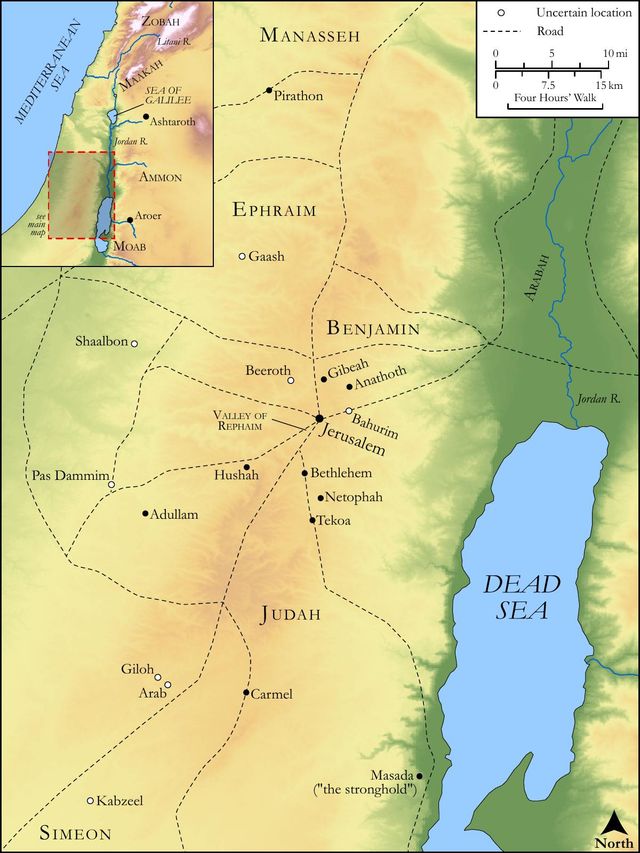
See on the biblical-era map
Study this verse
Public-domain commentary
Matthew Henry
From his Commentary on the Whole Bible. Henry comments on passages, not single verses — this entry covers 1 Chronicles 11:10–47. His two-level outline is real structure in the source text, so it is rendered as structure.
We have here an account of David's worthies, the great men of his time that served him and were preferred by him. The first edition of this catalogue we had, Sa2 23:8, etc. This is much the same, only that those named here from Ch1 11:41 to the end are added. Observe,
I.The connexion of this catalogue with that which is said concerning David, Ch1 11:9.
1.David waxed greater and greater, and these were his mighty men. Much of the strength and honour of great men is borrowed from their servants and depends upon them, which cannot but somewhat diminish pomp and power in the opinion of those that are wise. David is great because he has great men about him; take these away, and he is where he was.
2.The Lord of hosts was with him, and these were the mighty men which he had. God was with him and wrought for him, but by men and means and the use of second causes. By this it appeared that God was with him, that he inclined the hearts of those to come over to him that were able to serve his interest. As, if God be for us none can be against us, so, if God be for us, all shall be for us that we have occasion for. Yet David ascribed his success and increase, not to the hosts he had, but to the Lord of hosts, not to the mighty men that were with him, but to the mighty God whose presence with us is all in all.
II.The title of this catalogue (Ch1 11:10):
These are the men who strengthened themselves with him. In strengthening him they strengthened themselves and their own interest; for his advancement was theirs. What we do in our places for the support of the kingdom of the Son of David we shall be gainers by. In strengthening it we strengthen ourselves. It may be read, They held strongly with him and with all Israel. Note, When God has work to do he will not want fit instruments to do it with. If it be work that requires mighty men, mighty men shall either be found or made to effect it, according to the word of the Lord.
III.That which made all these men honourable was the good service that they did to their king and country; they helped to make David king (Ch1 11:10) - a good work. They slew the Philistines, and other public enemies, and were instrumental to save Israel. Note, The way to be great is to do good. Nor did they gain this honour without labour and the hazard of their lives. The honours of Christ's kingdom are prepared for those that fight the good fight of faith, that labour and suffer, and are willing to venture all, even life itself, for Christ and a good conscience. It is by a patient continuance in well-doing that we must seek for glory, and honour, and immortality; and those that are faithful to the Son of David shall find their names registered and enrolled much more to their honour than these are in the records of fame.
IV.Among all the great exploits of David's mighty men, here is nothing great mentioned concerning David himself but his pouring out water before the Lord which he had longed for, Ch1 11:18, Ch1 11:19. Four very honourable dispositions of David appeared in that action, which, for aught I know, made it as great as any of the achievements of those worthies.
1.Repentance for his own weakness. It is really an honour to a man, when he is made sensible that he has said or done any thing unadvisedly, to unsay it and undo it again by repentance, as it is a shame to a man when he has said or done amiss to stand to it.
2.Denial of his own appetite. He longed for the water of the well of Bethlehem; but, when he had it, he would not drink it, because he would not so far humour himself and gratify a foolish fancy. He that has such a rule as this over his own spirit is better than the mighty. It is an honour to a man to have the command of himself; but he that will command himself must sometimes cross himself.
3.Devotion towards God. That water which he thought too good, too precious, for his own drinking, he poured out to the Lord for a drink offering. If we have any thing better than another, let God be honoured with it, who is the best, and should have the best.
4.Tenderness of his servants. It put him into the greatest confusion imaginable to think that three brave men should hazard their lives to fetch water for him. In his account it turns the water into blood. It is the honour of great men not to be prodigal of the blood of those they employ, but, in all the commands they give them, to put their own souls into their souls' stead.
V.In the wonderful achievements of these heroes the power of God must be acknowledged.
How could one slay 300 and another the same number (Ch1 11:11, Ch1 11:20), another two lion-like men (Ch1 11:22), and another an Egyptian giant (Ch1 11:23), if they had not had the extraordinary presence of God with them, according to that promise, Jos 23:10, One man of you shall chase a thousand, for the Lord your God fighteth for you?
VI.One of these worthies is said to be an Ammonite (Ch1 11:39), another a Moabite (Ch1 11:46), and yet the law was that an Ammonite and a Moabite should not enter into the congregation of the Lord, Deu 23:3. These, it is likely, had approved themselves so hearty for the interest of Israel that in their case it was thought fit to dispense with that law, and the rather because it was an indication that the Son of David would have worthies among the Gentiles: with him there is neither Greek nor Jew.
Continue studying 1 Chronicles 11:14 across the web’s major study libraries — every link below opens this exact verse, chapter, or book on the destination site.
Read & Compare
 BibleGatewayThis verse in more than 200 translations and 70 languages.
 Bible.comThe YouVersion reader — hundreds of translations, reading plans, and highlights.
 ESV.orgCrossway's official English Standard Version reader.
 NET BibleThe NET translation with 60,000+ translators' notes on every rendering decision.
 STEP BibleTyndale House's free study tool — original text, vocabulary, and scholarly resources.
 BibliaLogos Bible Software's free web reader.
 USCCBThe New American Bible (Revised Edition) with the U.S. bishops' study notes.
Commentaries
 BibleHub CommentariesDozens of classic commentaries on this verse, gathered on one page.
 StudyLightMore than 100 commentary sets — the largest collection on the web.
 BibleRefPlain-English commentary on what this verse means, verse by verse.
 Enduring WordDavid Guzik's free commentary on this chapter, widely used by Bible teachers.
 Bible Study ToolsVerse commentary alongside Greek and Hebrew study aids.
Original Language & Research
- BibleHub InterlinearThe verse word by word — original language, transliteration, and English.
- BibleHub LexiconEvery word's original-language definition and Strong's entry.
 Blue Letter BibleDeep-study tools — Strong's numbers, concordance, and word studies.
 SefariaThe Hebrew text with Rashi and centuries of Jewish commentary.
Sermons, Hymns & Audio


TrulyRandomVerse is not affiliated with these sites and doesn’t control their content. They’re linked because they’re genuinely useful.
Summary
1 Chronicles 11:14 vividly portrays an extraordinary act of valor by one of David's mighty men, who, against overwhelming Philistine forces, defended a crucial parcel of land. This heroic stand, culminating in a decisive victory, is powerfully attributed not merely to human strength or tactical brilliance, but to the sovereign intervention of God, underscoring that the Lord Himself secured a "great deliverance" for His people.
Context
ShowHideLiterary Context
This verse is embedded within a pivotal section of 1 Chronicles (chapters 11 and 12), which details the establishment of David's kingdom and the assembly of his elite warriors. Specifically, 1 Chronicles 11:10-47 provides a comprehensive roster of David's "mighty men," highlighting their individual feats of courage and loyalty that contributed to the strength and security of David's reign. The account in 1 Chronicles 11:13-14 closely parallels the narrative found in 2 Samuel 23:11-12, which explicitly identifies the hero as Shammah, son of Agee the Hararite. While Chronicles uses the plural "they," implying a collective effort or perhaps Eleazar's involvement as per the preceding verse, the core narrative emphasizes a courageous stand against the Philistines, culminating in a divinely orchestrated victory. This incident serves as a testament to the character of David's loyal followers and, more importantly, to the God who empowered them.
Historical & Cultural Context
The period of David's reign was marked by ongoing conflict with the Philistines, Israel's formidable and persistent adversaries. These coastal people frequently raided Israelite territory, particularly agricultural lands, to plunder crops and assert dominance, as seen in 1 Samuel 13:19-22. The "parcel" mentioned in the verse was likely a field of barley (or lentils, as in 2 Samuel), a vital food source. Defending such a seemingly small plot of land was not merely about preserving crops; it was an act of profound national significance, symbolizing the defense of Israel's sovereignty, its God-given inheritance (Deuteronomy 1:8), and its very right to exist free from foreign oppression. The Philistines' presence in the valley of Rephaim (2 Samuel 5:18) indicates their proximity to Jerusalem and their constant threat to the heartland of Judah.
Key Themes
ShowHideThis verse powerfully contributes to several overarching themes within 1 Chronicles and the broader biblical narrative. First, it highlights Unwavering Courage and Resolve, as the mighty man (or men) stood firm against a numerically superior enemy, refusing to abandon the field and its vital produce. This embodies a spirit of determination and faithfulness in the face of overwhelming odds, a quality consistently praised in biblical heroes (e.g., Joshua 1:9). Second, and most crucially, the verse emphasizes Divine Deliverance. The concluding phrase, "and the LORD saved [them] by a great deliverance," shifts the focus from human might to divine power. This theological declaration underscores that ultimate victory and salvation come from God alone, not from human strength or strategy. This principle is a cornerstone of Israelite theology, echoed throughout the Old Testament, where God repeatedly intervenes on behalf of His people (Exodus 14:14, Psalm 44:3). Finally, the defense of the "parcel" of land subtly introduces the theme of Stewardship of the Land, reminding the reader of the importance of protecting the inheritance God had graciously given to Israel, a land meant to be cultivated and enjoyed under His blessing (Leviticus 25:23).
Exposition and Analysis
ShowHideKey Word Analysis
ShowHideThis word refers to a "portion," "field," or "plot of land." In this context, it specifically denotes an agricultural field, likely planted with barley. Its significance is not in its size, but in its representation of Israel's God-given inheritance and livelihood. The defense of this seemingly small "parcel" underscores the mighty man's commitment to protecting even the most basic elements of his people's existence and sovereignty.
This verb denotes taking a firm stand, positioning oneself resolutely, or standing fast. In the context of battle, it conveys an unwavering determination and courage, indicating that the warriors did not retreat but firmly established their position in the face of the enemy. It highlights their active and committed posture in defending the land.
This primitive root means "to be open, wide or free," and by implication, "to be safe." Causatively, it means "to free or succor," encompassing concepts like deliverance, help, preservation, and salvation. When applied to the LORD, as it is in this verse, it emphasizes God's active intervention to bring about safety, rescue, and ultimate victory, highlighting His role as the deliverer and source of salvation for His people.
Verse Breakdown
ShowHide"And they set themselves in the midst of [that] parcel"
This opening clause describes an act of profound courage and strategic positioning. "Setting themselves" (Hebrew: yityaṣṣĕbû) implies taking a firm, resolute stand. They did not retreat or abandon the field, but rather positioned themselves directly in the heart of the threatened area, signaling their unwavering commitment to defend it against a superior Philistine force. This physical act embodies a spirit of defiance and protective resolve.
"and delivered it, and slew the Philistines"
This part of the verse details the immediate outcome of their courageous stand. "Delivered it" refers to saving the field from being plundered or destroyed. The subsequent "and slew the Philistines" describes the decisive military action and the resulting victory. This clause highlights the human agency and the effectiveness of their fighting, demonstrating their skill and bravery in battle. It sets the stage for the ultimate theological declaration that follows.
"and the LORD saved [them] by a great deliverance"
This concluding clause is the theological climax of the verse. Despite the heroic human effort, the Chronicler attributes the ultimate victory and salvation not to the mighty men, but directly to God. The phrase "the LORD saved [them] by a great deliverance" powerfully asserts divine sovereignty. It means that the victory was not merely a human triumph, but an extraordinary, divinely orchestrated act, emphasizing that true and ultimate salvation comes from God's hand alone, transcending human capabilities and ensuring His glory.
Literary Devices
ShowHideThe Chronicler employs several potent literary devices in 1 Chronicles 11:14 to underscore its theological message. Parallelism is evident through its close relationship with 2 Samuel 23:11-12, inviting comparison and highlighting the Chronicler's specific interpretive emphasis. While 2 Samuel focuses on Shammah, 1 Chronicles uses the plural "they," possibly broadening the scope to include more individuals or the collective spirit of David's men, but consistently maintaining the focus on God's ultimate role. The most prominent device is Emphasis, particularly through the climactic phrase "and the LORD saved [them] by a great deliverance." This final declaration serves as a theological punchline, deliberately shifting the reader's attention from the impressive human feat to the even more magnificent divine intervention. It employs a form of Divine Causality, where human action is presented as a necessary but insufficient condition for victory, with God as the ultimate and decisive agent. The phrase "great deliverance" itself functions as a form of Hyperbole or Exaggeration, not to diminish the human effort, but to magnify the divine power at work, suggesting a victory far beyond what human strength alone could achieve. This narrative technique reinforces the Chronicler's overarching theological agenda: to illustrate God's faithfulness and active involvement in the history of Israel, particularly through the Davidic line.
Theological and Thematic Connections
ShowHideThe narrative of 1 Chronicles 11:14 brilliantly intertwines human courage with divine sovereignty, presenting a foundational theological truth: while God calls His people to courageous action and faithfulness, ultimate victory and salvation belong to Him alone. The mighty man's willingness to stand firm in the face of overwhelming odds demonstrates the kind of unwavering commitment God desires from His servants. Yet, the Chronicler ensures that the glory for the "great deliverance" is unequivocally ascribed to the Lord. This teaches us that human effort, no matter how valiant, is empowered and ultimately made effective by God's hand. It is a powerful reminder that our battles, whether physical, spiritual, or personal, are fought with God, not merely for God, and that His power is perfected in our weakness. This principle fosters both active obedience and humble reliance, recognizing that true success is a gift of divine grace.
Reflection and Application
ShowHide1 Chronicles 11:14 offers profound lessons for believers navigating the challenges of life and faith. Like the mighty man who defended the barley field, we are called to stand firm in our convictions, our faith, and our principles, even when facing seemingly insurmountable opposition or when the "parcel" we are defending seems small or insignificant. This might involve defending biblical truth in a skeptical world, standing up for justice, protecting the vulnerable, or persevering through personal trials. Our courage is not a naive optimism, but a resolute determination rooted in the knowledge that God is with us. However, the verse's ultimate message is one of humble reliance: while we are to act with diligence and bravery, our true victories, whether in spiritual warfare, personal struggles, or societal challenges, ultimately come from the Lord. Our efforts are essential, but they are empowered, sustained, and ultimately blessed by God's sovereign hand. This truth frees us from the burden of self-reliance and invites us into a partnership with the Almighty, where our faithfulness opens the door for His "great deliverance."
Questions for Reflection
ShowHideFAQ
ShowHideWho is "they" in this verse, and why is it significant?
ShowHideThe "they" in 1 Chronicles 11:14 refers to the mighty man (or men) who took a stand against the Philistines. While the Chronicler uses the plural, the parallel account in 2 Samuel 23:11-12 specifically identifies the hero as Shammah, one of David's three chief mighty men. Some scholars interpret the "they" in Chronicles as a collective reference to the spirit of David's warriors, or perhaps as including Eleazar (mentioned in 1 Chronicles 11:12) if the accounts are conflated. The significance of this grammatical choice in Chronicles is twofold: it may broaden the scope of the heroism beyond a single individual, emphasizing the collective valor of David's elite forces. More importantly, it serves to highlight the Chronicler's primary theological agenda: regardless of who the specific human agent was, the ultimate source of the victory and "great deliverance" was the Lord Himself. The focus is less on the individual hero and more on God's power working through His chosen instruments.
What does "great deliverance" truly mean here?
ShowHideThe phrase "great deliverance" (Hebrew: tĕšûʿâ gĕdôlâ) signifies a victory that transcends ordinary human achievement, pointing directly to a miraculous or extraordinary intervention by God. It implies that the battle's outcome was not merely a result of superior strategy, strength, or numbers, but a direct, powerful act of divine salvation. This "great deliverance" suggests that the odds were so overwhelming, or the victory so decisive and unexpected, that it could only be attributed to God's hand. It underscores the biblical principle that God often works through human agents, but the ultimate power and glory for salvation belong to Him (Psalm 44:3). This concept is consistent with other instances in Scripture where God brings about "great salvation" for His people, such as the crossing of the Red Sea (Exodus 14) or Gideon's victory with a small army (Judges 7).
Christ-Centered Fulfillment
ShowHideThe heroic stand of David's mighty man in 1 Chronicles 11:14, culminating in a "great deliverance" by the Lord, finds its ultimate and most profound fulfillment in the person and work of Jesus Christ. Just as the mighty man stood firm against overwhelming Philistine forces to defend a precious "parcel" of land, Jesus, the true and ultimate "Mighty Warrior" (Isaiah 9:6), stood firm against the formidable spiritual forces of sin, death, and the devil. He did not merely defend a physical plot of land, but secured the eternal inheritance for all who believe in Him. His crucifixion was the ultimate "setting Himself in the midst" of the enemy's territory, entering into the very domain of death and darkness. Through His sacrificial death and glorious resurrection, Jesus "delivered" humanity from the dominion of sin and "slew" the spiritual enemies that held us captive (Colossians 2:15, Hebrews 2:14-15). The "great deliverance" achieved by the Lord in 1 Chronicles 11:14 is but a shadow of the infinitely greater, eternal deliverance secured by God through Christ's finished work on the cross. He is the Lamb of God who takes away the sin of the world (John 1:29), and through His victory, believers are not only saved but also empowered to participate in His ongoing triumph over darkness, knowing that the ultimate victory belongs to Him who holds the keys of death and Hades (Revelation 1:18).