


1 Chronicles 11:15
Bible text: King James Version (1769 Blayney text) · Public domain
Bible text: King James Version with Strong's numbers · Public domain
Bible text: Berean Standard Bible · Public domain
Bible text: American Standard Version (1901) · Public domain
Bible text: World English Bible, Messianic edition · Public domain
Bible text: Geneva Bible (1599) · Public domain
Bible text: Young's Literal Translation · Public domain
- וַיֵּרְדוּvai·ye·re·Duand they went downH3381Conj-w ¦ V-Qal-ConsecImperf-3mpVerb Qal Consecutive Imperfect 3rd Plural Masculineוַandיֵּרְדוּthey went down
- שְׁלוֹשָׁהshe·lo·ShahthreeH7969N-csNoun Singular common gender Absolute
- מִןminofH4480PrepPreposition
- הַשְּׁלוֹשִׁיםha·she·lo·Shimthe thirtyH7970Art ¦ N-mpNoun Plural Masculine Absoluteהַtheשְּׁלוֹשִׁיםthirty
- רֹאשׁroshchiefH7218N-msNoun Singular Masculine Absolute
- עַל'altoH5921PrepPreposition
- הַצֻּרha·Tzurthe rockH6697Art ¦ N-msNoun Singular Masculine Absoluteהַtheצֻּרrock
- אֶל'eltoH413PrepPreposition
- דָּוִידda·VidDavidH1732N-proper-mNoun Proper Masculine
- אֶל'eltoH413PrepPreposition
- מְעָרַתme·'a·Rat[the] cave ofH4631N-fscNoun Singular Feminine Construct
- עֲדֻלָּם'a·du·LamAdullamH5725N-properNoun Proper Location
- וּמַחֲנֵהu·ma·cha·Nehand [the] camp ofH4264Conj-w ¦ N-fscNoun Singular Feminine Constructוּandמַחֲנֵה[the] camp of
- פְלִשְׁתִּיםfe·lish·Tim[the] PhilistinesH6430N-mpNoun Gentilic Plural Masculine Absolute
- חֹנָהcho·Nah[was] encampedH2583V-Qal-Prtcpl-fsVerb Qal Participle Singular Feminine Absolute
- בְּעֵמֶקbe·'E·mekin [the] valley ofH6010Prep-b ¦ N-mscNoun Singular Masculine Constructבְּinעֵמֶק[the] valley of
- רְפָאִיםre·fa·'Im[the] RephaitesH7497N-mpNoun Gentilic Plural Masculine Absolute
English is a literal word-by-word gloss of the Hebrew, not the KJV's wording. Why?
This is the original text the KJV's translators worked from — each Hebrew word with its own literal English meaning in this verse, prepared by scholars at Tyndale House, Cambridge. The KJV translates whole sentences, not word by word, so its wording differs: one Hebrew word can become several English words, and the KJV may choose “the LORD” where the gloss reads “Yahweh”. Both are faithful — they answer different questions. For the KJV's own rendering, switch to the KJV text.
Details
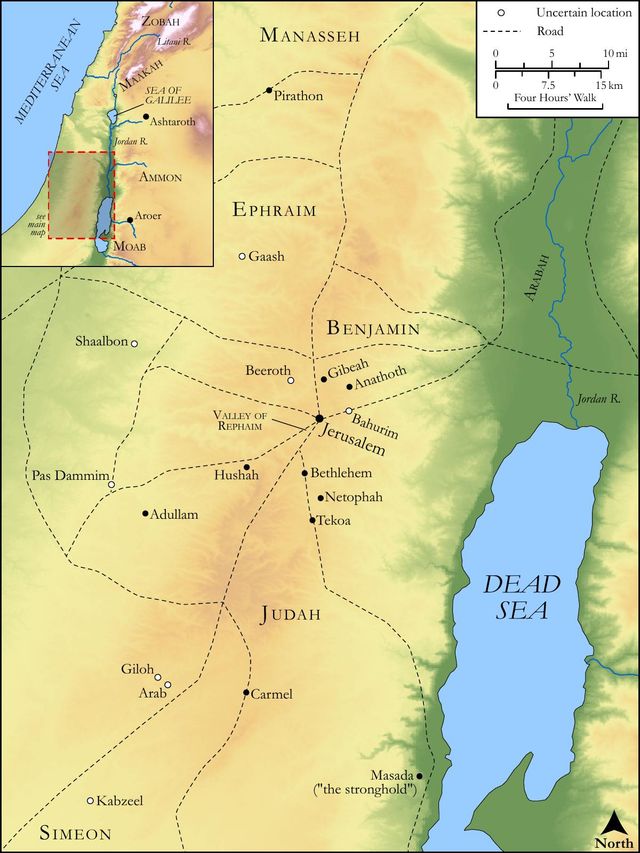
See on the biblical-era map
Study this verse
Public-domain commentary
Matthew Henry
From his Commentary on the Whole Bible. Henry comments on passages, not single verses — this entry covers 1 Chronicles 11:10–47. His two-level outline is real structure in the source text, so it is rendered as structure.
We have here an account of David's worthies, the great men of his time that served him and were preferred by him. The first edition of this catalogue we had, Sa2 23:8, etc. This is much the same, only that those named here from Ch1 11:41 to the end are added. Observe,
I.The connexion of this catalogue with that which is said concerning David, Ch1 11:9.
1.David waxed greater and greater, and these were his mighty men. Much of the strength and honour of great men is borrowed from their servants and depends upon them, which cannot but somewhat diminish pomp and power in the opinion of those that are wise. David is great because he has great men about him; take these away, and he is where he was.
2.The Lord of hosts was with him, and these were the mighty men which he had. God was with him and wrought for him, but by men and means and the use of second causes. By this it appeared that God was with him, that he inclined the hearts of those to come over to him that were able to serve his interest. As, if God be for us none can be against us, so, if God be for us, all shall be for us that we have occasion for. Yet David ascribed his success and increase, not to the hosts he had, but to the Lord of hosts, not to the mighty men that were with him, but to the mighty God whose presence with us is all in all.
II.The title of this catalogue (Ch1 11:10):
These are the men who strengthened themselves with him. In strengthening him they strengthened themselves and their own interest; for his advancement was theirs. What we do in our places for the support of the kingdom of the Son of David we shall be gainers by. In strengthening it we strengthen ourselves. It may be read, They held strongly with him and with all Israel. Note, When God has work to do he will not want fit instruments to do it with. If it be work that requires mighty men, mighty men shall either be found or made to effect it, according to the word of the Lord.
III.That which made all these men honourable was the good service that they did to their king and country; they helped to make David king (Ch1 11:10) - a good work. They slew the Philistines, and other public enemies, and were instrumental to save Israel. Note, The way to be great is to do good. Nor did they gain this honour without labour and the hazard of their lives. The honours of Christ's kingdom are prepared for those that fight the good fight of faith, that labour and suffer, and are willing to venture all, even life itself, for Christ and a good conscience. It is by a patient continuance in well-doing that we must seek for glory, and honour, and immortality; and those that are faithful to the Son of David shall find their names registered and enrolled much more to their honour than these are in the records of fame.
IV.Among all the great exploits of David's mighty men, here is nothing great mentioned concerning David himself but his pouring out water before the Lord which he had longed for, Ch1 11:18, Ch1 11:19. Four very honourable dispositions of David appeared in that action, which, for aught I know, made it as great as any of the achievements of those worthies.
1.Repentance for his own weakness. It is really an honour to a man, when he is made sensible that he has said or done any thing unadvisedly, to unsay it and undo it again by repentance, as it is a shame to a man when he has said or done amiss to stand to it.
2.Denial of his own appetite. He longed for the water of the well of Bethlehem; but, when he had it, he would not drink it, because he would not so far humour himself and gratify a foolish fancy. He that has such a rule as this over his own spirit is better than the mighty. It is an honour to a man to have the command of himself; but he that will command himself must sometimes cross himself.
3.Devotion towards God. That water which he thought too good, too precious, for his own drinking, he poured out to the Lord for a drink offering. If we have any thing better than another, let God be honoured with it, who is the best, and should have the best.
4.Tenderness of his servants. It put him into the greatest confusion imaginable to think that three brave men should hazard their lives to fetch water for him. In his account it turns the water into blood. It is the honour of great men not to be prodigal of the blood of those they employ, but, in all the commands they give them, to put their own souls into their souls' stead.
V.In the wonderful achievements of these heroes the power of God must be acknowledged.
How could one slay 300 and another the same number (Ch1 11:11, Ch1 11:20), another two lion-like men (Ch1 11:22), and another an Egyptian giant (Ch1 11:23), if they had not had the extraordinary presence of God with them, according to that promise, Jos 23:10, One man of you shall chase a thousand, for the Lord your God fighteth for you?
VI.One of these worthies is said to be an Ammonite (Ch1 11:39), another a Moabite (Ch1 11:46), and yet the law was that an Ammonite and a Moabite should not enter into the congregation of the Lord, Deu 23:3. These, it is likely, had approved themselves so hearty for the interest of Israel that in their case it was thought fit to dispense with that law, and the rather because it was an indication that the Son of David would have worthies among the Gentiles: with him there is neither Greek nor Jew.
Continue studying 1 Chronicles 11:15 across the web’s major study libraries — every link below opens this exact verse, chapter, or book on the destination site.
Read & Compare
 BibleGatewayThis verse in more than 200 translations and 70 languages.
 Bible.comThe YouVersion reader — hundreds of translations, reading plans, and highlights.
 ESV.orgCrossway's official English Standard Version reader.
 NET BibleThe NET translation with 60,000+ translators' notes on every rendering decision.
 STEP BibleTyndale House's free study tool — original text, vocabulary, and scholarly resources.
 BibliaLogos Bible Software's free web reader.
 USCCBThe New American Bible (Revised Edition) with the U.S. bishops' study notes.
Commentaries
 BibleHub CommentariesDozens of classic commentaries on this verse, gathered on one page.
 StudyLightMore than 100 commentary sets — the largest collection on the web.
 BibleRefPlain-English commentary on what this verse means, verse by verse.
 Enduring WordDavid Guzik's free commentary on this chapter, widely used by Bible teachers.
 Bible Study ToolsVerse commentary alongside Greek and Hebrew study aids.
Original Language & Research
- BibleHub InterlinearThe verse word by word — original language, transliteration, and English.
- BibleHub LexiconEvery word's original-language definition and Strong's entry.
 Blue Letter BibleDeep-study tools — Strong's numbers, concordance, and word studies.
 SefariaThe Hebrew text with Rashi and centuries of Jewish commentary.
Sermons, Hymns & Audio


TrulyRandomVerse is not affiliated with these sites and doesn’t control their content. They’re linked because they’re genuinely useful.
Summary
1 Chronicles 11:15 provides a concise yet profound snapshot of David's precarious early reign, highlighting the unwavering loyalty of his elite warriors amidst significant danger. This verse sets the scene for a remarkable act of devotion, depicting three of David's most distinguished captains undertaking a perilous journey to reach their leader in the strategic refuge of the cave of Adullam, even as the formidable Philistine army maintained a menacing encampment in the nearby, strategically vital Valley of Rephaim. It underscores the constant threat David faced and the exceptional courage of those who rallied to his cause.
Context
ShowHideLiterary Context
This verse is strategically positioned within 1 Chronicles 11, a chapter dedicated to establishing David's legitimate kingship and introducing the core of his military might. Following David's anointing as king over all Israel and his triumphant capture of Jerusalem from the Jebusites in the preceding verses, culminating in his growing power because "the Lord of hosts was with him" (1 Chronicles 11:1-9), the Chronicler shifts focus to the individuals who formed the backbone of his kingdom—his "mighty men." Verse 15 specifically introduces the "three of the thirty captains," the most prominent members of this elite fighting force. This introduction directly precedes the account of their extraordinary act of bravery in fetching water for David from Bethlehem (1 Chronicles 11:16-19), emphasizing their character and loyalty as foundational elements of David's successful reign. The Chronicler's narrative choice here underscores the divine favor and human devotion that converged to establish David's kingdom.
Historical & Cultural Context
At the time of this event, David was not yet the unified king ruling from Jerusalem, but a charismatic leader operating as a fugitive from King Saul. The cave of Adullam served as a crucial strategic refuge, a natural fortress within the Shephelah region of Judah. Here, David gathered a diverse group of discontented, indebted, and distressed men, forging them into a disciplined and highly effective fighting force. The "three of the thirty captains" refers to the most distinguished members of David's elite unit, known as his "mighty men" or "Gibborim," a list of whom is also found in 2 Samuel 23:8-39. Their journey to David was fraught with extreme danger, as indicated by the "host of the Philistines encamped in the valley of Rephaim." The Valley of Rephaim was a well-known and frequently contested battleground southwest of Jerusalem, serving as a common staging ground for Philistine incursions into Israelite territory. This immediate proximity of a formidable enemy underscores the immense courage and personal risk involved for these captains to reach David, highlighting the constant state of conflict and the unwavering commitment required to serve him.
Key Themes
ShowHideA central theme highlighted in this verse is the unwavering loyalty of David's men. Despite David's fugitive status and the palpable danger posed by the Philistines, these captains willingly risked their lives to be with him and to fulfill his unspoken desire. This loyalty transcends mere duty; it reflects a deep personal bond and a profound commitment to the divinely appointed leader, foreshadowing the faithful support David would receive throughout his reign. Another prominent theme is courage in adversity. Operating under constant threat from both King Saul and the Philistines, David and his followers consistently demonstrated valor and a willingness to confront danger for their leader and the nascent kingdom. This verse also serves as a powerful setting of the stage for heroism, directly preceding and providing the perilous context for the extraordinary act of devotion where these same three captains break through the Philistine lines to retrieve water for David from the well of Bethlehem (1 Chronicles 11:17-19), profoundly illustrating their self-sacrificial spirit and devotion.
Exposition and Analysis
ShowHideKey Word Analysis
ShowHideFrom an unused root apparently meaning to shake; the head (as most easily shaken), whether literal or figurative (in many applications, of place, time, rank, etc.); band, beginning, captain, chapiter, chief(-est place, man, things), company, end, [idiom] every (man), excellent, first, forefront, (be-)head, height, (on) high(-est part, (priest)), [idiom] lead, [idiom] poor, principal, ruler, sum, top. In this context, rôʼsh signifies the elite status and leadership role of these three men. They were not ordinary soldiers but "heads" or "chiefs," indicating their preeminence and authority among David's formidable "mighty men."
Probably from the passive participle of the same as עַדְלַי; Adullam, a place in Palestine. Adullam was a significant cave system in the Shephelah region of Judah, serving as David's primary base of operations and a rallying point during his time as a fugitive from Saul. Its natural defenses and strategic location made it an ideal place for David to gather and train his loyal followers, transforming a disparate group of outcasts into a disciplined military force.
Or רָפָה; from רָפָא in the sense of invigorating; a giant; giant, Rapha, Rephaim(-s). While the term "Rephaim" can refer to ancient giants, here it specifically denotes the "Valley of Rephaim," a fertile plain located southwest of Jerusalem, stretching towards Bethlehem. This valley was a frequent battleground between Israel and the Philistines, known for its strategic importance as an invasion route. Its mention here signifies the immediate and pervasive threat of the Philistine army, underscoring the danger faced by David and his men.
Verse Breakdown
ShowHide"Now three of the thirty captains went down to the rock to David"
This clause introduces the protagonists of the subsequent heroic act: a select group of three elite leaders from David's larger company of "mighty men." Their initiative to "go down" suggests a deliberate and dangerous journey, possibly from a higher defensive point or through enemy territory, to reach David. The "rock" likely refers to a specific, prominent geological feature near Adullam, serving as a landmark or a more immediate defensive position for David.
"into the cave of Adullam"
This specifies David's precise location, emphasizing his status as a fugitive seeking refuge. The cave of Adullam was not merely a hiding place but a strategic base where David's loyal followers gathered, forming the nucleus of his future kingdom. The captains' journey into this stronghold underscores their commitment to David, even in his vulnerable and exiled state.
"and the host of the Philistines encamped in the valley of Rephaim"
This final clause provides the critical backdrop of imminent danger and conflict. The "host of the Philistines" signifies a large, organized military force, indicating a significant and immediate threat to Israelite territory and to David's position. Their encampment in the strategically vital Valley of Rephaim highlights the constant Philistine pressure and the perilous environment in which David and his men operated, making the captains' journey and their subsequent actions all the more courageous and remarkable.
Literary Devices
ShowHideThe verse masterfully employs Juxtaposition to create a stark contrast between David's vulnerable position and the overwhelming external threat. David, the future king, is confined to a "cave of Adullam," a place of refuge but also of hiding, while the powerful "host of the Philistines" is openly "encamped in the valley of Rephaim," signaling their dominance and aggressive posture. This contrast heightens the sense of danger and underscores the precariousness of David's situation. The verse also functions as a powerful piece of Foreshadowing, subtly preparing the reader for the extraordinary act of heroism that immediately follows in the narrative. By introducing these "three of the thirty captains" and detailing the perilous circumstances of their journey, the Chronicler builds anticipation for their subsequent display of profound loyalty and valor. Furthermore, the mention of the Philistine encampment serves as a clear element of Conflict, establishing the primary external antagonist and the perilous conditions under which David's future kingdom was forged, emphasizing the courage and resilience required of his followers.
Theological and Thematic Connections
ShowHideThis verse, though brief, powerfully illustrates the themes of loyalty, courage, and the providential gathering of faithful individuals around God's chosen leader. It speaks to the nature of true devotion, where allegiance is not contingent on comfort or safety, but persists even in the face of overwhelming odds. The actions of these captains exemplify a commitment that transcends mere duty, reflecting a deep personal bond and a shared vision for David's divinely appointed destiny. Their willingness to risk their lives for David, even for a seemingly trivial desire like water, prefigures the ultimate sacrifice and unwavering commitment required of those who follow God's call. It reminds us that God often raises up faithful companions to support His servants, even in their most vulnerable moments, demonstrating His sovereign hand in establishing His purposes through human faithfulness.
Reflection and Application
ShowHideThe account of David's mighty men in 1 Chronicles 11:15 calls us to reflect on the nature of loyalty, courage, and sacrificial service in our own lives and communities. In a world often characterized by fleeting commitments and self-preservation, the unwavering devotion of these captains stands as a powerful testament to the strength found in faithful companionship and a willingness to put others before self. This passage challenges us to consider what it truly means to support leaders—whether in the church, our families, or other spheres—especially when they face adversity or when the path ahead is fraught with danger. It compels us to ask if we possess the kind of courage that would lead us to step out of our comfort zones, to overcome significant obstacles, and to take personal risks for a cause or a person we believe in, particularly when that cause aligns with God's purposes. The loyalty displayed by these men was not blind but born of a deep respect for David and an understanding of his divine calling, prompting us to cultivate discerning yet steadfast allegiance in our own spheres of influence, recognizing that true faith often calls for costly devotion.
Questions for Reflection
ShowHideFAQ
ShowHideWho were "the thirty captains" mentioned in this verse?
ShowHide"The thirty captains" refers to a highly distinguished and elite group within David's army, known as his "mighty men" or "Gibborim." This group was comprised of David's most skilled, courageous, and loyal warriors, who had proven their valor in numerous battles. While the number "thirty" served as a general designation for this elite unit, there was an even more select group of three "chiefs of the three" (as seen in 2 Samuel 23:8), who were the most prominent and accomplished among them. The men in 1 Chronicles 11:15 are these three, demonstrating their exceptional status and profound devotion to David.
Why was David in the cave of Adullam, and what was its significance?
ShowHideDavid was in the cave of Adullam because he was a fugitive, fleeing from the relentless pursuit of King Saul, who sought to kill him (1 Samuel 22:1). The cave of Adullam, located in the Shephelah region, was a natural fortress with a complex system of caves and tunnels, offering excellent defensive capabilities. It became a strategic refuge and a rallying point for David, where he gathered a diverse group of about 400 men—those who were distressed, in debt, or discontented—and transformed them into a disciplined and loyal fighting force that would eventually form the core of his kingdom's army. It was a place of training, community, and preparation for his future reign as God's anointed king.
What is the significance of the Philistines being encamped in the Valley of Rephaim at this time?
ShowHideThe Philistines' encampment in the Valley of Rephaim was highly significant because it indicated a direct and imminent military threat to Israel. The Valley of Rephaim, located southwest of Jerusalem, was a fertile plain and a common invasion route for the Philistines into the central highlands of Judah. It was a frequent battleground where Israel and the Philistines clashed (2 Samuel 5:18). Their presence there meant that the area around David's stronghold in Adullam was under enemy control or surveillance, making any movement, especially by elite captains, extremely dangerous. This perilous situation underscores the immense courage required for their mission to reach David and highlights the constant state of warfare during this period of Israel's history.
Christ-Centered Fulfillment
ShowHideThe extraordinary loyalty and self-sacrificial courage of David's mighty men, willing to risk their lives for their earthly king, find their ultimate fulfillment and deepest meaning in the person and work of Jesus Christ. Just as David was a king in exile, pursued by enemies, yet gathering a loyal following in the cave of Adullam, so too Jesus, the true King of Israel, came to a world hostile to Him, gathering those who were "weary and burdened" (Matthew 11:28). The "living water" that David's men sought to bring him from Bethlehem's well points powerfully to Christ, who offers spiritual "living water" that truly satisfies the deepest thirst of the human soul (John 4:10-14). Our King, Jesus, did not merely long for water; He thirsted on the cross for the redemption of humanity (John 19:28), and His followers are called to a loyalty that surpasses even that of David's mighty men. We are called to lay down our lives for Him, not to bring Him earthly sustenance, but to participate in His mission of salvation, demonstrating the "greater love" of laying down one's life for friends (John 15:13). Christ is our ultimate refuge, a stronger "cave of Adullam" where we find safety and strength from the spiritual "Philistine encampments" of sin, death, and the devil. Our courage and loyalty are not directed towards an earthly monarch, but towards the King of kings, who has already conquered every foe and offers eternal life to all who follow Him, fixing our eyes on "Jesus, the founder and perfecter of our faith" (Hebrews 12:2).