


1 Chronicles 11:13
Bible text: King James Version (1769 Blayney text) · Public domain
Bible text: King James Version with Strong's numbers · Public domain
Bible text: Berean Standard Bible · Public domain
Bible text: American Standard Version (1901) · Public domain
Bible text: World English Bible, Messianic edition · Public domain
Bible text: Geneva Bible (1599) · Public domain
Bible text: Young's Literal Translation · Public domain
- הוּאhu'heH1931Pro-3msPronoun Personal 3rd Singular Masculine
- הָיָהha·Yahhe wasH1961V-Qal-Perf-3msVerb Qal Perfect 3rd Singular Masculine
- עִם'imwithH5973PrepPreposition
- דָּוִידda·VidDavidH1732N-proper-mNoun Proper Masculine
- בַּפַּסba·Pasat <the> PasH6450Prep-b ¦ N-properNoun Proper Locationבַּat <the>פַּסPas
- דַּמִּיםda·MimDammimH6450N-properNoun Proper Location
- וְהַפְּלִשְׁתִּיםve·ha·pe·lish·Timand the PhilistinesH6430Conj-w ¦ Art ¦ N-mpNoun Gentilic Plural Masculine AbsoluteוְandהַtheפְּלִשְׁתִּיםPhilistines
- נֶאֱסְפוּne·'es·futhey were gatheredH622V-Niphal-Perf-3cpVerb Niphal Perfect 3rd Plural common gender
- שָׁםshamthereH8033AdvAdverb
- לַמִּלְחָמָהla·mil·cha·Mahfor <the> battleH4421Prep-l ¦ N-fsNoun Singular Feminine Absoluteלַfor <the>מִּלְחָמָהbattle
- וַתְּהִיva·te·Hiand it wasH1961Conj-w ¦ V-Qal-ConsecImperf-3fsVerb Qal Consecutive Imperfect 3rd Singular Feminineוַandתְּהִיit was
- חֶלְקַתchel·Kat[the] portion ofH2513N-fscNoun Singular Feminine Construct
- הַשָּׂדֶהha·sa·Dehthe fieldH7704Art ¦ N-msNoun Singular Masculine Absoluteהַtheשָּׂדֶהfield
- מְלֵאָהme·le·'AhfullH4392Adj-fsAdjective Singular Feminine Absolute
- שְׂעוֹרִיםse·'o·Rimbarley<s>H8184N-mpNoun Plural Masculine Absolute
- וְהָעָםve·ha·'Amand the peopleH5971Conj-w ¦ Art ¦ N-msNoun Singular Masculine Absoluteוְandהָtheעָםpeople
- נָסוּNa·suthey fledH5127V-Qal-Perf-3cpVerb Qal Perfect 3rd Plural common gender
- מִפְּנֵיmi·pe·Neifrom beforeH6440Prep-m ¦ N-mpcNoun Plural Masculine Constructמִfromפְּנֵיbefore
- פְלִשְׁתִּיםfe·lish·Tim[the] PhilistinesH6430N-mpNoun Gentilic Plural Masculine Absolute
English is a literal word-by-word gloss of the Hebrew, not the KJV's wording. Why?
This is the original text the KJV's translators worked from — each Hebrew word with its own literal English meaning in this verse, prepared by scholars at Tyndale House, Cambridge. The KJV translates whole sentences, not word by word, so its wording differs: one Hebrew word can become several English words, and the KJV may choose “the LORD” where the gloss reads “Yahweh”. Both are faithful — they answer different questions. For the KJV's own rendering, switch to the KJV text.
Details
See on the biblical-era map
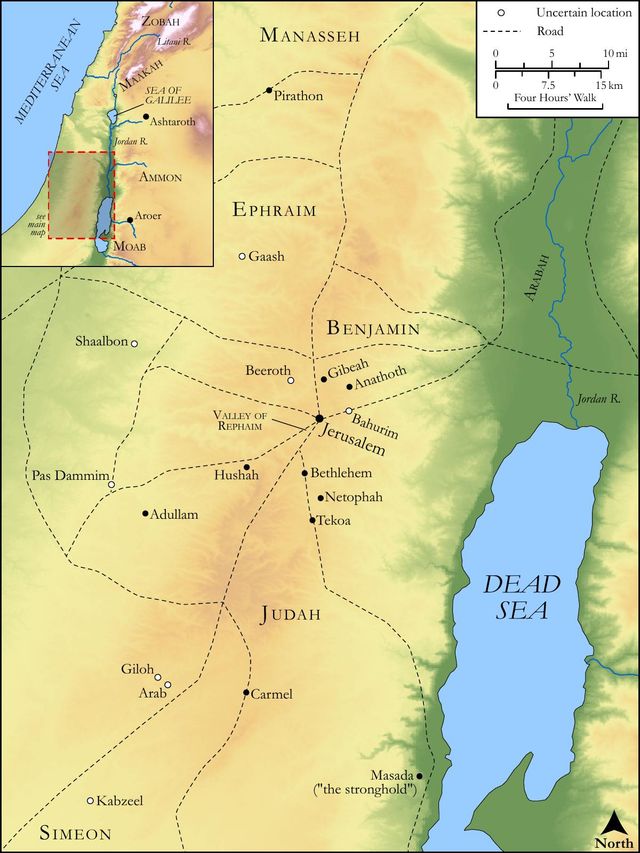
Study this verse
Public-domain commentary
Matthew Henry
From his Commentary on the Whole Bible. Henry comments on passages, not single verses — this entry covers 1 Chronicles 11:10–47. His two-level outline is real structure in the source text, so it is rendered as structure.
We have here an account of David's worthies, the great men of his time that served him and were preferred by him. The first edition of this catalogue we had, Sa2 23:8, etc. This is much the same, only that those named here from Ch1 11:41 to the end are added. Observe,
I.The connexion of this catalogue with that which is said concerning David, Ch1 11:9.
1.David waxed greater and greater, and these were his mighty men. Much of the strength and honour of great men is borrowed from their servants and depends upon them, which cannot but somewhat diminish pomp and power in the opinion of those that are wise. David is great because he has great men about him; take these away, and he is where he was.
2.The Lord of hosts was with him, and these were the mighty men which he had. God was with him and wrought for him, but by men and means and the use of second causes. By this it appeared that God was with him, that he inclined the hearts of those to come over to him that were able to serve his interest. As, if God be for us none can be against us, so, if God be for us, all shall be for us that we have occasion for. Yet David ascribed his success and increase, not to the hosts he had, but to the Lord of hosts, not to the mighty men that were with him, but to the mighty God whose presence with us is all in all.
II.The title of this catalogue (Ch1 11:10):
These are the men who strengthened themselves with him. In strengthening him they strengthened themselves and their own interest; for his advancement was theirs. What we do in our places for the support of the kingdom of the Son of David we shall be gainers by. In strengthening it we strengthen ourselves. It may be read, They held strongly with him and with all Israel. Note, When God has work to do he will not want fit instruments to do it with. If it be work that requires mighty men, mighty men shall either be found or made to effect it, according to the word of the Lord.
III.That which made all these men honourable was the good service that they did to their king and country; they helped to make David king (Ch1 11:10) - a good work. They slew the Philistines, and other public enemies, and were instrumental to save Israel. Note, The way to be great is to do good. Nor did they gain this honour without labour and the hazard of their lives. The honours of Christ's kingdom are prepared for those that fight the good fight of faith, that labour and suffer, and are willing to venture all, even life itself, for Christ and a good conscience. It is by a patient continuance in well-doing that we must seek for glory, and honour, and immortality; and those that are faithful to the Son of David shall find their names registered and enrolled much more to their honour than these are in the records of fame.
IV.Among all the great exploits of David's mighty men, here is nothing great mentioned concerning David himself but his pouring out water before the Lord which he had longed for, Ch1 11:18, Ch1 11:19. Four very honourable dispositions of David appeared in that action, which, for aught I know, made it as great as any of the achievements of those worthies.
1.Repentance for his own weakness. It is really an honour to a man, when he is made sensible that he has said or done any thing unadvisedly, to unsay it and undo it again by repentance, as it is a shame to a man when he has said or done amiss to stand to it.
2.Denial of his own appetite. He longed for the water of the well of Bethlehem; but, when he had it, he would not drink it, because he would not so far humour himself and gratify a foolish fancy. He that has such a rule as this over his own spirit is better than the mighty. It is an honour to a man to have the command of himself; but he that will command himself must sometimes cross himself.
3.Devotion towards God. That water which he thought too good, too precious, for his own drinking, he poured out to the Lord for a drink offering. If we have any thing better than another, let God be honoured with it, who is the best, and should have the best.
4.Tenderness of his servants. It put him into the greatest confusion imaginable to think that three brave men should hazard their lives to fetch water for him. In his account it turns the water into blood. It is the honour of great men not to be prodigal of the blood of those they employ, but, in all the commands they give them, to put their own souls into their souls' stead.
V.In the wonderful achievements of these heroes the power of God must be acknowledged.
How could one slay 300 and another the same number (Ch1 11:11, Ch1 11:20), another two lion-like men (Ch1 11:22), and another an Egyptian giant (Ch1 11:23), if they had not had the extraordinary presence of God with them, according to that promise, Jos 23:10, One man of you shall chase a thousand, for the Lord your God fighteth for you?
VI.One of these worthies is said to be an Ammonite (Ch1 11:39), another a Moabite (Ch1 11:46), and yet the law was that an Ammonite and a Moabite should not enter into the congregation of the Lord, Deu 23:3. These, it is likely, had approved themselves so hearty for the interest of Israel that in their case it was thought fit to dispense with that law, and the rather because it was an indication that the Son of David would have worthies among the Gentiles: with him there is neither Greek nor Jew.
Continue studying 1 Chronicles 11:13 across the web’s major study libraries — every link below opens this exact verse, chapter, or book on the destination site.
Read & Compare
 BibleGatewayThis verse in more than 200 translations and 70 languages.
 Bible.comThe YouVersion reader — hundreds of translations, reading plans, and highlights.
 ESV.orgCrossway's official English Standard Version reader.
 NET BibleThe NET translation with 60,000+ translators' notes on every rendering decision.
 STEP BibleTyndale House's free study tool — original text, vocabulary, and scholarly resources.
 BibliaLogos Bible Software's free web reader.
 USCCBThe New American Bible (Revised Edition) with the U.S. bishops' study notes.
Commentaries
 BibleHub CommentariesDozens of classic commentaries on this verse, gathered on one page.
 StudyLightMore than 100 commentary sets — the largest collection on the web.
 BibleRefPlain-English commentary on what this verse means, verse by verse.
 Enduring WordDavid Guzik's free commentary on this chapter, widely used by Bible teachers.
 Bible Study ToolsVerse commentary alongside Greek and Hebrew study aids.
Original Language & Research
- BibleHub InterlinearThe verse word by word — original language, transliteration, and English.
- BibleHub LexiconEvery word's original-language definition and Strong's entry.
 Blue Letter BibleDeep-study tools — Strong's numbers, concordance, and word studies.
 SefariaThe Hebrew text with Rashi and centuries of Jewish commentary.
Sermons, Hymns & Audio


TrulyRandomVerse is not affiliated with these sites and doesn’t control their content. They’re linked because they’re genuinely useful.
Summary
1 Chronicles 11:13 recounts a defining moment of valor during David's reign, highlighting the extraordinary courage of Eleazar, son of Dodo. This verse vividly describes a Philistine incursion at Pasdammim, where Israelite forces had succumbed to panic and fled. Amidst this widespread retreat, Eleazar alone chose to defend a strategically vital field of barley. This singular act of defiance against overwhelming odds powerfully illustrates themes of unwavering faithfulness, profound loyalty, and the divine empowerment that enables a solitary warrior to secure a crucial victory, thereby preserving essential resources and upholding the honor of the nation.
Context
ShowHideLiterary Context
This verse is deeply embedded within 1 Chronicles 11, a pivotal chapter that records David's anointing as king over all Israel and immediately transitions to celebrate his most distinguished warriors, known as "David's mighty men." The Chronicler's overarching purpose in this section is to underscore the divine legitimacy and favor bestowed upon David's kingship, emphasizing the spiritual and military strength divinely provided to establish his reign. Eleazar, specifically identified as one of "the three mighty ones" (alongside Jashobeam and Shammah, though Shammah's parallel account is more fully detailed in 2 Samuel 23:11-12), is presented as a prime example of this exceptional valor. The narrative of his solitary stand serves to illustrate the unparalleled quality and commitment of David's inner circle, thereby reinforcing the divinely ordained and sustained strength of David's kingdom.
Historical & Cultural Context
The setting of this dramatic event, Pasdammim (also known as Ephes-dammim in 1 Samuel 17:1), was a strategically significant borderland located in the Valley of Elah. This region was a perpetually contested frontier between the Israelites and their formidable, perennial adversaries, the Philistines. The Philistines, a powerful military force, consistently posed a severe threat to Israel's national security and sovereignty. Their gathering for battle, as described, indicates a major military incursion, likely aimed at disrupting Israelite life, seizing valuable resources, and asserting dominance. The specific mention of "a parcel of ground full of barley" is profoundly significant: barley was a foundational staple crop in ancient Israel, essential for human consumption, particularly for the poor, and for livestock feed. Defending such a field was far more than protecting property; it was an act of preserving the nation's fundamental livelihood, its very capacity to sustain itself and flourish. The widespread flight of "the people" vividly underscores the pervasive fear and the dire military predicament, making Eleazar's solitary and courageous stand all the more remarkable and heroic.
Key Themes
ShowHide1 Chronicles 11:13 contributes significantly to several overarching themes woven throughout the book of Chronicles and the broader biblical narrative. Unwavering Courage is prominently displayed, as Eleazar's resolute refusal to retreat in the face of an overwhelming Philistine army exemplifies extraordinary bravery and an unshakeable commitment to duty. This act also powerfully illustrates Faithfulness and Loyalty, not merely to King David, but implicitly to the nation of Israel and, by extension, to God's divine purposes for His chosen people. The subsequent verse, 1 Chronicles 11:14, reveals the miraculous outcome, strongly implying Divine Empowerment and God's Preservation, demonstrating that Eleazar's strength was supernaturally sustained to achieve victory against impossible odds. Furthermore, the defense of the "barley field" highlights the profound theme of Defending the Ordinary, emphasizing that true faithfulness and courage are not exclusively reserved for grand, epic battles but are equally vital in protecting the seemingly mundane yet essential aspects of life and livelihood. This narrative also subtly points to the powerful biblical theme of God Using the Few (or One) to Accomplish Much, echoing other instances where God empowers individuals or small groups to achieve victory against overwhelming opposition, as seen in Gideon's victory with a small army in Judges 7:7.
Exposition and Analysis
ShowHideKey Word Analysis
ShowHideThis place name, meaning "palm (i.e. dell) of bloodshed," is profoundly significant. Its etymology directly reflects the historical reality of this location as a frequent and fierce battleground where much blood was shed between the Israelites and the Philistines. The name itself serves as a grim foreshadowing of the intense conflict described in the verse, underscoring the inherent danger and strategic importance of the site. It emphasizes that Eleazar's heroic stand occurred in a place historically marked by violent struggle and loss.
Barley was one of the most common and essential grain crops in ancient Israel, frequently associated with providing sustenance, particularly for the poor (as seen in Ruth 2:17), and as animal feed. Its presence in the field signifies not merely food, but the very livelihood, economic stability, and basic sustenance of the community. Therefore, defending a "parcel of ground full of barley" was an act of preserving the nation's economic foundation and its ability to feed itself, elevating this seemingly mundane act to a matter of national survival and honor.
The verb "fled" describes the desperate action of "the people" (likely referring to the Israelite soldiers or local inhabitants) in response to the overwhelming Philistine threat. It powerfully conveys a sense of widespread panic, fear, and instinctual self-preservation, highlighting the complete abandonment of the battlefield by the majority. This act of flight serves as a stark and dramatic contrast to Eleazar's resolute and singular stand, profoundly emphasizing his unparalleled courage and unwavering commitment in the face of pervasive fear and desertion.
Verse Breakdown
ShowHide"He was with David at Pasdammim"
The pronoun "He" refers to Eleazar, son of Dodo, who is identified as one of David's most elite and valiant warriors. The phrase "with David" signifies not necessarily physical proximity during this specific battle, but rather Eleazar's unwavering allegiance, loyal service, and strategic connection to King David's cause and kingdom. Pasdammim precisely establishes the geographical and strategic context where this significant conflict unfolded.
"and there the Philistines were gathered together to battle"
This clause vividly sets the scene of imminent and organized conflict, indicating a deliberate and formidable military incursion by Israel's primary and most persistent enemy. The Philistines' concerted presence signals a grave and immediate threat to Israelite territory, security, and way of life.
"where was a parcel of ground full of barley"
This seemingly simple and mundane detail is critically important, as it identifies the specific and tangible object of contention in the ensuing battle. It underscores that the conflict was not merely for abstract territory but for vital, concrete resources—a field of barley representing the very livelihood, sustenance, and the fruit of Israelite labor and divine provision.
"and the people fled from before the Philistines"
This final clause dramatically underscores the dire and desperate situation faced by the Israelites. The widespread panic, disarray, and retreat of the Israelite forces or local populace vividly emphasize the overwhelming nature of the Philistine threat and the profound isolation of Eleazar's subsequent heroic stand. It powerfully sets the stage for the extraordinary and singular valor that is about to be displayed.
Literary Devices
ShowHideThe narrative of 1 Chronicles 11:13 masterfully employs several literary devices to enhance its dramatic impact and convey its profound message. Contrast is a primary and highly effective device, starkly juxtaposing Eleazar's solitary, unwavering, and courageous stand against the widespread panic and ignominious flight of "the people." This sharp contrast powerfully highlights Eleazar's exceptional bravery, singular faithfulness, and profound commitment. Symbolism is clearly evident in the "parcel of ground full of barley." While literally a field of grain, it functions symbolically to represent the ordinary, vital, and often overlooked aspects of life, livelihood, and national heritage that are profoundly worth defending, even when they may seem insignificant in the grand scale of war. The detail also functions as a subtle yet powerful Understatement, as the simple description of a barley field belies its immense strategic importance and the extraordinary courage required for one man to defend it alone against an army. Furthermore, the verse skillfully creates a strong sense of Suspense and Anticipation for the reader. By leaving the immediate outcome of Eleazar's stand unstated within this verse, the Chronicler compels the reader to continue to 1 Chronicles 11:14 to discover the miraculous and divinely wrought victory.
Theological and Thematic Connections
ShowHideEleazar's heroic and singular stand at the barley field serves as a profound testament to the transformative power of individual faithfulness and divine empowerment in the face of overwhelming odds. Theologically, this narrative vividly illustrates the biblical principle that God often chooses to work through the courageous and dedicated actions of a single individual, even when human strength, numbers, and resources are demonstrably insufficient. This account powerfully underscores the truth that "the battle belongs to the Lord," and that human faithfulness, however solitary it may appear, can become the direct conduit for God's miraculous intervention and victory. It serves as a potent reminder that God is not limited by our circumstances, the apparent strength of our enemies, or the widespread fear of others. Instead, He honors, empowers, and ultimately vindicates those who choose to stand firm for what is right, even when all others falter and flee.
Reflection and Application
ShowHideEleazar's solitary and courageous stand in the barley field offers a profound challenge and an enduring source of encouragement for believers in every generation. In a world that often pressures us to conform, retreat from conviction, or succumb to fear, Eleazar's unwavering example calls us to cultivate a radical courage that is deeply rooted in our convictions and unwavering trust in God. We are prompted to prayerfully identify the "barley fields" in our own lives – those core values, sacred truths, vital relationships, or God-given responsibilities that He has entrusted to our care. These may seem ordinary or even insignificant to the world, yet they are profoundly vital to our spiritual well-being, the flourishing of our families, or the health of our communities. These are the very areas where we are called to stand firm, even when those around us are fleeing, compromising their integrity, or succumbing to societal pressures. Eleazar's story powerfully reminds us that true courage is not the absence of fear, but rather the resolute willingness to act in obedience and faith despite our fears, trusting that God can powerfully use even a single, faithful stand to bring about significant and lasting impact, leading to His ultimate victory. His narrative inspires us to earnestly consider where God is calling each of us to be a faithful presence, a steadfast defender of truth, or a vigilant protector of what is sacred, regardless of the apparent odds or the prevailing tide of public opinion.
Questions for Reflection
ShowHideFAQ
ShowHideWho was Eleazar, and why is his story significant?
ShowHideEleazar, son of Dodo the Ahohite, was one of David's "three mighty ones," an elite and highly distinguished group of warriors renowned for their extraordinary valor, skill, and unwavering loyalty to King David. His story, recounted in 1 Chronicles 11:13 (and its parallel in 2 Samuel 23:9-10), is profoundly significant because it highlights a moment of singular courage where he stood alone against an advancing Philistine army to defend a seemingly ordinary barley field, even as the rest of the Israelite forces fled in panic. This act embodies a radical faithfulness, demonstrating that God can powerfully use a single individual's steadfastness and obedience to achieve a miraculous victory, thereby preserving vital resources for the nation and upholding its honor. His bravery serves as a timeless and powerful example of commitment, resilience, and divine empowerment in the face of overwhelming opposition.
What is the significance of the "parcel of ground full of barley"?
ShowHideThe "parcel of ground full of barley" holds multiple layers of profound significance. Literally, barley was a fundamental staple crop, absolutely essential for food and sustenance in ancient Israelite society. Therefore, defending this field was a crucial act of preserving the nation's livelihood, preventing economic ruin, and ensuring the survival of its people. Symbolically, it represents the ordinary, tangible, and often overlooked aspects of life, heritage, and daily provision that are profoundly worth fighting for, even amidst the grand scale of warfare. It teaches us that true courage and faithfulness are not exclusively reserved for grand, epic battles but are equally required for protecting the seemingly mundane yet vital necessities and values of life. It underscores that God's people are called to defend not just abstract ideals but also the practical means of their existence and the blessings God has graciously provided, echoing the importance of the land and its produce as God's divine gift, as seen in Joshua 24:13.
Christ-Centered Fulfillment
ShowHideEleazar's solitary and courageous stand in the barley field, where he fought alone to preserve a vital harvest for his people, powerfully foreshadows the ultimate, singular stand of Jesus Christ. Eleazar defended a physical field against a temporal enemy; Christ, the true and infinitely greater Warrior, stood profoundly alone against the formidable forces of sin, death, and the spiritual enemy, Satan, to secure an eternal harvest for His people. Just as "the people fled" from the Philistines, so too did humanity, in its fallen state, flee from God's holy presence due to sin, leaving Christ to face the ultimate battle alone on the cross. His sacrificial death was the supreme act of defending the "field" of humanity, laying down His life as the "grain of wheat" that falls into the earth to bear much fruit (John 12:24). Through His perfect life, atoning death, and glorious resurrection, Christ decisively disarmed the spiritual powers and authorities (Colossians 2:15), securing a victory that ensures not merely physical sustenance but eternal life, spiritual abundance, and complete redemption for all who believe. He is the ultimate "firstfruits" of the resurrection (1 Corinthians 15:20-22), having stood firm where all others failed, enabling us, by His grace, to stand firm in Him. We are therefore called to fix our eyes steadfastly on Him, the pioneer and perfecter of our faith, who for the joy set before Him endured the cross, despising its shame, and is now seated at the right hand of the throne of God (Hebrews 12:2).