

 TRV
TRV
- English
- King James KJV
- Complete Jewish CJB
- World English WEBM
- Berean Standard BSB
- American Standard ASV
- Geneva GNV
- Young's Literal YLT
- Douay-Rheims DRC
- International
- Shqip ALB
- العربية SVD
- বাংলা BN-IRV
- မြန်မာ Judson
- 简体文 CUV-S
- 繁體中文 CUV-T
- Čeština BKR
- Nederlands STVE
- Français LSG
- Deutsch SCH
- Ελληνικά Vamvas
- ગુજરાતી GU-IRV
- Hausa HCB
- עברית Hebrew
- हिन्दी HCV
- Magyar KAROLI
- Bahasa Indonesia INDO-TB
- Italiano Diodati
- 日本語 Kougo
- 한국어 Korean
- മലയാളം MAL
- मराठी MRCV
- Norsk DNB
- فارسی OPV
- Polski BG
- Português Almeida
- Română Cornilescu
- Русский Synodal
- Español RVG
- Kiswahili Neno
- Svenska SV1917
- Tagalog TAG-ADB
- தமிழ் TCV
- తెలుగు TSA
- ภาษาไทย THAI-KJV
- Українська Ohienko
- Tiếng Việt CADMAN
- Yorùbá YCB
Paul Begins the Voyage to Rome
Paul Begins the Voyage to Rome
In this passage
- Who
- Where
- When
- About
See also
Where else Scripture says this.
Acts 25:25
But when I found that he had committed nothing worthy of death, and as he himself appealed to the emperor I determined to send him.from verse 1Acts 24:23
He ordered the centurion that Paul should be kept in custody, and should have some privileges, and not to forbid any of his friends to serve him or to visit him.from verse 1Acts 10:1
Now there was a certain man in Caesarea, Cornelius by name, a centurion of what was called the Italian Regiment,from verse 1Acts 25:12
Then Festus, when he had conferred with the council, answered, “You have appealed to Caesar. To Caesar you shall go.”from verse 1Acts 28:11
After three months, we set sail in a ship of Alexandria which had wintered in the island, whose sign was “The Twin Brothers.”from verse 6Acts 18:2
He found a certain Jew named Aquila, a man of Pontus by race, who had recently come from Italy, with his wife Priscilla, because Claudius had commanded all the Jews to depart from Rome. He came to them,from verse 1Acts 27:11
But the centurion gave more heed to the master and to the owner of the ship than to those things which were spoken by Paul.from verse 1Acts 28:16
When we entered into Rome, the centurion delivered the prisoners to the captain of the guard, but Paul was allowed to stay by himself with the soldier who guarded him.from verse 1Acts 19:29
The whole city was filled with confusion, and they rushed with one accord into the theater, having seized Gaius and Aristarchus, men of Macedonia, Paul’s companions in travel.from verse 2Acts 6:9
But some of those who were of the synagogue called “The Libertines”, and of the Cyrenians, of the Alexandrians, and of those of Cilicia and Asia arose, disputing with Stephen.from verse 5Acts 27:21
When they had been long without food, Paul stood up in the middle of them, and said, “Sirs, you should have listened to me, and not have set sail from Crete, and have gotten this injury and loss.from verse 7Acts 27:43
But the centurion, desiring to save Paul, stopped them from their purpose, and commanded that those who could swim should throw themselves overboard first to go toward the land;from verse 1
Where this happens
Study this passage
Commentary written on this passage, not on a single verse.
Public-domain commentary
Matthew Henry
From his Commentary on the Whole Bible. Henry comments on passages, not single verses — this entry covers Acts 27:1–11. His three-level outline is real structure in the source text, so it is rendered as structure.
It does not appear how long it was after Paul's conference with Agrippa that he was sent away for Rome, pursuant to his appeal to Caesar; but it is likely they took the first convenience they could hear of to do it; in the mean time Paul is in the midst of his friends at Caesarea - they comforts to him, and he a blessing to them. But here we are told,
I.How Paul was shipped off for Italy:
a long voyage, but there is no remedy. He has appealed to Caesar, and to Caesar he must go: It was determined that we should sail into Italy, for to Rome they must go by sea; it would have been a vast way about to go by land. Hence, when the Roman conquest of the Jewish nation is foretold, it is said (Num 24:24), Ships shall come from Chittim, that is, Italy, and shall afflict Eber, that is, the Hebrews. It was determined by the counsel of God, before it was determined by the counsel of Festus, that Paul should go to Rome; for, whatever man intended, God had work for him to do there. Now here we are told,
1.Whose custody he was committed to - to one named Julius, a centurion of Augustus's band, as Cornelius was of the Italian band, or legion, Act 10:1. He had soldiers under him, who were a guard upon Paul, that he might not make his escape, and likewise to protect him, that he might have no mischief done him.
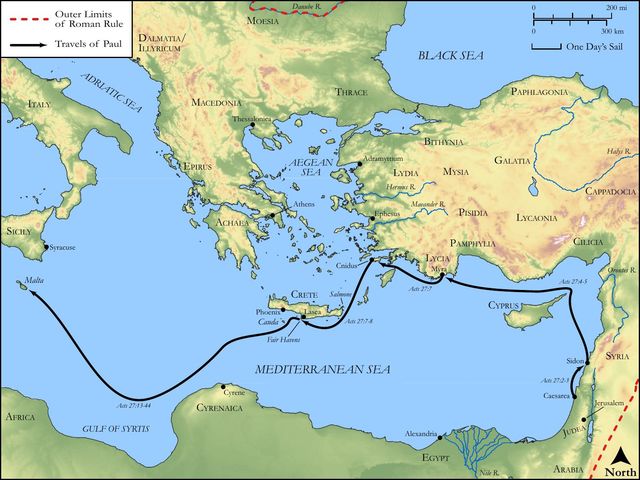
2.What bottom he embarked in: they went on board a ship of Adramyttium (Act 27:2), a sea-port of Africa, whence this ship brought African goods, and, as it should seem, made a coasting voyage for Syria, where those goods came to a good market.
3.What company he had in this voyage, there were some prisoners who were committed to the custody of the same centurion, and who probably had appealed to Caesar too, or were upon some other account removed to Rome, to be tried there, or to be examined as witnesses against some prisoners there; perhaps some notorious offenders, like Barabbas, who were therefore ordered to be brought before the emperor himself. Paul was linked with these, as Christ with the thieves that were crucified with him, and was obliged to take his lot with them in this voyage; and we find in this chapter (Act 27:42) that for their sakes he had like to have been killed, but for his sake they were preserved. Note, It is no new thing for the innocent to be numbered among the transgressors. But he had also some of his friends with him, Luke particularly, the penman of this book, for he puts himself in all along, We sailed into Italy, and, We launched, v. 2. Aristarchus a Thessalonian is particularly named, as being now in his company. Dr. Lightfoot thinks that Trophimus the Ephesian went off with him, but that he left him sick at Miletum (Ti2 4:20), when he passed by those coasts of Asia mentioned here (v. 2), and that there likewise he left Timothy. It was a comfort to Paul to have the society of some of his friends in this tedious voyage, with whom he might converse freely, though he had so much loose profane company about him. Those that go long voyages at sea are commonly necessitated to sojourn, as it were, in Mesech and Kedar, and have need of wisdom, that they may do good to the bad company they are in, may make them better, or at lest be made never the worse by them.
II.What course they steered, and what places they touched at, which are particularly recorded for the confirming of the truth of the history to those who lived at that time, and could by their own knowledge tell of their being at such and such a place.
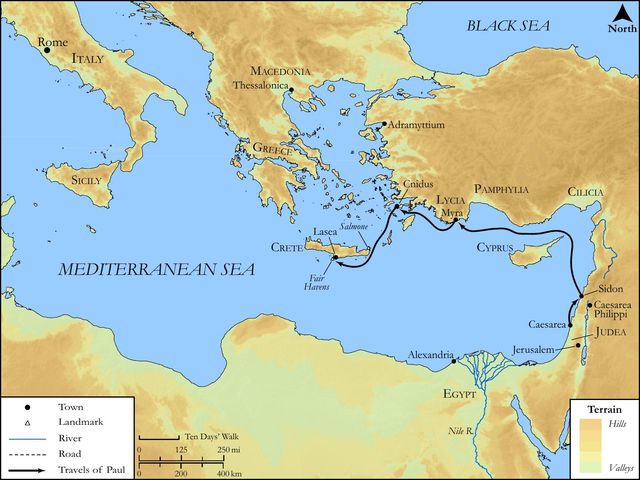
1.They touched at Sidon, not far off from where they went on board; thither they came the next day. And that which is observable here is, that Julius the centurion was extraordinarily civil to Paul. It is probable that he knew his case, and was one of the chief captains, or principal men, that heard him plead his own cause before Agrippa (Act 25:23), and was convinced of his innocency, and the injury done him; and therefore, though Paul was committed to him as a prisoner, he treated him as a friend, as a scholar, as a gentleman, and as a man that had an interest in heaven: He gave him liberty, while the business of the ship detained it at Sidon, to go among his friends there, to refresh himself; and it would be a great refreshment to him. Julius herein gives an example to those in power to be respectful to those whom they find worthy of their respect, and in using their power to make a difference. A Joseph, a Paul, are not to be used as common prisoners. God herein encourages those that suffer for him to trust in him; for he can put it into the hearts of those to befriend them from whom they least expect it - can cause them to be pitied, nay, can cause them to be prized and valued, even in the eyes of those that carry them captive, Psa 106:46. And it is likewise an instance of Paul's fidelity. He did not go about to make his escape, which he might have easily done; but, being out upon his parole of honour, he faithfully returns to his imprisonment. If the centurion is so civil as to take his word, he is so just and honest as to keep his word.
2.They thence sailed under Cyprus, Act 27:4. If the wind had been fair, they had gone forward by direct sailing, and had left Cyprus on the right hand; but, the wind not favouring them, they were driven to oblique sailing with a side wind, and so compassed the island, in a manner, and left it on the left hand. Sailors must do as they can, when they cannot do as they would, and make the best of their wind, whatever point it is in; so must we all in our passage over the ocean of this world. When the winds are contrary yet we must be getting forward as well as we can.
3.At a port called Myra they changed their ship; that which they were in, it is probable, having business no further, they went on board a vessel of Alexandria bound for Italy, Act 27:5, Act 27:6. Alexandria was now the chief city of Egypt, and great trading there was between that city and Italy; from Alexandria they carried corn to Rome, and the East-India goods and Persian which they imported at the Red Sea they exported again to all parts of the Mediterranean, and especially to Italy. And it was a particular favour shown to the Alexandrian ships in the ports of Italy that they were not obliged to strike sail, as other ships were, when they came into port.
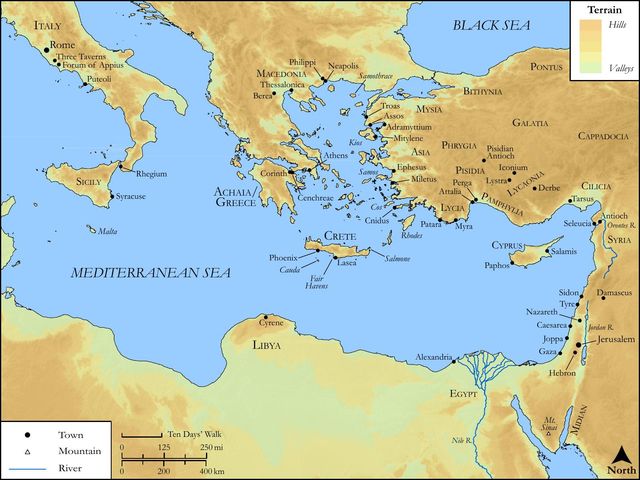
4.With much ado they made The Fair Havens, a port of the island of Crete, Act 27:7, Act 27:8. They sailed slowly many days, being becalmed, or having the wind against them. It was a great while before they made the point of Cnidus, a port of Caria, and were forced to sail under Crete, as before under Cyprus; much difficulty they met with in passing by Salmone, a promontory on the eastern shore of the island of Crete. Though the voyage hitherto was not tempestuous, yet it was very tedious. They many that are not driven backward in their affairs by cross providences, yet sail slowly, and do not get forward by favourable providences. And many good Christians make this complaint in the concerns of their souls, that they do not rid ground in their way of heaven, but have much ado to keep their ground; they move with many stops and pauses, and lie a great while wind-bound. Observe, The place they came to was called The Fair Havens. Travellers say that it is known to this day by the same name, and that it answers the name from the pleasantness of its situation and prospect. And yet,
(1.)It was not the harbour they were bound for; it was a fair haven, but it was not their haven. Whatever agreeable circumstances we may be in in this world, we must remember we are not at home, and therefore we must arise and depart; for, though it be a fair haven, it is not the desired haven, Psa 107:30.
(2.)It was not a commodious haven to winter in, so it is said, Act 27:12. It had a fine prospect, but it lay exposed to the weather. Note, Every fair haven is not a safe haven; nay, there may be most danger where there is most pleasure.
III.What advice Paul gave them with reference to that part of their voyage they had before them - it was to be content to winter where they were, and not to think of stirring till a better season of the year.
1.It was now a bad time for sailing; they had lost a deal of time while they were struggling with contrary winds. Sailing was now dangerous, because the fast was already past, that is, the famous yearly fast of the Jews, the day of atonement, which was on the tenth day of the seventh month, a day to afflict the soul with fasting; it was about the 20th of our September. That yearly fast was very religiously observed; but (which is strange) we never have any mention made in all the scripture history of the observance of it, unless it be meant here, where it serves only to describe the season of the year. Michaelmas is reckoned by mariners as a bad time of the year to be at sea as any other; they complain of their Michaelmas-blasts; it was that time now with these distressed voyagers. The harvest was past, the summer was ended; they had not only lost time, but lost the opportunity.
2.Paul put them in mind of it, and gave them notice of their danger (Act 27:10): "I perceive" (either by notice from God, or by observing their wilful resolution to prosecute the voyage notwithstanding the peril of the season) "that this voyage will be with hurt and damage; you that have effects on board are likely to lose them, and it will be a miracle of mercy if our lives be given us for a prey." There were some good men in the ship, and many more bad men: but in things of this nature all things come alike to all, and there is one event to the righteous and to the wicked. If both be in the same ship, they both are in the same danger.
3.They would not be advised by Paul in this matter, Act 27:11. They thought him impertinent in interposing in an affair of this nature, who did not understand navigation; and the centurion to whom it was referred to determine it, though himself a passenger, yet, being a man in authority, takes upon him to overrule, though he had not been oftener at sea perhaps than Paul, nor was better acquainted with these seas, for Paul had planted the gospel in Crete (Tit 1:5), and knew the several parts of the island well enough. But the centurion gave more regard to the opinion of the master and owner of the ship than to Paul's; for every man is to be credited in his own profession ordinarily: but such a man as Paul, who was so intimate with Heaven, was rather to be regarded in seafaring matters than the most celebrated sailors. Note, Those know not what dangers they run themselves into who will be governed more by human prudence than by divine revelation. The centurion was very civil to Paul (Act 27:3), and yet would not be governed by his advice. Note, Many will show respect to good ministers that will not take their advice, Eze 33:31.
Historical interpretation
Four Centuries of Reception
12 surviving comments on this passage. Each one is dated, so this reads as a timeline rather than a list.
Select a marker to jump to its quote. Markers stagger vertically where authors wrote within a few decades of each other.
But after Paul, in consequence of his appeal to Caesar, had been sent to Rome by Festus, the Jews, being frustrated in their hope of entrapping him by the snares that they had laid for him, turned against James, the brother of the Lord, to whom the episcopal seat at Jerusalem had been entrusted by the apostles. The following daring measures were undertaken by them against him. Leading him into their midst they demanded of him that he should renounce faith in Christ in the presence of all the people. But, contrary to the opinion of all, with a clear voice and with greater boldness than they had anticipated, [James] spoke out before the whole multitude and confessed that our Savior and Lord Jesus is the Son of God. But they were unable to bear longer the testimony of the man who, on account of the excellence of ascetic virtue and of piety that he exhibited in his life, was esteemed by all as the most just of people, and consequently they killed him. Opportunity for this deed of violence was furnished by the prevailing anarchy, which was caused by the fact that Festus had died just at this time in Judea and that the province was thus without a governor and head. The manner of James’ death has been already indicated by the above-quoted words of Clement, who records that he was thrown from the pinnacle of the temple and was beaten to death with a club.
"A ship of Alexandria," it says. It is likely that both those in the former ship would bear to Asia the report of what had befallen Paul, and that these would do the same in Lycia. See how God does not innovate or change the order of nature, but suffers them to sail into the unfavorable winds. But even so the miracle is wrought. That they may sail safely, He did not let them go out in the open sea, but they always sailed near the land.
See how God does not innovate or change the order of nature, but suffers them to sail into the unfavorable winds. But even so the miracle is wrought. That they may sail safely, He did not let them go out in the open sea, but they always sailed near the land.
Again trials, again contrary winds. See how the life of the saints is so composed of all these things: he escaped the court, and they fall into a shipwreck and a storm.
See how far Aristarchus also accompanies Paul. To good and useful purpose is Aristarchus present, as he would take back the report of all to Macedonia.
Aristarchus accompanies Paul for a while. He is fittingly and usefully present with the intention of reporting everything concerning him in Macedonia.