


Numbers 31:44
Bible text: King James Version (1769 Blayney text) · Public domain
Bible text: American Standard Version (1901) · Public domain
Bible text: World English Bible, Messianic edition · Public domain
Bible text: Geneva Bible (1599) · Public domain
Bible text: Young's Literal Translation · Public domain
- וּבָקָרu·va·Karand cattleH1241Conj-w ¦ N-csNoun Singular common gender Absoluteוּandבָקָרcattle
- שִׁשָּׁהshi·ShahsixH8337Adj-csAdjective Numerical Singular common gender Absolute
- וּשְׁלֹשִׁיםu·she·lo·Shimand thirtyH7970Conj-w ¦ Adj-mpAdjective Numerical Plural Masculine Absoluteוּandשְׁלֹשִׁיםthirty
- אָלֶף'A·lefthousandH505Adj-csAdjective Numerical Singular common gender Absolute
English is a literal word-by-word gloss of the Hebrew, not the KJV's wording. Why?
This is the original text the KJV's translators worked from — each Hebrew word with its own literal English meaning in this verse, prepared by scholars at Tyndale House, Cambridge. The KJV translates whole sentences, not word by word, so its wording differs: one Hebrew word can become several English words, and the KJV may choose “the LORD” where the gloss reads “Yahweh”. Both are faithful — they answer different questions. For the KJV's own rendering, switch to the KJV text.
Details
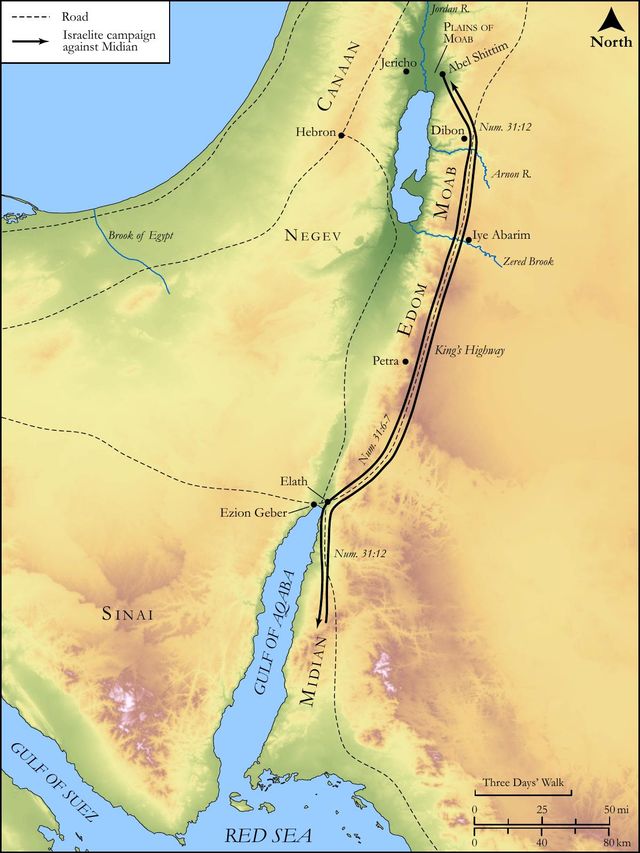
See on the biblical-era map
Study this verse
Continue studying Numbers 31:44 across the web’s major study libraries — every link below opens this exact verse, chapter, or book on the destination site.
Read & Compare
 BibleGatewayThis verse in more than 200 translations and 70 languages.
 Bible.comThe YouVersion reader — hundreds of translations, reading plans, and highlights.
 ESV.orgCrossway's official English Standard Version reader.
 NET BibleThe NET translation with 60,000+ translators' notes on every rendering decision.
 STEP BibleTyndale House's free study tool — original text, vocabulary, and scholarly resources.
 BibliaLogos Bible Software's free web reader.
 USCCBThe New American Bible (Revised Edition) with the U.S. bishops' study notes.
Commentaries
 BibleHub CommentariesDozens of classic commentaries on this verse, gathered on one page.
 StudyLightMore than 100 commentary sets — the largest collection on the web.
 BibleRefPlain-English commentary on what this verse means, verse by verse.
 Enduring WordDavid Guzik's free commentary on this chapter, widely used by Bible teachers.
 Bible Study ToolsVerse commentary alongside Greek and Hebrew study aids.
Original Language & Research
- BibleHub InterlinearThe verse word by word — original language, transliteration, and English.
- BibleHub LexiconEvery word's original-language definition and Strong's entry.
 Blue Letter BibleDeep-study tools — Strong's numbers, concordance, and word studies.
 SefariaThe Hebrew text with Rashi and centuries of Jewish commentary.
Sermons, Hymns & Audio


TrulyRandomVerse is not affiliated with these sites and doesn’t control their content. They’re linked because they’re genuinely useful.
Summary
Numbers 31:44, stating "And thirty and six thousand beeves," provides a precise numerical detail within the meticulous inventory of spoils acquired from the Midianites after Israel's divinely commanded punitive war. This seemingly simple entry underscores the immense scale of the victory, God's abundant and comprehensive provision for His people, and the rigorous accountability and order observed in handling resources acquired through divine judgment, all set against the backdrop of Israel's journey toward the Promised Land and the severe consequences of idolatry and rebellion against God.
Context
ShowHideLiterary Context
Numbers 31:44 is intricately woven into the highly detailed account of the war against Midian. The chapter begins with the divine command for vengeance against Midian, followed by the successful execution of the campaign and the return of the victorious Israelite army with captives and vast plunder, as recounted in Numbers 31:1-12. Following this, the narrative shifts to the necessary purification rituals for the returning warriors and the spoils, a process detailed in Numbers 31:19-24. Verse 44 specifically falls within the extensive section outlining the precise division of the enormous plunder, which spans from Numbers 31:25-47. This section meticulously details the allocation: one portion for the warriors, from which a tribute was given to the Lord, and a larger portion for the congregation, from which a tribute was also given to the Levites. The enumeration of "beeves" is part of the congregation's share, emphasizing the thoroughness, orderliness, and divine oversight of this entire process.
Historical & Cultural Context
The war against Midian was not a typical territorial conflict but a direct, divinely mandated act of judgment. Its impetus stemmed from Midian's pivotal role in luring Israel into idolatry and sexual immorality at Baal-peor, an incident vividly recounted in Numbers 25. This was a "holy war" (חֵרֶם, ḥerem), executed as a righteous judgment against a people who had actively sought to corrupt and undermine Israel's covenant relationship with God. Among the nations, the acquisition of spoils was a customary outcome of warfare. However, in this instance, the meticulous accounting and specific divine instructions for their distribution elevate the event beyond mere material gain, underscoring God's absolute sovereignty even over the material gains of war. Cattle, or "beeves," represented a primary form of wealth, sustenance, and sacrificial offering in this agrarian society, making their quantity a profound indicator of prosperity, provision, and the comprehensive nature of the victory.
Key Themes
ShowHideThe inclusion of Numbers 31:44 within the broader narrative powerfully illuminates several crucial theological themes. Firstly, it underscores Divine Justice and Retribution, demonstrating God's unwavering resolve to judge those who lead His people astray and actively oppose His covenant, as evidenced by the severe judgment against Midian. Secondly, the immense quantity of spoils, including the 36,000 beeves, exemplifies God's Abundant Provision for His people, even in the midst of executing judgment and war. This provision ensured their material needs were abundantly met in the wilderness, a recurring theme throughout their wilderness wanderings, as seen in passages detailing the provision of manna and quail in Exodus 16. Finally, the meticulous enumeration and precise division of the spoils highlight Order, Accountability, and Obedience to God's commands. It reinforces that even in the aftermath of battle, God's people were to operate with precision, integrity, and adherence to divine law, reflecting His character and the importance of covenant faithfulness, a principle echoed throughout the Pentateuch, for instance, in the laws concerning worship and offerings found in Deuteronomy 12.
Exposition and Analysis
ShowHideKey Word Analysis
ShowHideThis numerical term (H7970) signifies the quantity of three tens. In the context of Numbers 31:44, its presence, combined with "six," forms the large number "thirty and six thousand," indicating a vast quantity. The precision of this number highlights the meticulous nature of the inventory and the comprehensive scale of the spoils taken from Midian, underscoring the magnitude of God's provision and the thoroughness of the Israelite operation.
Derived from a root related to the ox's head (the first letter of the alphabet, eventually used as a numeral), this term (H505) signifies a large numerical unit. Here, it multiplies "thirty and six," resulting in an exceptionally large figure of 36,000. The use of "thousand" emphasizes the overwhelming abundance of the acquired cattle, reinforcing the idea of God's lavish provision and the completeness of the victory over Midian.
This archaic English term (H1241) refers to bovine animals, encompassing both oxen and cows, or more generally, cattle. The Hebrew word בָּקָר (bāqâr) is a common and broad term for cattle, often used collectively. In ancient Israel, cattle were a vital resource, serving as a primary source of meat, milk, hides, and labor for agriculture. Their inclusion in the spoils of war signifies not only a substantial acquisition of wealth but also a significant increase in the community's capacity for sustenance and sacrificial offerings, underscoring the practical, economic, and religious importance of this particular type of livestock.
Verse Breakdown
ShowHide"And thirty and six thousand beeves,"
This concise phrase presents a precise numerical count of a specific category of spoils: cattle. The opening conjunction "And" links this item to the preceding and following enumerated items in the comprehensive inventory, emphasizing its place within a meticulously recorded list. The exact figure, "thirty and six thousand," highlights the vastness of the plunder and the administrative precision involved in its accounting. This detail is not merely incidental but serves to convey the immense scale of God's provision for His people and the thoroughness of the divinely commanded operation, ensuring that every aspect of the victory and its proceeds was carefully managed and recorded according to divine instruction. The specificity of the number underscores the reality and tangible nature of the spoils.
Literary Devices
ShowHideThe primary literary device at play in Numbers 31:44, and indeed throughout the inventory section of Numbers 31, is Enumeration. The text systematically lists the precise quantities of various items taken as spoils of war (e.g., sheep, donkeys, human captives, and various metals). This detailed enumeration serves to emphasize the completeness of the victory and the vastness of the resources acquired. Beyond simple listing, the sheer scale of the numbers (e.g., 675,000 sheep, 72,000 cattle, 61,000 donkeys, 32,000 human captives, and immense quantities of precious metals) also creates a sense of Amplification, underscoring the overwhelming success of the campaign and the abundant provision of God. While not strictly hyperbole, the numbers are certainly amplified to impress upon the reader the magnitude of the divine blessing. The meticulousness of the count itself also functions as a form of Symbolism, representing God's divine order, His attention to detail, and the profound importance of accountability and stewardship within the covenant community.
Theological and Thematic Connections
ShowHideNumbers 31:44, though a simple numerical entry, is deeply embedded in the theological narrative of divine justice, provision, and covenant faithfulness. The war against Midian was not for territorial gain but as a direct judgment for their role in the Baal-peor incident, which threatened the very existence of Israel as a holy nation. The immense spoils, including the 36,000 beeves, serve as tangible evidence of God's comprehensive victory over His enemies and His abundant provision for His people even in the midst of executing judgment. This demonstrates that God is both a righteous judge who punishes sin and a faithful provider who cares for the material needs of His covenant people. The meticulous accounting further underscores the principle that all things, even the spoils of war, belong to the Lord and must be handled according to His precise instructions, highlighting the importance of obedience and stewardship within the community.
Reflection and Application
ShowHideWhile the context of Numbers 31:44 is a specific historical event of divinely commanded warfare and judgment, its underlying principles offer profound insights for contemporary believers. The meticulous accounting of the spoils, including the 36,000 beeves, reminds us of God's incredible attention to detail and His sovereign control over all circumstances, even those as chaotic as war. It encourages us to recognize that God is a God of order, and that His provision for us is often far beyond what we might expect or imagine, demonstrating His boundless generosity. This passage challenges us to consider our own stewardship of the resources God entrusts to us, whether material wealth, spiritual gifts, talents, or time, recognizing that all we have ultimately belongs to Him and is to be managed according to His will. Furthermore, it subtly points to the comprehensive nature of God's justice against sin, reminding us that while His mercy is vast and freely offered through Christ, His holiness demands a response to rebellion and that sin carries severe consequences.
Questions for Reflection
ShowHideFAQ
ShowHideWhy is such a specific number of "beeves" mentioned in the Bible?
ShowHideThe mention of "thirty and six thousand beeves" in Numbers 31:44 is part of a highly detailed and meticulous inventory of the spoils taken from the Midianites. This precision serves several important purposes. Firstly, it underscores the vastness of God's provision for Israel, demonstrating His ability to supply their needs abundantly, even through the context of war and judgment. Secondly, it highlights the administrative order and accountability within the Israelite community, reflecting God's character as a God of order and precision. The careful counting and division of spoils were not arbitrary but followed specific divine instructions, ensuring fairness and proper allocation, including a portion set aside for the Lord and the Levites (as seen in the detailed instructions in Numbers 31:25-47). This level of detail reinforces the historical veracity of the account and emphasizes the importance of every aspect of the divine command being meticulously fulfilled.
What was the significance of "beeves" (cattle) to the ancient Israelites?
ShowHideCattle, or "beeves," were incredibly significant to the ancient Israelites, serving as a cornerstone of their economy, diet, and religious practices. As an agrarian society, cattle provided essential labor for plowing, threshing, and other agricultural tasks. They were a primary source of meat and milk for sustenance, and their hides were used for clothing, tents, and other goods. Furthermore, cattle played a crucial role in the sacrificial system mandated by the Mosaic Law. Many of the prescribed offerings, such as burnt offerings, peace offerings, and sin offerings, required the sacrifice of cattle (e.g., the detailed instructions for offerings in Leviticus 1:3-9). Therefore, the acquisition of 36,000 beeves was not merely a matter of material wealth but also a substantial increase in resources vital for their daily life, their economic stability, and their worship of God.
How does this passage relate to God's justice and judgment?
ShowHideNumbers 31:44, while a simple numerical detail, is inextricably linked to the profound theme of God's justice and judgment. The war against Midian was not a conquest for land or resources in the typical sense, but a divinely commanded act of retribution for Midian's direct role in luring Israel into idolatry and immorality at Baal-peor, as vividly described in Numbers 25. This was a "holy war" (חֵרֶm, ḥerem), where the spoils, including the beeves, were a tangible consequence of God's righteous judgment against a people who had actively sought to corrupt and destroy His covenant nation. The immense scale of the spoils reflects the completeness and thoroughness of this judgment. It serves as a stark reminder that God is holy and righteous, and while His mercy is vast and freely offered, He will not tolerate persistent rebellion and sin that seeks to undermine His people and His covenant. This act of judgment underscores the seriousness of sin and the unwavering nature of God's justice.
Christ-Centered Fulfillment
ShowHideNumbers 31:44, detailing the abundant spoils of war, including 36,000 beeves, finds its ultimate Christ-centered fulfillment not in material gain, but in the spiritual victory and lavish provision secured by Jesus Christ. The war against Midian was a physical battle against an enemy that sought to corrupt God's people; Christ's work on the cross was the decisive spiritual battle against sin, death, and the devil, the true enemies of humanity, as described in Colossians 2:15. Just as the Israelites received immense spoils from their victory, believers in Christ receive the immeasurable "spoils" of His triumph: forgiveness of sins, eternal life, the indwelling Holy Spirit, and every spiritual blessing in the heavenly places, as profoundly articulated in Ephesians 1:3-14. The meticulous accounting of the beeves and other spoils foreshadows the perfect and complete work of Christ, who meticulously fulfilled every requirement of the law and secured a perfect redemption for all who believe, as highlighted in Matthew 5:17. Furthermore, just as the beeves provided sustenance and were used for sacrifices, Christ Himself is the ultimate and perfect sacrifice, the Lamb of God who takes away the sin of the world, providing eternal spiritual nourishment and making all further animal sacrifices obsolete through His once-for-all offering (Hebrews 10:10-14). His victory provides us with an inheritance far richer and more enduring than any earthly spoils, an inheritance kept in heaven for us by God's power (1 Peter 1:3-5).