


Numbers 31:43
Bible text: King James Version (1769 Blayney text) · Public domain
Bible text: King James Version with Strong's numbers · Public domain
Bible text: Berean Standard Bible · Public domain
Bible text: American Standard Version (1901) · Public domain
Bible text: World English Bible, Messianic edition · Public domain
Bible text: Geneva Bible (1599) · Public domain
Bible text: Young's Literal Translation · Public domain
- וַתְּהִיva·te·Hiand it wasH1961Conj-w ¦ V-Qal-ConsecImperf-3fsVerb Qal Consecutive Imperfect 3rd Singular Feminineוַandתְּהִיit was
- מֶחֱצַתme·che·Tzat[the] half ofH4275N-fscNoun Singular Feminine Construct
- הָעֵדָהha·'e·Dahthe congregationH5712Art ¦ N-fsNoun Singular Feminine Absoluteהָtheעֵדָהcongregation
- מִןminfromH4480PrepPreposition
- הַצֹּאןha·Tzonthe sheepH6629Art ¦ N-csNoun Singular common gender Absoluteהַtheצֹּאןsheep
- שְׁלֹשׁshe·loshthreeH7969Adj-cscAdjective Numerical Singular common gender Construct
- מֵאוֹתme·'othundred<s>H3967Adj-fpAdjective Numerical Plural Feminine Absolute
- אֶלֶף'e·lefthousandH505Adj-csAdjective Numerical Singular common gender Absolute
- וּשְׁלֹשִׁיםu·she·lo·Shimand thirtyH7970Conj-w ¦ Adj-mpAdjective Numerical Plural Masculine Absoluteוּandשְׁלֹשִׁיםthirty
- אֶלֶף'E·lefthousandH505Adj-csAdjective Numerical Singular common gender Absolute
- שִׁבְעַתshiv·'AtsevenH7651Adj-cscAdjective Numerical Singular common gender Construct
- אֲלָפִים'a·la·Fimthousand<s>H505Adj-cpAdjective Numerical Plural common gender Absolute
- וַחֲמֵשׁva·cha·Meshand fiveH2568Conj-w ¦ Adj-cscAdjective Numerical Singular common gender Constructוַandחֲמֵשׁfive
- מֵאוֹתme·'othundred<s>H3967Adj-fpAdjective Numerical Plural Feminine Absolute
English is a literal word-by-word gloss of the Hebrew, not the KJV's wording. Why?
This is the original text the KJV's translators worked from — each Hebrew word with its own literal English meaning in this verse, prepared by scholars at Tyndale House, Cambridge. The KJV translates whole sentences, not word by word, so its wording differs: one Hebrew word can become several English words, and the KJV may choose “the LORD” where the gloss reads “Yahweh”. Both are faithful — they answer different questions. For the KJV's own rendering, switch to the KJV text.
Details
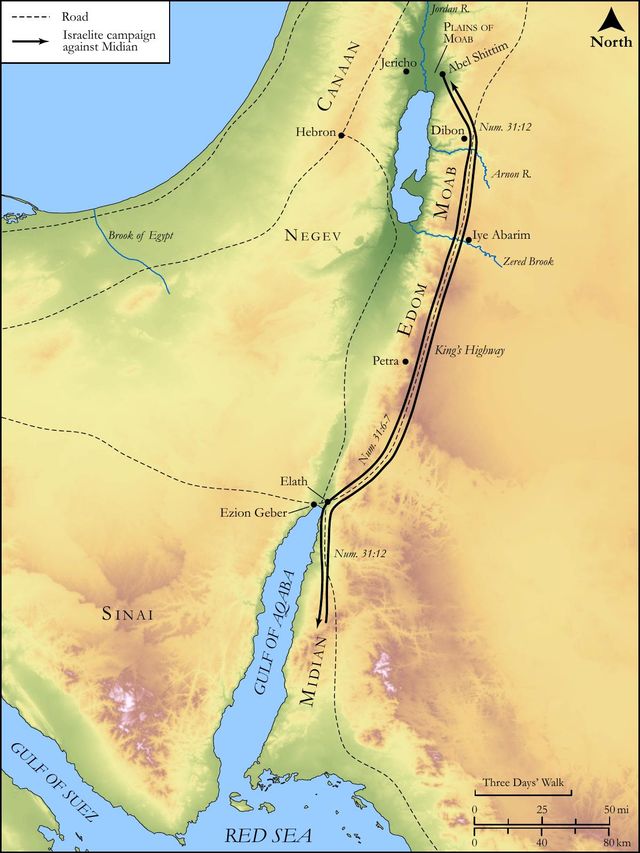
See on the biblical-era map
Study this verse
Continue studying Numbers 31:43 across the web’s major study libraries — every link below opens this exact verse, chapter, or book on the destination site.
Read & Compare
 BibleGatewayThis verse in more than 200 translations and 70 languages.
 Bible.comThe YouVersion reader — hundreds of translations, reading plans, and highlights.
 ESV.orgCrossway's official English Standard Version reader.
 NET BibleThe NET translation with 60,000+ translators' notes on every rendering decision.
 STEP BibleTyndale House's free study tool — original text, vocabulary, and scholarly resources.
 BibliaLogos Bible Software's free web reader.
 USCCBThe New American Bible (Revised Edition) with the U.S. bishops' study notes.
Commentaries
 BibleHub CommentariesDozens of classic commentaries on this verse, gathered on one page.
 StudyLightMore than 100 commentary sets — the largest collection on the web.
 BibleRefPlain-English commentary on what this verse means, verse by verse.
 Enduring WordDavid Guzik's free commentary on this chapter, widely used by Bible teachers.
 Bible Study ToolsVerse commentary alongside Greek and Hebrew study aids.
Original Language & Research
- BibleHub InterlinearThe verse word by word — original language, transliteration, and English.
- BibleHub LexiconEvery word's original-language definition and Strong's entry.
 Blue Letter BibleDeep-study tools — Strong's numbers, concordance, and word studies.
 SefariaThe Hebrew text with Rashi and centuries of Jewish commentary.
Sermons, Hymns & Audio


TrulyRandomVerse is not affiliated with these sites and doesn’t control their content. They’re linked because they’re genuinely useful.
Summary
Numbers 31:43 meticulously records the immense quantity of sheep allocated to the congregation of Israel following their divinely commanded victory over the Midianites. This verse, a precise enumeration of 337,500 sheep, highlights God's abundant provision for His people, the meticulous order and accountability demanded in the Mosaic Law, and the tangible results of divine judgment executed through Israel. It underscores the vast material blessing bestowed upon the community, demonstrating God's faithfulness to sustain and enrich His chosen nation in the wilderness.
Context
ShowHideLiterary Context
Numbers 31:43 is situated within the comprehensive account of the war against Midian, which spans the entirety of Numbers 31. The chapter opens with God's explicit command to Moses to execute vengeance against Midian for their role in enticing Israel into idolatry and sexual immorality at Baal-peor, a sin that had brought a devastating plague upon the Israelites (Numbers 31:1-3). Following a decisive victory where Israel miraculously suffered no casualties (Numbers 31:49), Moses, Eleazar the priest, and the tribal leaders oversaw the division of the vast plunder. Numbers 31:25-47 describes the specific instructions for dividing the spoils into two equal halves: one for the warriors who went to battle and one for the rest of the congregation. From each half, a specific tribute was levied for the Lord (from the warriors' share) and for the Levites (from the congregation's share). This particular verse, Numbers 31:43, along with the preceding verses (Numbers 31:36-42), provides the precise inventory of the congregation's half of the livestock, emphasizing the sheer scale of the acquired wealth and the meticulous adherence to divine instruction.
Historical & Cultural Context
The war against Midian was not merely a territorial or economic conflict but a direct act of divine judgment against a people who had actively sought to corrupt God's covenant nation. Midian, along with Moab, had enticed Israel into idolatry and sexual immorality at Baal-peor (Numbers 25:1-9), leading to a devastating plague that killed 24,000 Israelites. Thus, the campaign described in Numbers 31 served as a punitive expedition, demonstrating God's righteous wrath against those who sought to undermine His covenant and lead His people astray. Among the nations at war, the taking of spoils was a common practice, but in Israel, it was often regulated by divine command, ensuring that a portion was dedicated to the Lord and His sanctuary. The meticulous counting and division of the plunder, including vast numbers of sheep, oxen, donkeys, and human captives, reflect the economic realities of a nomadic society where livestock constituted significant wealth and a primary means of sustenance. This also highlights the importance of communal sharing and the structured fair sharing of goods under the leadership of Moses and Eleazar, reinforcing the societal order established by the Mosaic Law.
Key Themes
ShowHideThis verse, within its broader context, contributes to several significant themes. Firstly, it powerfully illustrates Divine Provision and Abundance. The staggering numbers of livestock underscore God's capacity and willingness to provide bountifully for His people, even through the means of warfare and judgment. This echoes themes of God's sustenance throughout the wilderness wanderings, as seen in the miraculous provision of manna and quail (Exodus 16). Secondly, the meticulous enumeration highlights the theme of Order and Accountability. The precise accounting of every animal and item, down to the last sheep, demonstrates the importance of integrity, transparency, and careful stewardship within the Israelite community, reflecting God's own orderly character and His demand for obedience in all matters. This contrasts sharply with chaotic or self-serving distribution, reinforcing the structured nature of the covenant community. Finally, the acquisition of such vast wealth is a direct consequence of God's Justice and Judgment. The spoils are not merely random plunder but the tangible outcome of God's righteous anger against Midian's wickedness, serving as a stark reminder that God punishes sin and vindicates His people. This aligns with broader biblical themes of divine retribution found throughout the Old Testament, such as in God's instructions for conquering the wicked nations of Canaan (Deuteronomy 7:1-2).
Exposition and Analysis
ShowHideKey Word Analysis
ShowHideFrom the root meaning "to halve," this term signifies a precise division into two equal portions. In the context of Numbers 31, it underscores the equitable distribution of the spoils between the warriors who risked their lives in battle and the rest of the congregation who supported them and maintained the camp. This division was not arbitrary but mandated by God through Moses (Numbers 31:27). The concept of "half" here emphasizes fairness, communal responsibility, and the structured nature of Israelite society under divine law, ensuring that all members of the community benefited from God's provision and victory.
This refers to the entire community of Israel, specifically the non-combatant segment, excluding the 12,000 warriors who went to battle. It highlights that the blessings and spoils of God's victory were not confined to the military elite but extended to the entire body of God's people. This collective benefit reinforces the covenantal nature of Israel, where the actions and blessings (or curses) of a portion of the community could impact the whole. The congregation's share was significant, demonstrating God's comprehensive care for the welfare of all His people, including the non-combatants, women, and children, ensuring their sustenance and prosperity.
This collective noun refers to a flock of sheep or goats, representing a primary form of wealth and sustenance in the days of the patriarchs and of Moses, especially for nomadic or semi-nomadic peoples like Israel in the wilderness. They provided meat, milk, wool, and sacrificial animals, making their acquisition a significant economic asset. The sheer number—337,500—represents an enormous economic boon, capable of sustaining the vast Israelite population for an extended period. This abundance of sheep underscores the magnitude of God's provision and the complete despoiling of Midian, signifying their utter defeat and the transfer of their wealth to Israel as a sign of divine favor and judgment.
Verse Breakdown
ShowHide"(Now the half [that pertained unto] the congregation"
This opening phrase clearly identifies the recipient of this specific portion of the spoils: the non-combatant segment of the Israelite community. It emphasizes the structured and equitable distribution mandated by God, where the entire nation, not just the warriors, benefited from the victory. This highlights God's comprehensive care for His people, ensuring that the blessings of the conquest were shared communally and systematically.
"was three hundred thousand and thirty thousand [and] seven thousand and five hundred sheep,"
This clause provides the precise numerical count of the sheep allocated to the congregation. The breakdown of the numbers (300,000 + 30,000 + 7,000 + 500) totals 337,500. This meticulous enumeration underscores the historical accuracy and detailed record-keeping characteristic of the Book of Numbers. It also serves to impress upon the reader the sheer scale of the plunder, signifying the completeness of God's victory over Midian and the immense material blessing bestowed upon Israel, demonstrating the tangible results of divine judgment and faithfulness.
Literary Devices
ShowHideThe primary literary device at play in Numbers 31:43 is Enumeration. The verse precisely lists the numerical quantity of sheep, emphasizing the meticulous accounting and the vastness of the spoils. This detailed counting is characteristic of the Book of Numbers, which often records censuses, offerings, and divisions of resources, lending an air of historicity and factual reporting to the narrative. The sheer scale of the numbers also creates a sense of Emphasis on the magnitude of God's provision and the completeness of the victory. While not strictly hyperbole, the quantity itself is so immense that it underscores the extraordinary nature of the divine blessing. Furthermore, the repetition of the numerical structure ("hundred thousand," "thirty thousand," "seven thousand") contributes to a rhythmic quality that reinforces the overwhelming abundance, imbuing the factual report with a sense of awe at God's lavish provision.
Theological and Thematic Connections
ShowHideNumbers 31:43, with its precise accounting of vast spoils, powerfully illustrates God's abundant provision for His people and the tangible results of His justice. This divine generosity, flowing from a righteous judgment against Midian's wickedness, reveals a God who not only punishes evil but also richly blesses those in covenant with Him. The meticulous division underscores the biblical principle of stewardship and accountability, where blessings are received not for selfish accumulation but for communal benefit and the advancement of God's purposes. The wealth acquired through this divinely sanctioned war was intended to sustain the nation, support the tabernacle service, and provide for the Levites, reinforcing the idea that all resources ultimately belong to God and are to be managed according to His will and for His glory.
Reflection and Application
ShowHideThe meticulous accounting of the spoils in Numbers 31:43, particularly the vast number of sheep, invites us to reflect on the nature of God's provision and our response to it. This was not a chaotic taking of plunder, but an orderly distribution, highlighting God's value for structure, fairness, and accountability within His community. For believers today, this passage serves as a powerful reminder that God is the ultimate provider, capable of supplying our needs beyond measure, often through unexpected means and in the aftermath of His righteous judgments. It challenges us to consider how we handle the resources—material, spiritual, and relational—that God entrusts to us. Are we meticulous in our stewardship, recognizing that all we have comes from Him and is to be used for His purposes? Do we share generously, reflecting the communal spirit evident in Israel's division of spoils, ensuring that the blessings are distributed for the good of the whole body? Furthermore, understanding the context of divine judgment reminds us that God's blessings often follow His righteous acts, and our prosperity is often tied to our obedience and His sovereign will, calling us to live in alignment with His character and commands.
Questions for Reflection
ShowHideFAQ
ShowHideWhy are the numbers of the spoils so precisely detailed in Numbers 31?
ShowHideThe precise detailing of the spoils, as seen in Numbers 31:43 and the surrounding verses, serves several crucial purposes. Firstly, it underscores the historicity and factual accuracy of the biblical account, characteristic of the Book of Numbers, which frequently includes censuses, inventories, and detailed regulations. This meticulous record-keeping lends credibility to the narrative as a historical document. Secondly, it emphasizes the magnitude of God's provision and the completeness of the victory over Midian. The sheer volume of livestock and other goods demonstrates God's abundant blessing upon Israel, signifying a comprehensive transfer of wealth. Thirdly, it highlights the importance of order, accountability, and fair distribution within the Israelite community, as divinely mandated. Every item was counted and divided according to specific instructions (Numbers 31:27), ensuring transparency, preventing disputes, and reinforcing the structured nature of the covenant community under God's law. This precision reflects God's own orderly character.
What was the purpose of dividing the spoils between the warriors and the congregation?
ShowHideThe division of spoils into two halves—one for the warriors who fought and one for the rest of the congregation—as detailed in Numbers 31:27, was a divinely ordained principle of communal sharing and recognition. The warriors were directly involved in the dangerous combat, and their share acknowledged their sacrifice, effort, and the risks they undertook. However, the congregation, though not on the battlefield, played a vital role in supporting the nation, maintaining the camp, and praying for the success of the mission. This equitable distribution ensured that the entire community benefited from God's victory, fostering unity and demonstrating that the blessings of the covenant were for all of Israel, not just a select few. It also established a precedent for how future spoils of war would be handled, emphasizing that all of Israel was united in its endeavors and shared in its blessings, reflecting God's care for the welfare of His entire people.
Christ-Centered Fulfillment
ShowHideWhile Numbers 31:43 details a literal division of physical spoils from a war of judgment, it powerfully foreshadows the spiritual spoils of Christ's ultimate victory. Just as God's judgment fell upon Midian for their sin and corruption, so too did God's ultimate judgment fall upon sin itself through the sacrifice of the Lamb of God, Jesus Christ. His death on the cross was a decisive victory over sin, death, and the powers of darkness (Colossians 2:15), disarming them and leading them in triumph. The immense provision of sheep for the congregation in Numbers points to the boundless spiritual blessings and "spoils" that Christ has secured for His church, the new covenant community. Through His victory, believers receive an inheritance that is imperishable, undefiled, and unfading, kept in heaven for them (1 Peter 1:3-4). The meticulous accounting of the sheep, emphasizing God's abundant provision, finds its ultimate fulfillment in Christ, who provides "every spiritual blessing in the heavenly places" (Ephesians 1:3) and promises to supply "all your needs according to his riches in glory in Christ Jesus" (Philippians 4:19). The ordered distribution of the spoils also reflects the order and grace by which Christ distributes His gifts and blessings to His body, the church, for its building up and flourishing, equipping believers for ministry (Ephesians 4:7-12). Thus, the material abundance of Numbers 31:43 serves as a tangible type of the immeasurable spiritual wealth, victory, and provision that is ours in Christ Jesus.