


Numbers 31:42
Bible text: King James Version (1769 Blayney text) · Public domain
Bible text: Berean Standard Bible · Public domain
Bible text: American Standard Version (1901) · Public domain
Bible text: World English Bible, Messianic edition · Public domain
Bible text: Geneva Bible (1599) · Public domain
Bible text: Young's Literal Translation · Public domain
- וּמִמַּחֲצִיתu·mi·ma·cha·Tzitand from [the] half ofH4276Conj-w ¦ Prep-m ¦ N-fscNoun Singular Feminine Constructוּandמִfromמַּחֲצִית[the] half of
- בְּנֵיbe·Nei[the] people ofH1121N-mpcNoun Plural Masculine Construct
- יִשְׂרָאֵלYis·ra·'ElIsraelH3478N-properNoun Proper Location
- אֲשֶׁר'a·SherwhichH834RelParticle Relative
- חָצָהcha·Tzahhe had dividedH2673V-Qal-Perf-3msVerb Qal Perfect 3rd Singular Masculine
- מֹשֶׁהmo·ShehMosesH4872N-proper-mNoun Proper Masculine
- מִןminfromH4480PrepPreposition
- הָאֲנָשִׁיםha·'a·na·Shimthe menH582Art ¦ N-mpNoun Plural Masculine Absoluteהָtheאֲנָשִׁיםmen
- הַצֹּבְאִיםha·tzoe·'Imwho had gone to warH6633Art ¦ V-Qal-Prtcpl-mpVerb Qal Participle Plural Masculine Absoluteהַwhoצֹּבְאִיםhad gone to war
English is a literal word-by-word gloss of the Hebrew, not the KJV's wording. Why?
This is the original text the KJV's translators worked from — each Hebrew word with its own literal English meaning in this verse, prepared by scholars at Tyndale House, Cambridge. The KJV translates whole sentences, not word by word, so its wording differs: one Hebrew word can become several English words, and the KJV may choose “the LORD” where the gloss reads “Yahweh”. Both are faithful — they answer different questions. For the KJV's own rendering, switch to the KJV text.
Details
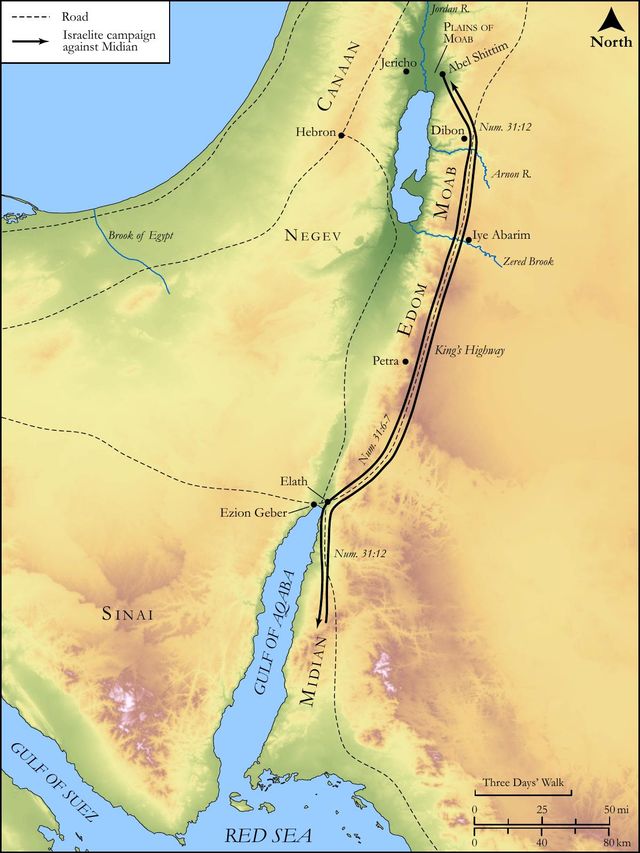
See on the biblical-era map
Study this verse
Continue studying Numbers 31:42 across the web’s major study libraries — every link below opens this exact verse, chapter, or book on the destination site.
Read & Compare
 BibleGatewayThis verse in more than 200 translations and 70 languages.
 Bible.comThe YouVersion reader — hundreds of translations, reading plans, and highlights.
 ESV.orgCrossway's official English Standard Version reader.
 NET BibleThe NET translation with 60,000+ translators' notes on every rendering decision.
 STEP BibleTyndale House's free study tool — original text, vocabulary, and scholarly resources.
 BibliaLogos Bible Software's free web reader.
 USCCBThe New American Bible (Revised Edition) with the U.S. bishops' study notes.
Commentaries
 BibleHub CommentariesDozens of classic commentaries on this verse, gathered on one page.
 StudyLightMore than 100 commentary sets — the largest collection on the web.
 BibleRefPlain-English commentary on what this verse means, verse by verse.
 Enduring WordDavid Guzik's free commentary on this chapter, widely used by Bible teachers.
 Bible Study ToolsVerse commentary alongside Greek and Hebrew study aids.
Original Language & Research
- BibleHub InterlinearThe verse word by word — original language, transliteration, and English.
- BibleHub LexiconEvery word's original-language definition and Strong's entry.
 Blue Letter BibleDeep-study tools — Strong's numbers, concordance, and word studies.
 SefariaThe Hebrew text with Rashi and centuries of Jewish commentary.
Sermons, Hymns & Audio


TrulyRandomVerse is not affiliated with these sites and doesn’t control their content. They’re linked because they’re genuinely useful.
Summary
Numbers 31:42 provides a concise administrative summary of Moses' faithful execution of God's command to divide the vast spoils of war taken from the Midianites. This verse specifically highlights the allocation of the "children of Israel's half," which was the portion designated for the general congregation, distinct from the share given to the combatants, thereby underscoring the communal nature of God's provision and judgment.
Context
ShowHideLiterary Context
Numbers 31:42 is embedded within the detailed account of Israel's punitive war against Midian, as commanded by God in response to the Baal Peor incident. The chapter begins with God's directive for vengeance against Midian for their role in leading Israel into idolatry and immorality (Numbers 25:16-18). Following a decisive military victory and the capture of immense plunder and captives (verses 1-12), Moses expresses displeasure with the warriors for sparing the Midianite women (verses 13-24), leading to further instructions on purification and the handling of the spoils. Verses 25-47 then meticulously detail the divinely ordained process for dividing the captured wealth. Verse 42 serves as a summary statement, preceding the specific inventory of items that constituted the congregation's half (verses 43-47). It emphasizes Moses' direct involvement in executing the divine ordinance, highlighting the communal aspect of the victory and its material benefits, ensuring that the entire nation, not just the soldiers, partook in the outcome of God's judgment.
Historical & Cultural Context
The war against Midian was not a typical territorial conflict but a divinely mandated act of judgment against a people who had actively enticed Israel into grave sin at Peor (Numbers 25:1-9). Among the nations, war spoils were a significant measure of a nation's power and its gods' favor. However, Israel's approach to spoils was unique, governed by specific divine laws. The division of spoils in Numbers 31 follows an extraordinary ordinance given by the Lord to Moses (verses 25-27), stipulating an equal 50/50 split between the warriors and the rest of the congregation. This ensured that the entire community benefited from military success, reflecting the deeply communal and tribal nature of Israelite society. Crucially, specific portions from both halves were designated as tribute to the Lord: from the warriors' half for the priests (Numbers 31:28-29) and from the congregation's half for the Levites (Numbers 31:30). This underscored the theological principle that all blessings flow from God, and a portion is due back to Him for the maintenance of His worship and service.
Key Themes
ShowHideThis brief verse significantly contributes to several overarching themes within the book of Numbers and the broader Pentateuch. Firstly, it exemplifies Divine Justice and Judgment, as the war and its spoils were a direct consequence of God's righteous wrath against Midian's sin. Secondly, it highlights Communal Solidarity and Shared Blessing. The meticulous division ensured that the entire nation, not just the fighting men, partook in the material benefits of the victory, fostering a profound sense of unity and shared destiny under God. This communal sharing is a recurring theme in Israel's wilderness journey, emphasizing their identity as a single covenant people (e.g., Deuteronomy 29:10-15). Thirdly, it underscores Moses' Administrative Authority and Faithful Leadership. As God's appointed mediator and leader, Moses was responsible for overseeing this complex and massive distribution, demonstrating his role as both a spiritual and practical governor of the nation, a theme consistently seen throughout his ministry (e.g., Exodus 18:13-16). Finally, it reinforces the theme of Support for the Tabernacle and its Ministers, as the division was a necessary precursor to the collection of the Lord's tribute for the priests and Levites, ensuring the ongoing operation of Israel's worship system and the sustenance of those dedicated to God's service.
Exposition and Analysis
ShowHideKey Word Analysis
ShowHideThe Hebrew noun מַחֲצִית (machătsîyth) refers to "a halving" or "the middle." In this context, it specifically denotes one of two equal divisions of the total spoil, as stipulated in Numbers 31:27. The repetition of the concept of "half" throughout Numbers 31 (e.g., verses 27, 29, 30, 34, 43) underscores the principle of equitable distribution and the dual beneficiaries—the warriors and the congregation. This term highlights the communal aspect of the victory, ensuring that the entire nation, not just the combatants, received a substantial share of the material blessings.
The Hebrew verb חָצָה (châtsâh) is a primitive root meaning "to cut or split in two" or "to halve." Its use here emphasizes a deliberate, systematic, and precise act of separation. It implies more than a casual splitting; it was an official and careful allocation according to established rules. This highlights Moses' role not as an arbitrary dispenser, but as an administrator faithfully executing a divine ordinance, ensuring that each party received its rightful and legally prescribed share. The meticulousness implied by this word underscores the divine order and justice inherent in the distribution process.
Verse Breakdown
ShowHide"And of the children of Israel's half"
This initial phrase immediately identifies the specific portion of the spoils being discussed. It refers to the 50% of the plunder that was designated for the general Israelite congregation, comprising women, children, and men who did not participate in the fighting. This highlights the principle that the victory was a national one, and its material benefits were to be shared broadly, not exclusively by the warriors. It underscores the communal nature of Israel's identity and the shared blessing that flowed from God's judgment and provision.
"which Moses divided"
This clause explicitly names Moses as the agent of the division. It emphasizes his authoritative role as God's appointed leader and administrator. Moses was not merely a bystander or a recipient, but the one personally overseeing the complex and massive task of separating and distributing the vast amounts of spoil. This highlights his unwavering commitment to executing God's commands precisely and transparently, ensuring that the divine ordinance for distribution was faithfully carried out. His involvement lends legitimacy and divine sanction to the entire process.
"from the men that warred"
This concluding phrase clarifies the source from which the congregation's half was separated. The "men that warred" refers to the 12,000 Israelite soldiers (1,000 from each tribe) who participated in the campaign against Midian. This distinction is crucial, as the other half of the spoil was specifically allotted to these warriors. The phrase underscores the two distinct beneficiaries of the plunder and the clear separation that Moses was tasked with making, ensuring that the two halves were kept separate before the respective tributes to the Lord were exacted from each.
Literary Devices
ShowHideThe primary literary device at play in Numbers 31:42, and indeed throughout the detailed account of spoil distribution in Numbers 31, is Administrative Detail. This is not a verse rich in metaphor or symbolism but rather a precise, factual statement reflecting the meticulous record-keeping and legalistic nature of the Pentateuch. The text employs Precision in its language, clearly delineating "the children of Israel's half" from the portion of "the men that warred." This exactitude serves to emphasize the divine order and the faithful execution of God's commands regarding the fair sharing of goods. Furthermore, the Repetition of the concept of "half" and the detailed enumeration of the spoils in the surrounding verses (32-47) reinforce the thoroughness and intentionality of the process. The verse functions as a concise summary statement within a larger, highly detailed administrative report, reflecting the importance of order, accountability, and the faithful adherence to divine statutes in the life of the Israelite community.
Theological and Thematic Connections
ShowHideNumbers 31:42, in its precise administrative detail, reveals profound theological principles. It demonstrates God's meticulous concern for justice, order, and the equitable provision for His people. The division of spoils was not merely a practical matter but an act of worship and obedience, acknowledging God as the ultimate source of victory and blessing. By ensuring that the entire community benefited, God reinforced the concept of Israel as a unified covenant people, where the success of one part contributes to the well-being of the whole. This divine ordinance also established a clear mechanism for supporting the Tabernacle ministry through the designated tributes, underscoring the principle that a portion of all blessings is due back to the Lord for the sustenance of His work. This administrative act, therefore, serves as a tangible expression of God's covenant faithfulness and His desire for His people to live in order, justice, and communal responsibility, all while acknowledging His sovereignty.
Reflection and Application
ShowHideNumbers 31:42, though rooted in an ancient military context, offers enduring principles for the contemporary believer and the church. It reminds us that blessings and victories, whether spiritual or material, are often communal. Just as the entire Israelite congregation benefited from the warriors' efforts, so too does the body of Christ thrive when individual members contribute their gifts and efforts for the common good. This verse calls us to consider how we, as individuals and as a community, practice fair sharing of goods, responsibilities, and even the "spoils" of spiritual victories (e.g., evangelism, discipleship). It challenges leaders to exercise transparent and just stewardship, ensuring that benefits are shared fairly and that God's work is adequately supported. Ultimately, it invites a posture of gratitude, recognizing that all we have comes from God, and prompts us to consider how we can faithfully contribute to the well-being of our spiritual community and the advancement of God's kingdom.
Questions for Reflection
ShowHideFAQ
ShowHideWhy was the spoil divided into two halves, one for the warriors and one for the congregation?
ShowHideThe division into two equal halves was a specific divine ordinance given by the Lord to Moses in Numbers 31:27. This unique arrangement ensured that the entire nation, not just the combatants, benefited from the victory. It underscored the communal nature of Israel's identity and the shared blessing that flowed from God's judgment and provision. Furthermore, this dual division facilitated the collection of specific tributes: a portion from the warriors' half was given to the priests (Numbers 31:28), and a portion from the congregation's half was given to the Levites (Numbers 31:30), thereby supporting the ongoing service of the Tabernacle and its ministers.
What was Moses' specific role in this division of spoils?
ShowHideAs Numbers 31:42 explicitly states, it was "Moses [who] divided" the spoil. Moses' role was crucial and multifaceted. He was not merely an observer but the direct executor of God's detailed instructions for the distribution. This highlights his administrative and judicial authority as God's appointed leader. His personal involvement ensured the meticulous and transparent adherence to the divine ordinance, demonstrating his faithfulness in stewarding God's provisions for the entire nation. This act was part of his broader responsibility to govern Israel according to God's laws, as seen throughout the Pentateuch (e.g., Exodus 18:13-16).
Does the principle of dividing war spoils apply to Christians today?
ShowHideWhile the specific context of dividing military spoils is unique to ancient Israel under the Old Covenant, the underlying principles resonate with Christian life. We are not called to engage in literal warfare for material gain, but the verse teaches us about stewardship, communal responsibility, and supporting God's work. As believers, we are called to be good stewards of the resources God entrusts to us. The principle of equitable distribution reminds us to care for one another within the body of Christ and to ensure that the blessings and "victories" (e.g., spiritual growth, successful ministry) are shared for the common good. Furthermore, the concept of giving a portion back to God for the support of ministry (the priests and Levites) foreshadows the New Testament principle of supporting those who minister the Gospel (1 Corinthians 9:13-14).
Christ-Centered Fulfillment
ShowHideNumbers 31:42, with its meticulous detail of dividing the spoils of victory and ensuring communal benefit, finds its ultimate and profound fulfillment in Jesus Christ. The "spoils" of the Midianite war, gained through divine judgment, provided material sustenance and supported the Tabernacle. In a far greater sense, Christ's victory on the cross constitutes the ultimate and decisive triumph over sin, death, and the powers of darkness (Colossians 2:15). From this unparalleled victory, Christ, our victorious Captain, distributes the eternal "spoils" to His people: salvation, righteousness, eternal life, and the Holy Spirit. Just as Moses divided the physical plunder for the benefit of all Israel, Christ, as the greater Moses, shares the spiritual riches of His triumph with His entire church. This is beautifully captured in passages like Ephesians 4:8, which speaks of Christ leading captivity captive and giving gifts to men. The communal sharing of the spoils in Numbers foreshadows the unity of the church, where all believers, combatants and non-combatants alike, are co-heirs in Christ, benefiting from His singular, perfect sacrifice and triumph (John 17:22). Furthermore, the portion of the spoils designated for the priests and Levites, supporting the Old Covenant worship, points to Christ as our great High Priest (Hebrews 7:1-3) and the true Temple, whose ongoing ministry is now sustained by the worship and lives of His royal priesthood (1 Peter 2:9), offered in gratitude for the immeasurable spoils of His grace.