


Numbers 31:41
Bible text: King James Version (1769 Blayney text) · Public domain
Bible text: Berean Standard Bible · Public domain
Bible text: American Standard Version (1901) · Public domain
Bible text: World English Bible, Messianic edition · Public domain
Bible text: Geneva Bible (1599) · Public domain
Bible text: Young's Literal Translation · Public domain
- וַיִּתֵּןvai·yi·Tenand he gaveH5414Conj-w ¦ V-Qal-ConsecImperf-3msVerb Qal Consecutive Imperfect 3rd Singular Masculineוַandיִּתֵּןhe gave
- מֹשֶׁהmo·ShehMosesH4872N-proper-mNoun Proper Masculine
- אֶת'et<obj.>H853DirObjMParticle Object Indicator
- מֶכֶסme·khes[the] tax ofH4371N-mscNoun Singular Masculine Construct
- תְּרוּמַתte·ru·Mat[the] contribution ofH8641N-fscNoun Singular Feminine Construct
- יְהוָהYah·wehYahwehH3068N-properNoun Proper Title
- לְאֶלְעָזָרle·'el·'a·Zarto EleazarH499Prep-l ¦ N-proper-mNoun Proper MasculineלְtoאֶלְעָזָרEleazar
- הַכֹּהֵןha·ko·Henthe priestH3548Art ¦ N-msNoun Singular Masculine Absoluteהַtheכֹּהֵןpriest
- כַּאֲשֶׁרka·'a·Sherjust asH834Prep-k ¦ RelParticle Relativeכַּjustאֲשֶׁרas
- צִוָּהtzi·Vahhe had commandedH6680V-Piel-Perf-3msVerb Piel Perfect 3rd Singular Masculine
- יְהוָהYah·wehYahwehH3068N-properNoun Proper Title
- אֶת'et<obj.>H853DirObjMParticle Object Indicator
- מֹשֶׁהmo·ShehMosesH4872N-proper-mNoun Proper Masculine
English is a literal word-by-word gloss of the Hebrew, not the KJV's wording. Why?
This is the original text the KJV's translators worked from — each Hebrew word with its own literal English meaning in this verse, prepared by scholars at Tyndale House, Cambridge. The KJV translates whole sentences, not word by word, so its wording differs: one Hebrew word can become several English words, and the KJV may choose “the LORD” where the gloss reads “Yahweh”. Both are faithful — they answer different questions. For the KJV's own rendering, switch to the KJV text.
Details
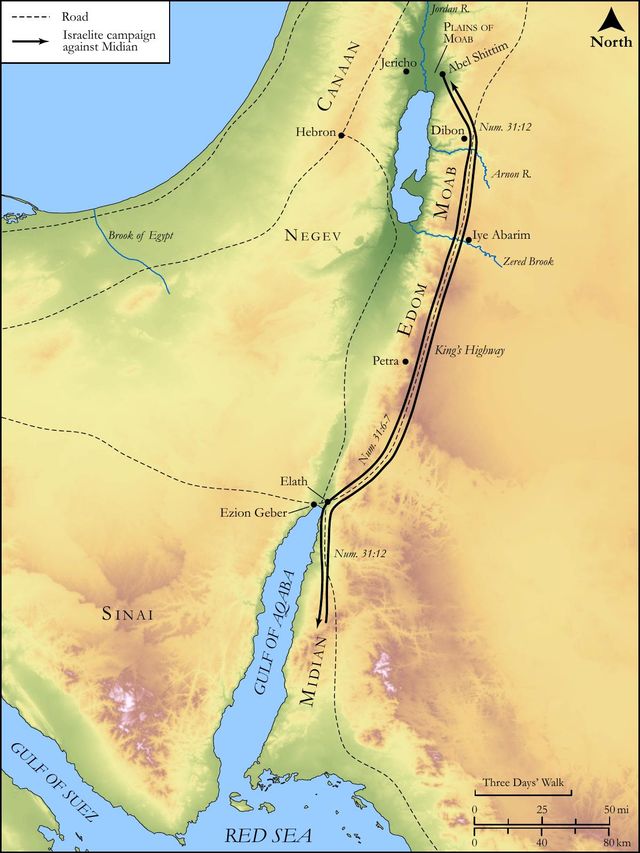
See on the biblical-era map
Study this verse
Continue studying Numbers 31:41 across the web’s major study libraries — every link below opens this exact verse, chapter, or book on the destination site.
Read & Compare
 BibleGatewayThis verse in more than 200 translations and 70 languages.
 Bible.comThe YouVersion reader — hundreds of translations, reading plans, and highlights.
 ESV.orgCrossway's official English Standard Version reader.
 NET BibleThe NET translation with 60,000+ translators' notes on every rendering decision.
 STEP BibleTyndale House's free study tool — original text, vocabulary, and scholarly resources.
 BibliaLogos Bible Software's free web reader.
 USCCBThe New American Bible (Revised Edition) with the U.S. bishops' study notes.
Commentaries
 BibleHub CommentariesDozens of classic commentaries on this verse, gathered on one page.
 StudyLightMore than 100 commentary sets — the largest collection on the web.
 BibleRefPlain-English commentary on what this verse means, verse by verse.
 Enduring WordDavid Guzik's free commentary on this chapter, widely used by Bible teachers.
 Bible Study ToolsVerse commentary alongside Greek and Hebrew study aids.
Original Language & Research
- BibleHub InterlinearThe verse word by word — original language, transliteration, and English.
- BibleHub LexiconEvery word's original-language definition and Strong's entry.
 Blue Letter BibleDeep-study tools — Strong's numbers, concordance, and word studies.
 SefariaThe Hebrew text with Rashi and centuries of Jewish commentary.
Sermons, Hymns & Audio


TrulyRandomVerse is not affiliated with these sites and doesn’t control their content. They’re linked because they’re genuinely useful.
Summary
Numbers 31:41 meticulously records Moses' faithful execution of a divine command, detailing the precise delivery of a portion of the Midianite war spoils—designated as the LORD's heave offering—to Eleazar the priest. This act not only underscores Moses' unwavering obedience to God's specific instructions but also highlights God's sovereign claim over all resources, even those acquired through conflict, ensuring the sacred provision for the priestly service within the nascent community of Israel.
Context
ShowHideLiterary Context
Numbers 31:41 serves as the conclusive act in the detailed narrative of Israel's punitive war against Midian. This conflict was initiated by a direct divine mandate to Moses, instructing him to avenge the Israelites for the Midianites' insidious role in the Baal of Peor apostasy, as commanded in Numbers 31:2. The preceding verses meticulously recount the execution of the war, the capture of extensive spoils—including people, animals, and material goods—and the subsequent elaborate processes of purification and division. The spoils were bifurcated, with one half allocated to the warriors who participated in the battle and the other half designated for the rest of the Israelite congregation. Crucially, from each of these halves, a specific "tribute" or "heave offering" was to be set aside for the LORD. Verse 41 specifically documents Moses' final act of obedience concerning the congregation's portion, ensuring its precise delivery to Eleazar the priest, exactly as instructed in Numbers 31:30. This verse therefore stands as a powerful testament to the complete, meticulous, and faithful execution of God's highly detailed instructions.
Historical & Cultural Context
This pivotal event unfolds during Israel's prolonged wilderness wanderings, immediately preceding their long-anticipated entry into the Promised Land of Canaan. The war against Midian was not merely a territorial skirmish but a divinely commanded act of judgment against a people who had actively enticed Israel into idolatry and sexual immorality at Baal of Peor, as vividly recounted in Numbers 25. Here the "holy war" (often termed ḥerem) is uniquely directed by Yahweh, accompanied by precise divine rules for engagement, ritual purification, and the meticulous handling of spoils. Setting aside a portion of spoils, harvests, or other produce as an offering to God is seen from the first, in Abel's offering of the firstlings of his flock and in Abram's tithe of the spoils to Melchizedek. However, in Israel, the "heave offering" (terumah) was uniquely dedicated to the LORD and specifically earmarked for the sustenance of the priests and Levites. Unlike the other tribes, the priestly and Levitical families received no tribal land inheritance; instead, their provision came directly from these consecrated offerings. This divine arrangement ensured their ability to fully dedicate themselves to serving the Tabernacle and teaching the Law, unburdened by the need to engage in agriculture or other trades for their livelihood.
Key Themes
ShowHideNumbers 31:41 powerfully reinforces several foundational theological themes that permeate the book of Numbers and the entire Pentateuch. Foremost among these is the theme of Obedience to Divine Command, profoundly exemplified by Moses' meticulous adherence to every minute detail of God's instructions, even concerning the precise handling of war spoils. This highlights the foundational importance of complete and faithful obedience to God's word for the flourishing and well-being of the covenant community, a principle echoed throughout Scripture, such as in Deuteronomy 11:27. Secondly, the Sanctity of Offerings and God's Sovereignty over All Possessions are profoundly evident; even plunder from a divinely sanctioned war is consecrated, demonstrating that all blessings and resources ultimately belong to God, and a dedicated portion is due to Him. Thirdly, the verse underscores the Divine Provision for the Priesthood. The designated offering was specifically given to Eleazar, emphasizing God's ordained system for supporting those dedicated to serving Him and His people, a principle that finds resonance in later biblical teachings on supporting ministry, as seen in Malachi 3:10. Finally, the detailed instructions for dividing the spoils and allocating the LORD's portion illustrate the divine desire for Order, Justice, and Proper Administration within the community of faith, reflecting God's own character and His desire for His people to live in an ordered and righteous manner.
Exposition and Analysis
ShowHideKey Word Analysis
ShowHideFrom an unused root meaning "to enumerate," this term (H4371) refers to an assessment or levy, typically based upon a census or count. In this specific context, it denotes a designated portion or assessment taken from the spoils of war. The text explicitly identifies it as "the LORD's heave offering," which distinguishes it from a general tax or forced labor and underscores its sacred purpose and divine recipient, emphasizing its consecrated nature rather than a mere secular imposition.
Derived from the root rûm (H7311), meaning "to be high," "to lift up," or "to set apart," this term (H8641) signifies a portion of produce, goods, or spoils that was "lifted off" or "set apart" from the whole and dedicated to God. A tᵉrûwmâh was distinct from other types of sacrifices (like burnt or peace offerings) and was typically designated for the sustenance of the priests and for the maintenance of the Tabernacle service, representing a consecrated gift offered to the LORD.
This primitive root (H6680) means "to constitute" or "to enjoin," often with an intensive force. It signifies to appoint, forbid, or give a charge or command. Its inclusion here, in the phrase "as the LORD commanded Moses," serves as a powerful affirmation of Moses' faithfulness as God's mediator and unequivocally establishes the divine origin and absolute authority of the instructions. It underscores the theme of complete and precise obedience as central to Israel's covenant relationship with Yahweh.
Verse Breakdown
ShowHide"And Moses gave the tribute"
This opening clause highlights Moses' active and obedient role as the executor of God's will. As the divinely appointed leader and mediator of the covenant, he bore the responsibility for ensuring that all of God's commands, regardless of their perceived scale or administrative detail, were carried out precisely and without deviation. His action here is not merely a logistical transfer of goods but a profound act of faithful obedience to divine instruction.
"[which was] the LORD'S heave offering"
This crucial parenthetical clarification defines the nature and ultimate ownership of the "tribute." It was not a mere tax or an arbitrary portion, but specifically consecrated to the LORD as a terumah—a portion "lifted up" and set apart exclusively for Him. This emphasizes the profound sacredness of the offering and God's ultimate and sovereign claim over all things, even the spoils of war.
"unto Eleazar the priest"
This specifies the divinely appointed recipient of the offering. Eleazar, as the high priest and successor to Aaron, was the designated representative of the priestly line. He was responsible for the sacred service of the Tabernacle and, critically, for receiving the offerings that were ordained to sustain the priesthood. This act demonstrates the practical and systematic implementation of God's meticulous provision for those consecrated to His service.
"as the LORD commanded Moses"
This concluding phrase serves as a powerful reiteration of the central themes of divine authority and human obedience. It emphatically confirms that Moses' actions were not arbitrary or self-initiated but were in direct, precise, and complete fulfillment of God's explicit and detailed instructions. This reinforces both the divine origin and the meticulous nature of the law, affirming Moses' unwavering faithfulness as God's servant.
Literary Devices
ShowHideThe primary literary device at play in Numbers 31:41, and indeed a pervasive feature throughout much of the book of Numbers and the Pentateuch, is Repetition. Specifically, the recurring phrase "as the LORD commanded Moses" or its various permutations (e.g., "as the LORD had commanded," "according to all that the LORD commanded") serves a crucial rhetorical and theological function. This Repetition emphatically underscores the theme of divine authority and the paramount importance of human obedience, highlighting that every action undertaken, particularly in matters of sacred law, ritual, and community administration, was directly mandated by God. This meticulous adherence to divine instruction not only showcases Moses' faithfulness but also establishes a foundational paradigm for Israel's covenant relationship with Yahweh. Furthermore, the verse employs Legal/Administrative Language, which is characteristic of the Pentateuch as a foundational law code for the nascent nation. This precise and procedural language, detailing specific guidelines for war, purification, and offerings, contributes to a profound sense of divine order and emphasizes the absolute necessity of exact fulfillment of God's ordinances.
Theological and Thematic Connections
ShowHideNumbers 31:41, though seemingly a simple administrative record, encapsulates profound theological truths. It powerfully asserts God's absolute sovereignty over all creation, extending even to the spoils of war. This demonstrates that even in the context of judgment and conflict, His holiness and His rightful claim on His people's resources remain paramount. The "heave offering" principle, or terumah, transcends its ancient Israelite context, teaching believers today about the enduring importance of acknowledging God as the ultimate source of all blessings. By intentionally setting aside a dedicated portion of our time, talents, and treasure for His work, we express our trust in His unfailing provision and affirm our commitment to His kingdom. This act of giving is not merely a financial transaction but a spiritual discipline that cultivates gratitude and dependence. It also profoundly highlights God's meticulous care for those who minister on His behalf, establishing a divine precedent for the consistent and joyful support of spiritual leaders and ministries within the church.
Reflection and Application
ShowHideNumbers 31:41, despite its ancient context of war and ritual offerings, yields enduring principles highly relevant for contemporary believers. Moses' unwavering and meticulous obedience, even in the seemingly minor details of handling war spoils, serves as a profound challenge to examine our own commitment to God's commands. Are we diligent in obeying His Word, not merely in grand, visible gestures, but also in the seemingly mundane, day-to-day aspects of our lives? This verse powerfully reinforces the biblical concept of stewardship: all that we possess—our finances, time, talents, and even our very lives—ultimately belongs to God. The "heave offering" serves as a timeless reminder to intentionally and sacrificially set apart a significant portion of our resources for the Lord's work. This act should not stem from a sense of mere obligation, but rather from a heart overflowing with grateful recognition of His absolute sovereignty and abundant provision. This practice of consecrated giving actively supports the ongoing spread of the Gospel, the care of God's people, and the flourishing of His church, mirroring the ancient divine provision for the priesthood.
Questions for Reflection
ShowHideFAQ
ShowHideWhat is a "heave offering" and why was it given to the priest?
ShowHideThe "heave offering" (Hebrew: tᵉrûwmâh, H8641) was a specific type of offering in ancient Israel, literally meaning "something lifted up" or "set apart." It was a portion of produce, goods, or, as in this case, war spoils, that was consecrated and dedicated to the LORD. Unlike burnt offerings or peace offerings, the tᵉrûwmâh was typically given directly to the priests for their sustenance. The priests and Levites were unique among the tribes of Israel in that they did not receive a tribal land inheritance; instead, the LORD declared Himself their inheritance, as stated in Numbers 18:20. Therefore, these offerings, including the "heave offering," were God's ordained means of providing for the priests and their families, enabling them to devote themselves fully to their sacred duties in the Tabernacle and later the Temple, as further detailed in Numbers 18:8.
Why was this offering taken from war spoils?
ShowHideThe fact that a "heave offering" was taken even from war spoils reinforces several key theological principles. Firstly, it underscores God's absolute sovereignty over all things, including the outcome of battles and the material gains derived from them. It signifies that even in the context of conflict and judgment, God's holiness and His claim on His people's resources are paramount. Secondly, it served to sanctify the war effort itself. By dedicating a portion of the plunder to the LORD, the Israelites acknowledged that their victory was from Him and that the spoils were rightfully His. This practice ensured that the community understood that all blessings, even those from a difficult and violent context, ultimately flowed from God's hand and were to be used for His purposes, including the support of His ministry, thereby preventing the spoils from being viewed as merely secular gain.
Christ-Centered Fulfillment
ShowHideNumbers 31:41, with its profound emphasis on meticulous obedience, consecrated offerings, and divine provision for the priesthood, finds its ultimate and most glorious Christ-centered fulfillment in the person and work of Jesus Christ. Moses' faithful and precise execution of God's command foreshadows the perfect and ultimate obedience of Jesus Christ, who flawlessly fulfilled the Father's will in every detail, even to the point of sacrificial death on a cross, as beautifully articulated in Philippians 2:8. Just as the "heave offering" was "lifted up" and set apart as holy for the LORD, Christ Himself was "lifted up" on the cross, becoming the ultimate, perfect, and once-for-all offering for the sins of humanity, a truth proclaimed in John 3:14. His singular sacrifice is the supreme act of consecration, by which we are made holy and set apart for God through His one-time, perfect offering, as affirmed in Hebrews 10:10. Furthermore, the provision for Eleazar the priest points forward to Christ as our great High Priest, who, unlike the Levitical priests who offered repeated sacrifices, offered Himself once for all time and now continually intercedes for us in the heavenly sanctuary, as celebrated in Hebrews 4:14. Thus, the enduring principles of obedience, consecrated giving, and divine provision for ministry found in Numbers 31:41 are not merely ancient commands but are ultimately fulfilled, perfected, and given eternal significance in the person and redemptive work of Jesus Christ, who is simultaneously the perfectly obedient Son, the ultimate "heave offering," and our eternal High Priest.