


Numbers 31:40
Bible text: King James Version (1769 Blayney text) · Public domain
Bible text: Berean Standard Bible · Public domain
Bible text: American Standard Version (1901) · Public domain
Bible text: World English Bible, Messianic edition · Public domain
Bible text: Geneva Bible (1599) · Public domain
Bible text: Young's Literal Translation · Public domain
- וְנֶפֶשׁve·Ne·feshand [the] person[s] ofH5315Conj-w ¦ N-fscNoun Singular Feminine Constructוְandנֶפֶשׁ[the] person[s] of
- אָדָם'a·DamhumankindH120N-msNoun Singular Masculine Absolute
- שִׁשָּׁהshi·Shah[were] six-H8337Adj-csAdjective Numerical Singular common gender Absolute
- עָשָׂר'a·SarteenH6240Adj-csAdjective Numerical Singular common gender Absolute
- אָלֶף'A·lefthousandH505Adj-csAdjective Numerical Singular common gender Absolute
- וּמִכְסָםu·mikh·Samand their taxH4371Conj-w ¦ N-msc ¦ 3mpNoun Singular Masculine Constructוּandמִכְסָtaxםtheir
- לַיהוָהla·Yah·wehfor YahwehH3068Prep-l ¦ N-properNoun Proper TitleלַforיהוָהYahweh
- שְׁנַיִםshe·Na·yim[was] twoH8147Adj-cdAdjective Numerical Dual common gender Absolute
- וּשְׁלֹשִׁיםu·she·lo·Shimand thirtyH7970Conj-w ¦ Adj-mpAdjective Numerical Plural Masculine Absoluteוּandשְׁלֹשִׁיםthirty
- נָפֶשׁNa·feshperson[s]H5315N-fsNoun Singular Feminine Absolute
English is a literal word-by-word gloss of the Hebrew, not the KJV's wording. Why?
This is the original text the KJV's translators worked from — each Hebrew word with its own literal English meaning in this verse, prepared by scholars at Tyndale House, Cambridge. The KJV translates whole sentences, not word by word, so its wording differs: one Hebrew word can become several English words, and the KJV may choose “the LORD” where the gloss reads “Yahweh”. Both are faithful — they answer different questions. For the KJV's own rendering, switch to the KJV text.
Details
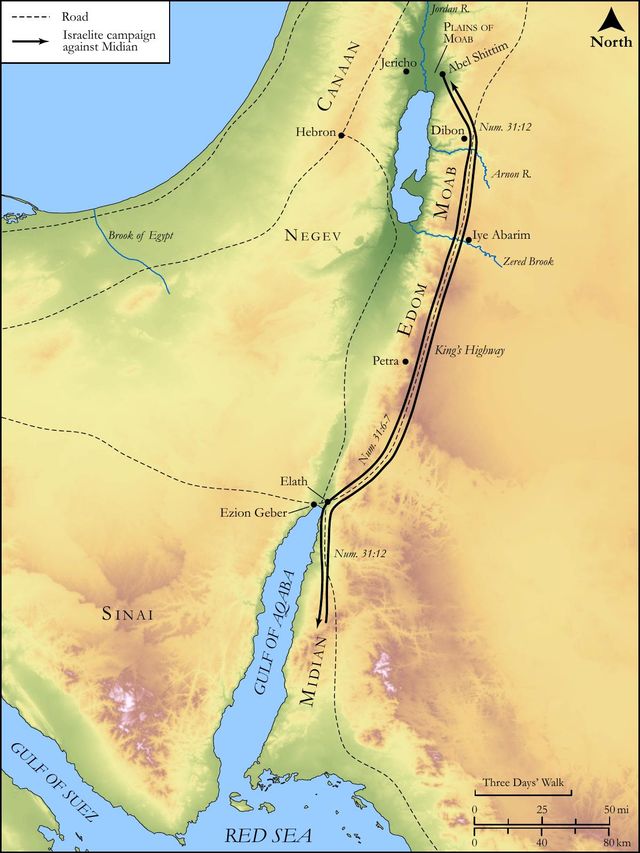
See on the biblical-era map
Study this verse
Continue studying Numbers 31:40 across the web’s major study libraries — every link below opens this exact verse, chapter, or book on the destination site.
Read & Compare
 BibleGatewayThis verse in more than 200 translations and 70 languages.
 Bible.comThe YouVersion reader — hundreds of translations, reading plans, and highlights.
 ESV.orgCrossway's official English Standard Version reader.
 NET BibleThe NET translation with 60,000+ translators' notes on every rendering decision.
 STEP BibleTyndale House's free study tool — original text, vocabulary, and scholarly resources.
 BibliaLogos Bible Software's free web reader.
 USCCBThe New American Bible (Revised Edition) with the U.S. bishops' study notes.
Commentaries
 BibleHub CommentariesDozens of classic commentaries on this verse, gathered on one page.
 StudyLightMore than 100 commentary sets — the largest collection on the web.
 BibleRefPlain-English commentary on what this verse means, verse by verse.
 Enduring WordDavid Guzik's free commentary on this chapter, widely used by Bible teachers.
 Bible Study ToolsVerse commentary alongside Greek and Hebrew study aids.
Original Language & Research
- BibleHub InterlinearThe verse word by word — original language, transliteration, and English.
- BibleHub LexiconEvery word's original-language definition and Strong's entry.
 Blue Letter BibleDeep-study tools — Strong's numbers, concordance, and word studies.
 SefariaThe Hebrew text with Rashi and centuries of Jewish commentary.
Sermons, Hymns & Audio


TrulyRandomVerse is not affiliated with these sites and doesn’t control their content. They’re linked because they’re genuinely useful.
Summary
Numbers 31:40 provides a precise accounting of the human captives, specifically sixteen thousand virgin females, that were allocated to the Israelite congregation from the spoils of the Midianite war. From this portion, a meticulously calculated "tribute" of thirty-two persons was designated for the LORD, underscoring God's ultimate sovereignty over all gains, His meticulousness in commanding offerings, and His provision for the Levitical priesthood.
Context
ShowHideLiterary Context
Numbers 31:40 is situated within the detailed account of Israel's divinely commanded war against the Midianites, a punitive expedition initiated in response to Midian's role in seducing Israel into idolatry and immorality at Baal-Peor, as recounted in Numbers 25. Following the decisive victory, Moses and Eleazar the priest provide comprehensive instructions for the purification of the warriors and the meticulous division of the vast plunder. The spoils were divided into two primary portions: one for the twelve thousand warriors who directly engaged in battle, and another for the rest of the Israelite congregation. From both shares, a specific "tribute" or offering was required for the LORD. Verse 40 specifically addresses the human captives (identified as virgin females in Numbers 31:18) that fell to the congregation's portion, from which a precisely calculated share was dedicated to God. This verse, along with Numbers 31:41, completes the accounting of the congregation's tribute, contrasting with the warriors' tribute detailed earlier in Numbers 31:28-29.
Historical & Cultural Context
The war against Midian was not merely a territorial conquest but a divinely mandated act of judgment against a people who had actively led Israel into grave sin, violating the covenant with Yahweh. Among the nations at war, the taking of spoils, including captives, was a common practice. However, Israel's system was unique, often involving the concept of herem (devotion to destruction) for certain enemies, while in other cases, spoils were taken but subjected to specific divine regulations. The "tribute" system, as seen here, reflects the foundational Israelite belief that all victory and all possessions ultimately belonged to Yahweh. The meticulous accounting and precise percentages underscore the structured and orderly nature of Israel's religious and societal life, distinct from the often arbitrary practices of surrounding nations. The destination of this tribute—for the Levites—also highlights the established system of supporting the priestly class who had no tribal land inheritance and were dependent on the offerings of the people for their sustenance and to enable their sacred service.
Key Themes
ShowHideThis verse powerfully contributes to several overarching themes within Numbers and the Pentateuch. Firstly, it reinforces the theme of Divine Sovereignty and Ownership, asserting that all blessings, victories, and possessions ultimately derive from and belong to God. The requirement for a "tribute to the LORD" was a tangible acknowledgment that the victory over Midian was His doing, and therefore, all spoils were ultimately His to command. Secondly, it highlights God's Provision for His Service. This tribute, specifically designated for the Levites (as confirmed in Numbers 31:41), demonstrates God's meticulous care for those set apart for His sacred work. This parallels the broader system of tithes and offerings designed to sustain the priesthood and the Tabernacle's operations, ensuring that those dedicated to spiritual duties were cared for (e.g., Numbers 18:21-24). Finally, the precise calculation (32 persons out of 16,000, a ratio of 1 in 500) underscores the theme of Divine Order and Meticulousness in God's commands regarding offerings and distribution, emphasizing that obedience extends to even the smallest details of the covenant.
Exposition and Analysis
ShowHideKey Word Analysis
ShowHideThe Hebrew word נֶפֶשׁ (H5315, nephesh) literally means "soul" or "life," but it is very widely used to refer to a living being, an individual, or a creature. In this context, it refers specifically to the human captives, emphasizing their status as living individuals rather than inanimate objects. The use of nephesh here underscores that even human lives, taken as spoils of war, were subject to God's ultimate claim and regulation, not merely to human discretion or arbitrary will.
The Hebrew term יְהֹוָה (H3068, Yᵉhôvâh) is the sacred, self-existent name of God, often transliterated as "Jehovah" or rendered as "the LORD" in English translations. Its presence here signifies that the tribute is not for Moses or Eleazar, but directly for the sovereign God of Israel. It emphasizes the divine authority behind the command and the sacred nature of the offering, highlighting that the victory and its spoils ultimately belong to Him.
The Hebrew word מֶכֶס (H4371, mekeç) denotes an "assessment" or "tribute," likely derived from a root meaning "to enumerate." It signifies a precisely calculated portion set apart. Unlike a general tax, this mekeç is specifically designated as "the LORD'S tribute," indicating a sacred portion dedicated to God as a recognition of His ownership and as a means of supporting His appointed servants, the Levites.
Verse Breakdown
ShowHide"And the persons [were] sixteen thousand"
This clause specifies the total number of human captives—specifically virgin females, as clarified in Numbers 31:18—that were allotted to the general Israelite congregation. This large figure highlights the scale of the victory over Midian and the significant human spoils taken. It establishes the numerical context from which the Lord's sacred tribute would be meticulously drawn, demonstrating the vastness of the divine provision and the scope of the divine command.
"of which the LORD'S tribute [was] thirty and two persons"
This phrase identifies the precise number of individuals from the congregation's share that were consecrated as a sacred offering to the LORD. This constituted a fixed ratio of 1 in 500 (16,000 / 500 = 32), demonstrating a meticulously calculated and divinely ordained proportion. This specific tribute was then given to Eleazar the priest for the Levites, as clarified in Numbers 31:41, highlighting its purpose in supporting those dedicated to Tabernacle service and ensuring their sustenance.
Literary Devices
ShowHideThe verse primarily employs Enumeration, providing precise numerical figures for both the total number of captives and the specific portion designated as the Lord's tribute. This meticulous accounting underscores the divine order and the exactitude of God's commands, leaving no room for ambiguity in the distribution of spoils and the fulfillment of sacred obligations. The Repetition of "persons" (explicit in the Hebrew, implied in the KJV) emphasizes the human element of the spoils, reminding the reader that these were living individuals, not inanimate objects, yet still subject to God's overarching authority and divine regulations. Furthermore, the concept of "the LORD'S tribute" functions as Symbolism, representing Israel's acknowledgment of God's ultimate ownership over all things, especially the fruits of a divinely sanctioned victory. It is a tangible sign of their obedience, gratitude, and recognition of His sovereign power.
Theological and Thematic Connections
ShowHideNumbers 31:40 profoundly reinforces the foundational biblical truth of God's ultimate sovereignty and ownership over all creation, including the spoils of war and even human lives. The requirement for a specific "tribute" from the congregation's share of captives served as a tangible acknowledgment that the victory was not by Israel's might but by God's hand, and therefore, a portion of the gains was due to Him. This principle extends beyond military conquest to encompass all aspects of life, reminding believers that all resources, talents, and successes are ultimately gifts from God, to be stewarded according to His will. This tribute also highlights God's meticulous provision for His servants, the Levites, ensuring that those dedicated to His work were sustained by the offerings of the people, a pattern seen throughout the Old Testament. It underscores the sacred nature of giving as an act of worship and obedience, demonstrating trust in God's ongoing provision and His faithfulness to those who serve Him.
Reflection and Application
ShowHideNumbers 31:40, though rooted in an ancient context of war and spoils, offers enduring principles for contemporary believers concerning stewardship, gratitude, and obedience. It challenges us to reflect on the source of our blessings and acknowledge God's ultimate ownership over all that we possess—our finances, our talents, our time, and even our very lives. Just as the Israelites were commanded to set apart a portion of their gains as a "tribute" to the LORD, we are called to live with a conscious awareness that everything we have is a gift from Him. This fosters a spirit of profound gratitude and humility, moving us beyond a sense of personal entitlement to one of faithful stewardship. Our giving, whether through tithes, offerings, or acts of service, becomes a tangible expression of our worship and trust in God's continued provision. This verse reminds us that obedience to God's commands extends to all areas of life, including our material possessions, and that our generosity is not merely an obligation but a joyful response to His generosity towards us. It calls us to consider how our resources can be used to support those dedicated to God's work today, echoing the ancient provision for the Levites.
Questions for Reflection
ShowHideFAQ
ShowHideWhy was a "tribute" required from human captives, specifically virgins?
ShowHideAmong the nations at war, taking captives was a common practice. However, Israel's legal system, given by God, placed strict regulations on such practices, often contrasting sharply with the brutality of surrounding nations. The virgins mentioned in Numbers 31:18 were not intended for sexual exploitation or as chattel in the modern sense, but rather for integration into Israelite society, likely as wives for the surviving men or as servants. The "tribute" from these captives was not a transaction of human beings as property in a dehumanizing sense, but a symbolic act acknowledging God's ultimate claim over all spoils of a divinely sanctioned victory, even human lives. It was a recognition that even these captives, now under Israelite authority, were ultimately under God's sovereignty. The 1-in-500 ratio for the Levites was for their support, ensuring the continuation of their sacred duties, rather than for them to "own" individuals in a manner contrary to God's broader laws concerning human dignity.
What was the purpose of this specific tribute, and who received it?
ShowHideThe purpose of this specific "tribute" (Hebrew mekeç, an "assessment" or "contribution") was multifaceted. Firstly, it served as a tangible acknowledgment of God's absolute sovereignty over the victory against Midian and over all the spoils acquired. It was an act of worship and obedience, recognizing that the triumph was His doing. Secondly, it was a means of divine provision for the Levites. As confirmed in Numbers 31:41, this tribute was given to Eleazar the priest, who then distributed it to the Levites. The Levites, unlike the other tribes, did not receive a territorial inheritance in the Promised Land; instead, they were set apart for service in the Tabernacle and later the Temple. Their sustenance, therefore, came from the tithes and offerings of the people, of which this tribute was a specific example. This system ensured that those dedicated to the spiritual well-being of the nation were adequately supported, allowing them to focus on their sacred duties without needing to engage in land cultivation or other forms of economic sustenance.
Christ-Centered Fulfillment
ShowHideNumbers 31:40, with its emphasis on a "tribute" or "assessment" set apart for the Lord, finds its ultimate fulfillment and transformation in the person and work of Jesus Christ. The meticulous Old Testament system of offerings, whether of animals, produce, or even human captives (symbolically, as in this case), pointed forward to the perfect and singular offering of Christ. He is the ultimate "tribute" lifted up to God, the Lamb of God who takes away the sin of the world, offered once for all on the cross to secure our redemption (John 1:29; Hebrews 9:14). Just as the ancient tribute acknowledged God's ownership over the spoils of war, Christ's sacrifice acknowledges God's ultimate claim over all humanity, having purchased us with His own blood (1 Corinthians 6:20). In response to His perfect offering, believers are now called to offer themselves as "living sacrifices," a spiritual "tribute" of worship and service, holy and pleasing to God (Romans 12:1). This New Covenant "tribute" is not a material portion of war spoils but the dedication of our entire lives—our bodies, minds, and spirits—to His glory. Furthermore, the Old Testament provision for the Levites through such tributes foreshadows God's abundant provision for His new covenant people, the church, through Christ, in whom all our needs are met according to His glorious riches (Philippians 4:19). We, as a "royal priesthood" (1 Peter 2:9), now offer spiritual sacrifices of praise and good deeds, fulfilling the spirit of the ancient tribute in a new and living way.