


Numbers 31:45
Bible text: King James Version (1769 Blayney text) · Public domain
Bible text: American Standard Version (1901) · Public domain
Bible text: World English Bible, Messianic edition · Public domain
Bible text: Geneva Bible (1599) · Public domain
Bible text: Young's Literal Translation · Public domain
- וַחֲמֹרִיםva·cha·mo·Rimand donkeysH2543Conj-w ¦ N-cpNoun Plural common gender Absoluteוַandחֲמֹרִיםdonkeys
- שְׁלֹשִׁיםshe·lo·ShimthirtyH7970Adj-mpAdjective Numerical Plural Masculine Absolute
- אֶלֶף'E·lefthousandH505Adj-csAdjective Numerical Singular common gender Absolute
- וַחֲמֵשׁva·cha·Meshand fiveH2568Conj-w ¦ Adj-cscAdjective Numerical Singular common gender Constructוַandחֲמֵשׁfive
- מֵאוֹתme·'othundred<s>H3967Adj-fpAdjective Numerical Plural Feminine Absolute
English is a literal word-by-word gloss of the Hebrew, not the KJV's wording. Why?
This is the original text the KJV's translators worked from — each Hebrew word with its own literal English meaning in this verse, prepared by scholars at Tyndale House, Cambridge. The KJV translates whole sentences, not word by word, so its wording differs: one Hebrew word can become several English words, and the KJV may choose “the LORD” where the gloss reads “Yahweh”. Both are faithful — they answer different questions. For the KJV's own rendering, switch to the KJV text.
Details
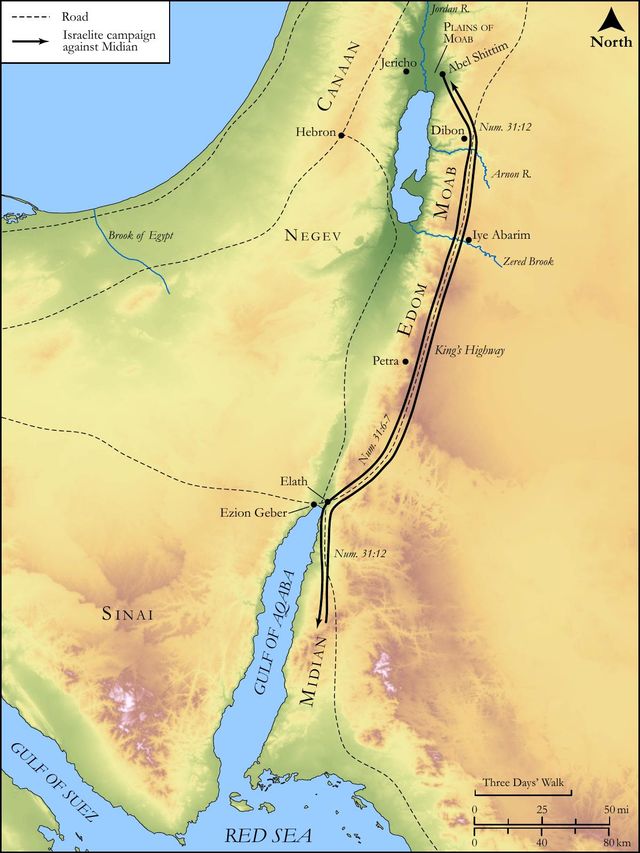
See on the biblical-era map
Study this verse
Continue studying Numbers 31:45 across the web’s major study libraries — every link below opens this exact verse, chapter, or book on the destination site.
Read & Compare
 BibleGatewayThis verse in more than 200 translations and 70 languages.
 Bible.comThe YouVersion reader — hundreds of translations, reading plans, and highlights.
 ESV.orgCrossway's official English Standard Version reader.
 NET BibleThe NET translation with 60,000+ translators' notes on every rendering decision.
 STEP BibleTyndale House's free study tool — original text, vocabulary, and scholarly resources.
 BibliaLogos Bible Software's free web reader.
 USCCBThe New American Bible (Revised Edition) with the U.S. bishops' study notes.
Commentaries
 BibleHub CommentariesDozens of classic commentaries on this verse, gathered on one page.
 StudyLightMore than 100 commentary sets — the largest collection on the web.
 BibleRefPlain-English commentary on what this verse means, verse by verse.
 Enduring WordDavid Guzik's free commentary on this chapter, widely used by Bible teachers.
 Bible Study ToolsVerse commentary alongside Greek and Hebrew study aids.
Original Language & Research
- BibleHub InterlinearThe verse word by word — original language, transliteration, and English.
- BibleHub LexiconEvery word's original-language definition and Strong's entry.
 Blue Letter BibleDeep-study tools — Strong's numbers, concordance, and word studies.
 SefariaThe Hebrew text with Rashi and centuries of Jewish commentary.
Sermons, Hymns & Audio


TrulyRandomVerse is not affiliated with these sites and doesn’t control their content. They’re linked because they’re genuinely useful.
Summary
Numbers 31:45 provides a precise accounting within the extensive inventory of spoils acquired from the Midianites, specifically detailing "thirty thousand asses and five hundred," totaling 30,500 donkeys. This seemingly minor numerical detail profoundly underscores the immense scale of the Israelite victory, the tangible divine provision for the nation, and the meticulous adherence to God's explicit instructions regarding the collection, purification, and distribution of war plunder, thereby reflecting a broader theological theme of divine order, accountability, and faithful stewardship prevalent throughout the book of Numbers.
Context
ShowHideLiterary Context
Numbers 31:45 is deeply embedded within a comprehensive narrative of the Israelite war against Midian, which spans the entirety of Numbers chapter 31. This conflict was initiated by a direct divine command for vengeance against Midian due to their insidious role in tempting Israel to idolatry and immorality at Peor, as meticulously detailed in Numbers 25:1-18. Following the execution of this punitive war and the decisive Israelite victory, the chapter transitions to the return of the army laden with immense spoils. The bulk of the chapter, specifically from Numbers 31:25-47, is dedicated to the meticulous inventory and subsequent division of these spoils among the warriors, the wider congregation, and special portions designated as offerings for the Lord and the Levites. Verse 45, alongside other verses enumerating specific quantities of animals and precious metals, contributes to the overall picture of the vast wealth acquired, emphasizing the thoroughness of the divine instructions and the Israelites' unwavering obedience in their implementation, setting a precedent for handling sacred resources.
Historical & Cultural Context
The war against Midian, as vividly depicted in Numbers 31, transcended a mere territorial dispute; it was a divinely mandated act of judgment against a people who had actively sought to corrupt Israel's unique covenant relationship with Yahweh. While the practice of taking spoils of war was commonplace among the nations, the Israelite approach, as meticulously outlined here, was distinctive due to its divine mandate for purification and precise distribution. The Midianites, as a prominent nomadic people, would have possessed substantial herds of livestock, including asses, which were indispensable for transport, agricultural labor, and represented a significant form of wealth in an agrarian and pastoral society. The sheer numbers recorded in the inventory reflect not only the economic devastation inflicted upon Midian but also the significant material provision divinely granted to Israel. Furthermore, the detailed accounting reflects the same care for meticulous record-keeping shown when Moses and Eleazar numbered the people on the plains of Moab, particularly concerning tribute and acquired wealth, and here it is elevated to a profound theological act of obedience and a recognition of God's absolute sovereignty over all resources.
Key Themes
ShowHideThis verse, though numerically brief, powerfully contributes to several overarching themes woven throughout the book of Numbers and the broader Pentateuch. It vividly illustrates Divine Judgment being executed against those who brazenly oppose God and seek to corrupt His covenant people, serving as a direct consequence of Midian's actions at Peor (Numbers 25:17-18). Simultaneously, the vast quantity of spoils, including the 30,500 asses, powerfully highlights God's Abundant Provision for His people, demonstrating His unwavering faithfulness to care for them, even through the means of judgment on their enemies. The meticulous enumeration of every item, down to specific numbers of animals, profoundly underscores Divine Meticulousness and Order, reflecting God's intricate attention to detail and His expectation of accountability from His people in handling all resources. Finally, the Israelites' diligent adherence to the counting and division process, precisely as commanded by Moses, exemplifies Obedience and Accountability to God's specific instructions, particularly concerning the handling of sacred spoils and the divinely ordained system of offerings (see Numbers 31:27-47).
Exposition and Analysis
ShowHideKey Word Analysis
ShowHideThe Hebrew word חֲמוֹר (chămôwr) is the standard and widely used term for a male donkey or ass. In the days of Moses, donkeys were indispensable animals, serving as primary beasts of burden for transport, agricultural labor, and representing a significant form of accumulated wealth. Their prominent inclusion in the spoils inventory highlights their critical economic value and practical utility to the burgeoning Israelite community. The staggering number, 30,500, indicates a massive acquisition, underscoring both the immense scale of the Midianite herds and the extent of the Israelite victory and subsequent divine provision.
The Hebrew word שְׁלֹשִׁים (shᵉlôwshîym) denotes the cardinal number "thirty." Its precise use here, combined with "thousand," emphasizes the meticulous and exact nature of the inventory. This numerical specificity is not arbitrary but reflects a practice of detailed record-keeping for administrative and economic purposes in Israel. The inclusion of such an exact count also serves to validate the divine command for a thorough accounting of all that was taken, demonstrating God's inherent orderliness and the Israelites' faithful obedience to His detailed instructions.
The Hebrew word אֶלֶף (ʼeleph) signifies "a thousand." When combined with "thirty," it forms the large quantity "thirty thousand." This term, often used in Scripture to denote large, sometimes approximate, numbers, here functions with precise numerical value in conjunction with "five hundred" to convey the immense scale of the captured livestock. It underscores the vastness of the resources God provided to Israel through this victory, highlighting the economic impact and the sheer abundance of the spoils.
Verse Breakdown
ShowHide"And thirty thousand asses"
This initial clause commences the precise enumeration of a specific and highly valuable category of livestock acquired as spoils from the Midianites. The immediate mention of "thirty thousand" powerfully conveys the immense scale of the captured animals, highlighting the vast wealth and resources that were suddenly at Israel's disposal. It points directly to the significant economic impact of the war, providing the Israelites with a substantial new source of transport, labor, and potential trade goods, essential for their journey and settlement.
"and five hundred"
This concluding phrase refines the preceding number, specifying an exact total of 30,500 donkeys. The addition of "and five hundred" underscores the extraordinary meticulousness of the entire inventory process. This level of detail is far more than mere record-keeping; it reflects the divine command for a thorough and accurate accounting of all spoils. This precision ensured that the subsequent distribution and the dedicated portions for the Lord and the Levites were handled with exactitude, integrity, and according to God's specific and unyielding instructions.
Literary Devices
ShowHideThe primary literary device at play in Numbers 31:45, and indeed throughout the extensive inventory section of Numbers 31, is Enumeration. The text provides a precise, itemized list of the spoils, meticulously detailing the exact number of each type of animal and precious metal. This meticulous counting serves to emphasize the vastness of the plunder and the thoroughness with which the divine command was executed, creating a profound sense of overwhelming abundance and divine provision. Furthermore, the detailed nature of this enumeration contributes to Verisimilitude, lending credibility and realism to the narrative by presenting it with the kind of specific data that would have been recorded in ancient administrative and military contexts. The effect of this detailed enumeration is also to highlight Divine Meticulousness, portraying God as one who orchestrates events and demands accountability even in the smallest details, reflecting His inherently orderly and sovereign character.
Theological and Thematic Connections
ShowHideNumbers 31:45, though a simple numerical detail, is remarkably rich in its theological implications. It speaks profoundly to God's sovereign control over all aspects of existence, including the precise outcomes of war and the meticulous fair sharing of goods. The sheer abundance of the spoils, particularly these 30,500 asses, signifies God's tangible and overflowing provision for His covenant people after a decisive act of judgment against their enemies. This provision is not random or chaotic but meticulously accounted for, underscoring God's inherent orderliness and His expectation of faithful stewardship from His people. It serves as a powerful reminder that all blessings, even those acquired through conflict, ultimately originate from Him and are to be managed according to His divine principles. The detailed inventory reflects a divine standard of accountability, where every resource is recognized as belonging to the Lord and is to be handled with integrity and purpose.
Reflection and Application
ShowHideThe meticulous accounting of the asses and other spoils in Numbers 31:45 might initially appear to be a dry, administrative detail, yet it offers profound and timeless lessons for contemporary believers. It serves as a powerful reminder that God is a God of order, precision, and intentionality, even in what might seem to us as the most mundane or insignificant details. Just as He commanded a thorough inventory of the physical spoils, He calls us to live with intentionality, integrity, and meticulousness in every area of our lives. This verse challenges us to deeply consider our own stewardship: how diligently and faithfully do we manage the resources, talents, and precious time God has entrusted to us? Are we as meticulous in our spiritual and practical accounting as the Israelites were with their physical assets? Furthermore, the overwhelming abundance of the spoils serves as a powerful reminder of God's boundless and unfailing provision for His people. Even in the midst of executing judgment against evil, God's generosity overflows to those who are faithful to Him. This truth should cultivate a deep, abiding trust in His infinite ability and unwavering willingness to provide for our needs, often in unexpected and miraculous ways, as we walk in humble obedience to His divine commands.
Questions for Reflection
ShowHideFAQ
ShowHideWhy is such a specific number of asses mentioned in the Bible?
ShowHideThe mention of "thirty thousand asses and five hundred" in Numbers 31:45 is an integral part of a larger, highly detailed inventory of the immense spoils taken from the Midianites. This extraordinary level of specificity serves multiple, crucial purposes. Firstly, it powerfully underscores the immense scale of the Israelite victory and the vast wealth acquired, thereby showcasing God's abundant and tangible provision for His people. Secondly, it highlights the meticulousness of the divine command regarding the handling of war spoils, emphasizing God's inherent orderliness and His expectation of precise accountability from the Israelites. Among the nations, detailed records of tribute and plunder were a common administrative and military practice, and this biblical account reflects that cultural norm while elevating it to a profound theological statement about divine oversight and human obedience. It demonstrates unequivocally that God cares about the smallest details and expects His people to be diligent and faithful stewards of everything He entrusts to them, as comprehensively outlined in the division process in Numbers 31:25-47.
Christ-Centered Fulfillment
ShowHideWhile Numbers 31:45 describes a literal and meticulous accounting of war spoils, its underlying theological themes find profound and ultimate Christ-centered fulfillment. The divinely commanded and meticulously executed judgment against Midian, which resulted in such vast material provision for Israel, powerfully foreshadows Christ's ultimate and decisive victory over sin, death, and all the forces of evil. Just as the Israelites received tangible spoils from their defeated enemies, believers in Christ receive an immeasurable and imperishable spiritual inheritance, far surpassing any earthly wealth or possession (Ephesians 1:3-14). The divine meticulousness in accounting for every single ass points to the even greater precision, intentionality, and perfect orchestration of God's grand redemptive plan, where every detail, from the miraculous incarnation to the sacrificial crucifixion and glorious resurrection, was perfectly designed and executed for our eternal salvation (Galatians 4:4-5). Christ, as the true Lamb of God, did not merely take spoils from an external enemy but became the ultimate sacrifice Himself, conquering sin and death from within to secure for us eternal life and an imperishable inheritance reserved in heaven (1 Peter 1:3-5). The abundance of asses served Israel's earthly and temporal needs; the abundance of grace, spiritual blessings, and divine power found in Christ serves our eternal needs, providing everything necessary for life and godliness through His glorious divine power (2 Peter 1:3).