


Numbers 31:46
Bible text: King James Version (1769 Blayney text) · Public domain
Bible text: American Standard Version (1901) · Public domain
Bible text: World English Bible, Messianic edition · Public domain
Bible text: Geneva Bible (1599) · Public domain
Bible text: Young's Literal Translation · Public domain
- וְנֶפֶשׁve·Ne·feshand person[s] ofH5315Conj-w ¦ N-fscNoun Singular Feminine Constructוְandנֶפֶשׁperson[s] of
- אָדָם'a·DamhumankindH120N-msNoun Singular Masculine Absolute
- שִׁשָּׁהshi·Shahsix-H8337Adj-csAdjective Numerical Singular common gender Absolute
- עָשָׂר'a·SarteenH6240Adj-csAdjective Numerical Singular common gender Absolute
- אָלֶף'A·lefthousandH505Adj-csAdjective Numerical Singular common gender Absolute
English is a literal word-by-word gloss of the Hebrew, not the KJV's wording. Why?
This is the original text the KJV's translators worked from — each Hebrew word with its own literal English meaning in this verse, prepared by scholars at Tyndale House, Cambridge. The KJV translates whole sentences, not word by word, so its wording differs: one Hebrew word can become several English words, and the KJV may choose “the LORD” where the gloss reads “Yahweh”. Both are faithful — they answer different questions. For the KJV's own rendering, switch to the KJV text.
Details
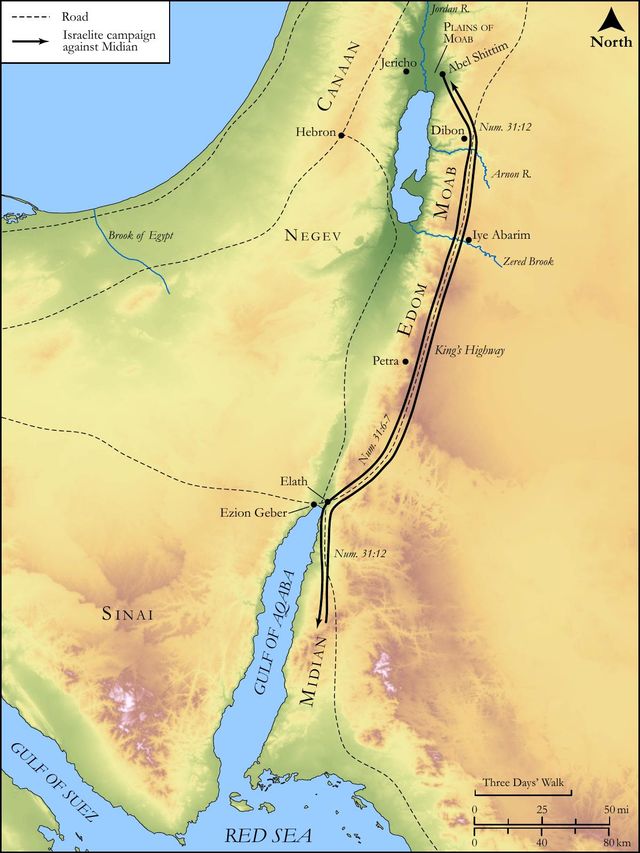
See on the biblical-era map
Study this verse
Continue studying Numbers 31:46 across the web’s major study libraries — every link below opens this exact verse, chapter, or book on the destination site.
Read & Compare
 BibleGatewayThis verse in more than 200 translations and 70 languages.
 Bible.comThe YouVersion reader — hundreds of translations, reading plans, and highlights.
 ESV.orgCrossway's official English Standard Version reader.
 NET BibleThe NET translation with 60,000+ translators' notes on every rendering decision.
 STEP BibleTyndale House's free study tool — original text, vocabulary, and scholarly resources.
 BibliaLogos Bible Software's free web reader.
 USCCBThe New American Bible (Revised Edition) with the U.S. bishops' study notes.
Commentaries
 BibleHub CommentariesDozens of classic commentaries on this verse, gathered on one page.
 StudyLightMore than 100 commentary sets — the largest collection on the web.
 BibleRefPlain-English commentary on what this verse means, verse by verse.
 Enduring WordDavid Guzik's free commentary on this chapter, widely used by Bible teachers.
 Bible Study ToolsVerse commentary alongside Greek and Hebrew study aids.
Original Language & Research
- BibleHub InterlinearThe verse word by word — original language, transliteration, and English.
- BibleHub LexiconEvery word's original-language definition and Strong's entry.
 Blue Letter BibleDeep-study tools — Strong's numbers, concordance, and word studies.
 SefariaThe Hebrew text with Rashi and centuries of Jewish commentary.
Sermons, Hymns & Audio


TrulyRandomVerse is not affiliated with these sites and doesn’t control their content. They’re linked because they’re genuinely useful.
Summary
Numbers 31:46 provides a precise accounting of the human captives—specifically, sixteen thousand persons—taken as spoils from the Midianites during Israel's divinely commanded punitive war. This verse concludes the meticulous inventory of the vast plunder acquired, highlighting the administrative precision and the immense scale of the victory before the subsequent division of these spoils among the Israelite warriors, the congregation, and dedicated portions for the Lord and the Levites.
Context
ShowHideLiterary Context
Numbers 31:46 is embedded within a comprehensive and detailed narrative of Israel's war against the Midianites, which spans the entirety of Numbers 31. The chapter commences with God's explicit command to Moses to execute vengeance upon Midian for their role in leading Israel into idolatry and immorality at Peor, as recounted in Numbers 25. Following a decisive victory in which all Midianite males and their five kings were slain, the Israelite army returned with immense plunder, including livestock, precious metals, and human captives. Moses, Eleazar the priest, and the tribal leaders then oversaw strict purification rituals and the meticulous division of these spoils. Verses 32-47 meticulously itemize all the plunder: sheep, cattle, donkeys, and finally, "persons." Verse 46 specifically concludes the tally of human captives, setting the stage for their subsequent division according to God's prescribed ratios for the warriors, the congregation, and the portions dedicated to the Lord and the Levites.
Historical & Cultural Context
The conflict with Midian was not merely a territorial dispute but a divinely ordained act of retribution for Midian's direct involvement in the Baal of Peor incident. In this tragic episode, Midianite women lured Israelite men into idolatry and sexual immorality, resulting in a devastating plague that claimed 24,000 Israelite lives, as detailed in Numbers 25:1-9. This context underscores the severity of God's judgment against those who actively seek to corrupt His covenant people. Among the nations, the practice of taking war spoils, including human captives (especially women and children), was a common feature of military victories, often serving as slaves, concubines, or a means to replenish populations. However, Israel's practices were distinct, governed by specific divine laws that set them apart from the indiscriminate brutality of surrounding nations. The command to spare only the virgin women and children (Numbers 31:17-18) reflects a unique moral framework, rooted in the immediate context of divine judgment against a corrupting influence, even while presenting challenges for modern ethical sensibilities.
Key Themes
ShowHideNumbers 31:46, within its broader chapter, contributes significantly to several profound theological themes. Firstly, it powerfully illustrates Divine Justice and Retribution, demonstrating God's unwavering commitment to judge sin, particularly that which leads His covenant people astray. The war and its subsequent spoils are a direct consequence of Midian's egregious actions at Peor. Secondly, the meticulous accounting of "sixteen thousand persons" underscores Meticulous Administration and Divine Order within the Israelite camp. The detailed inventory and precise division of spoils reflect Moses' faithful leadership and Israel's adherence to God's instructions, emphasizing that even in the aftermath of war, divine order, accountability, and obedience were paramount. This level of detail is characteristic of the Pentateuch, particularly in books like Exodus, Leviticus, and Numbers, where precise instructions for the Tabernacle, sacrifices, and tribal organization are consistently given (e.g., Exodus 25:9). Finally, the immense plunder, including these captives, signifies God's Provision and Blessing for His people, even as they execute His judgment. It demonstrates God's ability to provide for Israel's needs through the defeat of their enemies, reinforcing His covenant faithfulness and power.
Exposition and Analysis
ShowHideKey Word Analysis
ShowHideThe number "sixteen" is a combination of two Hebrew words: shêsh (שֵׁשׁ), meaning "six," and ʻâsâr (עָשָׂר), meaning "ten" (used in combination for numbers ending in -teen). This precise numerical designation highlights the exactness of the inventory. In the context of the spoils, it signifies a specific, verifiable quantity, rather than a general estimate, underscoring the meticulous nature of the accounting.
The Hebrew word אֶלֶף (ʼeleph) denotes "a thousand." Its use here, in conjunction with "sixteen," emphasizes the immense scale of the human captives taken. The number 16,000 is a substantial figure, indicating a significant military victory and a large acquisition of human resources, which would have been considered valuable assets among the nations of that day.
The Hebrew term נֶפֶשׁ (nephesh) is rich in meaning, often translated as "soul," "life," "being," or "self." In this specific context, it refers to living human beings, emphasizing their status as individual entities within the inventory of war spoils. The use of nephesh here underscores that these are not merely objects but living individuals, albeit now captives. While nephesh can also refer to animals, in the context of a census or a count of human populations, it invariably refers to people, as seen in other population counts throughout the book of Numbers.
Verse Breakdown
ShowHide"And sixteen thousand persons;)"
This concise clause provides the precise numerical total of human captives taken from Midian. The number "sixteen thousand" is profoundly significant in its magnitude, reflecting both the vast scale of the Israelite victory and the immense quantity of the plunder acquired. The term "persons" refers specifically to the women and children who were spared from the initial slaughter, particularly those who were virgins, as per Moses' later command in Numbers 31:18. This precise enumeration highlights the meticulous record-keeping and administrative order that characterized Israel's operations under divine instruction, ensuring that every item of spoil was accounted for before its division. The parenthetical mark in the King James Version text is a stylistic choice, indicating that this verse functions as a concluding count within a detailed list of captured items.
Literary Devices
ShowHideThe primary literary device at play in Numbers 31:46 is Enumeration, which is a specific form of Detailing. The verse provides a precise numerical count, emphasizing the meticulousness and thoroughness of the inventory of war spoils. This detailed listing, characteristic of the book of Numbers and indeed much of the Pentateuch, serves to underscore the administrative precision commanded by God and faithfully executed by Moses and the Israelite leadership. The sheer magnitude of the number, "sixteen thousand," also functions as Amplification, conveying the overwhelming nature of the Israelite victory and the extensive reach of the divine judgment against Midian. While not strictly hyperbole in the sense of exaggeration, the large, exact number serves to amplify the scale and significance of the event for the reader, reinforcing the comprehensive nature of God's judgment and Israel's triumph.
Theological and Thematic Connections
ShowHideNumbers 31:46, by detailing the human spoils of war, compels us to grapple with complex theological questions regarding divine judgment, the nature of ancient warfare, and God's interaction with humanity within specific historical and cultural contexts. It highlights God's absolute sovereignty over nations and His willingness to use human agents to execute His justice, even when the means are severe and challenging to modern ethical frameworks. The meticulous accounting within the chapter, including this verse, further emphasizes God's orderliness and the paramount importance of obedience to His specific commands, no matter how difficult or counter-intuitive they may seem. It serves as a stark reminder that God's ways are higher than our ways, and His justice, while sometimes appearing harsh from a human perspective, is always righteous and perfectly wise in His divine economy.
Reflection and Application
ShowHideWhile the specific context of war spoils and human captives in Numbers 31:46 is far removed from contemporary life, the underlying principles of divine justice, meticulous obedience, and God's sovereign provision remain profoundly relevant for believers today. This verse, situated within its broader narrative, challenges us to deeply consider the gravity of sin and its far-reaching consequences, as well as the importance of accountability and faithfulness in all areas of life. It calls us to cultivate a posture of trust in God's perfect justice, even when His methods or decrees are beyond our full comprehension, and to recognize that His commands, though sometimes difficult or demanding, are always for the ultimate good, purity, and holiness of His people. We are reminded that God is a God of order and intricate detail, expecting faithfulness and precision in our stewardship of all that He entrusts to us, whether it be material resources, interpersonal relationships, or spiritual responsibilities within His kingdom.
Questions for Reflection
ShowHideFAQ
ShowHideWhy did God command such a harsh war against the Midianites, including taking captives?
ShowHideThe war against Midian, meticulously detailed in Numbers 31, was not an arbitrary act of aggression but a direct and severe divine judgment for Midian's pivotal role in orchestrating the sin of Baal of Peor, as vividly described in Numbers 25. Midianite women deliberately enticed Israelite men into idolatry and sexual immorality, leading to a devastating plague that claimed the lives of 24,000 Israelites. God commanded this war as an act of "vengeance of the Lord" (Numbers 31:2), a righteous retribution for their deliberate corruption of His covenant people. The taking of captives, specifically virgin women and children, was a common practice in ancient warfare, but within Israel, it was uniquely governed by specific divine laws, distinguishing it from the indiscriminate brutality of surrounding nations. This act served as both a just judgment against Midian and a means of provision for Israel, while also removing a profound source of spiritual contamination that threatened the purity of God's chosen nation.
Christ-Centered Fulfillment
ShowHideWhile Numbers 31:46 details the spoils of a physical war and the judgment enacted upon Midian, its ultimate fulfillment points profoundly to Christ's spiritual victory over sin, death, and the powers of darkness. Just as the Israelites took "persons" as captives from their defeated enemy, Christ, through His sacrificial death and glorious resurrection, has triumphed decisively over the spiritual enemies that held humanity in bondage. Colossians 2:15 powerfully declares that He "disarmed the powers and authorities, he made a public spectacle of them, triumphing over them by the cross." He has, in a profound spiritual sense, "led captivity captive," leading a host of those freed from sin's dominion into His glorious kingdom, as alluded to in Ephesians 4:8. The precise accounting of the "sixteen thousand persons" in Numbers foreshadows the meticulous and complete redemption wrought by Christ, where every soul redeemed is known, accounted for, and precious to God. Furthermore, the purification rituals associated with the spoils in Numbers 31 find their ultimate reality in the cleansing blood of Christ, which purifies us from all sin and makes us holy before God, as affirmed in 1 John 1:7. The war against Midian was a battle against spiritual corruption manifested physically, and Christ's work on the cross is the definitive, eternal victory over the ultimate corrupting power of sin, securing a countless multitude of "persons" for His eternal kingdom, a multitude from every nation, tribe, people, and language, standing before the throne and before the Lamb (Revelation 7:9).