


Mark 4:30
Bible text: King James Version (1769 Blayney text) · Public domain
Bible text: Berean Standard Bible · Public domain
Bible text: American Standard Version (1901) · Public domain
Bible text: World English Bible, Messianic edition · Public domain
Bible text: Geneva Bible (1599) · Public domain
Bible text: Young's Literal Translation · Public domain
- ΚαὶKaiAndG2532CONJConjunction
- ἔλεγεν·elegenHe was sayingG3004V-IAI-3SVerb Imperfect Active Indicative 3rd Singular
- πῶςpōshowG4459PRT-IInterrogative Particle Interrogative
- ὁμοιώσωμενhomoiōsōmenshall we likenG3666V-AAS-1PVerb Aorist Active Subjunctive 1st Plural
- τὴνtēntheG3588T-ASFDefinite article Accusative Singular Feminine
- βασιλείανbasileiankingdomG932N-ASFNoun Accusative Singular Feminine
- τοῦtou<the>G3588T-GSMDefinite article Genitive Singular Masculine
- θεοῦtheouof GodG2316N-GSM-TNoun Genitive Singular Masculine Title
- ἢēOrG2228CONJConjunction
- ἐνeninG1722PREPPreposition
- τίνιtiniwhichG5101I-DSFInterrogative pronoun Dative Singular Feminine
- αὐτὴνautēnitG846P-ASFPersonal pronoun Accusative Singular Feminine
- παραβολῇparabolēaparableG3850N-DSFNoun Dative Singular Feminine
- θῶμεν;thōmenlet us presentG5087V-2AAS-1PVerb 2nd Aorist Active Subjunctive 1st Plural
English is a literal word-by-word gloss of the Greek, not the KJV's wording. Why?
This is the original text the KJV's translators worked from — each Greek word with its own literal English meaning in this verse, prepared by scholars at Tyndale House, Cambridge. The KJV translates whole sentences, not word by word, so its wording differs: one Greek word can become several English words, and the KJV may choose “charity” where the gloss reads “love”. Both are faithful — they answer different questions. For the KJV's own rendering, switch to the KJV text.
Details
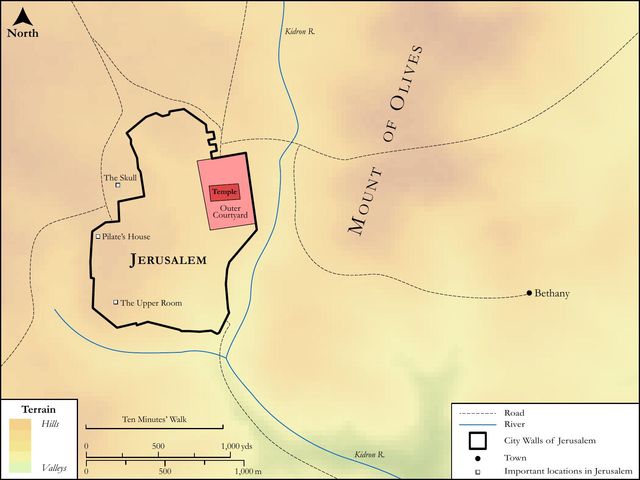
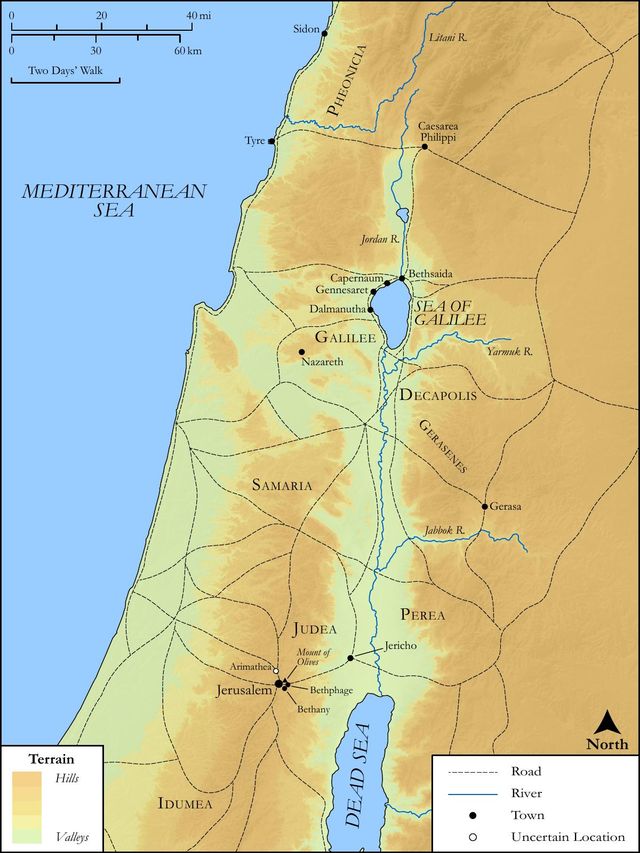
See on the biblical-era maps

Study this verse
Public-domain commentary
Matthew Henry
From his Commentary on the Whole Bible. Henry comments on passages, not single verses — this entry covers Mark 4:21–34. His three-level outline is real structure in the source text, so it is rendered as structure.
The lessons which our Saviour designs to teach us here by parables and figurative expressions are these: -
I.That those who are good ought to consider the obligations they are under to do good; that is, as in the parable before, to bring forth fruit. God expects a grateful return of his gifts to us, and a useful improvement of his gifts in us; for (Mar 4:21), Is a candle brought to be put under a bushel, or under a bed? No, but that it may be set on a candlestick. The apostles were ordained, to receive the gospel, not for themselves only, but for the good of others, to communicate it to them. All Christians, as they have received the gift, must minister the same. Note,
1.Gifts and graces make a man as a candle; the candle of the Lord (Pro 20:27), lighted by the Father of lights; the most eminent are but candles, poor lights, compared with the Sun of righteousness. A candle gives light but a little way, and but a little while, and is easily blown out, and continually burning down and wasting.
2.Many who are lighted as candles, put themselves under a bed, or under a bushel: they do not manifest grace themselves, nor minister grace to others; they have estates, and do no good with them; have their limbs and senses, wit and learning perhaps, but nobody is the better for them; they have spiritual gifts, but do not use them; like a taper in an urn, they burn to themselves.
3.Those who are lighted as candles, should set themselves on a candlestick; that is, should improve all opportunities of doing good, as those that were made for the glory of God, and the service of the communities they are members of; we are not born for ourselves.
The reason given for this, is, because there is nothing hid, which shall not be manifested, which should not be made manifest (so it might better be read), Mar 4:22. There is no treasure of gifts and graces lodged in any but with design to be communicated; nor was the gospel made a secret to the apostles, to be concealed, but that it should come abroad, and be divulged to all the world. Though Christ expounded the parables to his disciples privately, yet it was with design to make them the more publicly useful; they were taught, that they might teach; and it is a general rule, that the ministration of the Spirit is given to every man to profit withal, not himself only, but others also.
II.It concerns those who hear the word of the gospel, to mark what they hear, and to make a good use of it, because their weal or woe depends upon it; what he had said before he saith again, If any man have ears to hear, let him hear, Mar 4:23. Let him give the gospel of Christ a fair hearing; but that is not enough, it is added (Mar 4:24), Take heed what ye hear, and give a due regard to that which ye do hear; Consider what ye hear, so Dr. Hammond reads it. Note, What we hear, doth us no good, unless we consider it; those especially that are to teach others must themselves be very observant of the things of God; must take notice of the message they are to deliver, that they may be exact. We must likewise take heed what we hear, by proving all things, that we may hold fast that which is good. We must be cautious, and stand upon our guard, lest we be imposed upon. To enforce this caution, consider,
1.As we deal with God, God will deal with us, so Dr. Hammond explains these words, "With what measure ye mete, it shall be measured to you. If ye be faithful servants to him, he will be a faithful Master to you: with the upright he will show himself upright."
2.As we improve the talents we are entrusted with, we shall increase them; if we make use of the knowledge we have, for the glory of God and the benefit of others, it shall sensibly grow, as stock in trade doth by being turned; Unto you that hear, shall more be given; to you that have, it shall be given, Mar 4:25. If the disciples deliver that to the church, which they have received of the Lord, they shall be led more into the secret of the Lord. Gifts and graces multiply by being exercised; and God has promised to bless the hand of the diligent.
3.If we do not use, we lose, what we have; From him that hath not, that doeth no good with what he hath, and so hath it in vain, is as if he had it not, shall be taken even that which he hath. Burying a talent is the betraying of a trust, and amounts to a forfeiture; and gifts and graces rust for want of wearing.
III.The good seed of the gospel sown in the world, and sown in the heart, doth by degrees produce wonderful effects, but without noise (Mar 4:26, etc.); So is the kingdom of God; so is the gospel, when it is sown, and received, as seed in good ground.
1.It will come up; though it seem lost and buried under the clods, it will find or make its way through them. The seed cast into the ground will spring. Let but the word of Christ have the place it ought to have in a soul, and it will show itself, as the wisdom from above doth in a good conversation. After a field is sown with corn, how soon is the surface of it altered! How gay and pleasant doth it look, when it is covered with green!
2.The husbandman cannot describe how it comes up; it is one of the mysteries of nature; It springs and grows up, he knows not how, Mar 4:27. He sees it has grown, but he cannot tell in what manner it grew, or what was the cause and method of its growth. Thus we know not how the Spirit by the word makes a change in the heart, any more than we can account for the blowing of the wind, which we hear the sound of, but cannot tell whence it comes, or whither it goes. Without controversy, great is the mystery of godliness; how God manifested in the flesh came to be believed on in the world, Ti1 3:16.
3.The husbandman, when he hath sown the seed, doth nothing toward the springing of it up; He sleeps, and rises, night and day; goes to sleep at night, gets up in the morning, and perhaps never so much as thinks of the corn he hath sown, or ever looks upon it, but follows his pleasures or other business, and yet the earth brings forth fruit of itself, according to the ordinary course of nature, and by the concurring power of the God of nature. Thus the word of grace, when it is received in faith, is in the heart a work of grace, and the preachers contribute nothing to it. The Spirit of God is carrying it on when they sleep, and can do no business (Job 33:15, Job 33:16), or when they rise to go about other business. The prophets do not live for ever; but the word which they preached, is doing its work, when they are in their graves, Zac 1:5, Zac 1:6. The dew by which the seed is brought up tarrieth not for man, nor waiteth for the sons of men, Mic 5:7.
4.It grows gradually; first the blade, then the ear, after that the full corn in the ear, Mar 4:28. When it is sprung up, it will go forward; nature will have its course, and so will grace. Christ's interest, both in the world and in the heart, is, and will be, a growing interest; and though the beginning be small, the latter end will greatly increase. Though thou sowest not that body that shall be, but bare grain, yet God will give to every seed its own body; though at first it is but a tender blade, which the frost may nip, or the foot may crush, yet it will increase to the ear, to the full corn in the ear. Natura nil facit per saltum - Nature does nothing abruptly. God carries on his work insensibly and without noise, but insuperably and without fail.
5.It comes to perfection at last (Mar 4:29); When the fruit is brought forth, that is, when it is ripe, and ready to be delivered into the owner's hand; then he puts in the sickle. This intimates,
(1.)That Christ now accepts the services which are done to him by an honest heart from a good principle; from the fruit of the gospel taking place and working in the soul, Christ gathers in a harvest of honour to himself. See Joh 4:35.
(2.)That he will reward them in eternal life. When those that receive the gospel aright, have finished their course, the harvest comes, when they shall be gathered as wheat into God's barn (Mat 13:30), as a shock of corn in his season.
IV.The work of grace is small in its beginnings, but comes to be great and considerable at last (Mar 4:30-32); "Whereunto shall I liken the kingdom of God, as now to be set up by the Messiah? How shall I make you to understand the designed method of it?" Christ speaks as one considering and consulting with himself, how to illustrate it with an apt similitude; With what comparison shall we compare it? Shall we fetch it from the motions of the sun, or the revolutions of the moon? No, the comparison is borrowed from this earth, it is like a grain of mustard-seed; he had compared it before to seed sown, here to that seed, intending thereby to show,
1.That the beginnings of the gospel kingdom would be very small, like that which is one of the least of all seeds. When a Christian church was sown in the earth for God, it was all contained in one room, and the number of the names was but one hundred and twenty (Act 1:15), as the children of Israel, when they went down into Egypt, were but seventy souls. The work of grace in the soul, is, at first, but the day of small things; a cloud no bigger than a man's hand. Never were there such great things undertaken by such an inconsiderable handful, as that of the discipling of the nations by the ministry of the apostles; nor a work that was to end in such great glory, as the work of grace raised from such weak and unlikely beginnings. Who hath begotten me these?
2.That the perfection of it will be very great; When it grows up, it becomes greater than all herbs. The gospel kingdom in the world, shall increase and spread to the remotest nations of the earth, and shall continue to the latest ages of time. The church hath shot out great branches, strong ones, spreading far, and fruitful. The work of grace in the soul has mighty products, now while it is in its growth; but what will it be, when it is perfected in heaven? The difference between a grain of mustard seed and a great tree, is nothing to that between a young convert on earth and a glorified saint in heaven. See Joh 12:24.
After the parables thus specified the historian concludes with this general account of Christ's preaching - that with many such parables he spoke the word unto them (Mar 4:33); probably designing to refer us to the larger account of the parables of this kind, which we had before, Mt. 13. He spoke in parables, as they were able to hear them; he fetched his comparisons from those things that were familiar to them, and level to their capacity, and delivered them in plain expressions, in condescension to their capacity; though he did not let them into the mystery of the parables, yet his manner of expression was easy, and such as they might hereafter recollect to their edification. But, for the present, without a parable spoke he not unto them, Mar 4:34. The glory of the Lord was covered with a cloud, and God speaks to us in the language of the sons of men, that, though not at first, yet by degrees, we may understand his meaning; the disciples themselves understood those sayings of Christ afterward, which at first they did not rightly take the sense of. But these parables he expounded to them, when they were alone. We cannot but wish we had had that exposition, as we had of the parable of the sower; but it was not so needful; because, when the church should be enlarged, that would expound these parables to us, without any more ado.
Historical interpretation
Seventeen Centuries of Reception
9 surviving comments on this verse. Each one is dated, so this reads as a timeline rather than a list.
Select a marker to jump to its quote. Markers stagger vertically where authors wrote within a few decades of each other.
Or else, that seed is very small in fear, but great when it has grown into charity, which is greater than all herbs; for God is love, (1 John 4:16) whilst all flesh is grass. (Isa. 40:6 But the boughs which it puts forth are those of mercy and compassion, since under its shade the poor of Christ, who are meant by the living creatures of the heavens, delight to dwell.
For they were worthy to hear mysteries apart, in the most secret haunt of wisdom, for they were men, who, removed from the crowds of evil thoughts, remained in the solitude of virtue; and wisdom is received in a time of quiet.
Now a simile differs from a parable; for it is written in Mark, “With what can we compare the kingdom of God, or what parable shall we use for it?” From this it is plain that there is some logical distinction between a comparison and a parable. The simile seems to be generic, and the parable specific. The simile, which is the highest genus of the parable, contains the parable as one of its species.
(non occ. leg. ap. Possin. Cyril.) And also because the wisdom spoken amongst the perfect expands, to an extent greater than all other sayings, that which was told to men in short discourses, for there is nothing greater than this truth.
(non occ. sed v. Cat. in Marc.) Then after this, Mark, who delights in brevity, to show the nature of the parables, subjoins, And with many such parables spake he the word unto them as they could hear him.
(in Ezech. 2. Hom. 3) Or else; Man casts seed into the ground, when he places a good intention in his heart; and he sleeps, when he already rests in the hope which attends on a good work. But he rises night and day, because he advances amidst prosperity and adversity, though he knows it not, for he is as yet unable to measure his increase, and yet virtue, once conceived, goes on increasing. When therefore we conceive good desires, we put seed into the ground; when we begin to work rightly, we are the blade. When we increase to the perfection of good works, we arrive at the ear; when we are firmly fixed in the perfection of the same working, we already put forth the full corn in the ear.
And he said: To what shall we liken the kingdom of God, or with what parable shall we compare it? It is like a mustard seed which, when it is sown in the ground, is smaller than all the seeds that are on the earth. The kingdom of God is the preaching of the Gospel and the knowledge of the Scriptures which leads to life, and about which it is said to the Jews: The kingdom of God shall be taken from you and given to a nation producing its fruits. Therefore, the kingdom of this kind is like a mustard seed which, according to the Gospel of Matthew, a man took and sowed in his field (Matthew XIII). The man who sows is understood by many to be the Savior, who sows in the hearts of the believers. By others, the man himself sowing in the earth or his field, that is, in himself and in his heart. Who is it that sows if not our understanding and mind? Which, receiving the seed of preaching and nurturing the sown with the moisture of faith, makes it sprout in the field of his heart.
(ubi sup.) Again, the man who sows is by many taken to mean the Saviour Himself, by others, man himself sowing in his own heart.
Most brief indeed is the word of faith; Believe in God, and thou shalt be saved. But the preaching of it has been spread far and wide over the earth, and increased so, that the birds of heaven, that is, contemplative men, sublime in understanding and knowledge, dwell under it. For how many wise men among the Gentiles, quitting their wisdom, have found rest in the preaching of the Gospel! Its preaching then is greater than all.
Again, it put forth great boughs, for the Apostles were divided off as the boughs of a tree, some to Rome, some to India, some to other parts of the world.
For since the multitude was unlearned, he instructs them from objects of food and familiar names, and for this reason he adds, But without a parable spake he not unto them, that is, in order that they might be induced to approach and to ask Him. It goes on; And when they were alone, he expounded all things to his disciples, that is, all things about which they were ignorant and asked Him, not simply all, whether obscure or not.
(non occ.) After having narrated the parable concerning the coming forth of the fruit from the seed of the Gospel, he here subjoins another parable, to show the excellence of the doctrine of the Gospel before all other doctrines. Wherefore it is said, And he said, Whereunto shall we liken the kingdom of God?
I know quite well that, to you as to me, the Church which once felt like a refuge, now often feels like a trap. There is nowhere else to go! (I wonder if this desperate feeling, the last state of loyalty hanging on, was not, even more often than is actually recorded in the Gospels, felt by Our Lord's followers in His earthly life-time?) I think there is nothing to do but to pray, for the Church, the Vicar of Christ, and for ourselves; and meanwhile to exercise the virtue of loyalty, which indeed only becomes a virtue when one is under pressure to desert it...
The 'protestant' search backwards for 'simplicity' and directness - which, of course, though it contains some good or at least intelligible motives, is mistaken and indeed vain. Because 'primitive Christianity' is now and in spite of all 'research' will ever remain largely unknown; because 'primitiveness' is no guarantee of value, and is and was in great part a reflection of ignorance. Grave abuses were as much an element in Christian 'liturgical' behaviour from the beginning as now. (St Paul's strictures on eucharistic behaviour are sufficient to show this!)
Still more because 'my church' was not intended by Our Lord to be static or remain in perpetual childhood; but to be a living organism (likened to a plant), which develops and changes in externals by the interaction of its bequeathed divine life and history - the particular circumstances of the world into which it is set. There is no resemblance between the 'mustard-seed' and the full-grown tree. For those living in the days of its branching growth the Tree is the thing, for the history of a living thing is pan of its life, and the history of a divine thing is sacred.
The wise may know that it began with a seed, but it is vain to try and dig it up, for it no longer exists, and the virtue and powers that it had now reside in the Tree. Very good: but in husbandry the authorities, the keepers of the Tree, must look after it, according to such wisdom as they possess, prune it, remove cankers, rid it of parasites, and so forth. (With trepidation, knowing how little their knowledge of growth is!) But they will certainly do harm, if they are obsessed with the desire of going back to the seed or even to the first youth of the plant when it was (as they imagine) pretty and unafflicted by evils. The other motive (now so confused with the primitivist one, even in the mind of any one of the reformers): aggiornamento: bringing up to date: that has its own grave dangers, as has been apparent throughout history. With this 'ecumenicalness' has also become confused.
Continue studying Mark 4:30 across the web’s major study libraries — every link below opens this exact verse, chapter, or book on the destination site.
Read & Compare
 BibleGatewayThis verse in more than 200 translations and 70 languages.
 Bible.comThe YouVersion reader — hundreds of translations, reading plans, and highlights.
 ESV.orgCrossway's official English Standard Version reader.
 NET BibleThe NET translation with 60,000+ translators' notes on every rendering decision.
 STEP BibleTyndale House's free study tool — original text, vocabulary, and scholarly resources.
 BibliaLogos Bible Software's free web reader.
 USCCBThe New American Bible (Revised Edition) with the U.S. bishops' study notes.
Commentaries
 BibleHub CommentariesDozens of classic commentaries on this verse, gathered on one page.
 StudyLightMore than 100 commentary sets — the largest collection on the web.
 BibleRefPlain-English commentary on what this verse means, verse by verse.
 Enduring WordDavid Guzik's free commentary on this chapter, widely used by Bible teachers.
 Bible Study ToolsVerse commentary alongside Greek and Hebrew study aids.
Original Language & Research
- BibleHub InterlinearThe verse word by word — original language, transliteration, and English.
- BibleHub LexiconEvery word's original-language definition and Strong's entry.
 Blue Letter BibleDeep-study tools — Strong's numbers, concordance, and word studies.
 CNTR CollationThe earliest Greek manuscripts of this verse, collated letter by letter.
Sermons, Hymns & Audio


TrulyRandomVerse is not affiliated with these sites and doesn’t control their content. They’re linked because they’re genuinely useful.
Summary
In Mark 4:30, Jesus poses a profound rhetorical question, initiating a pivotal discussion about the nature and manifestation of the Kingdom of God. This inquiry serves as a direct prelude to the Parable of the Mustard Seed, highlighting Jesus' characteristic method of revealing divine truths through relatable, everyday imagery and challenging His audience to consider how God's sovereign reign operates in ways that often defy conventional human expectations.
Context
ShowHideLiterary Context
This verse is situated within a larger collection of parables Jesus taught by the Sea of Galilee, a teaching session that began in Mark 4:1. Immediately preceding Mark 4:30 are the Parable of the Sower (Mark 4:3-9), the explanation of its purpose (Mark 4:10-20), the Parable of the Lamp under a Basket (Mark 4:21-25), and the Parable of the Growing Seed (Mark 4:26-29). Jesus' question in Mark 4:30 directly sets the stage for the Parable of the Mustard Seed in Mark 4:31-32, demonstrating His consistent pedagogical approach of using earthly stories to convey heavenly realities.
Historical & Cultural Context
Jesus' ministry took place in first-century Galilee, a region under Roman occupation but deeply rooted in Jewish tradition. The concept of "kingdom" (Hebrew: malkuth, Greek: basileia) was highly significant to His Jewish audience, who often anticipated a political or military messiah who would overthrow Roman rule and establish a glorious earthly kingdom as prophesied in the Old Testament. Jesus, however, consistently redefined this expectation, presenting the Kingdom of God as a spiritual reality, God's active reign, already present yet still unfolding. His use of parables was a common teaching method in Israel, making complex ideas accessible through relatable agricultural or domestic scenarios, but also serving to veil truth from those unwilling to receive it, as He explains in Mark 4:11-12.
Key Themes
ShowHideThe overarching theme of Mark 4 is the nature and mystery of the Kingdom of God. Jesus' question in Mark 4:30 underscores that this Kingdom is not easily grasped by human reason or conventional standards; it requires divine revelation and spiritual discernment. Another prominent theme is parabolic teaching itself, a deliberate method employed by Jesus to both reveal and conceal spiritual truths, inviting deep engagement from those with "ears to hear" (Mark 4:9). Finally, this verse anticipates the theme of growth from humble beginnings, a concept central to the subsequent Parable of the Mustard Seed, illustrating how God's work often starts small and imperceptibly, yet yields immense and surprising results.
Exposition and Analysis
ShowHideKey Word Analysis
ShowHideThis primary verb signifies to "lay forth" or relate in words, often implying systematic or set discourse. Here, it indicates Jesus' deliberate and authoritative pronouncement, introducing a significant teaching moment rather than a casual remark. It underscores His role as a divine teacher revealing profound truths.
Properly meaning "royalty," this term refers abstractly to God's rule or concretely to the realm where His sovereign will is exercised. In this context, it emphasizes God's active reign and dominion, which Jesus is in the process of inaugurating and explaining, rather than merely a geographical territory.
Derived from parabállō ("to throw alongside"), this word denotes a similitude, a symbolic fictitious narrative, or an adage. It highlights Jesus' intention to use an analogy or a story from common life to convey a moral or spiritual truth, making the abstract concept of the Kingdom of God tangible and understandable.
Verse Breakdown
ShowHide"And he said,"
This introductory phrase, common in the Gospels, signals a new teaching or significant statement from Jesus. It establishes His authority as the speaker and draws the listener's attention to the impending profound inquiry.
"Whereunto shall we liken the kingdom of God?"
This is the first part of Jesus' rhetorical question. The phrase "whereunto shall we liken" (Greek: homoióō) indicates a search for an appropriate analogy or simile. Jesus is inviting His audience to consider what earthly thing could possibly compare to the unique, divine reality of God's sovereign rule, implicitly acknowledging its transcendent nature.
"or with what comparison shall we compare it?"
This second clause is a parallel rhetorical question, reinforcing the first. The word "comparison" (Greek: parabolḗ) explicitly points to the use of a parable or similitude. The verb "compare" (Greek: parabállō) reiterates the act of "throwing alongside" for the purpose of analogy. The repetition emphasizes the challenge of finding a suitable earthly illustration for such a heavenly reality, yet also signals Jesus' intent to provide one.
Literary Devices
ShowHideMark 4:30 is rich with literary techniques. The most prominent is the Rhetorical Question, which Jesus uses not to elicit an answer from His audience, but to stimulate thought and prepare them for the upcoming teaching. By asking "Whereunto shall we liken the kingdom of God? or with what comparison shall we compare it?", Jesus engages His listeners, prompting them to ponder the unique and often counter-intuitive nature of God's reign. This question also employs Parallelism, specifically synonymous parallelism, where the second clause ("or with what comparison shall we compare it?") reiterates and amplifies the meaning of the first ("Whereunto shall we liken the kingdom of God?"). This repetition adds emphasis and rhetorical force, highlighting the profound challenge of describing the Kingdom. Furthermore, the entire verse serves as an introduction to Simile or Metaphor, as Jesus is explicitly seeking an earthly likeness or comparison for a divine reality, setting the stage for the subsequent Parable of the Mustard Seed.
Theological and Thematic Connections
ShowHideMark 4:30 profoundly underscores the unique and often paradoxical nature of the Kingdom of God. It is not a kingdom that operates according to human expectations of power, size, or immediate visible impact. Instead, Jesus' rhetorical inquiry suggests that its essence requires a special kind of discernment, one that looks beyond the obvious to perceive God's subtle yet powerful work. This prepares the listener for the truth that the Kingdom's growth and influence often begin in humble, overlooked ways, yet possess an inherent, divine vitality that leads to immense and surprising outcomes. It challenges us to redefine our understanding of power and influence through a divine lens.
Reflection and Application
ShowHideMark 4:30 invites believers to engage in a deeper reflection on how we perceive and participate in the Kingdom of God today. In a world that often values grandeur, immediate results, and visible power, Jesus' question gently redirects our gaze toward the often-unseen, humble, and organic processes through which God's reign advances. It challenges us to cultivate spiritual discernment, recognizing that the most profound and transformative work of God often begins in quiet acts of faithfulness, in the seemingly insignificant seeds of prayer, service, or witness, and in the small, dedicated communities of believers. This verse encourages patience and faith in God's timing and methods, reminding us that true impact is measured not by human metrics but by divine design. It prompts us to consider how our lives, individually and corporately, can become fertile ground for the Kingdom's quiet, yet powerful, expansion.
Questions for Reflection
ShowHideFAQ
ShowHideWhy does Jesus ask a question instead of just telling them what the Kingdom is like?
ShowHideJesus' use of a rhetorical question in Mark 4:30 serves several pedagogical purposes. Firstly, it engages His audience, prompting them to think actively about the nature of the Kingdom of God rather than passively receiving information. This intellectual and spiritual engagement is crucial for deeper understanding. Secondly, it highlights the unique and transcendent nature of the Kingdom; it's not easily defined by earthly terms, implying that no single comparison can fully capture its essence. The question prepares them for the need for a parable, acknowledging the challenge of describing such a divine reality. Finally, it sets a tone of invitation, drawing listeners into the mystery and encouraging them to seek the deeper spiritual truths that His subsequent parables will reveal, particularly the Parable of the Mustard Seed.
Christ-Centered Fulfillment
ShowHideWhile Mark 4:30 directly introduces a parable about the Kingdom of God, its deeper Christ-centered fulfillment lies in Jesus Himself being the embodiment and inaugurator of that Kingdom. Jesus is not merely describing the Kingdom; He is the King, and His very presence and ministry mark the inbreaking of God's reign into human history. The question "Whereunto shall we liken the kingdom of God?" is ultimately answered in the person of Christ. His humble birth, His unassuming ministry, His sacrificial death on the cross (Philippians 2:7-8), and His glorious resurrection (Romans 1:4) all exemplify the paradoxical nature of the Kingdom: it begins small and seemingly insignificant, yet culminates in ultimate victory and dominion over all things. The "seed" of the Kingdom, as illustrated in the subsequent parable, is sown through Christ's life and work, growing into a vast spiritual reality that offers refuge and life to all who believe (Colossians 1:13-14). Thus, Jesus' question implicitly points to Himself as the ultimate comparison and the living reality of God's reign.