


Luke 13:18
Bible text: King James Version (1769 Blayney text) · Public domain
Bible text: Berean Standard Bible · Public domain
Bible text: American Standard Version (1901) · Public domain
Bible text: World English Bible, Messianic edition · Public domain
Bible text: Geneva Bible (1599) · Public domain
Bible text: Young's Literal Translation · Public domain
- ἜλεγενElegenHe was sayingG3004V-IAI-3SVerb Imperfect Active Indicative 3rd Singular
- οὖν·ounthenG3767CONJConjunction
- τίνιtiniTo whatG5101I-DSNInterrogative pronoun Dative Singular Neuter
- ὁμοίαhomoialikeG3664A-NSFAdjective Nominative Singular Feminine
- ἐστὶνestinisG1510V-PAI-3SVerb Present Active Indicative 3rd Singular
- ἡhētheG3588T-NSFDefinite article Nominative Singular Feminine
- βασιλείαbasileiakingdomG932N-NSFNoun Nominative Singular Feminine
- τοῦtou<the>G3588T-GSMDefinite article Genitive Singular Masculine
- θεοῦtheouof God?G2316N-GSM-TNoun Genitive Singular Masculine Title
- καὶkaiAndG2532CONJConjunction
- τίνιtinito whatG5101I-DSNInterrogative pronoun Dative Singular Neuter
- ὁμοιώσωhomoiōsōwill I likenG3666V-FAI-1SVerb Future Active Indicative 1st Singular
- αὐτήν;autēnit?G846P-ASFPersonal pronoun Accusative Singular Feminine
English is a literal word-by-word gloss of the Greek, not the KJV's wording. Why?
This is the original text the KJV's translators worked from — each Greek word with its own literal English meaning in this verse, prepared by scholars at Tyndale House, Cambridge. The KJV translates whole sentences, not word by word, so its wording differs: one Greek word can become several English words, and the KJV may choose “charity” where the gloss reads “love”. Both are faithful — they answer different questions. For the KJV's own rendering, switch to the KJV text.
Details
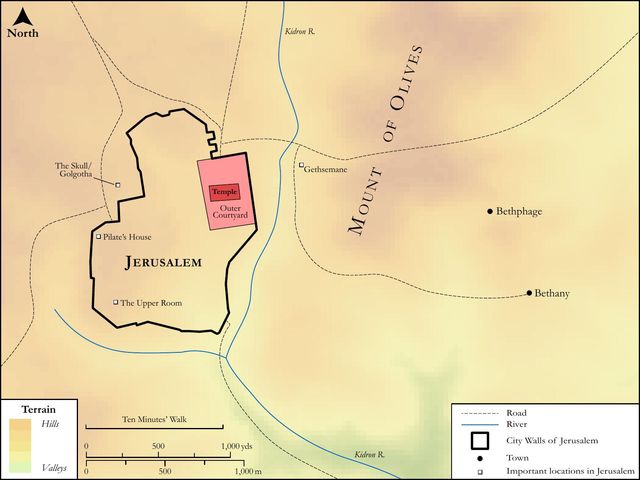
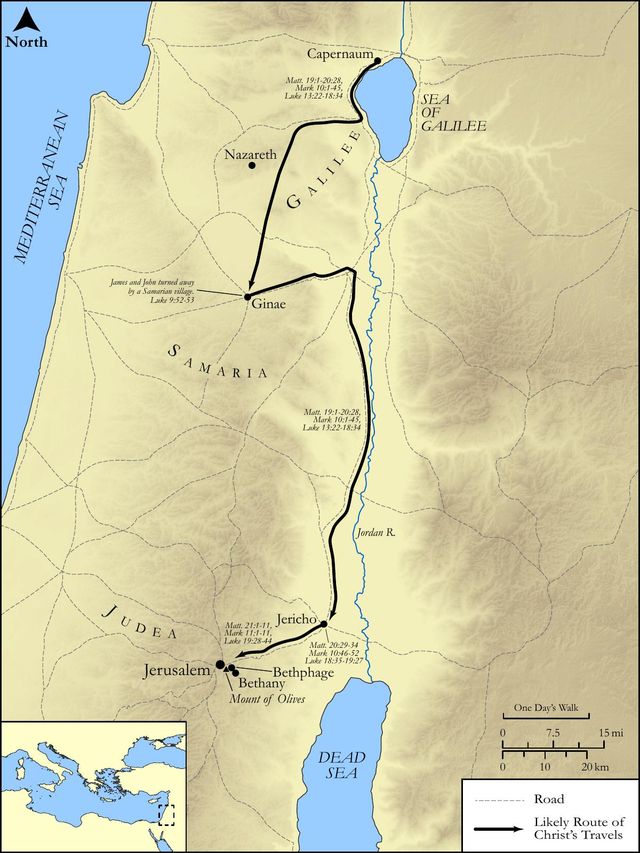
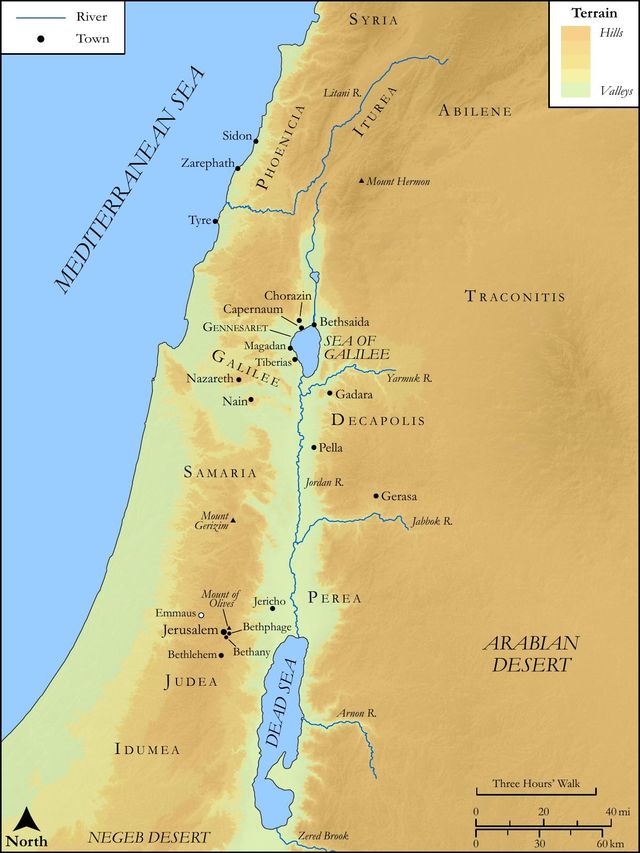
See on the biblical-era maps
Study this verse
Public-domain commentary
Matthew Henry
From his Commentary on the Whole Bible. Henry comments on passages, not single verses — this entry covers Luke 13:18–22.
Here is, I. The gospel's progress foretold in two parables, which we had before, Mat 13:31-33. The kingdom of the Messiah is the kingdom of God, for it advances his glory; this kingdom was yet a mystery, and people were generally in the dark, and under mistakes, about it. Now, when we would describe a thing to those that are strangers to it, we choose to do it by similitudes. "Such a person you know not, but I will tell you whom he is like;" so Christ undertakes here to show what the kingdom of God is like (Luk 13:18): "Whereunto shall I liken the kingdom of God? Luk 13:20. It will be quite another thing from what you expect, and will operate, and gain its point, in quite another manner." 1. "You expect it will appear great, and will arrive at its perfection all of a sudden; but you are mistaken, it is like a grain of mustard-seed, a little thing, takes up but little room, makes but a little figure, and promises but little; yet, when sown in soil proper to receive it, it waxes a great tree," Luk 13:19. Many perhaps were prejudiced against the gospel, and loth to come in to the obedience of it, because its beginning was so small; they were ready to say of Christ, Can this man save us? And of his gospel, Is this likely ever to come to any thing? Now Christ would remove this prejudice, by assuring them that though its beginning was small its latter end should greatly increase; so that many should come, should come upon the wing, should fly like a cloud, to lodge in the branches of it with more safety and satisfaction than in the branches of Nebuchadnezzar's tree, Dan 4:21. 2. "You expect it will make its way by external means, by subduing nations and vanquishing armies, though it shall work like leaven, silently and insensibly, and without any force or violence, Luk 13:21. A little leaven leaveneth the whole lump; so the doctrine of Christ will strangely diffuse its relish into the world of mankind: in this it triumphs, that the savour of the knowledge of it is unaccountably made manifest in every place, beyond what one could have expected, Co2 2:14. But you must give it time, wait for the issue of the preaching of the gospel to the world, and you will find it does wonders, and alters the property of the souls of men. By degrees the whole will be leavened, even as many as are, like the meal to the leaven, prepared to receive the savour of it."
II.Christ's progress towards Jerusalem recorded:
He went through the cities and villages, teaching and journeying, Luk 13:22. Here we find Christ an itinerant, but an itinerant preacher, journeying towards Jerusalem, to the feast of dedication, which was in the winter, when travelling was uncomfortable, yet he would be about his Father's business; and therefore, whatever cities or villages he could make in his way, he gave them a sermon or two, not only in the cities, but in the country villages. Wherever Providence brings us, we should endeavour to be doing all the good we can.
Historical interpretation
Sixteen Centuries of Reception
11 surviving comments on this verse. Each one is dated, so this reads as a timeline rather than a list.
Select a marker to jump to its quote. Markers stagger vertically where authors wrote within a few decades of each other.
Or else, by the leaven our Lord means the Holy Spirit, the Sower proceeding (as it were) from the seed, which is the word of God. But the three measures of meal, signify the knowledge of the Father, and the Son, and the Holy Spirit, which the woman, that is, Divine wisdom, and the Holy Spirit, impart.
If the kingdom of heaven is as a grain of mustard seed, and faith is as a grain of mustard seed, surely faith is the kingdom of heaven and the kingdom of heaven is faith. One who has faith has the kingdom. The kingdom and faith is among us. We read, "The kingdom of heaven is within you," and "Have faith in yourselves." Peter, who had all faith, received the keys of the kingdom of heaven to unlock it also for others.
In another place, a grain of mustard seed is introduced where it is compared to faith. If then the mustard seed is the kingdom of God, and faith is as the grain of mustard seed; faith is truly the kingdom of heaven, which is within us. (Luke 17:21.) A grain of mustard seed is indeed a mean and trifling thing, but as soon as it is crushed, it pours forth its power. And faith at first seems simple, but when it is buffeted by adversity, pours forth the grace of its virtue. The martyrs are grains of mustard seed. They have about them the sweet odour of faith, but it is hidden. Persecution comes; they are smitten by the sword; and to the farthest boundaries of the whole world they have scattered the seeds of their martyrdom. The Lord Himself also is a grain of mustard seed; He wished to be bruised that we might see that we are a sweet savour of Christ. (2 Cor. 2:15.) He wishes to be sown as a grain of mustard seed, which when a man takes he puts it into his garden. For Christ was taken and buried in a garden, where also He rose again and became a tree, as it follows, And it waxed into a great tree. For our Lord is a grain when He is buried in the earth, a tree when He is lifted up into the heaven. He is also a tree overshadowing the world, as it follows, And the fowls of the air rested in his branches; that is, the heavenly powers and they whoever (for their spiritual deeds) have been thought worthy to fly forth. Peter is a branch, Paul is a branch, into whose arms, by certain hidden ways of disputation, we who were a far off now fly, having taken up the wings of the virtues. Sow then Christ in thy garden; a garden is truly a place full of flowers, wherein the grace of thy work may blossom, and the manifold odour of thy different virtues be breathed forth. Wherever is the fruit of the seed, there is Christ.
Or else; The kingdom of God is the Gospel, through which we gain the power of reigning with Christ. As then the mustard seed is surpassed in size by the seeds of other herbs, yet so increases as to become the shelter of many birds; so also the life-giving doctrine was at first in the possession only of a few, but afterwards spread itself abroad.
As the text says, the kingdom of God is like a grain of mustard seed, because the kingdom is brought by a word from heaven. It is received through hearing and sown by faith. It takes root through belief and grows by hope. It is diffused by profession, and it expands through virtue. It is spread out into branches. To these branches, it invites the birds of heaven, the powers of spiritual insight. In those branches, it receives them in a peaceful abode.
There is written in these words of the Lord, “Someone took and threw it into his garden. It grew and became a tree, and the birds of heaven roosted in its branches.” Let us look more closely to find out to whom all these things pertain. We said before that the nature of mustard might resemble the holy martyrs because they are rubbed by different sufferings. Since Scripture says, “And it grew and became a tree, and the birds of heaven roosted in its branches,” I think that this is more properly compared to the Lord Christ himself. Born a man, he was humbled like a seed and in ascending to heaven was exalted like a tree. It is clear that Christ is a seed when he suffers and a tree when he rises. He is a seed when he endures hunger and a tree when he satisfies five thousand men with five loaves. In the one case, he endures barrenness in his human condition, in the other he bestows fullness by his divinity. I would say that the Lord is a seed when he is beaten, scorned and cursed, but a tree when he enlightens the blind, raises the dead and forgives sins. In the Gospel, he says that he is a seed: “Unless the grain of wheat, falling upon the earth, dies.”
Now the man, is Christ, the garden, His Church, to be cultivated by His discipline. He is well said to have taken the grain, because the gifts which He together with the Father gave to us from His divinity, He took from His humanity. But the preaching of the Gospel grew and was disseminated throughout the whole world. It grows also in the mind of every believer, for no one is suddenly made perfect. But in its growth, not like the grass, (which soon withers,) but it rises up like the trees. The branches of this tree are the manifold doctrines, on which the chaste souls, soaring upwards on the wings of virtue, build and repose.
The Satum is a kind of measure in use in the province of Palestine, holding about a bushel and a half.
Or, by the leaven He speaks of love, which kindles and stirs up the heart; the woman, that is, the Church, hides the leaven of love in three measures, because she bids us love God with all our hearts, all our minds, and all our strength. And this until the whole is leavened, that is, until love moves the whole soul into the perfection of itself, which begins here, but will be completed hereafter.
He said therefore, "To what is the kingdom of God like, and to what shall I compare it? It is like a mustard seed. The kingdom of God is the preaching of the Gospel and the knowledge of the Scriptures which leads to life. And concerning which it is said to the Jews, 'The kingdom of God will be taken away from you and given to a people producing its fruits' (Matthew XXI). The kingdom is therefore like a mustard seed, due to the fervor of faith particularly, or because it is said to expel poison. Hence, we also read elsewhere that perfect faith is compared to a mustard seed because it evidently conquers all doctrines of perversity, by its simplicity and humility.
Or, any man receiving a grain of mustard seed, that is, the word of the Gospel, and sowing it in the garden of his soul, makes it a great tree, so as to bring forth branches, and the birds of the air (that is, they who soar above the earth) rest in the branches, (that is, in sublime contemplation.) For Paul received the instruction of Ananias (Acts 9:17.) as it were a small grain, but planting it in his garden, he brought forth many good doctrines, in which they dwell who have high heavenly thoughts, as Dionysius, Hierotheus, and many others.
He next likens the kingdom of God to leaven, for it follows, And again he says, Whereunto shall I liken it? It is like to leaven, &c.
Or, for the woman you must understand the soul; but the three measures, its three parts, the reasoning part, the affections, and the desires. If then any one has hidden in these three the word of God, he will make the whole spiritual, so as not by his reason to lie in argument, nor by his anger or desire to be transported beyond control, but to be conformed to the word of God.
While His adversaries were ashamed, and the people rejoiced, at the glorious things that were done by Christ, He proceeds to explain the progress of the Gospel under certain similitudes, as it follows, Then said he, Unto what is the kingdom of God like? It is like a grain of mustard seed, &c. (Mat. 17:19.)
I know quite well that, to you as to me, the Church which once felt like a refuge, now often feels like a trap. There is nowhere else to go! (I wonder if this desperate feeling, the last state of loyalty hanging on, was not, even more often than is actually recorded in the Gospels, felt by Our Lord's followers in His earthly life-time?) I think there is nothing to do but to pray, for the Church, the Vicar of Christ, and for ourselves; and meanwhile to exercise the virtue of loyalty, which indeed only becomes a virtue when one is under pressure to desert it...
The 'protestant' search backwards for 'simplicity' and directness - which, of course, though it contains some good or at least intelligible motives, is mistaken and indeed vain. Because 'primitive Christianity' is now and in spite of all 'research' will ever remain largely unknown; because 'primitiveness' is no guarantee of value, and is and was in great part a reflection of ignorance. Grave abuses were as much an element in Christian 'liturgical' behaviour from the beginning as now. (St Paul's strictures on eucharistic behaviour are sufficient to show this!)
Still more because 'my church' was not intended by Our Lord to be static or remain in perpetual childhood; but to be a living organism (likened to a plant), which develops and changes in externals by the interaction of its bequeathed divine life and history - the particular circumstances of the world into which it is set. There is no resemblance between the 'mustard-seed' and the full-grown tree. For those living in the days of its branching growth the Tree is the thing, for the history of a living thing is pan of its life, and the history of a divine thing is sacred.
The wise may know that it began with a seed, but it is vain to try and dig it up, for it no longer exists, and the virtue and powers that it had now reside in the Tree. Very good: but in husbandry the authorities, the keepers of the Tree, must look after it, according to such wisdom as they possess, prune it, remove cankers, rid it of parasites, and so forth. (With trepidation, knowing how little their knowledge of growth is!) But they will certainly do harm, if they are obsessed with the desire of going back to the seed or even to the first youth of the plant when it was (as they imagine) pretty and unafflicted by evils. The other motive (now so confused with the primitivist one, even in the mind of any one of the reformers): aggiornamento: bringing up to date: that has its own grave dangers, as has been apparent throughout history. With this 'ecumenicalness' has also become confused.
Continue studying Luke 13:18 across the web’s major study libraries — every link below opens this exact verse, chapter, or book on the destination site.
Read & Compare
 BibleGatewayThis verse in more than 200 translations and 70 languages.
 Bible.comThe YouVersion reader — hundreds of translations, reading plans, and highlights.
 ESV.orgCrossway's official English Standard Version reader.
 NET BibleThe NET translation with 60,000+ translators' notes on every rendering decision.
 STEP BibleTyndale House's free study tool — original text, vocabulary, and scholarly resources.
 BibliaLogos Bible Software's free web reader.
 USCCBThe New American Bible (Revised Edition) with the U.S. bishops' study notes.
Commentaries
 BibleHub CommentariesDozens of classic commentaries on this verse, gathered on one page.
 StudyLightMore than 100 commentary sets — the largest collection on the web.
 BibleRefPlain-English commentary on what this verse means, verse by verse.
 Enduring WordDavid Guzik's free commentary on this chapter, widely used by Bible teachers.
 Bible Study ToolsVerse commentary alongside Greek and Hebrew study aids.
Original Language & Research
- BibleHub InterlinearThe verse word by word — original language, transliteration, and English.
- BibleHub LexiconEvery word's original-language definition and Strong's entry.
 Blue Letter BibleDeep-study tools — Strong's numbers, concordance, and word studies.
 CNTR CollationThe earliest Greek manuscripts of this verse, collated letter by letter.
Sermons, Hymns & Audio


TrulyRandomVerse is not affiliated with these sites and doesn’t control their content. They’re linked because they’re genuinely useful.
Summary
Luke 13:18 records Jesus' pivotal rhetorical question, serving as an engaging introduction to His parables about the Kingdom of God. By asking "Unto what is the kingdom of God like? and whereunto shall I resemble it?", Jesus invites His audience to actively contemplate the mysterious yet profound nature of God's reign, preparing them for the subsequent illustrations of its humble beginnings and vast, transformative growth. This verse encapsulates Jesus' pedagogical brilliance, drawing listeners into the spiritual realities He proclaimed.
Context
ShowHideLiterary Context
This verse is strategically placed within Luke's Gospel, immediately following Jesus' healing of a crippled woman on the Sabbath (Luke 13:10-17). This miraculous act, which sparked controversy with the synagogue ruler, demonstrates the present power and authority of the Kingdom of God confronting religious legalism. Jesus' question in Luke 13:18 then transitions directly into the parables of the Mustard Seed Luke 13:19 and the Leaven Luke 13:20-21, which serve as direct answers to His inquiry. These parables illustrate the Kingdom's growth from small, inconspicuous beginnings to a pervasive and encompassing reality, providing a spiritual counterpoint to the earlier confrontation.
Historical & Cultural Context
In the 1st-century Jewish world, the concept of the "Kingdom of God" (or "Kingdom of Heaven" in Matthew) was deeply rooted in Old Testament prophecy, often associated with a future, glorious, and overtly political reign of the Messiah that would overthrow Roman oppression and restore Israel's sovereignty. Jesus' teachings, however, consistently reoriented this expectation. He presented the Kingdom as both a present spiritual reality, inaugurated by His ministry Luke 17:20-21, and a future consummation. His use of parables was a common and effective teaching method in that culture, allowing complex truths to be conveyed in relatable, often agricultural or domestic, terms, inviting deeper reflection from those with "ears to hear" Luke 8:8.
Key Themes
ShowHideLuke 13:18 contributes significantly to several overarching themes in Luke's Gospel and Jesus' broader ministry. Firstly, it underscores the Nature of the Kingdom of God, emphasizing that its essence and operation are often contrary to human expectations, particularly those focused on earthly power or immediate, dramatic displays. Secondly, it highlights the theme of Growth from Humble Beginnings, preparing the audience for the idea that God's work, though starting small (like Jesus' own ministry with a few disciples), will ultimately have an expansive and transformative impact, as seen in the subsequent parables. Finally, the verse exemplifies Jesus' Masterful Teaching Method, employing a rhetorical question to engage His audience, stimulate their curiosity, and prompt active participation in discerning spiritual truth, rather than merely passive reception of information. This Socratic approach encourages deeper understanding of the profound truths of God's reign, a recurring motif throughout Jesus' parables.
Exposition and Analysis
ShowHideKey Word Analysis
ShowHideThis term signifies "royalty" or "rule," and concretely, a "realm." In the context of "Kingdom of God," it refers to God's sovereign reign and the sphere in which His authority is exercised. It is not merely a geographical territory but the dynamic, active rule of God in the hearts of people and over all creation, both now and in the future.
Referring to the supreme Divinity. When combined with "Kingdom," it specifies that this reign originates from and belongs to the one true God, distinguishing it from any earthly or human kingdom. It emphasizes the divine origin and nature of this unique realm.
Meaning "to assimilate" or "to compare." Jesus' use of this verb indicates His intention to explain the Kingdom through analogy or similitude, inviting His listeners to draw parallels between a known earthly reality and the spiritual truths of God's reign. This choice of word signals that a parable is about to be told.
Verse Breakdown
ShowHide"Then said he"
This introductory phrase, common in narrative, indicates a transition in Jesus' discourse. It marks the shift from the previous teaching or event (the healing of the crippled woman) to a new, significant teaching moment, signaling the audience to pay close attention to what follows.
"Unto what is the kingdom of God like?"
This is the first part of Jesus' rhetorical question. By asking "unto what is it like?", Jesus immediately frames the topic as an analogy. He is not asking for a definition but for a comparison, inviting His listeners to consider the nature of God's reign through a relatable image. This question challenges preconceived notions and opens the mind to new understanding.
"and whereunto shall I resemble it?"
This second part of the question reiterates and intensifies the first, emphasizing Jesus' intention to use a parable or simile. The repetition underscores the importance of the inquiry and the method He is about to employ. It's a direct invitation for the audience to anticipate and engage with the upcoming illustration, preparing them to receive a spiritual truth through an earthly comparison.
Literary Devices
ShowHideJesus' question in Luke 13:18 masterfully employs several literary devices. The most prominent is the Rhetorical Question, which is posed not to elicit an answer from the audience, but to stimulate thought and prepare them for the teaching that follows. By asking "Unto what is the kingdom of God like? and whereunto shall I resemble it?", Jesus actively engages His listeners, prompting them to ponder the nature of the Kingdom and anticipate the forthcoming parables. This technique fosters a deeper level of engagement than a simple declarative statement. Furthermore, the verse sets up the use of Simile and Analogy, as Jesus explicitly states His intention to "resemble" or "liken" the Kingdom to something familiar. This prepares the audience for the metaphorical language of the parables of the mustard seed and leaven, where abstract spiritual truths are illuminated through concrete, relatable images. Finally, this Socratic method of teaching, where the teacher asks questions to guide the student to discover truth, is a subtle but powerful device, encouraging active learning and personal revelation.
Theological and Thematic Connections
ShowHideLuke 13:18 serves as a crucial theological gateway, inviting believers to reconsider their understanding of God's active rule in the world. It challenges any notion of the Kingdom of God as a purely external, political, or immediately overwhelming force, redirecting focus to its often hidden, internal, and organic growth. This verse, by posing a question, emphasizes that the Kingdom's true nature is discovered through revelation and comparison, rather than through human logic or power. It highlights the divine wisdom in God's plan for His Kingdom to unfold not through grand, instantaneous displays, but through humble, often unnoticed beginnings that ultimately yield immense, pervasive influence. This divine strategy ensures that the Kingdom's expansion is attributed solely to God's power, not human effort, fostering humility and dependence on Him.
Reflection and Application
ShowHideLuke 13:18, though a question, carries profound implications for our spiritual journey and understanding of God's work in the world. It reminds us that God's methods often defy human expectations, beginning small and growing in ways that may seem imperceptible at first. For believers, this means cultivating patience and faith in the seemingly small acts of obedience, prayer, and service. A single act of kindness, a quiet word of witness, or consistent prayer for a loved one might appear insignificant, but like the mustard seed or leaven, these can be the catalysts for profound spiritual transformation and far-reaching impact within individuals, families, and communities. This verse encourages us to look beyond immediate results and trust in the sovereign, often incremental, work of God. It also challenges us to actively engage with spiritual truths, not just passively receive them, prompting us to ask our own questions and seek deeper understanding of how God's Kingdom is manifesting in our lives and the world around us.
Questions for Reflection
ShowHideFAQ
ShowHideWhy does Jesus ask a question instead of simply stating what the Kingdom of God is like?
ShowHideJesus often used rhetorical questions and parables as a pedagogical strategy to engage His audience more deeply. By asking "Unto what is the kingdom of God like? and whereunto shall I resemble it?" in Luke 13:18, He wasn't seeking an answer from the crowd, but rather prompting them to think, anticipate, and participate in the discovery of truth. This method encourages active reflection and makes the subsequent parables more impactful, as the listeners are already primed to understand the comparisons He is about to make. It's a Socratic approach that fosters deeper understanding and personal revelation rather than mere intellectual assent.
What is the "Kingdom of God" that Jesus refers to?
ShowHideThe "Kingdom of God" (or "Kingdom of Heaven" in Matthew) is a central theme of Jesus' teaching, referring not to a physical territory, but to God's sovereign rule and reign. It is both a present reality, inaugurated by Jesus' first coming and active wherever God's will is done and His authority recognized Luke 17:20-21, and a future hope, which will be fully established at His second coming Revelation 11:15. In Luke 13:18 and the parables that follow, Jesus emphasizes its organic, often hidden, growth from small beginnings to a pervasive and encompassing influence, illustrating how God's divine reign expands in the world through humble means.
Christ-Centered Fulfillment
ShowHideLuke 13:18, with its profound inquiry into the nature of the Kingdom of God, finds its ultimate fulfillment in the person and work of Jesus Christ. The "Kingdom of God" that Jesus seeks to describe is not an abstract concept but a dynamic reality inaugurated by His very presence and ministry. He is the King, and His coming marks the inbreaking of God's reign into human history Mark 1:15. The seemingly small and inconspicuous beginning of the Kingdom, as foreshadowed by the subsequent parables of the mustard seed and leaven, is perfectly mirrored in Christ's humble birth in Bethlehem Luke 2:7, His quiet life in Nazareth, and His ministry that began with a small band of disciples. Yet, from this humble origin, through His atoning death on the cross Colossians 1:13-14 and glorious resurrection Romans 1:4, the Kingdom has expanded through the power of the Holy Spirit, reaching "to the end of the earth" Acts 1:8. Jesus, as the incarnate Son of God, is the embodiment of this Kingdom, and all who believe in Him are transferred "from the domain of darkness to the kingdom of his beloved Son" Colossians 1:13. Thus, Jesus' question in Luke 13:18 is ultimately answered by His own life, death, resurrection, and ongoing reign, which continues to grow and transform hearts until its final, glorious consummation at His return Revelation 11:15.